Key Takeaways
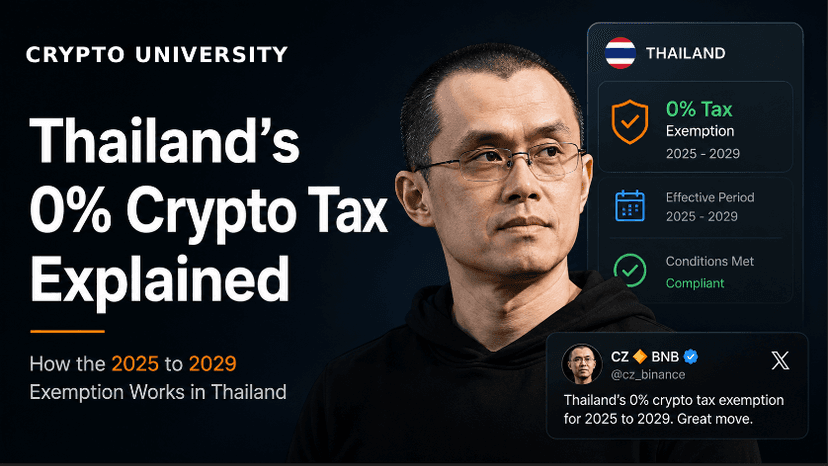
Thailand exempts individual crypto capital gains from personal income tax between January 1, 2025 and December 31, 2029, but only for trades made through exchanges, brokers, or dealers licensed by the Thai SEC.
The exemption does not cover trades on unlicensed or offshore platforms, and it generally does not cover income from mining, staking, or airdrops, which stay taxable under standard rules.
The rule was created through Ministerial Regulation No. 399, not full legislation, so it has a fixed five-year window and could be changed or allowed to expire after 2029.
What Thailand's 0% Crypto Tax Actually Is
Thailand has introduced a five-year exemption that removes personal income tax on profits from selling or transferring cryptocurrencies and digital tokens. The measure is often described online as a "0% capital gains tax," but in Thai law it is technically an exemption from personal income tax on qualifying gains rather than a separate capital gains tax being set to zero.
The policy was formalized through Ministerial Regulation No. 399, which was published in the Royal Gazette on September 5, 2025 after cabinet approval in June 2025. It applies retroactively to gains realized from January 1, 2025 and runs through December 31, 2029. The exemption gained fresh public attention in August 2026 after Binance founder Changpeng Zhao (widely known as CZ) highlighted it on X, but the underlying rule had already been in force for more than a year at that point.
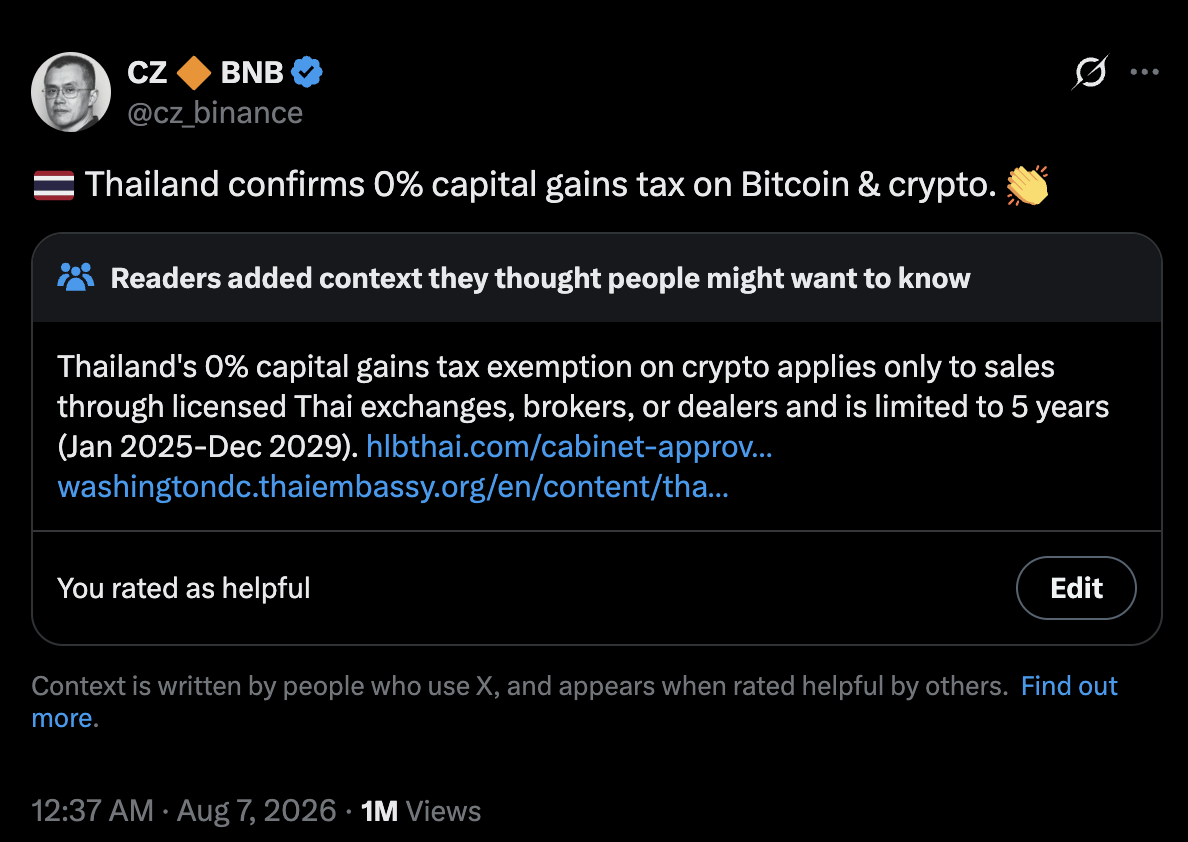
The important detail is the condition attached to it. The 0% rate is not a blanket break on all crypto activity. It applies only when the trade is executed through a digital asset exchange, broker, or dealer that is licensed by Thailand's Securities and Exchange Commission (SEC). Trades routed through unlicensed or offshore platforms do not automatically qualify and can still be taxed under Thailand's normal progressive income tax rates, which reach as high as 35%.
The Conditions at a Glance
The table below summarizes the core rules of the exemption. Treat these as widely reported figures based on the published regulation and coverage from tax and crypto outlets.
Element | Detail |
|---|---|
Legal basis | Ministerial Regulation No. 399 (MR 399) |
Published | Royal Gazette, September 5, 2025 |
Coverage window | January 1, 2025 to December 31, 2029 (5 years) |
Tax benefit | 0% personal income tax on qualifying gains |
Who qualifies | Individual investors only, not companies |
Key condition | Trade through a Thai SEC-licensed exchange, broker, or dealer |
Default rate if not exempt | Standard personal income tax, up to 35% |
Who Qualifies and Who Does Not
The exemption is aimed at individual investors. It does not apply to companies or other legal entities, which continue to be taxed on digital asset profits under corporate rules. The benefit also depends on where and how the trade happens rather than simply on the fact that a profit was made.
Qualifies: An individual selling Bitcoin or another digital asset through a platform holding a Thai SEC license, keeping records of the transaction for audit purposes.
Does not automatically qualify: An individual trading on an offshore or unlicensed exchange, a company realizing gains, or income earned from activities other than the sale of a digital asset.
What Is Covered and What Is Excluded
A common misunderstanding is that the exemption wipes out tax on everything crypto-related. It does not. It targets the gain on a sale or transfer completed through a licensed operator. Other forms of crypto income are treated separately.
Activity | Treatment under the exemption |
|---|---|
Selling crypto on a licensed Thai platform | Covered (0% personal income tax) |
Trading on offshore or unlicensed exchanges | Not covered, taxed as normal income |
Mining income | Not covered, taxable under standard rules |
Staking rewards | Not covered, taxable under standard rules |
Airdrops | Not covered, taxable under standard rules |
Corporate or business trading profits | Not covered, taxed under corporate rules |
This structure shows the policy's real intent. It rewards trading that happens inside Thailand's regulated system and leaves everything outside that perimeter under the usual tax treatment.
Which Exchanges Count as Licensed
To use the exemption, a trade must go through an operator supervised by the Thai SEC under the country's digital asset framework. As of mid-2025, reporting indicated roughly nine licensed digital asset exchanges operating in Thailand, alongside licensed brokers and dealers. Commonly cited licensed platforms include the following.
Bitkub – Thailand's largest retail exchange and one of the first licensees.
Gulf Binance (Binance TH) – a joint venture between Binance and Thailand's Gulf Energy, operating under a Thai license.
Orbix – formerly Satang Pro, now part of the Kasikornbank (KBank) group.
InnovestX – the digital asset arm of the SCB X group.
Upbit Thailand, Bitazza, GMO-Z.com, and WaanX – other licensed operators serving Thai users.
Because licenses change over time, the safest reference is the SEC's own license check on its official website rather than any third-party list. The global version of an international exchange is not the same as its Thai-licensed entity, so the local license is what matters for the exemption.
How to Make Sure a Trade Qualifies
The exemption is not applied automatically to every crypto profit a person makes. It depends on using the right venue and keeping proof of what happened. The general steps below reflect how the rule is described by Thai tax and legal commentators. They are educational only and not a substitute for professional advice.
Confirm the platform's license. Check that the exchange, broker, or dealer appears on the Thai SEC's official license register before trading, rather than relying on marketing claims.
Trade the qualifying activity. The benefit applies to gains from selling or transferring digital assets, not to mining, staking, or airdrop income.
Keep clear records. Retain buy and sell prices, dates, fees, and platform statements so the gain and the venue can be shown if the Revenue Department asks.
Separate offshore activity. Track trades made on foreign or unlicensed platforms separately, since those gains can still be taxable under normal rules.
Check your wider tax status. If you are a tax resident of another country, or you have foreign-sourced income and remittance questions, confirm how those rules interact with the Thai exemption.
Why Thailand Introduced the Policy
Thailand has been positioning itself as a regional digital asset hub for several years, and this exemption fits a broader pattern. In February 2024 the government waived the 7% value-added tax that had applied to digital asset gains. The 2025 income tax exemption extends that direction of travel.
The design encourages Thai residents to bring their trading onshore, where platforms must follow know-your-customer, anti-money-laundering, and security requirements. It also aligns crypto more closely with traditional finance, since capital gains from securities listed on the Stock Exchange of Thailand are already exempt from personal income tax for individuals.
Officials have framed the trade-off as worthwhile. Deputy Finance Minister Julapun Amornvivat was reported as projecting that growth in the regulated digital asset sector could generate over 1 billion baht, roughly 30 million US dollars, in additional tax revenue over the medium term. The reasoning is that broader, better-supervised activity can produce more revenue elsewhere even while direct gains go untaxed.
What the Exemption Does Not Change
A few limits are worth keeping in view. The rule was created by ministerial regulation rather than by an act of parliament, which means it can be adjusted or allowed to lapse with less friction than a full law. The window is fixed at five years, and there is no guarantee of an extension past the end of 2029.
The exemption also does not remove other obligations that may apply to a person's wider tax situation. Thailand has separate rules on foreign-sourced income and remittances, and residents of other countries may still owe tax at home. For example, US citizens are generally taxed on worldwide income regardless of where a gain is realized. None of this is financial or tax advice, and anyone affected should confirm their position with a qualified professional or the Thai Revenue Department.
Finally, the exemption sits inside a regulatory system that is still evolving. Thailand continues to tighten oversight of custody, capital requirements, and the range of products that licensed operators can offer. That backdrop is part of the policy's logic: lower the tax cost for eligible individuals while pulling more trading, custody, and compliance activity onshore. For learners, the practical takeaway is that the headline "0% tax" is real but conditional, and the conditions matter as much as the rate itself.
Frequently Asked Questions
Is crypto trading tax-free in Thailand?
For individuals, gains from selling digital assets are exempt from personal income tax between 2025 and 2029, but only when the trade goes through a Thai SEC-licensed exchange, broker, or dealer. Trades on unlicensed or offshore platforms do not automatically qualify.
When does the exemption start and end?
It covers gains realized from January 1, 2025 through December 31, 2029. The regulation was published in September 2025 but applies retroactively to the start of that year.
Does it cover Binance?
It covers trades made through a Thai-licensed operator. The Gulf Binance (Binance TH) entity holds a Thai license, while the global Binance platform does not automatically qualify. The local licensed entity is what counts.
Are mining, staking, and airdrops included?
No. The exemption targets gains from selling or transferring digital assets on licensed platforms. Income from mining, staking, and airdrops is generally taxed under standard rules.
Can the exemption be reversed?
It could be. Because it was created through a ministerial regulation rather than full legislation, it can be changed or allowed to expire after 2029 more easily than a statute.
Related Terms
Capital gains tax – tax owed on the profit from selling an asset for more than its purchase price.
SEC-licensed exchange – a trading platform authorized and supervised by a securities regulator, in this case Thailand's SEC.
Ministerial regulation – a rule issued by a government ministry under existing law, easier to amend than primary legislation.
Digital asset – a broad legal term covering cryptocurrencies and digital tokens.
Value-added tax (VAT) – a consumption tax; Thailand waived its 7% VAT on digital asset gains in 2024.
Disclaimer: This content is for educational and informational purposes only and is not financial advice. Nothing here is a recommendation to buy or sell any asset or use any platform. Do your own research and manage your risk.
Explore the Crypto University Cash Out Crypto Guide
How to Cash Out Crypto in the UK in 2026: A Step-by-Step Guide
How to Cash Out Crypto in Dubai in 2026
Best Platforms for Tokenized Stocks: Exchanges, Brokers and Onchain Apps
Sources
Cryptobriefing – Thailand implements 0% capital gains tax on Bitcoin and crypto for five years
Crypto.news – Thailand's 0% crypto tax raises stakes in global capital race
CoinTurk – Thailand exempts crypto capital gains tax on licensed exchanges until 2029
ExpatTax Thailand – Thailand crypto tax exemption 2025 to 2029
Fintech News Singapore – List of licensed cryptocurrency exchanges in Thailand
Thailand SEC – Digital asset business license check (official)