Key Takeaways
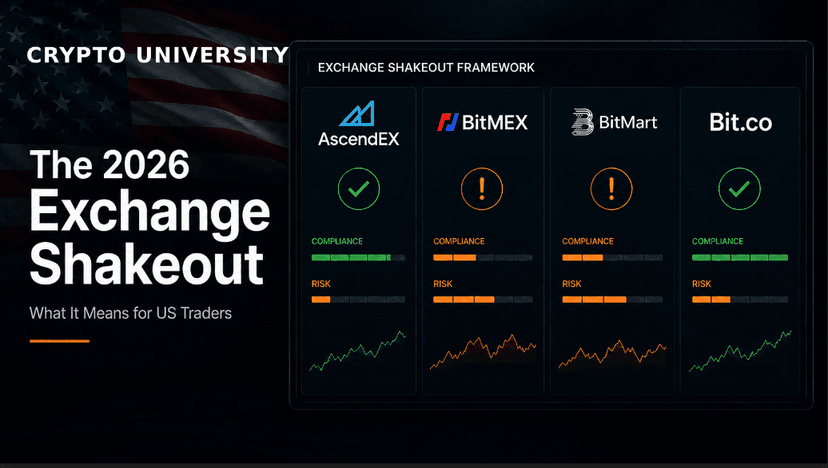
Three well known mid-tier exchanges announced wind-downs in a single month. AscendEX ceased operations on 1 July 2026, BitMEX announced closure on 23 July, and BitMart followed on 26 July. These were orderly exits with published deadlines rather than collapses, which makes the pattern structural rather than scandalous.
The cause is economics, not fraud. Compliance is now a large fixed cost, trading volumes have fallen, liquidity has concentrated at the largest venues, and on-chain perpetual exchanges have taken share. A platform in the middle of the market has no clear way to absorb all four pressures at once.
US traders are affected indirectly more than directly. Most of the closing venues restricted US customers, but the shakeout still narrows offshore access, removes trading records needed for tax reporting, and pushes activity toward a small group of US-regulated platforms at exactly the moment domestic derivatives rules are being rewritten.
What Actually Happened in 2026
Exchange failures are not new in crypto. What is new about 2026 is the type of failure. The 2022 cycle produced sudden collapses, frozen withdrawals, and insolvency proceedings. The 2026 cycle has produced something quieter: companies publishing wind-down schedules, giving customers weeks or months of notice, and closing the doors on their own terms.
Three centralized exchanges announced closures within a single month in July 2026.
Exchange | Announced | Key Dates | How It Wound Down |
|---|---|---|---|
AscendEX (formerly BitMax) | Ceased operations 1 July 2026 | Withdrawals moved to manual review from 6 July | Least orderly of the three. The exchange has said processing times and final amounts are not guaranteed. |
BitMEX | 23 July 2026 | Reduce-only from 26 August; full closure 23 September 2026 | Orderly. Published deadlines after eleven years of operation. Its BMEX token fell sharply on the news. |
BitMart | 26 July 2026 | Trading ends 26 August 2026; platform closes 31 January 2027 | Orderly, with a roughly six-month withdrawal window. A separate, earlier cutoff applied to US-covered users. |
Late 2025 | Full closure by 31 March 2026 | Phased shutdown as part of a business restructuring. |
These were not isolated. Smaller European venues including Knaken and Zondacrypto also wound down during 2026. Broader trackers put the total much higher. MarketScreener reported in August 2026 that more than 60 crypto companies and projects had announced closures during the year, spanning exchanges, mining firms, and DeFi protocols. Data platform RootData has counted roughly 95 project shutdowns across the same period, covering wallets, Layer 2 networks, NFT platforms, and analytics tools.
The important detail is which part of the market is disappearing. The largest venues are still operating. The smallest niche protocols continue to launch. It is the middle tier, platforms with real brand recognition but without top-five scale, that is being removed.
Why the Middle Tier Is Disappearing
Four pressures explain most of the closures. None of them is dramatic on its own. Together they remove the business case for a mid-sized centralized exchange.
Pressure | What It Means | Why the Middle Tier Cannot Absorb It |
|---|---|---|
Compliance became a fixed cost | Serving European users now requires MiCA authorisation, Travel Rule infrastructure, sanctions and address screening, and operational resilience obligations under DORA. | These costs do not scale down with volume. A top-five exchange spreads them across enormous turnover. A mid-tier venue carries almost the same bill on a fraction of the revenue. |
Volumes fell and moved | CoinGecko reported top-ten centralized exchange spot volume at roughly $2.7 trillion in Q1 2026, down about 39% quarter over quarter. Perpetual futures volume on centralized venues fell around 10% in Q2 2026. | Lower total volume hits smaller order books hardest, because traders migrate toward whichever venue still has depth. |
Liquidity concentrated at both ends | The largest exchanges absorbed liquidity-sensitive flow. On-chain perpetual exchanges took the self-custody flow, reaching roughly 13.5% of total open interest. | A mid-tier venue is squeezed from above and below simultaneously, with no defensible position in between. |
The long-tail listing model stopped paying | Mid-tier exchanges historically competed by listing assets the majors would not, funded partly by listing fees from token projects. | Retail appetite for long-tail tokens thinned, and fewer projects could afford listing fees, so the differentiator stopped generating revenue. |
The Exchange Token Problem
A fifth factor deserves separate attention because it affects users directly. Many mid-tier exchanges issued their own tokens, tied them to fee discounts and platform activity, and used them as a financing mechanism. That structure works in one direction only.
When BitMart announced its wind-down, its BMX token fell roughly 58% in a single day, following a decline of around 70% over the preceding year. BitMEX's BMEX token fell sharply on its own closure news. The lesson for a beginner is simple: an exchange token is a claim on the continued existence of the exchange. When the exchange stops existing, the token has nothing left to reference.
The Regulatory Trigger in Europe
Timing matters. The EU's Markets in Crypto-Assets regulation ended its transitional grandfathering period on 1 July 2026. From that date, any firm providing crypto-asset services to EU or EEA customers without full authorisation is in breach of EU law. The European Securities and Markets Authority stated repeatedly that no extension was available.
The scale of the filter was significant. ESMA's register showed roughly 244 authorised crypto-asset service providers across the EU and EEA at the deadline, out of a pre-MiCA population estimated in the thousands. Binance withdrew its Greek licence application in late June and stopped serving EEA customers on 1 July, offering existing users withdrawal-only access. AscendEX's closure on the same date has been widely reported as connected to losing its European authorisation.
This is why the July closures clustered. A regulatory deadline created a hard decision point for platforms that were already marginal.
A quick overview of deeper detail on EU MiCA License Tracker
This Is Consolidation, Not Contagion
It is worth separating 2026 from 2022 clearly, because the two look similar in headlines and behave very differently in practice.
Factor | 2022 Failures (Terra, Celsius, FTX) | 2026 Shakeout |
|---|---|---|
Trigger | Insolvency, misuse of customer assets, and a systemic credit shock | Business model exhaustion and rising fixed compliance costs |
Warning given | Little or none. Withdrawals froze without notice. | Published schedules, generally weeks to months of notice |
User outcome | Unsecured claims in lengthy bankruptcy proceedings | In most cases, funds withdrawable before the deadline |
Market effect | Contagion across lenders, funds, and exchanges | Liquidity migrating toward larger and on-chain venues |
What it signals | A credit bubble unwinding | An industry shedding excess capacity |
That distinction does not make the closures harmless. It changes what a user should worry about. The risk in 2026 is less about losing everything overnight and more about missing a deadline, losing access to records, or discovering that an account was subject to a regional cutoff that arrived earlier than the headline date.
How the Shakeout Affects US Traders
Most of the exchanges that closed in 2026 did not formally serve US customers. BitMEX has restricted US users since its 2020 settlement with US authorities, and several other global platforms including KuCoin and Bybit had already withdrawn from or limited the US market. That leads some readers to assume the shakeout is a foreign story. It is not. The effects on US traders are real, but they run through five specific channels.
1. Direct Account Exposure Still Exists, With Earlier Deadlines
Formal restrictions do not mean zero US users. BitMart issued a separate notice for customers who reside in, are located in, or are otherwise treated as US users under its agreement. Reporting on that notice indicated a US-specific withdrawal cutoff of 8 August 2026, well ahead of the 26 August global trading halt, along with additional identity, source-of-funds, and wallet-ownership checks.
The practical lesson: regional cutoffs can land earlier than the headline shutdown date, and closing platforms often tighten verification at the exact moment users are trying to leave. If you hold a balance on any offshore venue, the deadline that applies to you may not be the one in the news article.
2. Tax Records Disappear When Exchanges Do
This is the most underestimated US-specific consequence, and it arrives at an awkward time.
Form 1099-DA is being phased in. For the 2025 tax year, brokers reported gross proceeds only, with no cost basis. Cost basis reporting becomes mandatory for covered assets, meaning digital assets acquired on or after 1 January 2026 and held continuously at the same broker, with those forms arriving in early 2027.
The gap in that system is the problem. If an exchange closes and you can no longer download your trade history, you may be unable to prove what you originally paid. Where cost basis is missing, the tax outcome can default to treating the full sale amount as gain, which overstates what you actually owe. The IRS also receives a copy of every 1099-DA issued, so mismatches between broker-reported proceeds and your return are more likely to be flagged over time.
Before you withdraw from any closing platform, export everything: deposit and withdrawal history, spot and derivatives trade records, and full CSV account statements. Records are harder to recover than coins.
3. Offshore Access Narrows While Onshore Derivatives Open Up
The timing here is unusually clean. As offshore mid-tier venues close, regulated US derivatives access has expanded significantly.
Date (2026) | Development | Why It Matters for US Traders |
|---|---|---|
29 May | The CFTC approved KalshiEX's Bitcoin perpetual futures contract, the first listed on a US-regulated designated contract market. | Established that perpetual-style contracts can exist under US oversight. Reported volume exceeded $1 billion in the first week. |
15 June | Kraken launched CFTC-regulated perpetual futures for eligible US clients through Bitnomial, acquired by its parent earlier that year. | Brought a product previously available almost exclusively offshore onto a domestically regulated venue. |
Mid 2026 | Coinbase Financial Markets received clearance to route eligible US clients to affiliated global derivatives, and later listed nano Bitcoin and Ether perpetual-style contracts. | Expanded regulated leverage access, with segregated custody and federal oversight. |
Ongoing | CME has challenged the CFTC's Kalshi approval in court, arguing the contracts were wrongly classified. | The outcome could affect how far onshore perpetual products spread. Treat the current framework as unsettled. |
An important caution: regulated does not mean low risk. Perpetual futures are leveraged instruments. Leverage magnifies losses as well as gains, funding payments change the cost of holding a position, and liquidations happen automatically. A regulatory wrapper improves oversight, disclosure, and custody segregation. It does not change what the product is.
4. Fewer Venues Means Fewer Listings and More Concentration
Mid-tier exchanges were where many smaller tokens were first tradable. As those venues close, the number of places to access long-tail assets shrinks, and what remains splits between the largest centralized platforms, which list conservatively, and decentralized exchanges, which require self-custody and carry their own risks.
On the US side, activity is concentrated around a familiar group: Coinbase, Kraken, Gemini, Crypto.com, Binance.US, and Robinhood. Coinbase reported a record 8.6% share of global crypto trading volume in its Q1 2026 results. Concentration brings advantages, including deeper liquidity, clearer regulatory status, and better disclosure. It also means more of the market depends on fewer companies.
5. The US Rulebook Is Still Being Written
US traders are navigating this shakeout without a completed federal market structure framework. The status as of mid-August 2026:
Item | Status |
|---|---|
GENIUS Act (stablecoins) | Signed into law. Establishes federal licensing, reserve, and disclosure requirements for payment stablecoins. |
CLARITY Act (market structure) | Not law. Passed the House 294-134 in July 2025 and cleared the Senate Banking Committee 15-9 in May 2026. Placed on the Senate calendar in June 2026. |
Senate progress | A cloture motion on the motion to proceed was filed on 8 August 2026. No floor vote on passage has occurred. A procedural vote has been reported for mid-September 2026. |
If enacted | Would divide SEC and CFTC authority, create a test for when a token is a digital commodity, and require exchanges, brokers, and dealers to register federally. Most substantive rules would take effect roughly 360 days after enactment. |
Practical effect today | State money transmitter licensing and existing agency rules still govern. Nothing about the bill's status changes the legal position of any exchange or token right now. |
This information is provided for educational purposes and is not legal advice. Legislative status changes quickly, so verify the current position before relying on it.
How to Assess Whether Your Exchange Is at Risk
You cannot audit a private company from the outside. You can, however, read observable signals. None of these is proof on its own. Several appearing together deserve attention.
Signal | What to Look For |
|---|---|
Licensing status | Is the entity that actually holds your account authorised in your jurisdiction? For the EU, check the ESMA register. For the US, check state money transmitter registrations and any CFTC or FinCEN registrations. |
Proof of reserves quality | An attestation of assets without corresponding liabilities tells you very little. Look for whether liabilities are included, how recent the attestation is, and who verified it. |
Exchange token behaviour | A platform's own token falling much faster than the broader market has repeatedly preceded public trouble. |
Withdrawal friction | Processing times lengthening, or new limits appearing without announcement, is a meaningful signal. |
Product retreat | Delisting pairs, exiting jurisdictions, discontinuing services, or unusual executive turnover often precede a full wind-down. |
Unusually high yields | Aggressive deposit rates with no cap can indicate a platform that needs new capital rather than one that is performing well. |
Your own concentration | How much of your total holdings sits with one company? This is the only variable you fully control. |
What to Do If a Platform You Use Announces a Wind-Down
A practical sequence, in order of priority.
Find the deadline that applies to you specifically, not the headline date. Check for regional notices, particularly if you are a US person. Regional cutoffs have been earlier than global ones.
Export your complete records first. Trade history, deposits, withdrawals, and CSV statements. Do this before withdrawing, because account access is often reduced after the trading halt.
Complete any outstanding identity verification immediately. Closing platforms frequently add checks, and an unverified account can stall a withdrawal past the deadline.
Close leveraged and derivatives positions yourself. Platforms typically move futures accounts to reduce-only, then settle or force-close anything still open at the deadline, at their discretion.
Withdraw in tranches rather than one transaction, and send a small test amount first. Confirm the destination platform or wallet supports the exact asset and network.
Convert unsupported assets before moving. Some tokens are not supported at the destination and may need converting on the closing platform while trading is still live.
Do not send new deposits to a closing platform. Deposits are usually disabled first, and assets sent afterward can be difficult or impossible to recover.
The underlying principle: assets held on a custodial exchange are a claim against a company, not property under your direct control. In an orderly wind-down that claim is honoured. In a disorderly one it becomes an unsecured claim in an insolvency process. The difference between those outcomes is decided by the company, not by you. That is an argument for limiting concentration, not for abandoning exchanges, which provide real services including fiat on-ramps, deep order books, and fast execution.
What to Watch Next
Whether the CLARITY Act receives a Senate floor vote in the autumn of 2026, and whether the legislative calendar and election cycle leave room for it.
The outcome of CME's legal challenge to the CFTC's approval of perpetual-style contracts, which could shape how far onshore derivatives expand.
Whether consolidation continues through acquisition rather than closure. Recent years have seen large deals including Coinbase's purchase of Deribit and Kraken's acquisitions of NinjaTrader and Bitnomial.
Whether the share of derivatives open interest held by on-chain perpetual exchanges keeps rising from the roughly 13.5% reported in 2026.
Whether any additional mid-tier venues announce wind-downs, and whether those exits remain orderly.
The reasonable conclusion is not that centralized exchanges are unsafe or that the market is breaking. It is that the industry is removing capacity it no longer supports, and that the cost of that adjustment falls on users who are slow to notice a deadline. Reading the signals early is a learnable skill, and it is more useful than any prediction about where the market goes next.
Frequently Asked Questions
Which crypto exchanges shut down in 2026?
AscendEX ceased operations on 1 July 2026. BitMEX announced its wind-down on 23 July, with closure set for 23 September. BitMart announced on 26 July, ending trading on 26 August and closing fully on 31 January 2027. Bit.com completed a phased closure by 31 March 2026. Smaller European venues including Knaken and Zondacrypto also wound down. Broader trackers count more than 60 crypto companies and roughly 95 projects closing across 2026.
Why are so many crypto exchanges closing?
The main reasons are economic rather than criminal. Compliance obligations under frameworks such as MiCA became a large fixed cost that mid-sized venues cannot spread across enough volume. Trading volumes fell, liquidity concentrated at the largest exchanges, and on-chain perpetual exchanges took share. The long-tail listing model that once differentiated mid-tier platforms also stopped generating meaningful revenue.
Is this the same as the FTX collapse?
No. The 2022 failures involved insolvency, misuse of customer assets, and frozen withdrawals with little warning. The 2026 closures have mostly been orderly wind-downs with published deadlines and withdrawal windows. The risk profile is different: the main danger is missing a deadline, not a sudden freeze.
Were US traders affected if these exchanges did not serve the US?
Yes, in several ways. Some US persons held accounts despite restrictions, and BitMart set an earlier US-specific withdrawal cutoff. Beyond direct exposure, US traders face reduced offshore access, lost transaction records needed for tax reporting, and greater concentration among a small group of domestic platforms.
What happens to my open futures positions when an exchange closes?
Platforms typically move derivatives accounts to reduce-only mode, meaning you can close positions but not open new ones. Anything still open at the final deadline is generally settled or force-closed at the exchange's discretion. Closing positions yourself gives you control over the exit price.
Why do exchange tokens crash when a platform closes?
An exchange token derives its value from fee discounts, platform activity, and the continued operation of the exchange. Once the exchange announces it is closing, that underlying reference disappears. BitMart's BMX fell roughly 58% in a day on its closure announcement.
How does an exchange closure affect my US taxes?
The main risk is losing access to your trading history. Form 1099-DA reporting began with gross proceeds for the 2025 tax year, and mandatory cost basis reporting applies to covered assets acquired from 1 January 2026. If you cannot document what you paid, you may be taxed on a larger gain than you actually realised. Export full records before your account access ends.
Are the remaining large exchanges safe?
Scale and licensing reduce some risks but eliminate none. Assets held on any custodial exchange remain a claim against a company rather than property you control, and crypto balances generally do not carry the deposit insurance that applies to bank accounts. Reviewing licensing, proof-of-reserves quality, and your own concentration is more useful than assuming size equals safety.
Should I move everything to self-custody?
Self-custody removes counterparty and insolvency risk because no company holds your assets. It introduces different risks, including irreversible user error, lost keys, and signing malicious transactions. Neither model is uniformly safer. Many users split holdings, keeping trading balances on an exchange and long-term holdings in self-custody.
Will more exchanges close in 2026 and 2027?
The structural pressures that caused the 2026 closures, including fixed compliance costs, lower volumes, and liquidity concentration, have not reversed. Whether specific platforms close is not predictable, which is why monitoring warning signs and limiting concentration is more practical than trying to forecast individual outcomes.
Related Terms
Term | Definition |
|---|---|
Counterparty Risk | The risk that the company holding your assets fails to return them. On a centralized exchange, your balance is a claim against that company rather than property you directly control. |
A published attestation intended to show that an exchange holds sufficient assets to cover customer balances. Its usefulness depends on whether liabilities are included and who verified it. | |
A leveraged derivative contract with no expiry date, kept close to the spot price through periodic funding payments. Historically traded offshore, now available on some CFTC-regulated US venues. | |
MiCA (Markets in Crypto-Assets) | The European Union's crypto regulatory framework. Its transitional grandfathering period ended on 1 July 2026, after which unlicensed firms could no longer serve EU customers. |
Reduce-Only Mode | A trading restriction applied during a wind-down that allows users to close existing derivatives positions but not open new ones. |
Sources
All figures are as reported by the sources below and were verified on 19 August 2026. Market data, regulatory status, and closure timelines change frequently. Readers should confirm current details directly with the relevant exchange or regulator.
European Securities and Markets Authority (ESMA), statements on the end of the MiCA transitional period, 1 July 2026
Elliptic, "What the end of MiCA's transitional period means for crypto businesses," 30 June 2026
CoinDesk, "Kraken debuts U.S. perpetual futures as crypto derivatives move onshore," 15 June 2026
CoinDesk, "U.S. Senate opens first stage of crypto Clarity Act voting," 8 August 2026
Kraken Blog, "Announcing CFTC-regulated perpetual futures for US traders," 15 June 2026
MarketScreener, "Why crypto companies are shutting down in 2026," 5 August 2026
Latham & Watkins, US Crypto Policy Tracker: Legislative Developments, accessed August 2026
CoinGecko, Q1 2026 Crypto Industry Report, April 2026
Internal Revenue Service, Form 1099-DA (Digital Asset Proceeds From Broker Transactions) and final broker reporting regulations
Cointribune, "After Bit.com and BitMEX, BitMart also announces its closure," 27 July 2026
CryptoRank, reporting on BitMart's US user withdrawal notice, August 2026
JewelSwap Guides, "Crypto Exchanges Shutting Down in 2026: Full List and Warning Signs," 5 August 2026
Cryptopolitan, "2026 becomes the year of crypto shutdowns as liquidity repositions," July 2026
CryptoSlate, reporting on Coinbase perpetual-style futures and the CME legal challenge, July 2026
Reuters and Yahoo Finance coverage of the BitMEX and BitMart closure announcements, July 2026
Disclaimer: This article is educational content published by Crypto University. It is not financial, investment, legal, or tax advice, and it contains no price predictions or recommendations to buy or sell any asset. Regulatory and market information reflects publicly reported details as of 19 August 2026 and may change. Consult a qualified professional for advice specific to your situation.
BitMart Withdrawal Checklist: What To Do Before 26 August 2026
What Treasury's Proposed Rulemaking Actually Does
AscendEX Is Shutting Down: What Happened and What Users Should Do Now
BitMart Is Shutting Down: Timeline, What It Means, and What Traders Should Do