Key Takeaways
1. Treasury's proposed rule does not decide who gets a licence. The GENIUS Act already did that in 2025. The rule defines the words the law turns on: what counts as issuing a stablecoin, where an issuance happens, and when an offer reaches someone in the United States.
2. Two dates drive planning. From 18 January 2027 only licensed issuers may issue payment stablecoins in the US, and platforms may not make foreign-issued stablecoins available unless the foreign issuer can comply with lawful orders. From 18 July 2028 platforms generally may not offer or sell any payment stablecoin to a US person unless a licensed issuer stands behind it.
3. This is a proposal, not final law. The public comment window closes on 19 October 2026, and Treasury has asked dozens of open questions that could still change the outcome.
What Treasury Published, and What It Does Not Do
On 17 August 2026 the US Department of the Treasury issued a Notice of Proposed Rulemaking, or NPRM, implementing Section 3 of the GENIUS Act. It appeared in the Federal Register the following day at 91 FR 53368 and would create a new Part 1523 in Title 12 of the Code of Federal Regulations. Comments are due by 19 October 2026.
A common misreading is that this rule decides who receives a licence. It does not. The categories of licensed issuer were fixed by statute when the GENIUS Act was signed on 18 July 2025. What the NPRM does is narrower and, in practice, more consequential for daily operations. It defines the terms the prohibitions turn on. When has a stablecoin been issued? When is a person located in the United States? What counts as an offer? Those definitions decide whether a business sits inside or outside a prohibition that carries fines of up to one million dollars per violation and up to five years imprisonment for knowing participation.
What Counts as a Payment Stablecoin
Under the Act, a payment stablecoin is a digital asset that is designed to be used as a means of payment or settlement, and whose issuer is obligated to convert, redeem or repurchase it for a fixed amount of monetary value while representing, or creating a reasonable expectation, that it will hold a stable value against that amount.
Two consequences follow. First, the Act states expressly that payment stablecoins are neither securities nor commodities. Treasury notes in the proposal that traditional investment rules may not fit an instrument built for payment and settlement. Second, an asset that merely tracks a dollar price without a redemption obligation from an identified issuer falls outside this definition and is governed by other rules.
Treasury is asking whether the definition should stretch to assets redeemable only in credit union shares, or in other liabilities the public treats as convertible into bank deposits. That question is open.
Who May Issue: The Four Routes
The Act creates one category called a permitted payment stablecoin issuer, reached by three routes, plus a separate route for qualifying foreign issuers.
Route | Who qualifies | Oversight | Key limit |
|---|---|---|---|
Bank subsidiary | A subsidiary of an insured depository institution approved to issue payment stablecoins | Federal banking regulator of the parent | No specific size cap |
Federal qualified issuer | A non-bank entity approved by the Office of the Comptroller of the Currency | OCC | No specific size cap |
State qualified issuer | An entity licensed under a state regime certified as substantially similar to the federal standard | State regulator, with a federal backstop | Must move to federal oversight within 360 days of exceeding 10 billion dollars outstanding, unless waived |
Foreign issuer (Section 18) | An issuer supervised in a country Treasury determines comparable, and registered with the OCC | Home regulator plus OCC | Must hold reserves in US institutions sufficient for US customer liquidity; excluded if domiciled in a comprehensively sanctioned jurisdiction |
State certification runs through the Stablecoin Certification Review Committee, made up of the Treasury Secretary, the Federal Reserve Chair or Vice Chair, and the FDIC Chair. It must approve or deny each state submission unanimously within 30 days.
One notable point in the NPRM: Treasury reads the Act to permit qualifying foreign issuers to issue directly into the United States, not merely to have their tokens traded here. That reading was not obvious from Section 3(a) alone, and Treasury asks for comment on it.
The Compliance Timeline
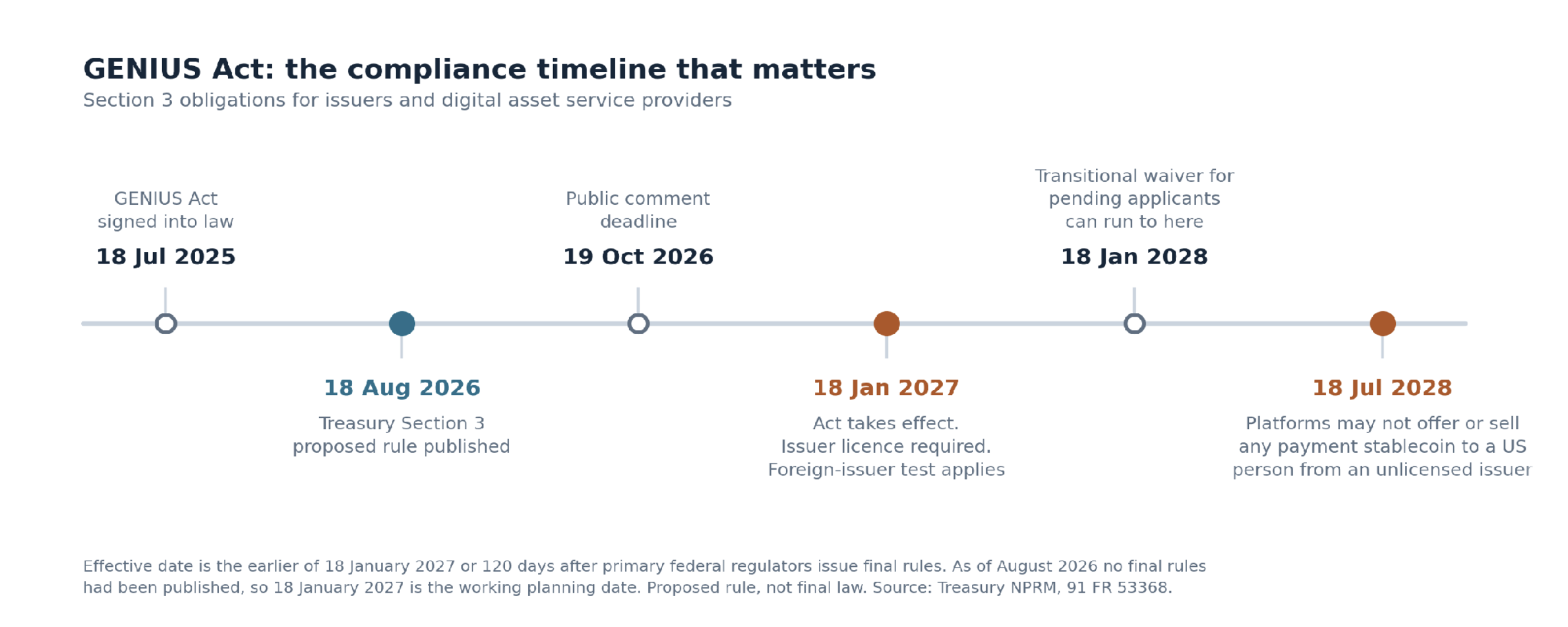
Date | What happens |
|---|---|
18 July 2025 | GENIUS Act signed into law. The 18-month implementation clock starts. |
17 to 18 August 2026 | Treasury issues and publishes the Section 3 proposed rule. |
19 October 2026 | Public comment deadline. Docket TREAS-DO-2026-0496 on Regulations.gov. |
18 January 2027 | The Act takes effect. Issuing a payment stablecoin in the US without a licence becomes unlawful. Section 3(b)(2) also bites: platforms may not make a foreign-issued stablecoin available in the US unless the issuer can comply with lawful orders. |
18 January 2028 | Latest possible expiry of the 12-month transitional waiver available to certain applicants whose applications were pending on the effective date. |
18 July 2028 | Section 3(b)(1) applies. Digital asset service providers may not offer or sell any payment stablecoin to a person in the United States unless it was issued by a permitted issuer or a qualifying foreign issuer. |
One mechanical detail is worth understanding. The Act takes effect on the earlier of 18 January 2027 or 120 days after the primary federal regulators issue final implementing rules. Those regulators missed the one-year rulemaking deadline of 18 July 2026, and as of August 2026 the agencies had published proposals but no final rules. Because a 120-day clock started after roughly 20 September 2026 would run past the backstop anyway, 18 January 2027 is the realistic planning date.
The Most Important Definition: What Issuing Means
Treasury proposes that to issue a payment stablecoin means the first transfer of that stablecoin by the issuer, directly or indirectly, including by crediting an account, that results or will result in someone other than the issuer having the right to use, transfer, convert, redeem or repurchase it.
That wording carries real operational weight:
A token that has been minted but sits in the issuer's own treasury has not been issued.
A token minted directly into a holder's wallet has been issued.
Crediting a customer's account counts as issuance even if the token never leaves the issuer's wallet, for example where the issuer is also the custodian.
A token that is redeemed and later transferred out again is treated as a new issuance, whether or not the original was burned.
A lockup on redemption does not delay issuance. Treasury explicitly flags this as an anti-evasion measure.
Where You Are Matters More Than Who You Are
Section 3 repeatedly refers to persons located in the United States but never defines the phrase. Treasury proposes to fill that gap.
Type of person | Proposed test for 'located in the United States' |
|---|---|
Individual | Physically present in the US, unless the person is not a US resident and their presence is only temporary, such as a holiday |
Business entity | Organised or incorporated under US or state law, or has its principal place of business in the US |
An issuance is treated as happening in the United States if either the issuer is located here or the recipient is. Treasury deliberately declined to capture transactions where neither side is US-located. It also carved out a US resident travelling abroad, reasoning that someone on holiday overseas should still be able to buy a small amount of a locally used stablecoin.
For issuers outside the US, the proposal offers a four-part safe harbour. The issuer must not be located in the US, must reasonably believe each recipient is not located in the US, must have adopted and actually implemented controls designed to avoid issuing to US persons, and must not run advertising or solicitation that targets or predictably reaches US persons. Treasury stresses that written policies alone are not enough and that controls must be reviewed and updated over time.
The Foreign Issuer Question
This is where the rule has the sharpest near-term effect, and it is widely misreported. The prohibition on foreign-issued stablecoins does not wait until 2028. Section 3(b)(2) applies from the effective date. From 18 January 2027, a digital asset service provider may not offer, sell or otherwise make available in the United States a stablecoin from a foreign issuer unless that issuer has the technological capability to comply, and will comply, with the terms of any lawful order and any reciprocal arrangement between jurisdictions.
In plain terms, a lawful order includes a request to freeze or seize tokens. A compliant payment stablecoin under this framework is designed to be freezable. Users should understand that as a deliberate feature of the regime rather than an accident.
The scale of what this touches is significant. As of mid-August 2026, widely reported market data put Tether's USDT at roughly 183 to 184 billion dollars, close to 60 percent of a total stablecoin market of around 305 to 310 billion dollars, with Circle's USDC second at roughly 72 to 74 billion. Tether is incorporated in El Salvador, and as of mid-2026 no foreign jurisdiction had received a comparability determination from Treasury. Tether launched a separate US-focused token, USAT, in January 2026, issued through Anchorage Digital Bank, a federally chartered US institution. That is a different structural answer to the same regulatory problem. These figures move daily and should be treated as estimates.
Crypto University takes no view on which stablecoin will win. The structural point is what matters: access to US users is becoming a function of issuer licensing status rather than of liquidity or brand.
What Is Carved Out
Section 3 does not reach everything. The Act exempts three categories:
A direct transfer of digital assets between two individuals acting on their own behalf, for lawful purposes, with no intermediary involved.
A transfer by an individual between an account they own in the US and an account they own abroad, where both are offered by the same parent company.
Any transaction made through a software or hardware wallet that facilitates the individual's own self-custody.
The target of this framework is intermediaries, not self-custody or person-to-person transfers.
What Changes for You as a User
If you | What to expect |
|---|---|
Hold stablecoins on a US platform | Listing decisions will increasingly follow issuer licensing status. Expect delisting, migration or conversion notices for non-qualifying tokens ahead of each deadline rather than on the day itself. |
Self-custody your holdings | Self-custody wallets and direct person-to-person transfers are carved out of Section 3. |
Travel internationally | The location tests turn on physical presence, so platforms are likely to apply geolocation and residency checks more consistently. |
Accept stablecoins in a business | If you exchange, transfer, custody or facilitate issuance for compensation, you may meet the definition of a digital asset service provider and inherit those obligations. |
Use a foreign-issued stablecoin | The January 2027 test is whether the issuer can honour lawful orders such as freeze and seizure requests, not whether the token holds its peg. |
What Is Still Unsettled
Reading a proposed rule means reading the questions as much as the text. Several outcomes remain genuinely open:
Whether Treasury keeps its location-based test or switches to an offshore transaction framework modelled on Regulation S under the securities laws.
Whether an inadvertent issuance to a US person becomes a strict violation regardless of the diligence performed.
How bridged, wrapped and cross-chain representations of a stablecoin are treated, and whether a bridge operator can itself be an issuer.
Whether the Digital Asset Market Clarity Act rewrites parts of the GENIUS Act. That bill was reported to have stalled in the Senate before the August 2026 recess.
Whether any foreign jurisdiction receives a comparability determination in time to matter for January 2027.
How to Read the Rule Yourself
The proposal is 24 pages in the Federal Register and is readable without a legal background. The definitions sit at proposed Section 1523.1, issuance at 1523.2, offers and sales at 1523.3, and exemptions and safe harbours at 1523.4. Appendix A contains worked interpretations applied to common scenarios, which is the most useful section for anyone trying to place their own activity. Comments can be filed through Regulations.gov under docket TREAS-DO-2026-0496 until 19 October 2026.
Frequently Asked Questions
Is USDT illegal in the United States?
No. As of August 2026 nothing has changed for holders, and the rule discussed here is a proposal rather than final law. The relevant question is what happens at the deadlines. From 18 January 2027, US platforms may not make a foreign-issued stablecoin available unless the issuer can comply with lawful orders and any reciprocal arrangement. From 18 July 2028, platforms generally may not offer or sell any payment stablecoin to a US person unless it comes from a licensed issuer or a qualifying foreign issuer.
Does this rule ban self-custody or sending stablecoins to a friend?
No. The Act expressly carves out direct transfers between two individuals acting on their own behalf without an intermediary, transactions through self-custody software or hardware wallets, and transfers between a person's own accounts in the US and abroad at the same parent company.
Do I need a licence to use stablecoins?
No. The obligations fall on issuers and on digital asset service providers, meaning businesses that for compensation exchange digital assets, transfer them for others, act as custodians, or participate in financial services relating to issuance. Individuals using stablecoins are not the target of Section 3.
What is the difference between the January 2027 and July 2028 deadlines?
January 2027 is the effective date of the Act. It turns on the issuance prohibition and the specific foreign-issuer test about lawful orders. July 2028 is when the broader prohibition applies, at which point platforms may not offer or sell any payment stablecoin to a US person unless a permitted or qualifying foreign issuer stands behind it.
Could the January 2027 date move earlier?
In theory yes. The Act takes effect on the earlier of 18 January 2027 or 120 days after the primary federal regulators issue final rules. Because no final rules had been published as of August 2026, a 120-day clock would now end on or after the backstop date, so the earlier trigger is effectively out of reach.
Are payment stablecoins regulated as securities?
Not under this framework. The GENIUS Act states expressly that payment stablecoins are neither securities nor commodities. Treasury notes in the proposal that rules built for investment products may not fit instruments designed for payment and settlement, though it has asked for comment on whether parts of the securities framework should be borrowed.
Can I still comment on the rule?
Yes, until 19 October 2026. Comments are filed publicly through Regulations.gov under docket TREAS-DO-2026-0496. All submissions become part of the public record.
Related Terms to Know
Permitted payment stablecoin issuer. A licensed entity permitted to issue payment stablecoins in the US, reached through one of three routes: a subsidiary of an insured depository institution, a non-bank approved by the OCC, or a state-licensed issuer under a certified state regime.
Digital asset service provider. A business that, for compensation, exchanges digital assets, transfers them for others, custodies them, or participates in financial services relating to their issuance. Exchanges, wallets with custody, and payment processors typically fall inside this definition.
Comparability determination. Treasury's determination that a foreign country's stablecoin regime is comparable to the US framework, which is one of the conditions a foreign issuer must meet to serve US users lawfully.
Stablecoin Certification Review Committee. A three-member body made up of the Treasury Secretary, the Federal Reserve Chair or Vice Chair, and the FDIC Chair, which must unanimously approve a state's certification that its regime is substantially similar to the federal standard.
Lawful order. A legal instruction, such as a request to freeze or seize tokens, that an issuer must be technologically capable of executing. From January 2027, a foreign issuer's ability to comply determines whether US platforms may make its stablecoin available.
Sources
1. US Department of the Treasury, GENIUS Act Regulations on Payment Stablecoin Issuance, Offer, and Sale, Notice of Proposed Rulemaking, 91 FR 53368, published 18 August 2026. Docket TREAS-DO-2026-0496, RIN 1505-AC95.
2. US Department of the Treasury press release, Treasury Seeks Public Comment on GENIUS Act Proposed Rulemaking, 17 August 2026. home.
3. Guiding and Establishing National Innovation for U.S. Stablecoins Act, Public Law enacted 18 July 2025, codified at 12 U.S.C. 5901 and following.
4. Office of the Comptroller of the Currency, Bulletin 2026-3, GENIUS Act Regulations: Notice of Proposed Rulemaking. occ.gov
5. Financial Crimes Enforcement Network and Office of Foreign Assets Control, Permitted Payment Stablecoin Issuer AML/CFT and Sanctions Compliance Program Requirements, proposed rule, 10 April 2026.
6. The Block, US regulators miss GENIUS Act's one-year deadline for final stablecoin rules, 18 July 2026.
7. DefiLlama and CoinPaprika stablecoin market data, mid-August 2026. Market capitalisation figures are widely reported estimates that change daily.
Disclaimer: This content is for educational and informational purposes only and is not financial advice. Nothing here is a recommendation to buy or sell any asset or use any platform. Do your own research and manage your risk.
The 5-Minute Token Safety Check: How to Use RugCheck, GoPlus and Bubblemaps
Best Crypto Off-Ramps in the UAE: OKX, BitOasis and Fasset Compared
Best Token Safety Checkers in 2026
CryptoPanic Review 2026: Best Crypto News Aggregator? (Features, Filters, Alerts)
What Is a Memecoin Trading Terminal? How Platforms Like FOMO Work
What Are the Alternatives to AscendEX? A Guide to MiCA-Licensed Exchanges in Europe