Key Takeaways
A tokenized stock is not a share. In almost every product live today, the real share stays with a licensed custodian in the traditional system, and the token is a separate instrument that tracks its economic value.
Structure decides your rights. Robinhood Chain Stock Tokens are tokenised debt securities issued by Robinhood Assets (Jersey) Limited. They give economic exposure to a listed share or ETF, backed 1:1 by shares held with a custodian, but they carry no voting rights and no legal claim on the company behind the ticker.
24/7 trading changes price discovery, not the underlying market. The token can move at any hour, but its reference price feed updates on a 24/5 market-hours schedule, so weekend prices can drift from the underlying and spreads can widen.
What a tokenized stock actually is
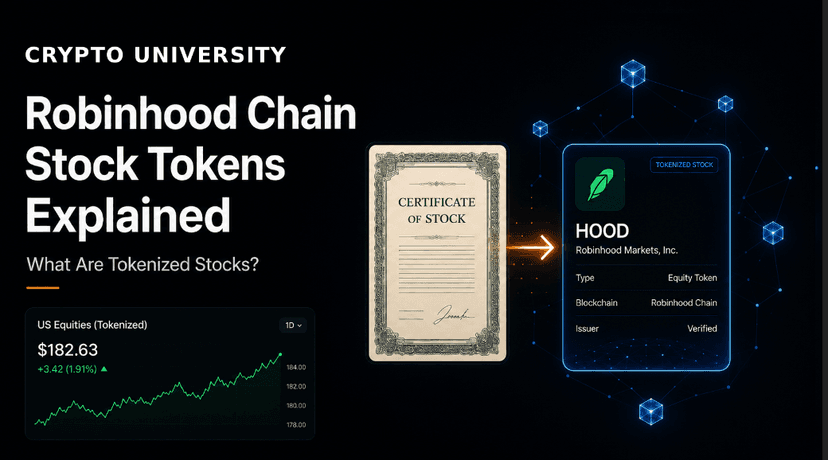
A tokenized stock is a blockchain token designed to track the value of a listed share or exchange-traded fund. Buying one is not the same as buying the share.
In nearly every product available today, the underlying share never leaves the traditional financial system. It is registered through a central securities depository and held by a licensed custodian. The token is a separate legal instrument, issued by someone else, that sits on top of that custody arrangement and passes the economic performance of the share through to the holder.
That gap between “tracks the price of Apple” and “is a share of Apple” is the single most important thing to understand about the category. “Tokenized stock” is a marketing label, not a legal classification. Two products using the same ticker-style name can give holders very different rights.
Three structures behind one label
In January 2026, staff at the US Securities and Exchange Commission published a statement setting out how tokenized securities are classified. The statement is not a rule and creates no new obligations, but it is the clearest public map of the models in use. Its central point is that securities laws apply the same way whether ownership is recorded on-chain or off-chain. Its second point is more practical for retail users: with third-party tokens, holders can be exposed to risks relating to that third party, such as its bankruptcy, that a holder of the underlying share would not face.
The staff described the following models.
Model | What the holder has | Voting rights | Where you see it |
Issuer-sponsored token | The security itself, recorded on-chain in the issuer’s shareholder file | Same as the traditional share | Rare for large listed companies today |
Custodial token (tokenized security entitlement or digital custodial receipt) | An indirect interest in a share held in custody | Usually none in practice | Some transfer-agent and receipt-based programs |
Synthetic token (linked security) | A debt or equity instrument issued by a third party whose return is linked to the referenced share | None | Robinhood Stock Tokens, several tracker certificate products |
Synthetic token (security-based swap) | A swap contract referencing the share | None | Restricted to eligible contract participants unless registered |
What a Robinhood Chain Stock Token represents
Robinhood Chain, an Ethereum layer 2 built with the Arbitrum platform, launched its public mainnet on 1 July 2026 with roughly 100 millisecond block times, alongside day one partners including Uniswap, Chainlink, Alchemy and BitGo. Stock Tokens are its flagship real-world asset, with more than 190 tokens linked to US shares and ETFs at the time of writing.
The legal wrapper matters more than the chain. Robinhood’s own documentation describes Stock Tokens as tokenised debt securities issued by Robinhood Assets (Jersey) Limited, a private company incorporated in Jersey. They provide economic exposure to underlying securities but do not grant investors any legal or beneficial rights in, or against the issuer of, those underlying securities. Technically they are standard ERC-20 tokens with 18 decimals, each with its own Chainlink price feed.
Robinhood states that every Stock Token in circulation is backed 1:1 by the corresponding underlying equity, held by a US-based custody partner. In the event of the issuer’s insolvency, Robinhood’s disclosures say an independent security agent would sell the underlying shares and arrange for cash proceeds to be paid to token holders. The claim is therefore secured against collateral and against the Jersey issuer, not against Apple, Nvidia or any other referenced company.
Custody and settlement mechanics
Understanding who can create tokens, and who can only trade them, explains most of the pricing behaviour discussed later.
Primary market: only Authorised Participants can subscribe for Stock Tokens directly from the issuer after business onboarding checks. Robinhood’s developer documentation notes that at issuance the only Authorised Participant was BBVI.
Secondary market: everyone else buys and sells existing tokens through Robinhood Wallet, decentralised exchanges such as Uniswap, Rialto, Lighter, Arcus and 1inch, or centralised exchanges that list them.
Redemption: holders can sell in the secondary market, and Robinhood says they can also redeem directly with the issuer where there is no Authorised Participant, subject to completing identity verification.
There are two settlement layers running at different speeds. The token transfer settles on Robinhood Chain in a fraction of a second and eventually finalises to Ethereum. The underlying share only moves inside the traditional system, on its own timetable and only when that system is open. Fast on-chain settlement of the token does not mean a share changed hands.
Dividends, splits and voting
Robinhood does not pay cash dividends on Stock Tokens. It uses a multiplier instead. When a company pays a dividend, the cash is reinvested into more shares of that company, and the token’s multiplier increases so that one token comes to represent slightly more than one share. Your raw token balance stays the same.
The multiplier is readable on-chain through the token’s uiMultiplier() function, defined by ERC-8056, and the Chainlink feed already includes it. That has a consequence worth flagging: the feed price for a Stock Token drifts above the headline share price over time. Robinhood’s documentation states this is expected, because the token tracks the total return of the underlying, meaning price changes plus reinvested dividends, rather than the share price alone.
Corporate action | Effect on the token |
|---|---|
Cash dividend | Reinvested, multiplier increases, balance unchanged |
Stock split or reverse split | Handled through position or multiplier adjustment |
Ticker change, merger, spin-off | Position adjusted to reflect the outcome |
Delisting | Position liquidated, since the underlying no longer trades on a supported exchange |
Any of the above, while processing | Price oracle is paused, readable on-chain via oraclePaused() |
Voting is the clearest gap. No major tokenized equity program currently passes shareholder voting rights through to token holders. The custodian holding the underlying shares votes them or abstains. If shareholder participation matters to you, a tokenized wrapper does not provide it.
What 24/7 trading actually changes
“24/7 trading” is the headline feature, and it is real, but it is narrower than it sounds.
The tokens can be transferred and swapped at any hour because they are ERC-20 tokens on a permissionless chain. The reference data cannot. Robinhood’s own documentation states plainly that Stock Token price feeds update 24/5, following market hours. When US equity markets are closed, there is no live executed reference price, and no Authorised Participant can create or redeem against the actual share to close a gap.
The practical effects are consistent across every tokenized equity venue studied so far:
Wider spreads and thinner depth outside market hours, because a fixed pool of already-issued tokens is doing all the work.
Premiums and discounts to the underlying. Robinhood publishes a price deviation policy and discloses a token when its on-chain price differs from the underlying reference price by 5% or more for seven consecutive trading days, assessed against the NYSE close.
Fragmented liquidity. The same ticker can exist across several issuers, chains and venues, which splits order flow.
No traditional market structure protections. There is no national best bid and offer obligation and no regulated exchange routing behind an on-chain swap.
Infrastructure dependencies. Robinhood Chain currently runs a single operator-run sequencer, and Chainlink’s own guidance recommends checking sequencer uptime before trusting a price on any layer 2.
For scale, tokenized equities across all issuers reached roughly $2.8 billion in market capitalization by mid-August 2026, about 15% of the total tokenized real-world asset market according to widely cited RWA.xyz data. That is a fast-growing but still small market next to the equities it references. A quick overview of deeper detail on Best Robinhood Chain Trading Platforms in 2026: FOMO, GMGN, Uniswap and OpenSea Compared.
Feature | US listed share | Robinhood Stock Token |
|---|---|---|
What you hold | The equity security | A tokenised debt security linked to it |
Trading hours | Roughly 9:30 to 16:00 ET, plus extended sessions | 24/7 on-chain |
Reference price updates | Continuous during market hours | 24/5, following market hours |
Voting rights | Yes | No |
Dividends | Cash or broker reinvestment | Multiplier increase, no cash payout |
Settlement | Traditional clearing and settlement | On-chain token transfer, Ethereum finality |
Key counterparty | Broker and depository | Jersey issuer, custodian, security agent |
Availability | Broad, subject to broker access | 120+ countries, with significant exclusions |
Where Stock Tokens are and are not available
Availability is a legal outcome, not a product decision. Stock Tokens are not registered under the US Securities Act and are offered outside the United States under Regulation S. Robinhood states they may not be offered, sold or delivered in the US or to US persons, and that offers and sales are restricted in other jurisdictions including Canada, the United Kingdom and Switzerland. The company’s July 2026 launch disclosure also named the UAE. A separate list of prohibited investor jurisdictions covers sanctioned countries. Robinhood says the product is available to eligible users in more than 120 countries, with availability varying locally.
Two Robinhood products share similar names and should not be confused:
Product | Issuer or counterparty | Legal form | Where |
|---|---|---|---|
Stock Tokens | Robinhood Assets (Jersey) Limited | Tokenised debt securities on Robinhood Chain | 120+ countries, self-custody wallets and exchanges |
Classic Stock Tokens | Robinhood Europe UAB | Derivative contracts priced off the underlying | Robinhood Europe app |
The EU framework behind both is worth knowing. The Markets in Crypto-Assets Regulation, or MiCA, generally excludes tokenized securities, which instead fall under MiFID II and the Prospectus Regulation. Robinhood Europe UAB is authorised by the Bank of Lithuania, which passports its services across the EU. In July 2025 the Bank of Lithuania publicly asked Robinhood for clarification on the structure and consumer communication of its OpenAI and SpaceX tokens, an episode that shows supervisors are actively testing how these wrappers are described to retail users.
Questions worth answering before using any tokenized stock product
This is not advice, and none of these questions have a universally correct answer. They are simply the things the structure determines rather than the marketing.
Who is the legal issuer, and in which jurisdiction is it incorporated?
Is there a base prospectus and final terms you can read?
What happens if the issuer becomes insolvent, and is there a security agent over the collateral?
Are dividends paid, reinvested through a multiplier, or ignored?
Can you redeem directly, or only sell to another holder?
Is the product legally available where you live, and what happens if you move?
How does the price behave when the underlying market is closed?
How does your local tax authority treat a token that tracks an equity? Many jurisdictions treat these differently from shares, and a qualified tax professional is the right source for your situation.
FAQ
Do Robinhood Stock Tokens make you a shareholder? No. They are tokenised debt securities issued by Robinhood Assets (Jersey) Limited. They provide economic exposure to the underlying share or ETF but grant no legal or beneficial rights in it, and no claim against the company behind the ticker.
Are Stock Tokens backed by real shares? Robinhood states that every token in circulation is backed 1:1 by the corresponding underlying equity, held by a US-based custody partner, and monitored daily. Backing is not the same as ownership, and the holder’s legal claim runs to the issuer and the collateral arrangement rather than to the share directly.
Can people in the United States buy Stock Tokens? No. They are not registered under US securities law and may not be offered or sold in the United States or to US persons. Canada, the United Kingdom and Switzerland are also restricted, along with sanctioned jurisdictions.
Do you get dividends? Not as cash. Dividends are reinvested and the token’s multiplier increases, so one token gradually represents more than one share. This is why the on-chain price of a Stock Token can sit above the headline share price.
If the tokens trade 24/7, why does the price sometimes drift? Because the price feed does not. Robinhood’s documentation states Stock Token feeds update 24/5, following market hours. Outside those hours there is no live executed reference price and no creation or redemption against the real share, so on-chain prices are set purely by who is willing to trade.
How is this different from xStocks or other tokenized equities? The differences are in the issuer, the legal wrapper, the approving regulator, the chain, and how dividends and redemption are handled. Several competing products are also structured as tracker certificates or synthetic instruments rather than direct ownership, so the same caution about shareholder rights applies broadly.
Is a tokenized stock a crypto asset or a security? Regulators generally treat it as a security. SEC staff stated in January 2026 that federal securities laws apply regardless of whether ownership is recorded on-chain or off-chain, and in the EU tokenized securities fall outside MiCA and under MiFID II and the Prospectus Regulation.
Related Terms
Real-world asset (RWA) tokenization: the practice of representing off-chain assets such as equities, treasuries, commodities or credit as blockchain tokens.
Linked security: a security issued by a third party whose return is tied to a referenced security, without conferring any rights from the referenced issuer.
Authorised Participant: an approved firm permitted to create or redeem units directly with an issuer, the mechanism that normally keeps a wrapper’s price aligned with its underlying.
Price oracle: a service such as Chainlink that publishes off-chain prices on-chain so smart contracts can read them.
Layer 2 sequencer: the component that orders transactions on a layer 2 network, and a dependency worth checking, since feeds can go stale during a sequencer outage.
New to the network? Start with our Robinhood Chain beginner’s guide.
Sources
Robinhood RHJ, “Price Deviations” and “Restricted Jurisdictions”
US Securities and Exchange Commission staff, “Statement on Tokenized Securities”, 28 January 2026
The Block, “Robinhood Chain goes live on mainnet alongside 24/7 tokenized stocks”, 1 July 2026
Arbitrum blog, “Robinhood Chain mainnet is live, built with the Arbitrum Platform”, July 2026.
The Block, “Tokenized equities triple market share”, 17 August 2026.
Reporting on Bank of Lithuania requests for clarification on Robinhood’s EU stock tokens, July 2025.
Disclaimer: This content is for educational and informational purposes only and is not financial advice. Nothing here is a recommendation to buy or sell any asset or use any platform. Do your own research and manage your risk. Market figures are estimates from widely cited industry data and change frequently.
Explore the Crypto University Tokenized Stocks Directory.
Best Robinhood Chain Trading Platforms in 2026: FOMO, GMGN, Uniswap and OpenSea Compared
Best RugCheck Alternatives Every Beginner Trader Needs
How to Get Started on Robinhood Chain: A Complete Beginner's Guide
Best RugCheck Alternatives Every Beginner Trader Needs
Solana vs Robinhood Chain: Which Network Has the Better Future?