Key Takeaways
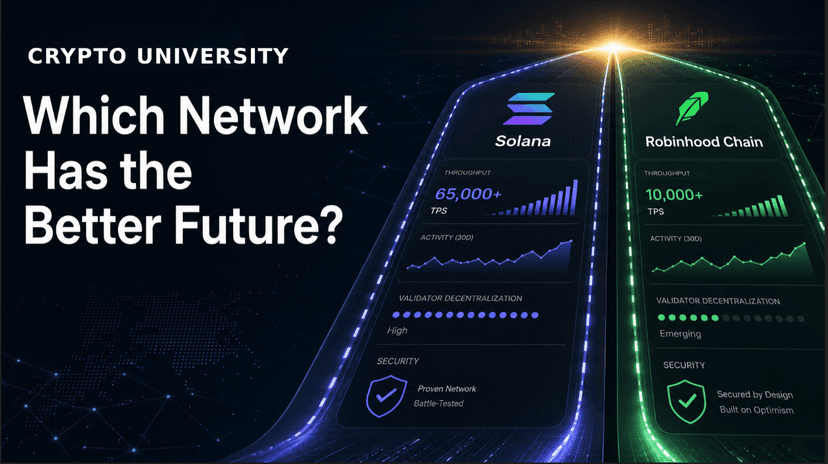
1. They are not really the same thing. Solana is its own independent blockchain, while Robinhood Chain is built on top of Ethereum. Comparing them is more about strategy and direction than a simple head-to-head race.
2. Their strengths come from different places. Solana already has a busy, established crypto ecosystem. Robinhood Chain's edge is built-in access to millions of everyday Robinhood users and a focus on tokenized real-world assets.
3. There probably will not be a single winner. Solana can keep leading crypto-native activity while Robinhood Chain grows into a trusted home for tokenized finance. The real fight is over users, stablecoins, developers, and liquidity.
Two Very Different Bets
If you are new to crypto, the first thing to know is that Solana and Robinhood Chain are not clean substitutes for each other. They are solving different problems, and they are built in different ways.
Solana is an independent Layer 1 blockchain. That means it runs on its own network of validators, has its own token, its own way of processing transactions, and its own culture. Nobody sits underneath it.
Robinhood Chain is an Ethereum Layer 2, built using Arbitrum technology. In simple terms, it settles onto Ethereum for security, and its big advantage is that it is tied to one of the largest retail investment platforms in the United States and Europe.
Put another way: Solana is betting on being one fast, global machine that everyone shares. Robinhood Chain is betting that brand trust, easy access, tokenized assets, and Ethereum compatibility can finally bring mainstream finance on-chain.
Quick Comparison at a Glance
Here is the short version before we dig into the details.
Category | Solana | Robinhood Chain |
|---|---|---|
Architecture | Layer 1 (independent) | Ethereum Layer 2 |
Main ecosystem | Consumer crypto, trading, payments, memes | Tokenized finance, Robinhood-linked apps |
Virtual machine | SVM | EVM |
Native asset | SOL | Check current gas and token design |
Maturity | Established, live for years | Newer network |
Distribution edge | Crypto-native apps and users | Robinhood brokerage customers |
Decentralization | Independent validators | L2 sequencer, bridge, Ethereum settlement |
Developer stack | Rust / Solana | Solidity / Ethereum |
Speed: Faster Is Not the Whole Story
Solana is designed for high throughput and low fees right at its base layer. Robinhood Chain advertises very fast block times through its Arbitrum-based Layer 2 design.
But here is the beginner trap: the headline block time is not the same as your real experience. When you actually use a network, a few things matter more than a marketing number:
How long until your transaction feels confirmed
How long until it is truly final and settled
How long it takes to withdraw funds across a bridge
How reliable the sequencer is when things get busy
How the network behaves under heavy congestion
How quickly apps respond in day-to-day use
Solana can offer fast native settlement without moving through a Layer 2 bridge at all. Robinhood Chain can feel instant inside its own environment, but it leans on a more layered settlement model underneath.
Distribution: Robinhood Chain's Strongest Card
This is where Robinhood Chain shines. Robinhood does not have to convince crypto users to install yet another wallet. It can potentially show its existing customers tokenized assets and on-chain products through a familiar brand and regulated, easy-to-use screens.
Solana's reach comes from crypto-native success instead. Its ecosystem grew through popular apps and active communities, including:
Phantom (a leading wallet)
Jupiter (a popular trading hub)
Meme-coin markets and speculation
Stablecoin payments
Consumer apps and DePIN projects
NFT infrastructure and busy developer communities
So think of it this way: Robinhood has a financial-app funnel that already holds millions of users. Solana has an on-chain ecosystem funnel that already holds real crypto activity.
Tokenization: Bringing Real Assets On-Chain
Tokenization simply means turning a real-world asset into a token you can hold and trade on a blockchain. Robinhood Chain is built with this idea front and center. That could include tokenized versions of:
Stocks and equities
Private assets
Commodities
Funds
Credit and other financial instruments
Solana supports tokenization too, and it already has strong payments and stablecoin performance. The real difference is go-to-market, meaning how each one reaches customers.
Robinhood can plug tokenized products straight into an existing brokerage relationship, which is a huge shortcut. Solana relies more on issuers, wallets, exchanges, and apps to piece the user journey together.
Decentralization: Read the Fine Print
Solana has its own independent validator network and its own consensus. It has faced fair criticism over the years around validator hardware requirements, stake concentration, client diversity, and past outages, though the network and its software have kept improving.
Robinhood Chain inherits parts of the Ethereum and Arbitrum stack, but as a Layer 2 it adds its own trust assumptions you should understand:
Who controls the sequencer that orders transactions
Who holds the upgrade keys
How the bridge contracts are secured
How data availability is handled
How governance and emergency powers work
“settles to Ethereum” does not mean “identical to Ethereum.” Always read the Layer 2 security model before you trust it with real money.
Developer Experience
If you plan to build (or you are just curious how builders think), each network offers a different trade-off. Here is a side-by-side view.
Solana
Strengths | Trade-offs |
|---|---|
High-performance execution | A different programming model to learn |
Growing SVM tooling | Rust has a learning curve |
Strong consumer and trading ecosystem | Account-model complexity |
Very low transaction costs | Different debugging and infrastructure |
Robinhood Chain
Strengths | Trade-offs |
|---|---|
EVM compatible (familiar to Ethereum devs) | A crowded EVM landscape |
Standard Solidity tooling | Depends on Robinhood's strategy |
Access to the Arbitrum ecosystem | A new chain must bootstrap liquidity |
Robinhood-linked distribution programs | Layer 2 fragmentation across many chains |
DeFi and Liquidity
Liquidity is just how easily you can buy or sell without moving the price. It matters a lot, and here Solana starts ahead. It already has mature exchanges, lending, perpetuals, wallets, and stablecoin rails in place.
Robinhood Chain has to attract or import that liquidity from scratch. It might do that through:
Incentive programs and rewards
Tokenized assets people actually want
Its own Robinhood user base
Market makers and ecosystem grants
New apps built natively on the chain
Distribution can speed things up, but remember: liquidity is not created by a press release. It has to be earned.
Culture: Chaotic vs Controlled
Solana is crypto-native and often chaotic. That does bring scams and heavy speculation, but it also fuels fast, creative experimentation.
Robinhood Chain is likely to feel more finance-native, brand-controlled, and compliance-conscious. That can win over institutions and mainstream users, but it may also limit the wild, permissionless experimentation in certain asset types.
Is Robinhood Chain a “Solana Killer”?
No, not really. It makes far more sense to see it as a competitor to:
Base
Arbitrum Orbit chains
Other exchange-linked or app-linked Layer 2s
Tokenization-focused EVM networks
Solana competes at a broader level as a full execution layer. That said, Robinhood Chain can still pull away activity that might otherwise have landed on Solana, especially tokenized trading and everyday retail financial products.
How You Might Actually Invest
This is the part beginners care about most, so let us be clear. Buying SOL gives you direct exposure to Solana's native token and the economics of its network. It is a simple, direct trade.
Robinhood Chain may not offer that same simple public-token exposure. Instead, you might get exposure through Robinhood stock, through apps in its ecosystem, or through specific assets launched on the chain.
different trades with different risks. And importantly, a successful Robinhood Chain does not automatically mean any single token goes up in value. Do not assume the two are the same.
None of this is financial advice, and I am not a financial advisor. Always do your own research and only risk what you can afford to lose.
The Bull and Bear Case for Each
Every honest comparison should show both sides. Here is what could go right and what could go wrong for each network.
Solana
Bull case (could go right) | Bear case (could go wrong) |
|---|---|
Consumer crypto keeps growing | Activity stays overly speculative |
Payments and stablecoins expand | Validator economics centralize |
Stays the top high-speed trading venue | Outages or client issues return |
Firedancer improves resilience | Rival chains match its performance |
SVM adoption spreads and fees support SOL | Value flowing to SOL disappoints |
Robinhood Chain
Bull case (could go right) | Bear case (could go wrong) |
|---|---|
Millions of Robinhood users come on-chain | Users stay in the app and skip the chain |
Tokenized assets go mainstream | Tokenized assets stay legally restricted |
Developers value built-in distribution | Liquidity incentives fade over time |
Institutional products move in | The network is seen as too centralized |
Ethereum and Arbitrum security hold up | Base or other EVM chains keep the edge |
The Final Verdict
Solana is the stronger existing crypto network today. Robinhood Chain has the stronger built-in mainstream distribution story.
Think of it like this. Solana is a bet on independent, high-performance blockchain infrastructure. Robinhood Chain is a bet on a regulated financial platform turning its users and products into an on-chain economy.
The most likely future is not a single winner. Solana can keep dominating crypto-native consumer markets, while Robinhood Chain becomes an important rail for tokenized finance. The real competition will be over users, stablecoins, developers, and liquidity, not marketing claims about transactions per second.
Frequently Asked Questions
What is the main difference between Solana and Robinhood Chain?
Solana is an independent Layer 1 blockchain that runs on its own. Robinhood Chain is an Ethereum Layer 2 that settles onto Ethereum for security and is tied to the Robinhood platform.
Is Robinhood Chain going to replace Solana?
Very unlikely. They serve different goals. Robinhood Chain competes more directly with other Layer 2 networks like Base and Arbitrum-style chains, while Solana competes as a full base-layer blockchain.
Which one is faster?
Both are fast, but speed is more than a headline block time. Solana settles quickly on its own base layer, while Robinhood Chain can feel instant inside its environment but relies on a more layered settlement model.
Can I buy a Robinhood Chain token the way I buy SOL?
Not necessarily. Buying SOL is direct exposure to Solana. Robinhood Chain exposure may come indirectly through Robinhood stock, ecosystem apps, or assets launched on the chain. These are different trades with different risks.
Which network is better for a beginner to explore first?
If you want a busy, established crypto ecosystem with lots of apps, Solana is easy to explore today. If you care most about tokenized real-world assets and a familiar, regulated interface, Robinhood Chain may appeal more once it matures.
Is this financial advice?
No. This guide is for education only. Always do your own research, understand the risks, and consider speaking with a qualified professional before investing.
Research Notes and Sources
Robinhood Chain official docs: docs.robinhood.com/chain/
Robinhood connection and architecture details: docs.robinhood.com/chain/connecting/
Robinhood mainnet announcement (Robinhood newsroom)
ArbitrumDAO launch factsheet (Arbitrum forum)
Solana official documentation: solana.com/docs
Solana validator and network metrics should be refreshed from live official sources on publication day.
Disclaimer: This content is for educational and informational purposes only and is not financial advice. Nothing here is a recommendation to buy or sell any asset or use any platform. Do your own research and manage your risk.
How to Get Started on Robinhood Chain: A Complete Beginner's Guide
How to Evaluate a Web3 Protocol: An On-Chain Due Diligence Framework
MetaMask Agent Wallet: A Complete Beginner's Guide
AI Agents in Crypto Wallets: Technical Foundations and Security Considerations
Tokenized Assets Go Institutional: What Standard Chartered's 2028 Projection Means for Web3 Learners
What Is a Liquidity Pool? How AMMs Replace Order Books
Best Robinhood Chain Trading Platforms in 2026: FOMO, GMGN, Uniswap and OpenSea Compared