KEY TAKEAWAYS
1. Asset tokenization converts ownership rights in physical or financial assets into blockchain-based tokens, making them programmable, divisible, and tradable 24/7. 2. Standard Chartered projects the tokenized real-world asset (RWA) market will grow from roughly $35 billion to $2 trillion by 2028, with money market funds and equities expected to account for the largest share. 3. Major institutions including BlackRock, Franklin Templeton, and Fidelity have already launched on-chain products, signaling that tokenization has moved from experiment to mainstream financial infrastructure. |
In October 2025, Standard Chartered published a research report projecting that the market for tokenized real-world assets would grow from approximately $35 billion to $2 trillion by the end of 2028. That is a roughly 57-fold increase over three years.
The projection came from Geoff Kendrick, the bank's global head of digital assets research, and it is not an isolated view. By 2026, the same bank had revised its total tokenized asset forecast to $4 trillion when stablecoins are included, with real-world assets and stablecoins each accounting for half of that figure.
For anyone learning about crypto and blockchain, this shift raises an important question: what exactly is asset tokenization, why do major banks care about it, and what does it mean for the broader Web3 ecosystem?
This article explains asset tokenization from first principles, walks through how it works on-chain, and uses real institutional examples to show why traditional finance is now building directly on top of blockchain rails.
What Is Asset Tokenization?
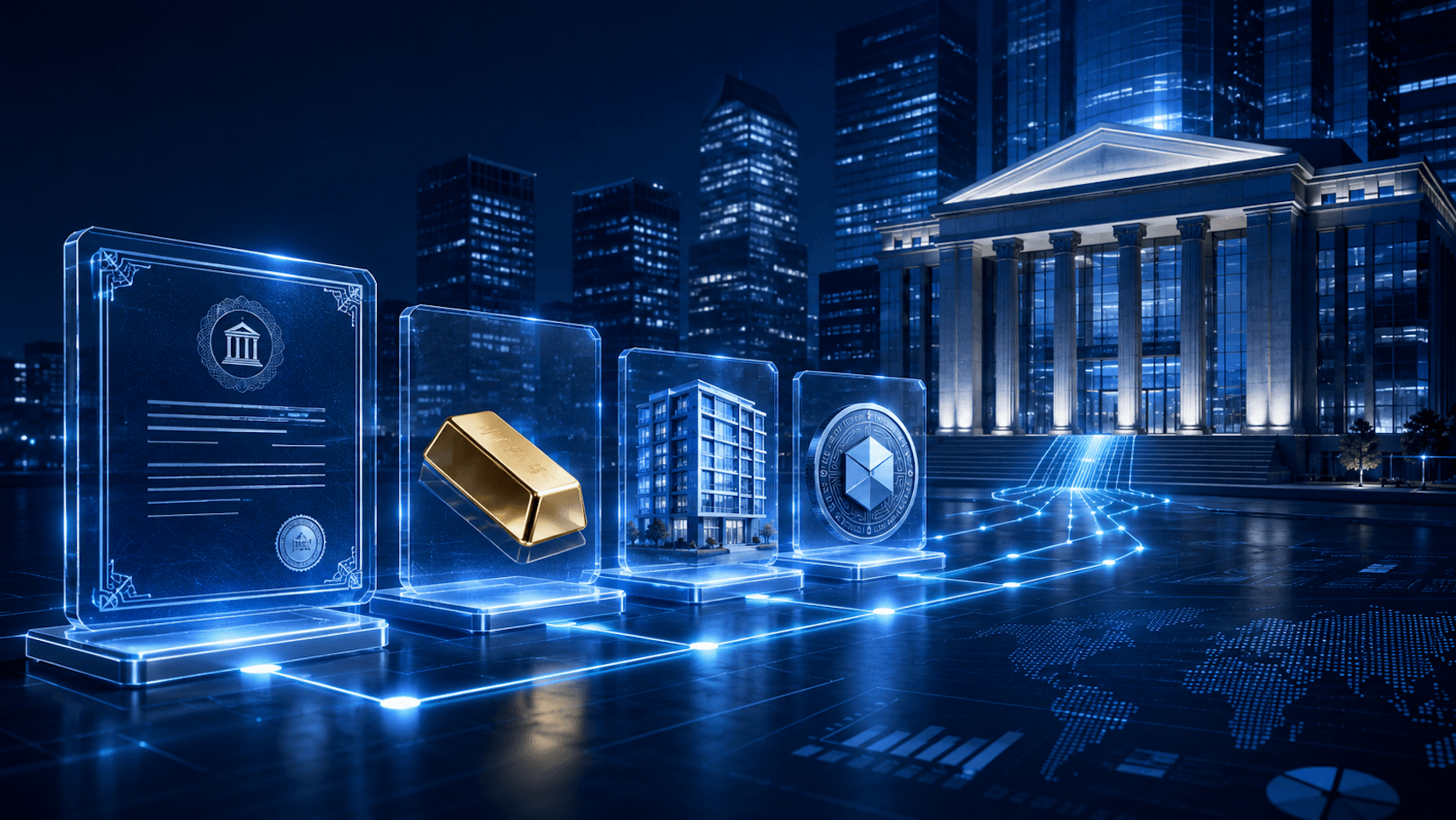
Asset tokenization is the process of converting ownership rights in a real-world asset into a digital token recorded on a blockchain.
The real-world asset could be almost anything: a US Treasury bill, a commercial property, a share in a private equity fund, a quantity of gold, or a corporate bond. Once tokenized, that ownership right exists as a digital token, typically following a standard like ERC-20 on Ethereum, that can be transferred, traded, or used as collateral without the usual infrastructure of banks, brokers, or settlement delays.
It is important to understand what the token actually represents. When you hold a tokenized Treasury bill, you are not holding the Treasury bill directly on the blockchain. You are holding a digital claim on that asset, which is held off-chain by a custodian or a legal structure called a Special Purpose Vehicle (SPV). The blockchain records and transfers ownership, but the underlying legal and financial infrastructure still exists in the traditional world.
Key Terms You Need to Know
Term | What It Means |
RWA | Real-world asset. Any asset from the physical or traditional financial world that has been represented on a blockchain. |
Token | A digital unit on a blockchain representing a right, ownership stake, or claim. |
Smart Contract | Self-executing code on a blockchain that automatically enforces the rules of a transaction without an intermediary. |
SPV (Special Purpose Vehicle) | A legal entity created specifically to hold the underlying asset and issue tokens against it. |
Custodian | A regulated institution that holds the physical or financial asset on behalf of token holders. |
Composability | The ability for on-chain assets to interact with other blockchain protocols, such as using a tokenized Treasury as collateral in a DeFi lending application. |
Minting | The act of creating new tokens on a blockchain, typically when new assets are deposited or verified. |
DeFi | Decentralized Finance. Financial services built on blockchain using smart contracts instead of traditional intermediaries. |
How Tokenization Works: Step by Step
The tokenization process connects traditional legal and financial infrastructure to a blockchain. Here is how it typically works:
Asset Selection and Valuation
An issuer identifies an asset suitable for tokenization. This could be a government bond, a real estate property, a private equity fund, or a commodity like gold. For tangible assets, an independent valuation is conducted. For financial assets, existing pricing mechanisms apply.
Legal Structuring
A legal wrapper is created, often an SPV, to hold the underlying asset. This structure defines what token holders are entitled to: ownership, income rights, redemption rights, or a combination. The legal structure must comply with the regulations of the relevant jurisdiction.
Token Design and Smart Contract Deployment
The issuer chooses a blockchain, most commonly Ethereum, and deploys a smart contract that governs how the tokens behave. This includes how many tokens represent the asset, how they can be transferred, who is permitted to hold them, and how income or yield is distributed.
Minting and Issuance
Once the asset is secured and the legal structure is in place, tokens are minted and issued to investors. Each token represents a defined share of the underlying asset. For example, a $10 million Treasury fund might be divided into 10 million tokens at $1 each.
Trading and Settlement
Token holders can transfer or trade their tokens on secondary markets, which may be decentralized exchanges or regulated platforms. Settlement happens on-chain, often in minutes, compared to the standard two-day settlement cycle in traditional markets.
Redemption
When a token holder wants to exit, they redeem their tokens through the smart contract or the issuing platform. The tokens are burned, and the underlying asset value is returned, typically in cash or stablecoins.
Why Traditional Finance Is Building On-Chain
For much of blockchain's early history, major financial institutions were skeptical observers. That position has shifted significantly. Several structural advantages of tokenization are driving institutional adoption:
Faster settlement: Traditional securities markets operate on a T+2 settlement cycle, meaning a trade takes two business days to fully settle. On-chain, settlement can happen in seconds or minutes, reducing counterparty risk and freeing up capital.
Fractional ownership: Tokenization allows expensive or illiquid assets to be divided into smaller units. A $5 million commercial property could be divided into 5,000 tokens at $1,000 each, making it accessible to a wider range of investors.
24/7 availability: Unlike stock exchanges that operate during set business hours, tokenized assets can be transferred and traded at any time of day or night.
Composability: Once an asset is on-chain, it can interact with DeFi protocols. A tokenized Treasury bill can simultaneously earn yield and be used as collateral for a loan, something that requires multiple intermediaries and legal agreements in traditional finance.
Reduced operational costs: Smart contracts automate compliance checks, dividend distribution, and record-keeping functions that currently require significant back-office infrastructure.
Real-World Examples: Who Is Already Doing This?
Asset tokenization is no longer theoretical. Here are some of the most significant institutional examples currently active:
Institution / Product | Asset Type | Blockchain | Notable Detail |
BlackRock BUIDL | US Treasury bills and cash | Ethereum | Launched March 2024, held approximately $1.7 billion in assets by May 2026. Daily dividend distribution via on-chain accrual. |
Ondo Finance (OUSG / USDY) | US Treasuries, money market funds | Ethereum and others | Over $3.5 billion TVL by 2026 across multiple blockchains. USDY crossed $1 billion in TVL in early 2026. |
Franklin Templeton (BENJI) | US Government Money Market Fund | Stellar and Polygon | One of the first regulated fund managers to issue tokenized fund shares on a public blockchain. |
WisdomTree (WTGXX) | Tokenized Money Market Fund | Ethereum | Received SEC approval in 2026 for 24/7 trading and instant USDC settlement. |
These products validate the asset class and demonstrate that institutional-grade tokenization is operationally possible within existing regulatory frameworks.
What the Standard Chartered Projection Actually Means
Standard Chartered's $2 trillion RWA projection by 2028 is based on several assumptions worth understanding:
Money market funds lead the way: The bank expects tokenized money market funds and listed equities to each account for approximately $750 billion of the total, with the remaining $500 billion split across private equity, corporate bonds, real estate, and commodities.
Ethereum as the dominant chain: The report identifies Ethereum as the leading blockchain for tokenization due to its decade-long operating history without major disruption and its established developer and institutional ecosystem.
Stablecoins as the foundation: The 2025 growth of stablecoin supply, which reached $300 billion in late 2025, is described as having laid the infrastructure groundwork. Stablecoins enable on-chain lending, borrowing, and settlement, which tokenized assets can then plug into.
Regulatory clarity as the key variable: The report warns that progress could stall if comprehensive crypto legislation does not pass in the United States. The CLARITY Act, which cleared the Senate Banking Committee in May 2026, is identified as the most significant near-term catalyst.
It is worth noting that projections like this are estimates. The $2 trillion figure represents one bank's analysis of current trends. Other research firms offer different numbers: Binance Research, for example, estimated tokenized assets could reach $1.6 trillion by 2030. These figures should be understood as directional signals, not certainties.
Risks and Limitations
Asset tokenization offers genuine efficiencies, but it is not without risk. Web3 learners should understand the following challenges:
Regulatory risk: Token structures must comply with securities laws, which vary by jurisdiction and are still evolving. A product that is legal in one country may not be in another.
Custodial risk: The token is only as secure as the off-chain infrastructure holding the underlying asset. If the custodian fails or the SPV is poorly structured, token holders may face losses.
Smart contract risk: Code vulnerabilities can be exploited. Researchers tracked $14.6 million in losses from RWA-related exploits in the first half of 2025.
Liquidity risk: Secondary markets for many tokenized assets remain thin. Being able to buy a token does not guarantee being able to sell it quickly at a fair price.
Complexity risk: The interaction between on-chain tokens and off-chain legal rights requires careful structuring. Investors need to understand what they actually own legally, not just what token they hold.
What This Means for Web3 Learners
The growth of tokenized real-world assets represents a convergence between traditional finance and blockchain infrastructure. For anyone studying crypto and Web3, a few practical points are worth keeping in mind:
RWAs are expanding the on-chain economy beyond speculation. When government bonds, real estate, and private credit live on-chain, DeFi protocols gain access to trillions of dollars in more stable, yield-generating assets.
Institutional involvement is reshaping the space. Products like BlackRock BUIDL have brought regulatory scrutiny and compliance standards to tokenization, which is likely to define the norms for future issuance.
The infrastructure being built now, smart contract standards, custodial frameworks, and oracle systems, will serve as the foundation for a much larger tokenized economy.
Understanding the difference between a token and the underlying legal claim it represents is essential. Holding a tokenized asset is not the same as holding the asset directly.
Tokenization is not a new concept. Stock certificates, fund units, and bearer bonds are all ways of representing asset ownership through a paper or digital record. What blockchain adds is programmability, interoperability, and the ability to transfer ownership without a central clearinghouse.
The question is not whether traditional assets will move on-chain. The trajectory strongly suggests they will, over time. The more useful questions for learners are: how does this infrastructure work, who controls it, and what protections exist for participants.
Frequently Asked Questions
What is a real-world asset (RWA) in crypto?
A real-world asset in the context of crypto is any asset from the physical or traditional financial world that has been represented on a blockchain as a digital token. Examples include US Treasury bills, real estate, corporate bonds, gold, and private equity fund shares.
How is tokenization different from an NFT?
NFTs (non-fungible tokens) represent unique, one-of-a-kind items. Tokenized real-world assets typically use fungible tokens, meaning each token is identical and interchangeable, similar to how shares of a stock are interchangeable. The key difference is that RWA tokens represent claims on real-world assets with measurable economic value, not just digital ownership of a unique item.
Is it safe to invest in tokenized assets?
Tokenized assets carry multiple layers of risk, including smart contract vulnerabilities, custodial risk, regulatory uncertainty, and secondary market liquidity risk. This article is educational and does not constitute financial advice. Anyone considering a tokenized product should review the legal structure carefully and consult appropriate professional guidance.
Why does Ethereum dominate tokenized assets?
Ethereum's decade-long track record of consistent operation, its large developer ecosystem, and its established standards for token creation (such as ERC-20) give it a structural advantage for institutional use. Standard Chartered's research specifically identifies Ethereum's operational history as a key reason institutions trust it for tokenization use cases.
What is BlackRock BUIDL?
BlackRock BUIDL is the BlackRock USD Institutional Digital Liquidity Fund, a tokenized money market fund launched on Ethereum in March 2024. It invests in US Treasury bills, repurchase agreements, and cash, and distributes yield daily through on-chain accrual. It is open to qualified institutional investors and held approximately $1.7 billion in assets by May 2026.
What does the Standard Chartered $2 trillion projection mean for me as a learner?
It signals that tokenization is moving from a niche experiment to a mainstream component of global finance. For anyone learning about crypto and blockchain, understanding how RWAs work, what risks they carry, and how they interact with DeFi protocols is becoming increasingly relevant knowledge for navigating the space.
Disclaimer: This content is for educational and informational purposes only and is not financial advice. Nothing here is a recommendation to buy or sell any asset or use any platform. Do your own research and manage your risk.
Read More
How to Safely Use Crypto Bridges in 2026: Risk Assessment Checklist and Best Practices
AI Agents and Crypto: A Beginner's Guide to Autonomous On-Chain Payments
How to Evaluate a Crypto Whitepaper: A 7-Point Framework for Spotting Vapor from Value
Layer 1 vs Layer 2: Understanding Blockchain Scalability from First Principles
Need deeper training?
Join our structured modules with live examples and expert checklists for effective implementation.
JOIN THE ACADEMY