Mastering Next-Gen Decentralized Perpetuals: gTrade, SynFutures, and MUX Network in 2026
The decentralized perpetual futures market has undergone a massive architectural evolution. While early decentralized exchanges (DEXs) relied on clunky, high-slippage virtual Automated Market Makers (vAMMs), the landscape in 2026 is dominated by Next-Gen Decentralized Perpetuals. These platforms combine the deep liquidity and advanced order types of centralized exchanges (CEXs) with the non-custodial security, transparency, and global accessibility of decentralized finance (DeFi).
For sophisticated retail traders, quantitative desks, and privacy-conscious investors, migrating to these advanced decentralized perps is a strategic imperative. They offer access to synthetic leverage on real-world assets (RWAs), decentralized order books for custom trading pairs, and multi-chain aggregated liquidity that eliminates the fragmentation of the early DeFi era.
This comprehensive guide breaks down the core architectures of modern decentralized perpetuals, the top-tier platforms dominating the space in 2026, and the strict operational security frameworks required to trade on-chain derivatives safely and profitably.
The 3 Pillars of Next-Gen Decentralized Perpetuals in 2026
To trade effectively in this advanced environment, you must understand the mechanical advantages that separate these platforms from legacy DeFi derivatives.
Synthetic Leverage and Multi-Asset Exposure:
Platforms utilizing synthetic architectures (like gTrade) decouple trading from underlying liquidity pools. Instead of matching buyers and sellers or drawing from a shared pool, traders bet against a smart contract that tracks the real-world price via decentralized oracles. This allows for up to 150x leverage on crypto, forex, and commodities with zero price impact (zero slippage), regardless of trade size.
Decentralized Central Limit Order Books (CLOB):
Hybrid platforms (like SynFutures) utilize off-chain matching engines for lightning-fast order execution, while keeping all collateral and settlement strictly on-chain. This provides the precise limit orders, post-only, and immediate-or-cancel (IOC) functionality that professional traders demand, without the counterparty risk of a centralized entity.
Multi-Chain Aggregated Liquidity and Dynamic Hedging:
Advanced protocols (like MUX Network) aggregate liquidity across multiple blockchains (Ethereum, Arbitrum, BNB Chain, etc.) into a single, unified margin account. This allows traders to open positions using collateral from any supported chain, while the protocol dynamically hedges the aggregate exposure on centralized venues to maintain solvency and offer competitive, stable funding rates.
Top Platforms for Next-Gen Decentralized Perpetuals in 2026
Executing advanced on-chain derivatives requires platforms with robust oracle networks, audited smart contracts, and deep, resilient liquidity.
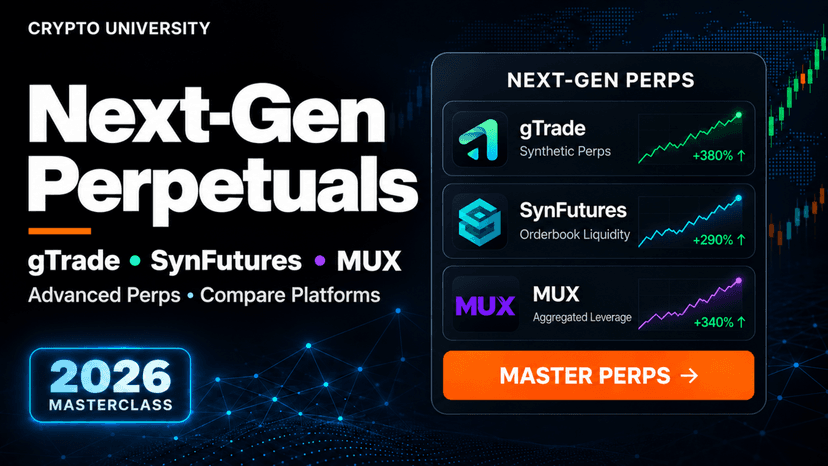
1. gTrade (Gains Network): Best for Synthetic Leverage and Zero-Slippage Execution
gTrade has established itself as the premier platform for traders who demand CEX-like execution on a decentralized, non-custodial infrastructure.
Core Features: gTrade’s synthetic trading model allows users to trade crypto, forex, and commodities with up to 150x leverage. Because trades are executed against a smart contract priced by Chainlink oracles, users experience zero slippage and instant trade execution, even for large block sizes.
Multi-Chain Accessibility: Deployed across high-throughput networks like Arbitrum and Polygon, gTrade ensures that transaction fees remain a fraction of a cent, making high-frequency scalping and tight stop-loss management economically viable.
Why Traders Choose It: It completely eliminates the liquidity fragmentation and slippage issues of traditional AMM-based perps, offering a seamless, professional-grade trading experience with full self-custody.
👉 Trade Crypto, Forex, and Commodities with Zero Slippage on gTrade
2. SynFutures: Best for Decentralized Order Books and Custom Pair Creation
For traders who require the precision of an order book but refuse to sacrifice the security of self-custody, SynFutures is the industry standard for decentralized CLOB trading.
Core Features: SynFutures utilizes a high-performance, decentralized matching engine that supports advanced order types (limit, stop, trailing stop). Its standout feature is the ability for the community to permissionlessly list and trade custom perpetual pairs (including long-tail altcoins and RWAs) by providing initial liquidity, democratizing market creation.
Unified Margin System: Traders can use a variety of collateral assets (including stablecoins and blue-chip cryptos) to margin their positions, with cross-margin functionality that maximizes capital efficiency across multiple open positions.
Why Traders Choose It: It bridges the gap between retail DeFi and institutional trading infrastructure, providing the depth, speed, and customization of a top-tier CEX in a trustless, on-chain environment.
👉 Access Decentralized Order Book Perpetuals and Custom Pairs on SynFutures
3. MUX Network: Best for Multi-Chain Aggregated Liquidity and Capital Efficiency
MUX Network solves the problem of fragmented DeFi liquidity by offering a unified, multi-chain perpetual trading experience.
Core Features: MUX aggregates liquidity from multiple sources and chains, allowing users to deposit collateral on one network (e.g., BNB Chain) and open leveraged positions on another (e.g., Arbitrum) seamlessly. The protocol employs a sophisticated dynamic hedging mechanism to manage aggregate risk, ensuring stable funding rates and deep liquidity for traders.
MUX Token Utility: The native token is integral to the ecosystem, offering fee discounts, a share of the protocol’s revenue, and governance rights over risk parameters and new chain deployments.
Why Traders Choose It: It provides unparalleled flexibility and capital efficiency for multi-chain traders, eliminating the need to manually bridge funds between networks to chase the best trading conditions.
👉 Maximize Capital Efficiency with Multi-Chain Aggregated Perps on MUX Network
Top Tools for Supporting Your Decentralized Perp Workflow
A professional decentralized trading setup requires a secure, analytical, and compliant technology stack.
4. TradingView: Best for Charting Custom Perp Pairs and Oracle Spreads
Successful perpetual trading requires rigorous market analysis, especially when trading custom or synthetic pairs that may not be available on traditional charting platforms.
Core Features: Advanced traders use TradingView to chart the "basis" (the price difference between the decentralized perp price and the global spot index) and to monitor historical funding rate trends. Custom Pine Script indicators can overlay on-chain data, such as open interest spikes or liquidation heatmaps, directly onto price charts.
Why Traders Choose It: It provides the macro and micro-level visibility needed to time entries, identify over-leveraged market conditions, and avoid trading during periods of extreme, unpredictable volatility.
👉 Analyze Perp DEX Metrics, Custom Pairs, and Funding Rates with TradingView
5. Ledger: Best for Securing On-Chain Derivative Collateral
When interacting with any DeFi protocol, the security of the source wallet is paramount. Ledger provides the essential hardware layer to protect your capital from sophisticated drainers that target active DEX traders.
Core Features: By connecting your Ledger hardware wallet to platforms like gTrade, SynFutures, or MUX, you ensure that every trade execution, token approval, and withdrawal requires physical confirmation on the device’s secure, tamper-proof screen.
Clear Signing: Ledger’s integration with major DeFi protocols allows it to parse and display human-readable transaction details (e.g., "Approve 5000 USDC for MUX Margin Vault"), preventing "blind signing" attacks where malicious contracts disguise token drains as routine actions.
Why Traders Choose It: It provides the ultimate physical circuit breaker. Even if your browser is compromised by a perfect phishing replica of a DEX, the attacker cannot drain your funds without your physical button press.
👉 Secure Your On-Chain Trading Operations with a Ledger Hardware Wallet
6. Koinly: Best for Tracking Complex Perpetual DEX Tax Events
Every time you open, close, or pay funding fees on a perpetual position, it is a taxable event. Furthermore, providing liquidity to a protocol like MUX generates dozens of micro-taxable events.
Core Features: Koinly seamlessly ingests data from your self-custody wallets and DEX interactions via read-only public keys. Its advanced heuristic engine is specifically trained to decode complex DeFi transactions, accurately categorizing perpetual trading profits, funding fee payments, and liquidity pool yields.
Why Traders Choose It: It transforms the chaotic, high-frequency nature of DEX trading into a clean, compliant, and easily auditable ledger, ensuring you don't overpay or underreport your tax liabilities.
👉 Automate Your Complex Perp DEX Tax Tracking with Koinly
Step-by-Step: How to Transition to Next-Gen Decentralized Perps
Moving your derivatives trading on-chain requires a deliberate, security-first workflow to avoid costly mistakes.
Step 1: Establish a Secure, Dedicated Web3 Wallet
Do not use your primary, long-term holding wallet for active DEX trading. Create a dedicated wallet using a reputable browser extension (like Rabby or MetaMask). Crucial: Connect this software wallet to your Ledger hardware device to ensure all interactions are physically verified.
Step 2: Bridge Capital to the Target Network
Next-gen perps operate on specific networks (e.g., Arbitrum for gTrade, Polygon for SynFutures). Use a reputable, audited cross-chain bridge to transfer your collateral (typically USDC or ETH) to the target network. Ensure you retain a small amount of the native gas token to pay for transaction fees.
Step 3: Approve and Deposit Collateral
Navigate to the official DEX interface. Connect your Ledger-secured wallet. You will need to sign a one-time "Approve" transaction, granting the DEX’s smart contract permission to access your specific collateral token. Then, deposit the funds into the platform’s margin or vault contract.
Step 4: Execute with Advanced Order Types
Avoid market orders unless absolutely necessary, as they can be subject to minor oracle latency. Instead, use Limit Orders or Trigger Orders (for stop-losses and take-profits). This allows you to define your exact entry and exit prices, ensuring your risk parameters are strictly enforced by the smart contract.
Risk Management: The Hidden Dangers of On-Chain Derivatives
While next-gen decentralized perps eliminate CEX counterparty risk, they introduce specific, nuanced risks that must be actively managed:
Oracle Manipulation and Lag: Decentralized perps rely on decentralized oracles (like Chainlink or Pyth) to determine mark prices for liquidations. During extreme, second-by-second volatility, oracle feeds can occasionally lag the true spot price, potentially triggering unfair liquidations. Mitigation: Never use maximum leverage on illiquid altcoins. Stick to conservative leverage (3x to 10x) on major pairs to provide a wide buffer against temporary oracle discrepancies.
Smart Contract Vulnerabilities: Your funds are locked in code. While top platforms are heavily audited, zero-day exploits remain a non-zero risk in DeFi. Mitigation: Only trade on battle-tested platforms with significant Total Value Locked (TVL), multiple top-tier audits (e.g., PeckShield, OpenZeppelin), and active, well-funded bug bounty programs.
Funding Rate Bleed: If you hold a perpetual position in a market with sustained, high positive funding rates, the cost of holding that position can slowly erode your margin balance, inching your liquidation price closer to the current market price. Mitigation: Always check the predicted funding rate before entering a leveraged position. If it is excessively high, wait for a cooldown or consider an alternative hedging strategy.
Risk Warning: Cryptocurrency trading, especially involving decentralized derivatives and leverage, carries a high level of risk and may not be suitable for all investors. Smart contract vulnerabilities, oracle manipulation, and extreme market volatility can result in the rapid and total loss of your initial investment.
Not Financial Advice: The information provided in this article is for educational and informational purposes only. It does not constitute financial, investment, legal, or tax advice. Always conduct your own research (DYOR) and consult with a qualified, licensed professional before interacting with decentralized finance protocols or making any financial decisions.
Affiliate Disclaimer: This article contains affiliate links. If you click on these links and sign up for a service or make a purchase, we may earn a commission at no additional cost to you. We only recommend platforms, tools, and services that we have thoroughly vetted and believe provide genuine value, security, and utility to our readers.