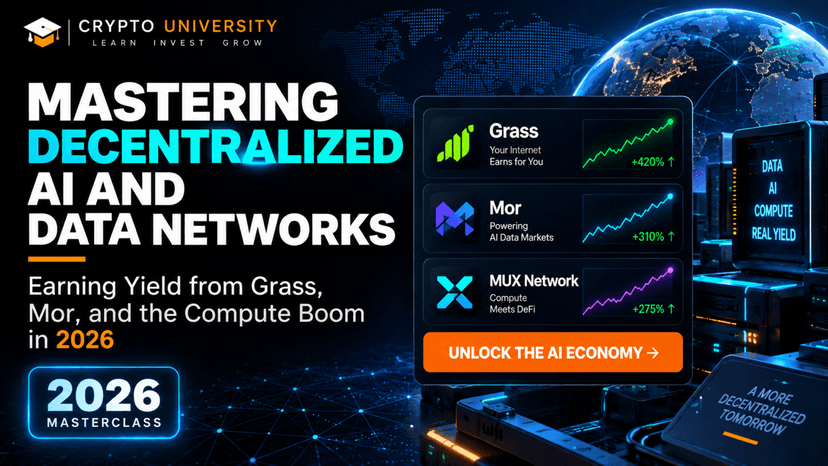
Mastering Decentralized AI and Data Networks: Earning Yield from Grass, Mor, and the Compute Boom in 2026
The artificial intelligence boom of the mid-2020s exposed a critical vulnerability in the global tech ecosystem: centralization. A handful of massive corporations monopolized both the GPU compute power required to train models and the pristine, human-generated data needed to prevent "model collapse" (the degradation of AI quality when trained on AI-generated data).
By 2026, the cryptocurrency sector has successfully disrupted this duopoly through Decentralized AI and Data Networks. This specialized, high-growth subset of DePIN (Decentralized Physical Infrastructure Networks) allows everyday users and institutional capital to monetize their unused internet bandwidth, provide liquidity to decentralized compute markets, and route autonomous AI agents.
For sophisticated retail investors, yield seekers, and tech-forward entrepreneurs, participating in decentralized AI networks offers a unique opportunity to earn "Real Yield" derived from the actual revenue of AI developers paying for decentralized infrastructure. This comprehensive guide breaks down the mechanics of the decentralized AI economy, the top-tier platforms dominating the space in 2026, and the strict operational frameworks required to monetize your hardware and capital safely.
The 3 Pillars of Decentralized AI Infrastructure in 2026
To capture value from the AI-crypto intersection, investors must understand the three distinct layers of the decentralized AI stack:
Decentralized Data Provenance and Scraping:
AI companies desperately need verified, ethically sourced, human-generated web data to train next-generation models. Decentralized networks allow users to contribute their unused residential bandwidth to act as "nodes" that scrape and verify public web data. In return for providing this crucial data pipeline, users earn continuous micro-rewards in the network’s native token.
Open Smart Agent Economies and Compute Routing:
In 2026, autonomous AI agents execute millions of daily transactions, requiring constant access to APIs, LLMs, and decentralized compute power. Open networks act as decentralized marketplaces where AI agents pay in crypto to access compute resources. Capital providers and liquidity pools that underwrite these compute networks earn a percentage of the routing fees, generating sustainable, usage-based yield.
Node Operation and Hardware Provision:
For those with technical expertise or spare hardware, running lightweight validation nodes or renting out idle GPU power to decentralized rendering networks provides direct, high-yield compensation from AI startups that cannot afford centralized AWS or Azure pricing.
Top Platforms for Decentralized AI and Data Monetization in 2026
Participating in the AI-DePIN sector requires platforms that offer seamless node deployment, transparent yield distribution, and robust security.
1. Grass: Best for Passive Data Monetization and Bandwidth Sharing
Grass has emerged as the undisputed leader in decentralized web scraping and AI data provenance. It allows users to monetize their unused internet bandwidth with zero technical expertise.
Core Features: By installing the Grass browser extension or lightweight desktop node, users contribute their residential IP addresses to a decentralized network. AI companies and data aggregators pay the Grass network to scrape the public web ethically, bypassing centralized data monopolies.
Passive Yield: Users earn GRASS tokens continuously based on their network uptime and the quality of their bandwidth. It is one of the most accessible "set-and-forget" yield strategies in the 2026 DePIN landscape.
Why Users Choose It: It requires no expensive hardware or capital lock-ups. You are simply monetizing an asset (your internet connection) that you are already paying for, turning a monthly expense into a passive crypto income stream.
👉 Start Monetizing Your Unused Bandwidth with Grass
2. Mor (MOR20 / Open Network): Best for AI Smart Agent Routing and Capital Provision
As autonomous AI agents become the primary consumers of blockchain blockspace, Mor provides the open, decentralized infrastructure required to connect these agents with compute providers and APIs.
Core Features: Mor operates as an open network where AI agents pay for decentralized services. Capital providers can supply liquidity to the network’s routing pools, underwriting the compute and API access that AI agents require. In return, capital providers earn a share of the network's revenue, generated directly from AI agent usage fees.
Decentralized AI Governance: The MOR20 standard allows developers to launch their own specialized, niche AI networks (e.g., a decentralized network specifically for medical AI compute) while leveraging the broader Mor ecosystem for security and liquidity.
Why Investors Choose It: It offers exposure to the "picks and shovels" of the autonomous AI economy. Instead of betting on a single AI model, you are providing the capital infrastructure that all decentralized AI agents must use to function.
👉 Provide Capital and Earn Yield from AI Agent Routing on Mor
3. OneKey & Ledger: Best for Securing DePIN Node Rewards and AI Wallets
Running AI nodes and interacting with decentralized compute smart contracts requires frequent wallet signatures and interactions with experimental dApps. Securing the wallets that hold your accumulated AI rewards is non-negotiable.
Core Features: Hardware wallets like OneKey and Ledger provide air-gapped, Secure Element protection for your DePIN earnings. OneKey is highly regarded in the developer and DePIN community for its open-source firmware, multi-chain support, and seamless integration with node-management dashboards. Ledger remains the industry standard for institutional-grade Clear Signing, ensuring you never blindly approve a malicious compute-routing contract.
Why Node Operators Choose Them: They provide the ultimate physical circuit breaker. If your node management software or browser is compromised by malware, your accumulated AI tokens and principal capital cannot be drained without physical verification on the hardware device.
👉 Secure Your AI Node Rewards with an OneKey Hardware Wallet
👉 Secure Your AI Node Rewards with a Ledger Hardware Wallet
Top Tools for Supporting Your AI-DePIN Workflow
4. TradingView: Best for Tracking AI Tokenomics and Compute Demand
The decentralized AI sector is highly narrative-driven, but long-term success requires tracking actual network usage. TradingView is essential for analyzing the fundamentals of AI tokens.
Core Features: Advanced investors use TradingView to chart the price action of AI infrastructure tokens against traditional tech benchmarks (like the Nvidia or SMCI indices). Custom Pine Script indicators can be used to track on-chain metrics like "Active AI Agent Wallets" or "Compute Revenue" to verify if a protocol's yield is backed by real demand.
Why Investors Choose It: It separates sustainable, revenue-generating AI networks from speculative, inflationary "vaporware" projects.
👉 Analyze AI Token Metrics and Compute Demand with TradingView
5. Koinly: Best for Tracking High-Frequency DePIN Micro-Rewards
DePIN nodes, especially data-scraping networks like Grass, distribute rewards on a highly frequent, micro-transaction basis. Manually tracking thousands of fractional token deposits for tax purposes is impossible.
Core Features: Koinly seamlessly integrates with major DePIN networks and the exchanges where their tokens are traded. It automatically detects these frequent, small reward payouts, categorizing them correctly as ordinary income based on the fair market value at the exact time of receipt.
Why Node Operators Choose It: It ensures that your passive AI income is reported accurately to tax authorities, preventing a massive, unmanageable compliance burden at year-end.
👉 Automate Your DePIN and AI Node Tax Tracking with Koinly
Step-by-Step: How to Deploy Capital and Hardware into Decentralized AI
Participating in the AI-DePIN sector requires a deliberate, security-first workflow. Follow this exact blueprint:
Step 1: Choose Your Participation Model
Passive Bandwidth (Low Effort): Install the Grass node on your primary computer or a dedicated mini-PC. Ensure your network allows background traffic and keep the node running 24/7 to maximize uptime rewards.
Capital Provision (Medium Effort): Allocate stablecoins or ETH to decentralized AI routing pools (like Mor) to earn yield from AI agent compute fees.
Active GPU Node (High Effort): If you possess high-end GPUs, configure them to connect to decentralized rendering networks (like Akash or Render) to rent your compute power directly to AI developers.
Step 2: Establish a Dedicated Node Wallet
Never use your primary, long-term cold storage wallet to interact with AI node dashboards or experimental compute smart contracts. Create a dedicated "hot" or "warm" wallet specifically for claiming DePIN rewards.
Step 3: Secure the Wallet with Hardware
Import this dedicated wallet into a OneKey or Ledger device. When the AI protocol requires you to sign a message to prove node ownership or claim weekly rewards, verify the payload on the hardware screen to prevent phishing attacks.
Step 4: Automate Reward Compounding and Tax Tracking
Set up a routine to periodically transfer your accumulated AI tokens from your node wallet to your secure cold storage or a liquid exchange. Connect all relevant addresses to Koinly to ensure every micro-reward is logged for tax compliance.
Risk Management: The Hidden Dangers of Decentralized AI Networks
While the AI narrative is powerful, the underlying infrastructure carries unique risks that must be actively managed:
Data Privacy and Regulatory Scrutiny: Networks that scrape web data or route AI agents may face regulatory pushback regarding copyright infringement, data privacy (GDPR/CCPA), or unauthorized network scraping. Mitigation: Favor protocols that implement strict "opt-in" data verification and zero-knowledge proofs to ensure user privacy and legal compliance.
Hardware Depreciation and Electricity Costs: If you are running active GPU nodes, the rapid release of new AI chips (like next-gen Nvidia architectures) can render your hardware obsolete, destroying your ROI. Mitigation: Calculate your break-even period conservatively, factoring in local electricity costs, and prioritize lightweight, bandwidth-based nodes (like Grass) if you lack enterprise-grade hardware.
Smart Contract Risk in Routing Pools: Providing capital to decentralized AI compute pools exposes you to the risk of smart contract exploits. Mitigation: Only allocate capital to battle-tested, heavily audited networks with a proven track record and active bug bounty programs.
Tax Complexity: As mentioned, node rewards are generally classified as ordinary income. Mitigation: Rely on automated tracking via Koinly from day one.
Frequently Asked Questions (FAQ)
Q: Will running a node like Grass slow down my internet connection?
A: No. Modern decentralized data networks are engineered to utilize only your unused bandwidth. The node software dynamically throttles its usage based on your current network activity, ensuring that your streaming, gaming, or work-from-home connection remains completely unaffected.
Q: How is yield from decentralized AI networks taxed?
A: In most major jurisdictions, tokens received as compensation for providing bandwidth, compute, or capital to a network are treated as ordinary income based on their fair market value at the time of receipt. When you later sell those tokens, it triggers a separate capital gains or losses event. Automated tracking via Koinly is essential due to the high frequency of these payouts.
Q: What is the difference between decentralized AI compute and centralized cloud (AWS/Azure)?
A: Centralized cloud providers charge massive premiums, enforce strict censorship, and suffer from single points of failure. Decentralized AI networks crowdsource idle global compute and bandwidth, creating a more resilient, censorship-resistant, and significantly cheaper alternative for AI developers, with the cost savings passed back to network participants as token rewards.
Q: Is it safe to connect my wallet to AI agent routing protocols?
A: Interacting with any smart contract carries inherent risk. AI agent protocols are highly complex. Always use a dedicated wallet secured by a hardware device like OneKey or Ledger, and never approve "unlimited" token spending limits when interacting with compute routing dashboards.
Risk Warning: Participating in decentralized AI networks, DePIN node operation, and compute routing protocols carries significant risks, including smart contract vulnerabilities, hardware depreciation, regulatory scrutiny over data scraping, and extreme token volatility. You could sustain a partial or total loss of your initial investment or hardware costs.
Not Financial Advice: The information provided in this article is for educational and informational purposes only. It does not constitute financial, investment, legal, or tax advice. Always conduct your own rigorous research (DYOR) and consult with a qualified, licensed professional before deploying hardware or capital into decentralized infrastructure networks.
Affiliate Disclaimer: This article contains affiliate links. If you click on these links and sign up for a service or make a purchase, we may earn a commission at no additional cost to you. We only recommend platforms, tools, and services that we have thoroughly vetted and believe provide genuine value, security, and utility to our readers.