Key Takeaways
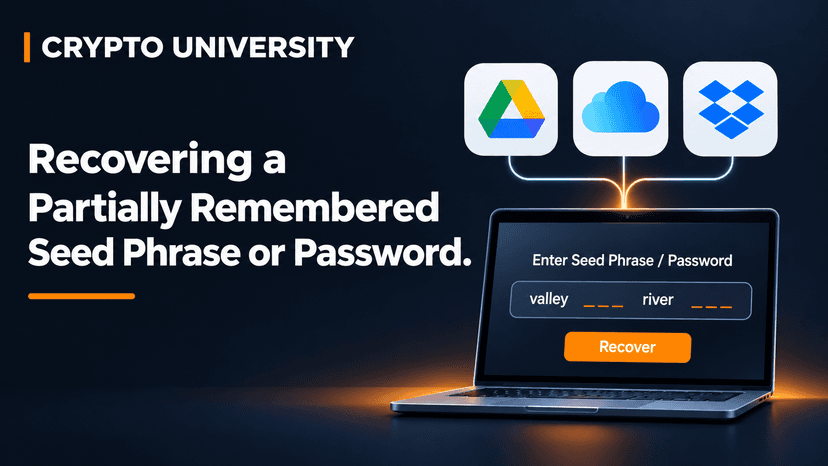
One or two missing seed words are usually recoverable on a normal computer, because every BIP39 word comes from a fixed list of 2,048 words and the phrase contains a built-in checksum.
The difficulty grows very fast. Three or four missing words can take serious computing power, and five or more is generally treated as impossible with today's hardware.
Passwords are different from seed words. A forgotten password is only realistic to recover if you remember most of it, and you should never hand your secrets to a stranger who offers to "recover" them.
Why Partial Recovery Is Possible at All
A seed phrase is not a password you invented. In wallets that follow the BIP39 standard, every word comes from a published list of exactly 2,048 words (BIP39 specification). That fixed list is what makes partial recovery possible. If you know 11 of your 12 words, the missing one can only be one of 2,048 options, and a computer can test all of them in seconds.
Two more features help:
The checksum. The last word of a BIP39 phrase includes a few bits calculated from the other words. A random guess usually fails this check, so most wrong combinations are rejected before a wallet even looks at the blockchain. As one expert told Cointelegraph, the final word can be worked out easily once you have the first 11.
A known address. If you have any address the wallet once used, a recovery tool can check each valid candidate against it. When the generated address matches, you have found your phrase.
The flip side is that every extra unknown word multiplies the work by about 2,048. That is the whole security model of a seed phrase, and it is why "a few missing words" and "most of the phrase" are very different problems.
The Numbers: How Many Missing Words Are Realistic?
The table below shows how many raw combinations exist for a 12 word phrase when the positions of the missing words are known. These figures come from simple multiplication (2,048 to the power of the number of missing words). The checksum then filters out about 15 of every 16 combinations on a 12 word phrase, and about 255 of every 256 on a 24 word phrase.
Missing words (positions known) | Raw combinations | Realistic outlook |
|---|---|---|
1 | 2,048 | Seconds on any laptop |
2 | About 4.2 million | Minutes on a normal computer |
3 | About 8.6 billion | Hours to days, faster with a GPU |
4 | About 17.6 trillion | Serious GPU time, often weeks or more |
5 or more | Over 36 quadrillion | Generally treated as infeasible |
Industry guides land in a similar place. Spark's recovery overview rates one or two missing words as recoverable, three or four as possible but hard, and five or more as computationally impractical (Spark). The maintainer of BTCRecover has also described large numbers of missing words as a math problem rather than a software problem: even far faster hardware would not make it practical.
What makes it harder
Situation | Effect on the search |
|---|---|
You do not know where the missing words go | Multiplies the work by the number of possible positions. Two missing words in unknown spots of a 12 word phrase gives about 66 times more work. |
Words are out of order | Twelve known words in an unknown order is about 479 million arrangements, which is manageable. Twenty four scrambled words is far beyond reach. |
You have no address to check against | The tool must compare candidates to a large database of used addresses, which adds setup time. |
You also used a passphrase | Every passphrase guess creates a different wallet, so it multiplies the search again. |
What makes it easier
Knowing the exact position of each missing word.
Having a receiving address, or better, the extended public key (xpub, ypub, or zpub) of the account.
Knowing which wallet made the seed, so the tool uses the right derivation path.
Partial clues, such as "the word started with S" or "it was an animal," which shrink 2,048 options to a handful.
Common Cases That Look Worse Than They Are
Many people who think they are "missing words" actually have a transcription problem. Recovery tools are built for these too.
What happened | Why it is often fixable |
|---|---|
A word was misspelled | Only the first four letters of a BIP39 word need to be unique, so a typo usually points to one real word. |
Two words were swapped | A tool can test swapped pairs quickly. |
You wrote 11 or 23 words | One word is missing, which is the easiest case. |
A similar looking word was copied | Tools can try every "close" word, not just exact matches. |
The phrase is valid but the wallet is empty | Often the wrong derivation path, a missing passphrase, or the wrong wallet app, not a wrong word. |
BTCRecover's seed tool runs through phases that cover one typo, two typos, and wrong words, and its documentation says these phases should take at most a few hours for a typical 12 word seed on a modern computer (BTCRecover docs).
Passwords: A Different Kind of Problem
A seed word comes from a list of 2,048. A password can be almost anything, so recovery depends on how much you remember. There are three common types:
Type | Where it is used | How a wrong guess behaves |
|---|---|---|
Wallet file password | Encrypts a file such as wallet.dat or an Electrum wallet | The software tells you it is wrong |
BIP39 passphrase ("25th word") | Added to a seed phrase to create a hidden wallet | Every guess "works" and opens a different, usually empty, wallet |
Hardware wallet PIN | Unlocks the device | The device wipes itself after a set number of wrong tries |
A hardware wallet PIN is not something you brute force. If you have the seed phrase, you simply reset the device and restore from the seed.
For wallet file passwords and passphrases, tools like BTCRecover use a token list. You write down the fragments you remember, such as a pet's name, a year, and a symbol, and the tool tries every combination. It can also add common typos, like caps lock or a repeated letter. This works well when you remember the building blocks. It does not work if the password was long and random, because then there is nothing to narrow the search.
One limit to know: BTCRecover's FAQ notes that GPU acceleration is available for BIP39 seed recovery but not for BIP39 passphrase recovery (BTCRecover FAQ). So a forgotten passphrase relies much more on good guesses than on raw speed.
A Safe, Step by Step Approach
Stop and write everything down. Record every word you are sure of, every word you are unsure of, and any clue about positions or spelling.
Find something to check against. Look for an old receiving address in emails, exchange withdrawal history, or tax records. An xpub is even better.
Identify the wallet type. BIP39, Electrum, and SLIP39 seeds need different settings.
Use reputable open source software only. BTCRecover is free and open source. Download it from its official repository and check that you have the real project.
Work on an offline computer. Ideally use a clean machine that is disconnected from the internet during the search.
Work on copies. For wallet files, BTCRecover's own documentation says to run it against copies of your wallet files, never the originals (BTCRecover intro).
Move funds after success. Once you recover access, send the funds to a brand new wallet with a fresh seed, because the old one has now been typed into a computer.
Never do these things
Never paste a partial seed phrase into a website, browser extension, or chat.
Never share your words with someone who contacted you first offering help.
Never pay an upfront fee to a "recovery expert" who found you on social media.
The CFTC warns about recovery frauds that target people who have already lost money and lists warning signs to watch for (CFTC). Some legitimate firms do offer paid recovery help, but you should research them independently, never accept an unsolicited offer, and understand that sharing your partial seed means trusting them with your funds.
When to Accept That Recovery Is Not Realistic
It is honest to say that some cases cannot be solved. Recovery is unlikely when:
Five or more words are missing.
Most of a 24 word phrase is in an unknown order.
The password was long, random, and stored only in a password manager you no longer have.
You have no idea which wallet or coin the seed belonged to, and no address to check.
In these cases, spending money on services or tools rarely changes the outcome. The best next step is to search physical and digital records for the original backup.
FAQ
How many missing seed words can be recovered? One or two words are usually recoverable on a normal computer. Three or four may be possible with strong hardware and time. Five or more is generally treated as infeasible.
Can I recover the last word of my seed phrase? Yes. On a 12 word BIP39 phrase, only 128 of the 2,048 words pass the checksum in the final position. A tool can test each against a known address.
Is it safe to use an online seed phrase recovery tool? Typing seed words into a website is risky because the operator could take your funds. Use open source software on an offline computer instead.
Can a forgotten BIP39 passphrase be recovered? Only if you remember most of it. Each guess opens a valid wallet, so you need a known address to confirm the right one.
What if my seed is valid but the wallet shows zero? The words may be correct. Check the derivation path, any passphrase, and whether you used the right wallet app before assuming a word is wrong.
Related Terms
Checksum: A small piece of data calculated from other data, used to detect mistakes such as a wrong seed word.
Brute Force Attack: A method of finding a secret by trying every possible combination until one works.
BIP39 Passphrase: An optional extra word or phrase added to a seed phrase that creates a separate wallet.
Disclaimer
This article is for educational purposes only and is not financial, legal, or security advice. Recovery outcomes vary and estimates in this article are approximate. Never share your seed phrase or password with anyone.
Sources
The BIP39 specification defines the 2,048 word list and checksum.
Cointelegraph reports expert views on how many missing words can be recovered.
Spark's wallet recovery guide rates recovery difficulty by number of missing words.
The BTCRecover seed recovery overview explains what the tool needs and how long typical searches take.
The BTCRecover FAQ covers passphrase recovery and GPU limits.
The BTCRecover introduction describes token lists and advises working on copies.
The CFTC recovery fraud page lists warning signs of fake recovery services.