Key Takeaways
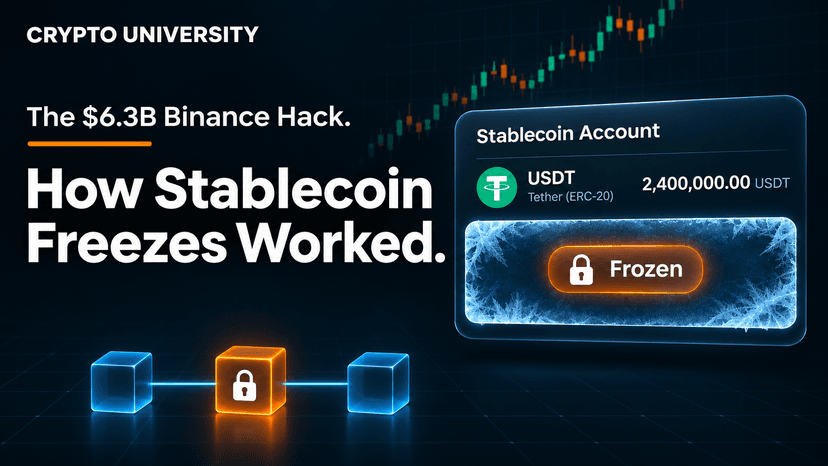
Stablecoin freezes stopped a large share of the theft. Issuers led by Tether and Circle froze roughly $2.7 billion to $2.85 billion of an estimated $6.3 billion to $6.4 billion taken, mostly within the first hour.
A freeze is not a refund. Frozen tokens cannot move, but returning them usually needs legal process, followed by the issuer burning the frozen tokens and reissuing new ones to the rightful owner.
Freezes only work on assets with a central issuer. Bitcoin, ether, XRP, and SOL taken in the attack could not be frozen, and the attacker swapped hundreds of millions of dollars in stablecoins into ether before the freezes landed.
What Happened in the Binance Hack
On October 29, 2026, an attacker drained hot wallets at Binance, the world's largest crypto exchange, across about 11 blockchains. Most of the outflows happened within roughly 20 to 45 minutes.
Estimates of the total differ by source. Binance puts the impact at about $6.3 billion, TRM Labs counts about $6.36 billion, and Elliptic estimates $6.43 billion at prices at the time of the theft. It is the largest crypto theft on record, roughly four times the 2025 Bybit hack.
The FBI, TRM Labs, and Chainalysis have attributed the attack to TraderTraitor, a hacking unit linked to North Korea. Binance said it would cover user losses, and on November 12 it said it had finished replacing affected customer assets using more than $6.34 billion of its own funds.
About half of what was stolen was stablecoins. That is the main reason so much of the loss could be stopped.
Asset taken | Estimated amount | Could it be frozen? |
|---|---|---|
USDT, USDC, RLUSD | About $3.4 billion combined (TRM) | Yes, by the issuer |
Bitcoin (BTC) | About 18,270 BTC, roughly $1.47 billion | No |
Ether (ETH) and Ethereum tokens | Largest single chain loss, about $3.8 billion including stablecoins (Elliptic) | ETH no; some tokens yes |
XRP | About 233 million XRP | No |
Solana (SOL) | About 970,500 SOL | No |
Figures are estimates from blockchain analytics firms and changed as investigations continued.
How a Stablecoin Freeze Works
Most large stablecoins are issued by a company, not by a decentralized network. That company controls the token's smart contract, and the contract includes admin functions.
Blacklisting: The issuer adds an address to a blocklist. In USDC's contract, a blacklisted address cannot send, receive, mint, or burn the token.
Tether's tools: The USDT contract has a function to add an address to a blacklist and another to destroy the funds held in a blacklisted address.
Other issuers: Ripple's terms for RLUSD allow it to freeze or burn tokens for legal and compliance reasons.
Once an address is blacklisted, the tokens still appear in the wallet, but they are useless to the attacker. They cannot be sold, swapped, or bridged.
This control is also built into regulation. Under the US GENIUS Act, a permitted payment stablecoin issuer must be technically able to comply with lawful orders to seize, freeze, burn, or block transfers.
The Freeze Timeline: Minutes Mattered
The speed of the response is the part of this story that stands out. According to Elliptic's timeline (all times UTC, October 29):
Time | Event |
|---|---|
About 20:05 | Theft begins, starting on the XRP Ledger, then other chains |
20:24 | Stolen USDT reaches the attacker's main Ethereum wallet |
About 21:01 | Tether freezes that wallet, about 37 minutes later |
Within the next 17 minutes | Tether freezes four more attacker addresses |
About 3 minutes after Tether | Circle freezes 823 million USDC in the same wallet |
October 31 | FBI publishes attacker addresses; Optimism governance moves OP out of reach |
November 1 | Binance begins reopening withdrawals in phases |
Who froze what
Issuer | Token | Reported frozen amount |
|---|---|---|
Tether | USDT | More than 1.567 billion USDT stated; on-chain counts range from about 1.18 billion to 1.77 billion depending on the tracker |
Circle | USDC | 823 million USDC in one wallet; Circle later cited more than $1.1 billion in total |
Ripple | RLUSD | About 40.5 million RLUSD tracked on-chain |
World Liberty Financial | USD1 | About $27 million USD1 |
Others | Various | Paxos, First Digital, and Binance's own wrapped ETH token also froze assets, per Elliptic |
By November 1, Elliptic had verified about $2.85 billion frozen or seized, around 44% of its theft estimate. Stablecoins made up about 94% of that frozen value. Arbitrum's Security Council also recovered about $30 million in ETH and ARB through an emergency contract upgrade, which is a rare example of a network acting directly.
From Freeze to Return: Burn and Reissue
A freeze stops movement. It does not hand money back. Returning frozen stablecoins usually follows three steps:
Freeze. The issuer blacklists the attacker's address.
Legal process. Law enforcement typically obtains a court order or seizure warrant. Lawyers quoted in coverage of the hack noted that a freeze does not decide who legally owns the funds.
Burn and reissue. The issuer destroys the frozen balance and mints the same amount of new tokens to the rightful owner or a government-controlled wallet.
There is no standard timeline. Freezes can happen in minutes, but returning funds can take months or years.
The Binance case has started moving through this process. On November 12, the US Department of Justice said it had court authorization to seize or restrain more than $1.2 billion of the stolen crypto. That leaves an estimated $1.5 billion frozen but not yet covered by a disclosed court order. Because Binance has already repaid customers, it is the likely claimant for any funds that are eventually returned.
Tether reports that across all cases it has frozen more than 7 billion USDT and returned about 1.2 billion USDT to owners and law enforcement through reissuance. In other words, past freezes have often led to returns, but slowly.
The Limits of Stablecoin Freezes
The Binance response was fast, but it also showed clearly where freezes stop working.
1. Native coins cannot be frozen
No company issues bitcoin or ether, so no company can freeze them. As of early November, Elliptic estimated the attacker still controlled about $3.25 billion in assets that issuers cannot freeze, including roughly 18,300 BTC and hundreds of thousands of ETH. Exchanges can refuse deposits from flagged addresses, but they cannot lock the coins themselves.
2. Attackers race to swap out of stablecoins
Before the freezes landed, the attacker converted an estimated $729 million to $786 million in stablecoins into ETH and TRX through decentralized exchanges and market maker systems, accepting losses of more than 10% on some trades. Six of Tether's 11 freezes reportedly hit wallets that had already been emptied. A 37 minute response was fast by industry standards, and still not fast enough for all of it.
3. Cross-chain bridges and automation spread the trail
Funds were sent through at least six bridges and split across more than 20,000 wallets, according to Elliptic. Laundering on Tron involved over 1,000 transfers with a median gap of about 90 seconds, which suggests automated scripts. Each hop makes it harder to freeze anything that lands on a regulated platform.
4. Freezing depends on issuer judgment
Freezes are decisions made by private companies. Critics pointed out that issuers acted within minutes for Binance, but in the April 2026 Drift Protocol hack of about $290 million, Circle was criticized for not freezing USDC quickly. After Drift, Circle reportedly added a policy exception allowing freezes on urgent law enforcement requests before a court order.
5. Centralization cuts both ways
The same control that stops thieves can also freeze innocent users by mistake or under pressure. Tether has faced a US lawsuit from holders who said their USDT was frozen after an informal agent request, without a court order at the time. For users, a freezable stablecoin is more recoverable when stolen, but it is never fully under their own control.
Freezes at a glance
Strength | Limit |
|---|---|
Can stop stolen funds within minutes | Useless once funds are swapped to BTC, ETH, or other native coins |
Works across any wallet on the chain | Needs the issuer to act, and act fast |
Frozen tokens can be reissued to victims | Return requires legal process with no fixed timeline |
Backed by regulation such as the GENIUS Act | Same power can affect innocent holders |
What This Means for Everyday Users
Exchange users were protected here mainly because Binance covered the loss, not because stolen funds were returned. Whether a platform can absorb a hack often matters more than recovery.
Stablecoin holders should understand that USDT and USDC carry issuer control. This helps after theft, but it is a trade-off, not a free benefit.
Victims of personal theft should report quickly to the issuer, any receiving exchange, and police. Speed is the single biggest factor in whether a freeze is possible.
FAQ
How much of the Binance hack was frozen? Estimates range from about $2.7 billion to $2.85 billion, depending on the tracker. That is roughly 44% of the total taken. Nearly all of it was USDT and USDC.
Does a frozen stablecoin get returned automatically? No. A freeze only stops the tokens from moving. Returning them usually requires a court order or seizure warrant, after which the issuer burns the frozen tokens and reissues them to the rightful owner.
Why could Bitcoin and ether not be frozen? They have no central issuer and no admin controls in their protocols. Only exchanges and services that receive the coins can block them, and only on their own platforms.
Did Binance customers lose money? Binance said it replaced all affected customer assets using more than $6.34 billion of company funds, including its SAFU fund. Customers should still check official Binance announcements for their own accounts.
Can Tether or Circle freeze my wallet? Technically, yes. Issuers can blacklist any address holding their tokens. In practice, freezes are usually tied to theft, sanctions, or law enforcement requests.
Related Terms
Stablecoin: A crypto token designed to keep a steady value, usually pegged to a currency such as the US dollar.
Hot Wallet: A crypto wallet connected to the internet, used for fast transactions but more exposed to hacking.
Decentralized Exchange: A platform that lets users swap tokens directly through smart contracts without a central operator holding their funds.
Disclaimer
This article is for educational purposes only and is not financial, investment, or legal advice. Figures about the Binance hack are estimates from public reporting and blockchain analytics firms, and they may change as investigations continue.
Sources
Stablecoin Insider, What stablecoin freezes did and did not stop
Stablecoin Insider, DOJ court orders for $1.2B of stolen Binance crypto
Altcoin Buzz, Chainalysis and TRM tie the hack to North Korea
CryptoSlate, Tether freeze and the $729 million that escaped
ForkLog, Debate over double standards in freezing stolen crypto
American Banker, Binance heist and the stablecoin freeze dilemma
The Paypers, Tether's cumulative freeze and reissuance figures
CoinTurk, Tether sued over a USDT freeze without a court order