If you suspect a crypto scam, stop sending money, contact the bank or exchange involved, and report it promptly through the official channels for your location. Save the information you already have, but do not wait for a complete evidence file before asking for help.
Reporting can help authorities connect cases and pursue an investigation. It does not guarantee that funds will be frozen, recovered, or returned to you. A confirmed blockchain transfer generally cannot simply be reversed.
Key Takeaways
Act now, then add detail. Alert your financial providers and the appropriate authorities while preserving evidence. Missing a transaction hash is not a reason to delay.
Secure the right thing. An exposed exchange password, a malicious token approval, and a stolen wallet seed phrase require different responses.
Use official reporting routes. Advice hotlines and scam-intelligence forms do not always replace a police report.
Expect recovery scams. Do not pay someone who unexpectedly promises to retrieve your crypto or asks for your wallet secrets.
Step 1: Stop Further Losses and Secure Your Accounts
Stop payments and contact your providers
Do not pay more money to release a withdrawal, cover a supposed tax, or “verify” an account. Fake trading platforms can display invented balances and profits. Stop engaging with the suspected scammer, but preserve the conversation. The FBI advises victims of suspected cryptocurrency investment fraud to stop sending money and report promptly. FBI victim guidance
Contact your bank, card provider, and any legitimate exchange involved through their official app or website. Explain exactly what happened and ask whether they can stop a pending payment, restrict a compromised account, or review available recovery options. Be accurate about payments you authorized, including a legitimate crypto purchase followed by a transfer to a scammer. A bank refund or chargeback is not automatic. FTC: What to do if you were scammed
If someone has remote access to your device, stop using it for banking or wallet activity. Use a different, trusted device to contact providers and secure accounts. If you face threats or immediate danger, contact your local emergency services rather than relying on an online report.
Exchange and email accounts
From a trusted device, change exposed or reused passwords, secure the associated email account, and review account recovery settings and active sessions. Enable strong multifactor authentication supported by the provider. Tell the exchange immediately if someone else may control your account. Coinbase account-security guidance
Self-custody wallets
What you exposed matters:
You connected a wallet or approved a suspicious contract. Disconnect the site and review the permissions you actually granted. Connecting alone is different from signing an approval or transaction. Where applicable, revoke malicious token approvals using your wallet provider’s official instructions. Disconnecting a site does not cancel existing on-chain approvals. Revocation does not recover assets already taken. MetaMask: Disconnecting a wallet
You revealed a seed phrase or private key. Treat the affected wallet as compromised. Changing its app password or revoking approvals does not make the exposed key secret again. Use a trusted device to create a genuinely new wallet with a new recovery phrase, then follow your provider’s guidance to protect any remaining assets. Do not simply add another account under the exposed phrase. Stop using affected accounts. MetaMask: Compromised-wallet guidance
Incoming funds disappear immediately. A sweeper may be taking them. Do not keep adding cryptocurrency for transaction fees; it may be stolen too. Seek guidance through the wallet provider’s verified support channel. MetaMask: Compromised-wallet guidance
Never give a seed phrase, private key, password, or live authentication code to someone offering reporting or recovery help. Do not sign an unfamiliar transaction to “validate” a complaint.
Step 2: Preserve Evidence Without Delaying Your Report
Your account of what happened and the transaction records both matter. Start a short timeline and keep original files where possible. Report with what you have now; the FBI explicitly says victims should report even without transaction information. FBI reporting instructions
Evidence | What to save |
|---|---|
Transactions | Transaction hashes, sending and receiving addresses, asset, network, amount, and date/time with time zone |
Payments | Bank or card receipts, exchange withdrawals, and crypto ATM receipts |
Platforms | Exact website addresses, app names, download links, and account identifiers |
Communications | Original emails, chat exports, screenshots, usernames, phone numbers, and call logs |
Timeline | How contact began, what was promised, payments made, and when you realized something was wrong |
Reports | Police reference numbers, complaint confirmations, and provider support-ticket numbers |
Separate money actually sent from profits displayed by a suspected fake platform. Record any money returned as well. If a number is an estimate, label it clearly.
A reputable block explorer can help you check public transaction details on the correct network. Save the link and the transaction hash as text, not just a screenshot. You do not need to connect a wallet or sign anything to view a public transaction. An explorer entry can show a transfer; by itself it does not prove who controlled an address or that a crime occurred.
Keep sensitive documents private. Share them only through verified reporting or support channels, and provide only the information requested. Do not post an unredacted evidence folder publicly.
Step 3: Report Through the Channels for Your Location
Start with the country where you live or where the incident occurred. The scammer’s claimed location may be false. These routes have different roles, so an intelligence report may need to be accompanied by a police report.
United States
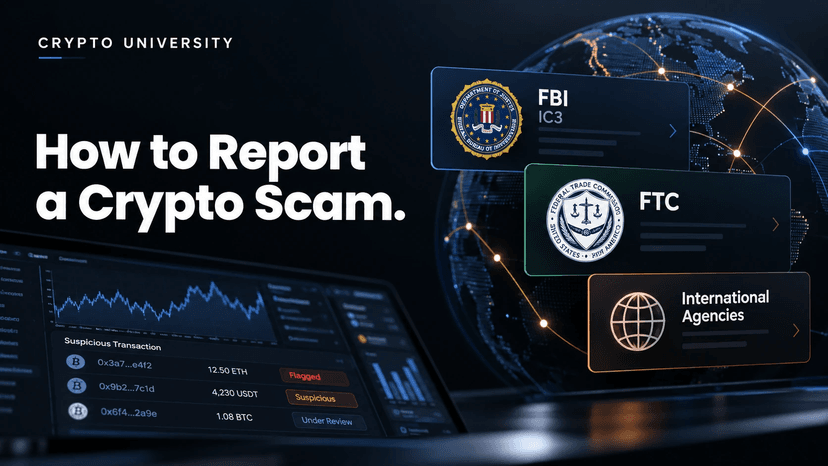
FBI Internet Crime Complaint Center: File at IC3 for suspected cyber-enabled fraud, including crypto scams. You can report attempts even if no money was lost. IC3 cryptocurrency guidance
Federal Trade Commission: Report consumer scams at ReportFraud.ftc.gov. The FTC also directs crypto-scam victims to the relevant regulators and the company used to send the money. FTC cryptocurrency guidance
Securities and Exchange Commission: For suspected securities fraud, use the SEC tips and complaints route.
Commodity Futures Trading Commission: For suspected violations involving commodity or derivatives markets, use the CFTC complaint route.
Local law enforcement: Contact police directly for urgent matters and ask about making a local report. An IC3 submission is not an emergency response service.
To file with IC3, describe the incident in time order and include contact, platform, payment, and transaction details you know. Save or print the submitted complaint before leaving the confirmation screen: IC3 says it will not email you a copy. It does not accept attachments, so retain your original evidence separately.
IC3 analyzes and refers reports; it does not itself investigate complaints or provide investigation-status updates. If you later have additional information, its FAQ instructs you to file a new complaint explaining that it supplements the earlier one. IC3 FAQ
United Kingdom
For England, Wales, and Northern Ireland, use Report Fraud online or call 0300 123 2040. In Scotland, contact Police Scotland on 101. If a crime is happening now, Report Fraud directs people to local police: 999 for emergencies or 101 for non-emergencies.
Use the current Report Fraud service rather than an old Action Fraud bookmark. Telephone network charges may apply. Report Fraud contact information
Canada
Report through the National Cybercrime and Fraud Reporting System, or call the Canadian Anti-Fraud Centre at 1-888-495-8501. If you are a victim, also contact your local police promptly. The CAFC collects and shares information to support investigations; local police are responsible for investigating reported incidents. CAFC reporting guidance
Australia
Use ReportCyber to report a cryptocurrency scam to police. Start from the government’s reporting page, as directed by Scamwatch’s cryptocurrency-scam guidance.
Also submit information to Scamwatch, operated by the National Anti-Scam Centre. Scamwatch reports help identify patterns and warn others, but its form explicitly states that they are not official police reports. Contact your bank or exchange promptly rather than waiting for a reporting service to respond.
Reporting a Crypto Scam in Taiwan: 165, 110, and Police Stations
Taiwan’s 165 anti-fraud hotline provides scam advice and accepts reports. The National Police Agency also offers online intake through the 165 anti-fraud website.
The important distinction is between starting the process and completing the required police paperwork. The NPA explains that online reporting can prepare an initial statement and arrange referral to a convenient police station, where the remaining statement and procedures are completed. Do not assume an advice call or online submission has completed every reporting requirement; ask what follow-through is needed. NPA guidance on 165 and online reporting
Call 165 for anti-fraud advice and reporting assistance.
Call 110 when you need police assistance or to report a crime, especially an urgent or ongoing incident. It is not a guaranteed account-freezing service. NPA guidance on 110
Follow through with a police station as instructed. Keep the report receipt and case details. The NPA’s case-status service uses information from the official report receipt.
For a bank transfer, contact your bank immediately and provide the receiving account, amount, and time. For crypto, save the network, addresses, and transaction hashes too. A bank-account restriction and action involving crypto assets are different processes; a hotline call cannot guarantee either.
Ask police about language assistance if needed. Do not delay your initial contact while waiting for someone to translate an entire evidence file. Some calls to 165 may incur carrier charges, according to the NPA’s guidance.
Singapore
Call the ScamShield Helpline at 1799 for scam checks and advice. The helpline explicitly says it cannot make a police report for you. Use the police-report link on the official ScamShield page to reach Singapore Police Force services, or report in person. Call 999 if urgent police assistance is needed.
Hong Kong
The Anti-Scam Helpline at 18222 provides round-the-clock consultation. It is not a substitute for reporting the case. The Anti-Deception Coordination Centre directs suspected victims to their nearest police station; call 999 in an emergency. ADCC reporting guidance
Step 4: Notify the Crypto Services and Platforms Involved
Give the legitimate exchange you used the relevant transaction details and ask for a fraud-support case number. If you have evidence that another exchange received the funds, alert that service through its official support channel too. An address label on a block explorer is a lead, not definitive proof of who owns the funds.
Exchanges may restrict accounts under their own procedures or respond to lawful requests. They cannot necessarily retrieve funds that have already left their control. Private recovery companies cannot issue seizure orders. FBI cryptocurrency report, recovery-scam guidance
Some stablecoin issuers have limited address-blocking capabilities. For example, Circle describes a process for blocking USDC or EURC addresses in specific circumstances and directs theft victims to law enforcement. Blocking is different from reversing a transfer or returning funds. Circle’s blocklisting guidance
Report fraudulent profiles, advertisements, and apps to the relevant social platform or app store after preserving evidence. Avoid support phone numbers in unsolicited messages or advertisements; navigate independently to the provider’s official site or app.
Step 5: Avoid Recovery Scams
A second scam may arrive as an offer from a supposed lawyer, investigator, exchange employee, or government official. The FBI warns that fake law firms target crypto-scam victims and falsely claim agency connections. FBI warning about fraudulent recovery offers
Treat these as serious warning signs:
An unexpected message promising guaranteed recovery
A request for an advance “tax,” “release fee,” or payment to help an investigation
A request for your seed phrase, private key, password, or remote device access
Pressure to send assets to a supposedly safe wallet controlled by someone else
A claim of government affiliation that you cannot independently verify
Law enforcement does not charge victims to investigate a crime. A private company charging for a service is not, by itself, proof of fraud, but payment does not establish competence or give it police powers. Verify any professional independently and be especially cautious about unsolicited approaches.
Even a real-looking complaint number is not proof that a caller is genuine. Australian authorities have warned about criminals misusing ReportCyber reports to impersonate police and target crypto holders. Call back using contact details obtained independently from the agency. Australian government impersonation warning
Common Scam Types to Describe
You do not need to know the legal name of the offense. Explain the behavior:
Relationship-based investment fraud: Someone builds trust before directing you to a fake investment.
Fake trading platforms: A website shows apparent gains but blocks withdrawals or demands more payments.
Impersonation: Someone poses as an authority, business, or support agent and asks for crypto.
Wallet phishing: A site obtains wallet secrets or tricks you into authorizing a harmful transaction.
Fake giveaways: Someone promises to multiply cryptocurrency you send.
These patterns are covered in FTC cryptocurrency-scam guidance. Describe what happened even if your case does not fit one label.
Frequently Asked Questions
Can I get my crypto back after a scam?
Recovery is uncertain. Confirmed transfers are generally irreversible, and reporting does not guarantee a freeze, seizure, refund, or return. Prompt reporting gives authorities and providers relevant information while any available options can still be assessed. Avoid anyone guaranteeing an outcome.
Should I report to both IC3 and the FTC?
For a US consumer crypto scam, both can be appropriate because their roles differ. IC3 collects cybercrime complaints for analysis and referral; the FTC uses consumer reports for enforcement and prevention. Also contact the providers involved and local police where appropriate.
Should I wait until I have every transaction hash?
No. Report what you know now and preserve additional records as you find them. Follow each agency’s instructions for adding information. Never invent missing details.
Is calling Taiwan’s 165 the same as completing a police report?
165 accepts reports and can help start the process. Confirm whether you need to attend a police station and complete a statement or other paperwork. Online intake alone should not be assumed to finish those steps.
Does reporting cost money?
You do not need a paid recovery company to make a report. Do not pay someone claiming an official investigation or release fee. Telephone charges may apply, including for some calls to Report Fraud or Taiwan’s 165.
What if the scammer is abroad?
Start with your local or national reporting service and the financial providers involved. Cross-border cases can be difficult, but suspected overseas involvement is not a reason to stay silent. IC3 also accepts reports from people outside the United States. IC3 FAQ
Related Terms
Transaction Hash: An identifier used to look up a blockchain transaction.
Block Explorer: A tool for viewing public blockchain records.
Recovery Scam: A follow-up fraud that exploits someone seeking to recover lost funds.
Seed Phrase: Backup words used to restore a compatible wallet; exposing them can compromise its accounts.
Pig Butchering Scam: A term often used for prolonged relationship-based investment fraud.