Key Takeaways
Recovery scams target people who have already lost money. The FBI has warned repeatedly about fake recovery companies, fake law firms, and people posing as FBI or IC3 staff who promise to get stolen crypto back for a fee.
Upfront fees and guarantees are the clearest warning signs. Real law enforcement never charges victims, and no honest service can promise that stolen crypto will be returned.
Verify before you trust. Check any lawyer, firm, or "agent" through official channels you find yourself, never through the links, phone numbers, or documents they send you.
What Is a Crypto Recovery Scam?
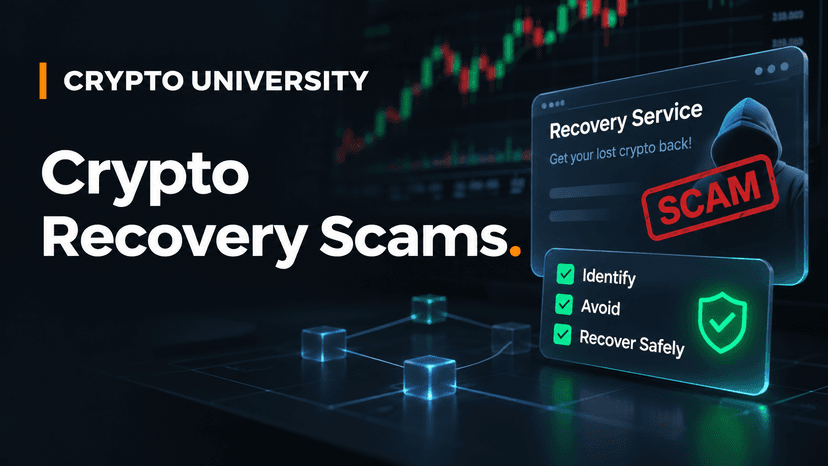
A crypto recovery scam is a follow-up fraud aimed at someone who has already been scammed or hacked. The criminal claims they can trace and return the lost funds, then charges fees, steals personal data, or drains whatever money the victim has left.
The US Commodity Futures Trading Commission (CFTC) describes recovery scams as a form of advance-fee fraud: you pay something now in exchange for a promised larger payout later that never arrives (CFTC).
These scams work because the timing is cruel. A victim has often contacted banks, police, and exchanges and heard nothing back. A message saying "we found your money" arrives at exactly the moment they most want it to be true.
Why Victims Are Targeted Twice
Crypto transfers cannot be reversed by a bank, and real recovery is slow. It usually depends on exchanges freezing deposits, stablecoin issuers blocking tokens, or law enforcement seizing assets, sometimes years later. Scammers exploit the gap between that slow reality and a victim's hope for a fast fix.
The FBI first highlighted fake recovery companies in August 2023. In June 2024 it reported that victims lost more than $9.9 million to fictitious law firms between February 2023 and February 2024 (FBI IC3, June 2024). It issued an updated warning with more red flags in August 2025 (FBI IC3, August 2025).
In July 2026, the FBI warned that criminals were impersonating FBI staff and the IC3 complaint portal, using AI-generated videos, fake letterhead, and spoofed websites that can appear in normal search results (McDonald Hopkins summary). Scammers also look for victims in social media groups for fraud survivors, sometimes posing as fellow victims who "got their money back."
The Main Types of Recovery Scams
Scam type | How it usually starts | What they want |
|---|---|---|
Fake recovery company | Online ads, search results, or reviews promising "guaranteed recovery" | Upfront fees, then more fees |
Fake law firm | Unsolicited email or message, often using a real lawyer's name or letterhead | Legal fees, retainer, "court costs" |
Fake FBI or IC3 agent | Contact on Facebook, Telegram, or phone after you mention filing a report | Personal data, payment to "release" funds |
Fake regulator | Letters or calls claiming to be from the CFTC, FTC, or a foreign regulator | Taxes or processing fees |
Fake "ethical hacker" | Comments under scam warnings or in victim forums | Payment for "hacking back" the scammer |
Fake exchange or wallet support | Messages claiming your frozen funds can be unlocked | Seed phrase, remote access, deposits |
Red Flags Before You Hire Anyone
Any single item below should make you stop. Several together almost always mean fraud.
1. They contacted you first
Legitimate lawyers and forensic firms rarely cold-contact victims. The FBI specifically warns to be cautious when a law firm reaches out unexpectedly, especially if you have not reported the crime to any authority.
2. They ask for money upfront
This is the core of the scam. Fees may start small and grow. Watch for labels such as "tax," "release fee," "donation," "gas fee," or "verification deposit." The CFTC notes that scammers often claim fees cannot be taken out of the recovered money, which is a strong warning sign.
3. They want payment in crypto or gift cards
The FBI lists requests for payment in cryptocurrency or prepaid gift cards as a red flag. The US government does not charge victims for law enforcement services.
4. They guarantee results
No one can promise to recover crypto that has been moved through mixers, bridges, or overseas cash-out services. Guarantees, success rates near 100%, and "no recovery, no fee" offers that still require a deposit are all warning signs.
5. They claim special government lists or powers
Scammers say you are on a "government list of scam victims" or that they have authority to issue seizure orders to exchanges. Private companies do not have that power.
6. They ask for your seed phrase or remote access
No legitimate recovery process needs your recovery phrase, private keys, or remote control of your computer. Sharing these hands over any funds you still have.
7. They use messaging apps and free email
Contact only through WhatsApp, Telegram, or Signal, or emails from Gmail or similar free services, is a red flag. Real US government agencies use ".gov" email addresses.
8. They know a lot about your loss
Scammers may know your exact loss amount and the scam platform's name. This information can come from leaked victim lists or from the original scammers themselves. Detailed knowledge is not proof of legitimacy.
9. Their documents look copied
Watch for pasted seals, logos, or signatures, poor grammar, and missing or unverifiable business addresses.
10. They create urgency or secrecy
"Act today or the funds return to the scammer" and "do not tell your bank" are pressure tactics. Real legal processes do not work this way.
Red flags at a glance
Red flag | What a legitimate party does instead |
|---|---|
Unsolicited contact | Responds when you contact them through verified channels |
Upfront fee in crypto or gift cards | Uses a written engagement agreement and standard payment methods |
Guaranteed recovery | Explains risks and that recovery is often not possible |
Asks for seed phrase | Never asks for private keys or recovery phrases |
Messaging apps only | Has a verifiable office, phone line, and professional license |
Claims to be FBI and wants money | Law enforcement never charges victims to investigate |
How to Check a Recovery Service or Lawyer
Not everyone who works on crypto losses is a scammer. Licensed attorneys can pursue civil claims, and blockchain forensics firms trace funds, mostly for law enforcement, exchanges, and legal teams. The difference is that they can be verified. Here is a simple checking process.
Find them yourself. Search for the firm independently. Do not use links, phone numbers, or emails from the message you received.
Verify the lawyer's license. In the US, check the state bar association's official directory. Then call the firm using the number on the bar listing or the firm's long-established website, and confirm the person actually works there.
Check the domain and history. A website created a few weeks ago, with no real team, address, or track record, is a warning sign.
Read the engagement terms. A real firm will provide a written agreement explaining fees, scope, and the realistic chance of recovery.
Confirm any official contact. If someone says they are from the FBI, call your local FBI field office directly. IC3 typically forwards complaints to field offices rather than running recoveries itself (Fox5 Vegas).
Never pay in crypto or gift cards to start a recovery.
Where to Report Safely
Reporting is free. It supports investigations and possible asset seizures, though it does not guarantee a refund.
Country or region | Where to report |
|---|---|
United States | FBI IC3 at ic3.gov (type it directly), FTC at reportfraud.ftc.gov, CFTC for commodity and crypto fraud |
United Kingdom | Action Fraud (England, Wales, Northern Ireland) or Police Scotland |
Elsewhere | Your national police cybercrime unit and financial regulator |
Also report to any exchange that received your funds. If you were contacted by a recovery scammer, include that contact in your report too.
What to Do If You Already Paid a Recovery Scammer
Stop all payments and contact. Do not send "one final fee."
Secure your accounts. Change passwords, turn on two-factor authentication, and move remaining crypto to a new wallet if you shared your seed phrase.
Contact your bank or card issuer if you paid by card or wire transfer. Non-crypto payments sometimes have more options.
Save evidence. Keep messages, wallet addresses, transaction hashes, and websites.
Report the second scam to the same authorities as the first.
FAQ
Are all crypto recovery services scams? No, but many that advertise to individual victims are. Legitimate lawyers and forensic firms can be verified, do not guarantee results, and never ask for seed phrases.
Does the FBI charge a fee to return stolen crypto? No. The FBI says law enforcement does not charge victims to investigate crimes, and IC3 does not contact victims on messaging apps or charge fees to release funds.
Can a hacker get my stolen crypto back? Offers to "hack back" a scammer are a well-known recovery scam. Paying them usually results in a second loss.
How did the scammer know details of my loss? Victim data can leak from the original scam operation or from public posts. Knowing your details does not make someone legitimate.
Is a "no recovery, no fee" offer safe? Only if there are truly no upfront costs. If they ask for any deposit, tax, or release fee first, treat it as a red flag.
Related Terms
Advance-Fee Fraud: A scam where the victim pays upfront for a promised larger sum of money that never arrives.
Pig Butchering: A long-con investment scam where criminals build trust over weeks before convincing victims to deposit crypto into a fake platform.
Seed Phrase: A list of words that gives full control of a crypto wallet and should never be shared with anyone.
Disclaimer
This article is for educational purposes only and is not legal or financial advice. Crypto University does not endorse any recovery service. If you have lost funds, contact law enforcement and, if needed, a licensed attorney you have verified yourself.
Sources
FBI IC3, Fictitious Law Firms Target Crypto Scam Victims ($9.9M lost, June 2024)
FBI IC3, Updated Red Flag Indicators for Fake Law Firms (August 2025)
McDonald Hopkins, Summary of FBI July 2026 IC3 Impersonation Warning
Dallas Express, IC3 Impersonation Tactics & Victim Group Targeting (July 2026)
Fox5 Vegas / InvestigateTV, How Criminals Impersonate FBI's Complaint Center (Sept 2026)