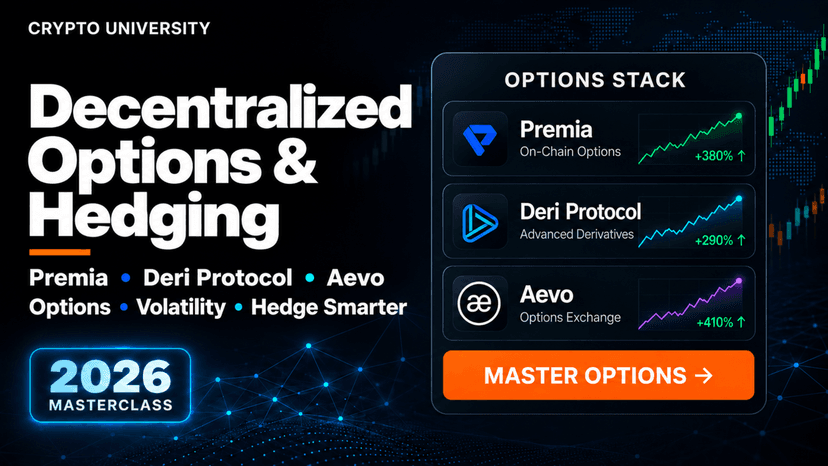
Mastering Decentralized Options and Advanced Hedging: Premia, Deri Protocol, and Aevo in 2026
While perpetual futures have dominated the crypto derivatives landscape for years, sophisticated investors know that true portfolio protection and advanced yield generation require a more precise instrument: Options.
Historically, decentralized finance (DeFi) options were plagued by fragmented liquidity, clunky user interfaces, and exorbitant gas fees. By 2026, this has completely changed. The convergence of high-throughput Layer 2 networks, advanced Automated Market Maker (AMM) designs, and hybrid Central Limit Order Book (CLOB) architectures has birthed a new generation of Decentralized Options Protocols. These platforms now offer institutional-grade pricing, customizable strike prices, and non-custodial settlement, allowing traders to execute complex strategies like tail-risk hedging, covered call writing, and the "Wheel" strategy directly from their self-custodied wallets.
For High-Net-Worth Individuals (HNWIs), quantitative desks, and advanced retail traders, mastering decentralized options is the ultimate evolution in crypto portfolio management. This comprehensive guide breaks down the core mechanics of modern DeFi options, the top-tier platforms dominating the space in 2026, and the strict operational frameworks required to trade volatility safely and profitably.
The 3 Pillars of Modern Decentralized Options in 2026
To effectively utilize crypto options, you must understand the technological innovations that make on-chain derivatives viable and capital-efficient.
Non-Custodial Clearing and Settlement:
Unlike centralized options exchanges where your collateral is held by a corporate entity, decentralized options protocols use audited smart contracts as the clearinghouse. When you buy an option, your premium is locked in the contract; when you sell one, your collateral is locked. Settlement is automatic and trustless, entirely eliminating counterparty and insolvency risk.
Hybrid AMM and CLOB Liquidity Models:
Early DeFi options relied on rigid peer-to-peer order books, resulting in zero liquidity. Modern protocols utilize advanced AMM models (like concentrated liquidity for options) or hybrid architectures that match orders off-chain for microsecond latency while settling collateral on-chain. This ensures tight bid-ask spreads and minimal slippage, even for large block trades.
Advanced Yield and Hedging Strategies:
Options are not just for speculation; they are essential risk management tools.
Hedging: Buying Out-of-the-Money (OTM) puts to protect a spot portfolio against black swan events (Tail-Risk Hedging).
Yield Generation: Selling Covered Calls or Cash-Secured Puts to generate consistent premium income in sideways or mildly bullish markets (The "Wheel" Strategy).
Top Platforms for Decentralized Options Trading in 2026
Executing on-chain options requires platforms with robust pricing oracles, deep liquidity pools, and battle-tested smart contracts.
1. Aevo: Best for High-Speed, Hybrid CLOB Options and Perpetuals
Aevo has established itself as the premier destination for traders who demand the speed and precision of a centralized exchange, but refuse to sacrifice the security of self-custody.
Core Features: Built on a custom Layer 2 rollup, Aevo utilizes an off-chain matching engine to provide sub-millisecond order execution and advanced order types (limit, stop, post-only), while all collateral and settlements are secured on-chain. It supports both European-style options and perpetual futures on major assets like BTC and ETH.
Institutional-Grade UI: The platform offers a professional trading interface complete with options chains, Greek visualizations (Delta, Gamma, Theta, Vega), and implied volatility (IV) surface charting.
Why Traders Choose It: It perfectly bridges the gap between retail DeFi and institutional trading infrastructure, providing the deep liquidity and advanced tooling required for serious options strategies.
👉 Access High-Speed, Non-Custodial Options and Perps on Aevo
2. Deri Protocol: Best for Synthetic, Capital-Efficient Portfolio Hedging
For traders looking to hedge complex, multi-asset portfolios without the capital drag of traditional over-collateralized DeFi lending, Deri Protocol offers a highly innovative synthetic approach.
Core Features: Deri allows users to trade synthetic options and perpetuals directly against a decentralized liquidity pool. Its standout feature is Portfolio Margining, which calculates risk based on the net exposure of your entire account. If you hold spot BTC and buy a BTC put option, the protocol recognizes the hedged nature of the position and drastically reduces your margin requirements.
Cross-Chain Accessibility: Deployed across major Layer 2 networks (like Arbitrum and zkSync), Deri ensures that transaction fees remain negligible, making frequent hedging adjustments economically viable.
Why Traders Choose It: It provides unparalleled capital efficiency for advanced hedgers, allowing them to protect their portfolios with minimal collateral while maintaining full self-custody.
👉 Execute Capital-Efficient Synthetic Options Hedging on Deri Protocol
3. Premia (Premia Blue): Best for Flexible, Peer-to-Pool Options Trading
Premia has evolved into the most flexible decentralized options marketplace, empowering users to trade with customizable parameters that traditional exchanges simply do not offer.
Core Features: Premia Blue utilizes a sophisticated peer-to-pool architecture. Instead of being forced to choose from a limited set of standardized strike prices and expiration dates, users can mint and trade options with custom strikes and expirations. Liquidity providers deposit capital into concentrated volatility pools, earning premiums from traders who buy these bespoke options.
Advanced Strategy Support: The platform natively supports multi-leg strategies, allowing users to execute spreads (e.g., Bull Call Spreads, Iron Condors) in a single, atomic transaction, saving significant gas fees and eliminating execution risk between legs.
Why Traders Choose It: It offers unmatched flexibility for sophisticated options traders who want to tailor their risk-reward profiles precisely to their market outlook, backed by a robust, decentralized liquidity network.
👉 Trade Custom, Peer-to-Pool Crypto Options on Premia
Top Tools for Supporting Your Options Workflow
A professional options trading setup requires a broader technology stack to ensure precise analysis, security, and compliance.
4. TradingView: Best for Visualizing Volatility Surfaces and Options Greeks
Successful options trading requires rigorous analysis of implied volatility (IV) and the "Greeks." TradingView is the indispensable command center for this.
Core Features: Advanced traders use TradingView’s extensive library of custom Pine Script indicators to chart IV Rank, IV Percentile, and historical volatility directly alongside price action. This allows traders to identify when options are historically "cheap" (ideal for buying) or "expensive" (ideal for selling).
Why Traders Choose It: It provides the macro and micro-level visibility needed to time options entries and exits with mathematical precision, avoiding the trap of buying overpriced volatility during market panics.
👉 Analyze Options Volatility and Greeks with Custom TradingView Charts
5. Ledger: Best for Securing Complex Options Smart Contract Interactions
Interacting with options protocols involves approving complex, multi-step smart contract transactions (e.g., minting, exercising, or rolling an option). This makes your wallet a prime target for sophisticated drainers.
Core Features: Ledger hardware wallets ensure that every interaction with a decentralized options platform requires physical cryptographic approval on the device’s secure, tamper-proof screen.
Clear Signing: Ledger’s integration parses these complex transactions, displaying human-readable details (e.g., "Approve 1 ETH as collateral for Premia Put Option") to prevent "blind signing" attacks where malicious contracts disguise token drains as routine actions.
Why Traders Choose It: It provides the ultimate physical circuit breaker. Even if your browser is compromised by a perfect phishing replica of an options dApp, the attacker cannot drain your collateral without your physical button press.
👉 Secure Your Decentralized Options Collateral with a Ledger Hardware Wallet
6. Koinly: Best for Tracking the Complex Tax Implications of Options
Options trading generates a highly complex web of taxable events. Every premium paid, premium received, contract exercised, or contract expired has distinct tax implications that standard portfolio trackers often mishandle.
Core Features: Koinly seamlessly integrates with major decentralized protocols and self-custody wallets. Its advanced heuristic engine accurately categorizes options transactions, distinguishing between non-taxable collateral locks, taxable premium income (ordinary income), and capital gains/losses upon exercise or expiration.
Why Traders Choose It: It transforms a chaotic ledger of multi-leg options strategies into a clean, audit-ready tax report, ensuring you don't overpay or underreport your tax liabilities to authorities.
👉 Automate Your Complex Decentralized Options Tax Tracking with Koinly
Step-by-Step: How to Execute a Decentralized Options Strategy
Deploying capital into options requires a disciplined, risk-aware workflow. Follow this exact blueprint:
Step 1: Define Your Objective (Hedge vs. Yield)
Determine your goal. Are you buying a put option to protect a $100,000 BTC holding from a 20% drawdown (Hedging)? Or are you selling a cash-secured put on ETH to acquire it at a 10% discount while earning premium (Yield)? Your objective dictates your strategy.
Step 2: Analyze Implied Volatility (IV)
Before executing, check the IV Rank on TradingView. If IV is historically high, premiums are expensive, making it an ideal time to sell options. If IV is historically low, premiums are cheap, making it an ideal time to buy options for protection.
Step 3: Connect and Approve via Hardware Wallet
Navigate to your chosen platform (e.g., Aevo, Deri, or Premia). Connect your Ledger-secured wallet. When prompted to approve the collateral deposit or token spend, verify the exact amount and contract address on your Ledger’s physical screen before signing.
Step 4: Monitor and Manage the Position
Options are decaying assets (Theta decay). If you are a buyer, monitor the position closely as expiration approaches. If the thesis plays out, consider selling the option early to capture remaining extrinsic value, rather than holding to expiration. If you are a seller, be prepared to be assigned or to "roll" the option to a further expiration date if the market moves against you.
Risk Management: The Hidden Dangers of Decentralized Options
While DeFi options eliminate counterparty risk, they introduce specific, nuanced risks that must be actively managed:
Smart Contract Vulnerabilities: Your collateral is locked in code. A zero-day exploit in the options protocol’s smart contract could result in the total loss of your funds, regardless of your trade’s direction. Mitigation: Only use battle-tested platforms with significant Total Value Locked (TVL), multiple top-tier audits (e.g., PeckShield, OpenZeppelin), and active, well-funded bug bounty programs.
Liquidity and Slippage Risk: While improving, DeFi options liquidity can still be fragmented. Attempting to close a large, deep Out-of-the-Money (OTM) position near expiration may result in massive slippage. Mitigation: Trade primarily on high-volume assets (BTC, ETH) and use limit orders to close positions, avoiding market orders.
Assignment Risk (for Sellers): If you sell an option, you are obligated to fulfill the contract if the buyer exercises it. If you sell a cash-secured put and the market crashes, you will be forced to buy the asset at the strike price, which may be significantly higher than the current market price. Mitigation: Only sell options on assets you are genuinely willing to hold long-term, and always maintain adequate collateral.
Frequently Asked Questions (FAQ)
Q: What is the difference between American and European options in DeFi?
A: American options can be exercised at any time before expiration, offering more flexibility but commanding higher premiums. European options can only be exercised at the exact moment of expiration. Most decentralized protocols (like Aevo and Premia) utilize European-style options for simplicity and capital efficiency in AMM models.
Q: How are decentralized options trades taxed?
A: Tax treatment is complex. Generally, premiums received for selling options are treated as ordinary income or short-term capital gains. Premiums paid for buying options adjust your cost basis. If an option expires worthless, the premium paid is a capital loss. If it is exercised, it is folded into the cost basis of the underlying asset. Automated tracking via Koinly is essential to navigate this complexity accurately.
Q: Can I get liquidated on a decentralized options protocol?
A: If you are buying an option, your maximum loss is capped at the premium paid; you cannot be liquidated. However, if you are selling (writing) options, your potential loss can be substantial. Protocols like Deri and Aevo will automatically liquidate your position if your collateral value falls below the required maintenance margin due to adverse market movements.
Q: Is it safe to use a software wallet for decentralized options trading?
A: It is highly discouraged for significant capital. Options dApps are prime targets for sophisticated phishing attacks. Always use a Ledger hardware wallet to physically verify the smart contract address and transaction details before signing, ensuring your collateral cannot be drained by a fake website.
Risk Warning: Cryptocurrency options trading carries an exceptionally high level of risk and is not suitable for all investors. While buying options limits risk to the premium paid, selling (writing) options can result in substantial, potentially unlimited losses. Smart contract vulnerabilities, liquidity constraints, and extreme market volatility can result in the rapid loss of your collateral.
Not Financial Advice: The information provided in this article is for educational and informational purposes only. It does not constitute financial, investment, legal, or tax advice. Always conduct your own research (DYOR) and consult with a qualified, licensed professional before deploying capital into decentralized options protocols or making any financial decisions.
Affiliate Disclaimer: This article contains affiliate links. If you click on these links and sign up for a service or make a purchase, we may earn a commission at no additional cost to you. We only recommend platforms, tools, and services that we have thoroughly vetted and believe provide genuine value, security, and utility to our readers.
More reading:
Mastering Advanced Crypto Market Intelligence