Key Takeaways
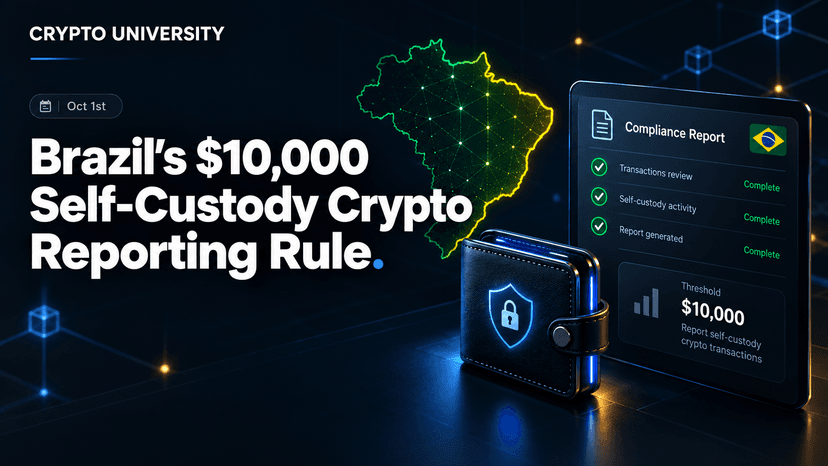
From October 1, 2026, regulated crypto firms in Brazil must report transfers worth US$10,000 or more to or from self-custody wallets to Coaf, the country's financial intelligence unit.
This is a reporting rule, not a ban or a cap. Brazilians can still hold crypto in their own wallets and move amounts above US$10,000.
A separate rule starts on January 1, 2027. Firms must then hold certain outbound transfers above US$10,000 to self-custody wallets or foreign crypto firms for up to 24 hours.
What Is Changing on October 1, 2026?
Brazil is adding a new reporting requirement for crypto transfers that cross between regulated platforms and self-custody wallets.
The Central Bank of Brazil (Banco Central do Brasil, or BCB) published Resolution BCB No. 588 on September 23, 2026. It amends Circular No. 3,978, the central bank's anti-money laundering and counter-terrorist financing (AML/CFT) framework for supervised institutions. The resolution adds a new item to Article 49 of that circular, which lists the operations institutions must communicate to Coaf.
In plain terms: if you move crypto worth US$10,000 or more between a regulated Brazilian platform and a wallet where you control your own private keys, the platform files a report. You do not file anything yourself under this rule.
The Rule at a Glance
Item | Detail |
|---|---|
Rule | Resolution BCB No. 588 |
Published | September 23, 2026 |
Takes effect | October 1, 2026 |
Who reports | Institutions authorized by the central bank that handle virtual assets |
Who receives the report | Coaf (Council for Financial Activities Control) |
Threshold | Equal to or greater than the equivalent of US$10,000 |
Direction | Both: transfers to and from self-custody wallets |
Reporting deadline | By the next business day, under existing Article 49 rules (as widely reported) |
Is it a transfer limit? | No. It is a reporting trigger only |
What Is Coaf?
Coaf stands for Conselho de Controle de Atividades Financeiras, or the Council for Financial Activities Control. It is Brazil's financial intelligence unit (FIU).
Banks, brokers, and other supervised firms already send Coaf reports about certain large or unusual transactions. Coaf analyzes this data and can share intelligence with law enforcement when it finds signs of money laundering or other financial crime.
A report to Coaf is not an accusation. Most reports simply record that a transaction met a defined threshold. Under the existing rules, institutions are also reported to be prohibited from telling customers that a report was made.
What Counts as a Self-Custody Wallet?
A self-custody wallet (also called a self-hosted or non-custodial wallet) is a wallet where you hold the private keys. No company can freeze, move, or recover the funds for you.
Feature | Custodial Account (Exchange) | Self-Custody Wallet |
|---|---|---|
Who holds the private keys | The platform | You |
Examples | Balance held on a crypto exchange | Hardware wallet, mobile wallet app with your own seed phrase |
Customer records | Kept by a supervised company | No company holds your identity data |
Account recovery | Usually possible through the platform | Only possible with your seed phrase |
Visibility for regulators | High | Lower, which is the gap this rule targets |
The central bank said self-custody can reduce the information available for monitoring and risk assessment. When assets stay with an authorized institution, customer records remain inside a supervised entity. Once crypto leaves for a self-custody wallet, that link weakens.
How the Reporting Works in Practice
The rule applies at the "bridge" point, where crypto moves in or out of a regulated platform. Here are some simple scenarios, based on how the rule has been widely described.
Scenario | Reported Under Resolution 588? |
|---|---|
You withdraw stablecoins worth US$12,000 from a Brazilian exchange to your hardware wallet | Yes |
You deposit Bitcoin worth US$15,000 from your own wallet into a Brazilian exchange | Yes |
You withdraw crypto worth exactly US$10,000 to your own wallet | Yes (the threshold is "equal to or greater than") |
You withdraw crypto worth US$8,000 to your own wallet | Not under this specific rule |
You send crypto between two of your own self-custody wallets, with no regulated firm involved | No, because no covered institution handles the transfer |
Two points are worth noting:
No automatic aggregation is stated. Reporting on the text indicates that Resolution 588 does not say several smaller transfers must be added together to reach the US$10,000 threshold. This is different from the 24-hour hold rule described below.
Other reporting still applies. Firms already have general duties to flag suspicious activity. A transfer below US$10,000 can still be reported if it looks unusual under a firm's AML controls.
Why Is Brazil Doing This?
The central bank's stated goals are to strengthen AML monitoring and to fight fraud.
Brazilian authorities have pointed to the growing use of crypto, including stablecoins, to move proceeds from financial scams quickly. Because crypto transfers settle fast and can leave the regulated system in seconds, authorities have fewer chances to intervene.
The rule also fits into a larger regulatory build-out:
Law No. 14,478 (2022) created Brazil's legal framework for virtual assets and gave the central bank supervisory authority.
Resolutions BCB No. 519, 520, and 521 took effect in February 2026. They require crypto service providers to obtain central bank authorization and meet governance, security, and AML standards.
Resolutions 584, 588, and 589 (August and September 2026) add fraud controls, reporting duties, and supervisory data rules.
The Second Rule: A 24-Hour Hold From January 2027
The October reporting rule is often confused with a separate measure: Resolution BCB No. 584, published on August 7, 2026. It amends Resolution BCB No. 142 of 2021, the central bank's fraud-prevention rule for payment services, and takes effect on January 1, 2027.
Under Resolution 584, covered firms must wait 24 hours before executing certain outbound crypto transfers. Key features, as widely reported:
Destinations covered: self-custody wallets and crypto service providers based abroad.
Trigger: a single transaction, or the sum of a customer's transactions on the same day, above US$10,000.
When the clock starts: when the provider receives the funds behind the customer's deposit, in reais or in crypto.
Early release: firms may release a held transfer before 24 hours after a documented risk review.
Smaller transfers: can also be held if a firm's risk controls flag them.
Stablecoins: fiat-referenced assets are included.
Customer notice: firms must tell customers when a hold is applied.
Resolution 588 vs Resolution 584
Feature | Resolution 588 (Reporting) | Resolution 584 (24-Hour Hold) |
|---|---|---|
Purpose | AML/CFT visibility | Fraud prevention |
Start date | October 1, 2026 | January 1, 2027 |
Direction | To and from self-custody wallets | Outbound only |
Destinations | Self-custody wallets | Self-custody wallets and foreign crypto firms |
Threshold | US$10,000 or more per transfer | Above US$10,000 per transaction or same-day total |
Same-day aggregation | Not stated | Yes |
Effect on the user | A report is filed; no delay | Transfer may be delayed up to 24 hours |
Other Related Changes: Resolution 589
Published alongside Resolution 588, Resolution BCB No. 589 adds two further layers:
From November 6, 2026: authorized institutions generally cannot carry out or facilitate crypto transactions with service providers that lack authorization to operate in Brazil, except where Resolution 520 allows it.
From January 1, 2027: providers must send the central bank supervisory data, including customer balances, assets held in custody, proof-of-reserves information, and assets committed to staking.
Timeline of Key Dates
Date | What Happens |
|---|---|
February 2026 | Authorization and AML rules for crypto providers take effect (Resolutions 519 to 521) |
August 7, 2026 | Resolution 584 (24-hour hold) published |
September 23, 2026 | Resolutions 588 and 589 published |
October 1, 2026 | Self-custody transfer reporting to Coaf begins |
November 6, 2026 | Limits on dealing with unauthorized crypto providers begin |
January 1, 2027 | 24-hour hold and new supervisory data rules begin |
What This Means for Everyday Users
For most people, day-to-day crypto use will not change much. Here is a factual summary of the practical effects:
Self-custody remains legal. You can still withdraw to your own wallet and hold your own keys.
You do not file reports under Resolution 588. The obligation sits with the regulated firm.
Large withdrawals and deposits will be visible to Coaf. Transfers at or above US$10,000 create a record in Brazil's financial intelligence system.
Timing may matter from 2027. Large outbound transfers soon after funding an account may be delayed by up to 24 hours.
Tax rules are separate. These are AML and fraud rules. Crypto taxation in Brazil follows its own rules from the tax authority.
This article is for education only. It is not legal, tax, or financial advice.
How the Industry Has Responded
Reactions have been mixed. The central bank frames the measures as fraud and AML protections. Industry group ABcripto criticized the 24-hour hold during consultation, with its president arguing it could reduce traceability rather than improve it. Some privacy advocates have raised concerns that repeated reports could, over time, link self-custody addresses to identified individuals.
These are debates about policy trade-offs. The rules themselves are now published, with fixed start dates.
FAQ
Does Brazil ban self-custody wallets?
No. Resolution 588 does not ban self-custody or limit how much you can transfer. It only requires regulated firms to report qualifying transfers to Coaf.
Is the US$10,000 threshold measured in dollars or reais?
The rule refers to the equivalent of US$10,000. The value of a transfer in reais or crypto is compared against that dollar amount.
Do I need to register my wallet with the government?
No. The rule does not require wallet registration, and it does not create a new filing duty for individual wallet owners.
Will my transfer be delayed starting October 1?
Not because of Resolution 588. Delays of up to 24 hours relate to Resolution 584, which starts on January 1, 2027.
Does the rule apply to transfers between my own wallets?
Not directly. Resolution 588 applies when a covered institution handles the transfer. Wallet-to-wallet transfers with no regulated firm involved are outside its scope.
Related Terms
Self-Custody Wallet: A crypto wallet where the user, not a company, controls the private keys and therefore the funds.
Private Key: A secret number that proves ownership of crypto and authorizes transactions from a wallet.
Anti-Money Laundering (AML): Laws and procedures that help detect and prevent criminals from disguising illegal funds as legitimate money.
Virtual Asset Service Provider (VASP): A business, such as an exchange or custodian, that offers crypto services to customers and is subject to regulation.
Financial Intelligence Unit (FIU): A national agency that receives and analyzes financial transaction reports to detect money laundering and other financial crimes.
Sources
Banco Central do Brasil, Resolution BCB No. 588, Resolution BCB No. 584, and Resolution BCB No. 589 (official texts at bcb.gov.br)
Blockonomi, "Brazil Central Bank Sets $10,000 Reporting Rule for Self-Custody Crypto Transfers": https://blockonomi.com/brazil-central-bank-sets-10000-reporting-rule-for-self-custody-crypto-transfers
crypto.news, "Brazil sets $10K self-custody crypto reporting rule": https://crypto.news/brazil-sets-10k-self-custody-crypto-reporting-rule/
Crypto News Flash, "Brazil's New Crypto Rule Makes the Self-Custody Bridge Visible": https://www.crypto-news-flash.com/brazils-new-crypto-rule-makes-the-self-custody-bridge-visible/
FinanceFeeds, "Brazil to Report $10,000 Self-Custody Crypto Moves Oct 1": https://financefeeds.com/brazil-to-require-reporting-of-10000-self-custody-crypto-transfers-from-october-1/
The Block, "Brazil to tighten crypto fraud controls with new 24-hour wait on transfers to self-custody wallets": https://www.theblock.co/news/regulation/2026-08-09-brazil-to-tighten-crypto-fraud-controls-with-new-24-hour-wait-on-transfers-to-self-custody-wallets-411219
Crypto News Australia, "Brazil to Impose 24-Hour Wait on Certain Crypto Wallet Withdrawals": https://cryptonews.com.au/news/brazil-to-impose-24-hour-wait-on-certain-crypto-wallet-withdrawals-134514/
Bits of Blocks, "Hold-up: Brazil's central bank orders a 24-hour delay on outbound crypto transfers": https://www.bitsofblocks.io/post/hold-up-brazil-s-central-bank-orders-a-24-hour-delay-on-outbound-crypto-transfers