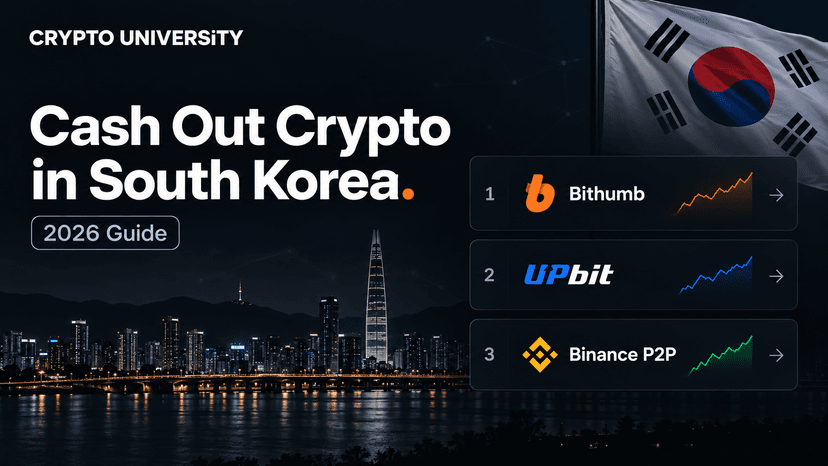
Key Takeaways
Only FIU-registered exchanges with a bank partnership can pay out Korean won. As of mid-2026, those are widely reported to be Upbit, Bithumb, Coinone, Korbit and Gopax, each linked to one partner bank.
Bithumb and Upbit are the two most common cash-out routes. Bithumb uses KB Kookmin Bank and Upbit uses K Bank, so you need an account at the matching bank in your own name.
P2P platforms such as Binance P2P sit outside the Korean regulated system. They carry higher risks, including scams, frozen bank accounts linked to fraud, and no local user protection.
Introduction
Selling crypto and moving the money into a Korean bank account sounds simple. In practice, South Korea has one of the most tightly controlled crypto banking systems in the world. The rules decide which platforms you can use, which bank you need, and how quickly your money arrives.
This guide explains how cashing out works in South Korea, compares the two largest exchanges, Bithumb and Upbit, and looks honestly at peer-to-peer (P2P) options such as Binance P2P. It is educational content only and is not financial, legal or tax advice.
How Cashing Out Works in South Korea
The Real-Name Bank Account System
In South Korea, you cannot freely send Korean won (KRW) from any bank to any exchange. Users must open a real-name deposit and withdrawal account at an exchange's partner bank to trade crypto against KRW. The name on your exchange account and your bank account must match.
Only platforms registered with the Financial Intelligence Unit (FIU) that also hold a real-name bank partnership can offer KRW deposits and withdrawals. Each exchange works with a single bank.
Exchange | Partner Bank for KRW | Notes |
|---|---|---|
Upbit | K Bank | Largest Korean exchange by trading volume |
Bithumb | KB Kookmin Bank | Switched from NH Nonghyup Bank in March 2025 |
Coinone | KakaoBank | Smaller KRW exchange |
Korbit | Shinhan Bank | Smaller KRW exchange |
Gopax | Jeonbuk Bank (reported) | Majority owned by Binance since FIU approval in October 2025 |
Bank partnerships are renewed periodically, so always confirm the current partner bank in the exchange app before opening an account.
Who Can Use Korean Exchanges
Korean exchanges are built for local residents. In general you need:
A Korean mobile phone number registered in your name
Identity verification (KYC)
A real-name account at the exchange's partner bank
Foreign residents usually need a valid Alien Registration Card (ARC) to open the partner bank account. Tourists and short-term visitors generally cannot access KRW withdrawals on these platforms.
Option 1: Bithumb
Overview
Bithumb, founded in 2014, is widely described as South Korea's second-largest exchange by trading volume. It is known for a large selection of listed assets and offers KRW trading, deposits and withdrawals through KB Kookmin Bank.
Bithumb moved its banking partner from NH Nonghyup Bank to KB Kookmin Bank on March 24, 2025. Korean media reported in September 2026 that KB Kookmin Bank extended the partnership for one year, through the end of September 2027.
How to Cash Out on Bithumb
Verify your identity in the Bithumb app and link your Korean phone number.
Open or link a KB Kookmin Bank account in your own name. Bithumb has introduced a web-based account opening option, so the KB Star Banking app is not strictly required.
Deposit your crypto to your Bithumb wallet address, or keep assets you already hold there.
Sell the crypto in the KRW market.
Request a KRW withdrawal to your linked KB Kookmin Bank account.
Things to Know
Account opening limits: Korean banks restrict opening multiple accounts in a short period. If you opened an account at another bank within the past 20 business days, a new KB Kookmin Bank account may be delayed.
Fees: Trading fees vary by promotion and user tier. Published reviews commonly cite a range of about 0.04% to 0.25%. Check Bithumb's current fee page before trading.
Old accounts: Users who only have a legacy NH Nonghyup link must register a KB Kookmin Bank account to use KRW services.
Option 2: Upbit
Overview
Upbit is operated by Dunamu and is the largest crypto exchange in South Korea. It was reported to hold around 72% of trading volume among registered Korean exchanges in October 2025. KRW deposits and withdrawals run through K Bank.
Upbit also operates separate platforms in Singapore, Indonesia and Thailand under local licenses. These international versions do not support Korean won, so this guide refers only to Upbit Korea.
How to Cash Out on Upbit
Complete identity verification in the Upbit app.
Open a K Bank account in your own name and link it to Upbit.
Transfer your crypto to your Upbit deposit address.
Sell for KRW in the KRW market.
Withdraw KRW to your linked K Bank account.
Things to Know
Low trading fees: Upbit's KRW market fee is widely reported at 0.05%, which is lower than many global exchanges.
Withdrawal fees: Crypto withdrawal fees are flat per asset and can change. Always check the fee shown before confirming.
Regulatory history: The FIU sanctioned Dunamu in 2025 over compliance issues. The Seoul Administrative Court overturned the business suspension in April 2026, and the FIU has appealed.
Option 3: P2P Options such as Binance P2P
How P2P Trading Works
On a P2P marketplace, you sell crypto directly to another person. The platform holds the crypto in escrow while the buyer sends money to your bank account. Once you confirm receipt, the platform releases the crypto to the buyer.
Binance P2P is one of the best-known P2P marketplaces globally. Some users look at P2P when they cannot access Korean exchanges, such as foreigners without an ARC.
Regulatory Status in South Korea
This is the most important point for readers in Korea:
Binance is not a registered virtual asset service provider in South Korea. Its legal presence in the country is through its majority stake in Gopax, which the FIU approved in October 2025.
Korean law requires registration for overseas platforms that target Korean users, for example by offering a Korean-language service or processing KRW transactions.
App stores restrict unregistered platforms. Since 2025, Google Play and Apple have blocked many unregistered overseas exchange apps in Korea at the FIU's request. From January 2026, Google Play began requiring FIU registration for crypto apps distributed in Korea.
Key Risks of P2P Cash-Outs
Risk | What It Means |
|---|---|
Tainted funds | A buyer may pay you with money stolen from a fraud victim. Your bank account can be frozen during an investigation. |
Payment scams | Fake payment screenshots, reversed transfers, or payments from a third party's account. |
No Korean user protection | Unregistered platforms are not covered by Korean supervision or user protection rules. |
Voice phishing links | Korean authorities are actively targeting channels that convert scam proceeds into USDT. Innocent sellers can get caught up in these cases. |
Tax and records | Trades outside domestic exchanges can be harder to document for future tax reporting. |
P2P is not automatically illegal for users, but the combination of fraud risk and regulatory uncertainty makes it the highest-risk route covered in this guide.
Comparison: Bithumb vs Upbit vs Binance P2P
Feature | Bithumb | Upbit | Binance P2P |
|---|---|---|---|
Registered with Korean FIU | Yes | Yes | No (Binance operates in Korea via Gopax) |
KRW bank partner | KB Kookmin Bank | K Bank | None; buyer pays your bank directly |
Who can use it | Korean residents and ARC holders | Korean residents and ARC holders | Varies by platform availability |
Trading fees | About 0.04% to 0.25% (varies) | About 0.05% in KRW market | Set by platform and counterparty price |
Main strength | Wide asset selection | Deepest KRW liquidity | Flexible, no Korean bank partner needed |
Main risk | Bank account opening delays | Bank account opening delays | Fraud, frozen accounts, no local protection |
Best for | Residents who bank with KB Kookmin | Residents who want high liquidity | Informed users who understand the risks |
Rules That Affect Your Withdrawal
Travel Rule Changes
The Travel Rule requires exchanges to share sender and receiver details when crypto moves between service providers. South Korea currently applies it to transfers of 1 million won or more. On August 11, 2026, the Cabinet approved removing this threshold, so the rule will cover every transfer between registered providers from February 20, 2027.
The same amendment adds tighter checks on overseas transfers:
Transfers to low-risk overseas exchanges are permitted.
Transfers to other overseas exchanges or personal wallets are permitted only when sender and recipient are the same person.
Transfers involving high-risk counterparties are prohibited.
Transfers of 10 million won or more to overseas platforms or personal wallets face extra suspicious-transaction monitoring.
Practical tip: If you move crypto from an overseas exchange to Upbit or Bithumb, the names on both accounts should match, and the sending exchange may need to be on the Korean exchange's supported list.
Withdrawal Delays
In April 2026, Korean regulators ordered all domestic exchanges to use one unified system for withdrawal delays to fight voice phishing. Officials expected fewer than 1% of users to qualify for instant withdrawal exceptions. If your withdrawal is held, this is a normal safety control rather than a sign of a problem.
Taxes on Crypto Gains in South Korea
South Korea plans to tax crypto income from January 1, 2027. Key points as currently reported:
Item | Details |
|---|---|
Tax rate | 22% (20% national tax plus 2% local income tax) |
Annual deduction | 2.5 million won of gains |
Income type | "Other income" |
First filing | May 2028, for 2027 income |
Status | Scheduled, but a petition seeking a two-year delay is under parliamentary review |
The tax has already been postponed three times. Check the National Tax Service or a licensed tax professional for the rules that apply to you.
Safety Checklist Before You Cash Out
Confirm the platform is on the FIU's list of registered providers.
Make sure your exchange and bank names match exactly.
Test with a small crypto transfer first, especially on a new network.
Double-check the network (for example, ERC-20 vs TRC-20) before sending.
Never release crypto on P2P until money is visible in your own bank account.
Reject payments from anyone whose name does not match the buyer.
Keep records of every trade, transfer and withdrawal.
Conclusion
For Korean residents and ARC holders, the most straightforward way to cash out crypto is through a registered exchange. Bithumb suits people who bank with KB Kookmin Bank, while Upbit offers the deepest KRW liquidity through K Bank. P2P options such as Binance P2P operate outside the Korean regulated system and carry real risks, from fraud to frozen accounts. Rules are changing quickly in 2026 and 2027, so check official sources before every large transaction.
Frequently Asked Questions
Can foreigners cash out crypto in South Korea?
Foreigners with a valid Alien Registration Card can often open the partner bank account needed for Upbit or Bithumb. Tourists and short-term visitors generally cannot use KRW withdrawals on Korean exchanges.
Which bank do I need for Upbit and Bithumb?
Upbit uses K Bank and Bithumb uses KB Kookmin Bank. Your bank account must be in the same name as your exchange account.
Is Binance P2P legal in South Korea?
Binance is not registered as a virtual asset service provider in South Korea, and its Korean presence is through Gopax. Using unregistered platforms means you lack Korean user protections. Regulatory treatment can change, so check current FIU guidance.
Why was my bank account frozen after a P2P trade?
Banks may freeze an account if incoming money is linked to a fraud report, even if you acted in good faith. Contact your bank, request the reason, and provide trade records.
Do I pay tax when I cash out crypto in Korea?
South Korea plans a 22% tax on annual crypto gains above 2.5 million won starting January 1, 2027. Implementation could still change, so confirm with the National Tax Service.
Related Terms
Off-ramp: A service that converts crypto into fiat money.
P2P trading: Buying or selling crypto directly with another person, usually through a marketplace with escrow.
KYC (Know Your Customer): Identity checks that regulated platforms require before you trade.
Escrow: A system where a platform holds crypto until both sides of a trade complete their obligations.
Sources
The Korea Times, "Bithumb to change account issuance partner bank from NongHyup to Kookmin" (January 2025): https://www.koreatimes.co.kr/economy/cryptocurrency/20250113/bithumb-to-change-account-issuance-partner-bank-from-nonghyup-to-kookmin
The Asia Business Daily, Bithumb KB Kookmin Bank KRW service launch (March 2025): https://www.asiae.co.kr/en/article/2025032415193115622
Bloomingbit, KB Kookmin Bank renews Bithumb partnership (September 2026): https://en.bloomingbit.io/feed/news/119857
KED Global, Binance officially enters South Korea via Gopax (October 2025): https://www.kedglobal.com/cryptocurrencies/newsView/ked202510160007
CoinDesk, South Korean authorities mandate unified crypto withdrawal delays (April 2026): https://www.coindesk.com/policy/2026/04/08/south-korean-authorities-mandate-unified-crypto-withdrawal-delays-to-curb-fraud
CoinDesk, South Korea's long-delayed crypto tax set to start in 2027 (July 2026): https://www.coindesk.com/policy/2026/07/30/south-korea-s-long-delayed-crypto-tax-set-to-start-in-2027
The Block, South Korean investors push for fourth crypto tax delay (September 2026): https://www.theblock.co/news/regulation/2026-09-14-south-korean-investors-crypto-tax-delay-414581
21 Analytics, South Korea Travel Rule updates (2026): https://www.21analytics.co/blog/south-korea-travel-rule-what-vasps-need-to-know/
Cointelegraph, South Korea drops crypto Travel Rule threshold (August 2026): https://cointelegraph.com/news/south-korea-travel-rule-threshold-crypto-transfers
Cryptonews, Google Play to block unregistered exchanges in Korea (January 2026): https://cryptonews.com/news/google-play-to-block-binance-okx-from-korea-starting-jan-28/
CoinLaw, Upbit statistics (February 2026): https://coinlaw.io/upbit-statistics/
More Reading
South Korea's Travel Rule: Latest Updates Summarised (21 Analytics)
World's Largest Crypto Exchange Binance Approved to Enter Korean Market (The Korea Times)
South Korea Moves to Refund Crypto Stolen in Voice Phishing Scams (The Crypto Times)
Explore the Crypto University Cash Out Crypto Guide
How to Cash Out Crypto in South Africa in 2026
Disclaimer: This article is for educational purposes only and does not constitute financial, legal or tax advice. Crypto regulations in South Korea change frequently. Always verify details with official sources.