Key Takeaways
Robinhood Chain is an Ethereum Layer 2 built on Arbitrum. Its public mainnet launched on July 1, 2026, and it uses ETH to pay for gas, so you need a small amount of ETH on the chain before you can do anything.
You can bridge through the official canonical bridge or through partner bridges. The canonical bridge is the trust-minimized option but is slower, especially for withdrawals. Partner routes such as Across, Relay, Stargate, Chainlink CCIP, and LI.FI are faster but add their own trust assumptions.
USDC usually arrives as USDG. USDG, a Paxos-issued stablecoin, is the main dollar token on Robinhood Chain. Several popular routes convert USDC into USDG automatically, which is expected behavior and not an error.
What Is Robinhood Chain?
Robinhood Chain is a public blockchain created by Robinhood, the US brokerage and crypto platform. It is a Layer 2 (L2) network, which means it processes transactions on its own chain and settles them to Ethereum for security.
The chain is built with Arbitrum technology and is compatible with the Ethereum Virtual Machine (EVM). In practice, this means wallets like MetaMask and Rabby work with it, and the same wallet address you use on Ethereum also works on Robinhood Chain.
Robinhood opened a public testnet in February 2026 and launched the public mainnet on July 1, 2026. The chain is designed around tokenized real-world assets, such as Robinhood Stock Tokens, along with stablecoins and decentralized finance (DeFi) apps. Access to some products depends on your jurisdiction.
Why You Need to Bridge
Your crypto does not automatically exist on every network. ETH on Ethereum or USDC on Base stays on those chains until you move it. A bridge is a tool that moves value from one blockchain to another.
To use apps on Robinhood Chain, you typically need two things:
ETH for gas. Every transaction on Robinhood Chain is paid in ETH.
The asset you want to use. For most people this is ETH or a stablecoin, usually USDG.
Robinhood Chain Network Settings
Before bridging, add Robinhood Chain to your wallet. Many bridge interfaces offer to add it automatically. If you add it manually, use the official values below and double check each one.
Setting | Robinhood Chain Mainnet |
|---|---|
Network name | Robinhood Chain |
Chain ID | 4663 |
RPC URL | |
Currency symbol | ETH |
Block explorer |
Tip: Robinhood Wallet, the company's self-custody mobile wallet, also supports Robinhood Chain.
ETH, USDC, and USDG on Robinhood Chain
These three assets behave differently when you bridge them. Understanding this upfront prevents most beginner confusion.
Asset | What It Is | What Usually Arrives on Robinhood Chain | Notes |
|---|---|---|---|
ETH | Ethereum's native asset | ETH | Used for gas. WETH, the wrapped ERC-20 version, is also deployed on the chain. |
USDC | Circle's US dollar stablecoin | Often USDG, depending on the route | At the time of writing, Robinhood's official token contracts page lists WETH and USDG but not a native USDC contract. |
USDG | Global Dollar, issued by Paxos | USDG | The anchor stablecoin for launch trading pairs. Paxos states it is fully backed and redeemable 1:1 for US dollars. |
Why USDC Turns Into USDG
Robinhood Chain launched with USDG as its main stablecoin. Bridges such as Across accept USDC on chains like Ethereum, Arbitrum, Base, Optimism, and Polygon, and a relayer delivers USDG on Robinhood Chain in one transaction. When you bridge back out, USDG can be returned as USDC on the destination chain.
Both are dollar stablecoins, but they have different issuers, reserves, and legal structures. Treat them as separate tokens, not identical ones.
Bridge Options Compared
Robinhood's developer documentation lists one canonical bridge and several partner routes.
Route | Type | Typical Speed | Best For |
|---|---|---|---|
Arbitrum canonical bridge | Trust-minimized L1 to L2 bridge | Deposits about 10 minutes, withdrawals about 7 days | Moving ETH and ERC-20 tokens between Ethereum and Robinhood Chain with Ethereum-level security |
Across | Intents-based bridge | Seconds | Fast USDC to USDG and ETH transfers from many EVM chains |
Relay | Intents-based bridge | Seconds | Fast, low-cost transfers, including bridge-and-execute actions |
LayerZero OFT / Stargate | Messaging and omnichain token transfer | Minutes | Moving USDG, WBTC, and other omnichain tokens |
Chainlink CCIP / Transporter | Messaging and token transfer | Minutes | Cross-chain token transfers and app interactions |
LI.FI (Jumper) / 0x | Cross-chain swap aggregators | Seconds to minutes | Swapping and bridging in one step |
Canonical Bridge vs Partner Bridges
The canonical bridge relies on Arbitrum's rollup design. It does not require outside validators, so its security comes from Ethereum. The tradeoff is speed. Withdrawals back to Ethereum take about seven days because of the fraud proof challenge period.
Intents-based bridges such as Across and Relay work differently. You deposit on the source chain, and a relayer sends you funds on Robinhood Chain from its own liquidity. The relayer is repaid later. This is fast, but you rely on the bridge's smart contracts and settlement system working correctly.
Step-by-Step: How to Bridge to Robinhood Chain
The steps below apply to most bridge interfaces. Exact buttons vary by app.
Step 1: Prepare a Self-Custody Wallet
Use an EVM wallet you control, such as MetaMask, Rabby, or Robinhood Wallet. Make sure your funds are on a supported source chain, like Ethereum, Arbitrum, or Base.
Step 2: Keep ETH for Gas on the Source Chain
You pay a fee to send the bridge transaction. Bridging from Ethereum mainnet usually costs more than bridging from another L2 because Ethereum gas is higher.
Step 3: Open the Bridge From an Official Link
Go to the bridge through the links on Robinhood's official bridging documentation or the bridge's verified website. Bookmark the correct URL. Fake bridge sites are a common scam.
Step 4: Connect and Select Networks
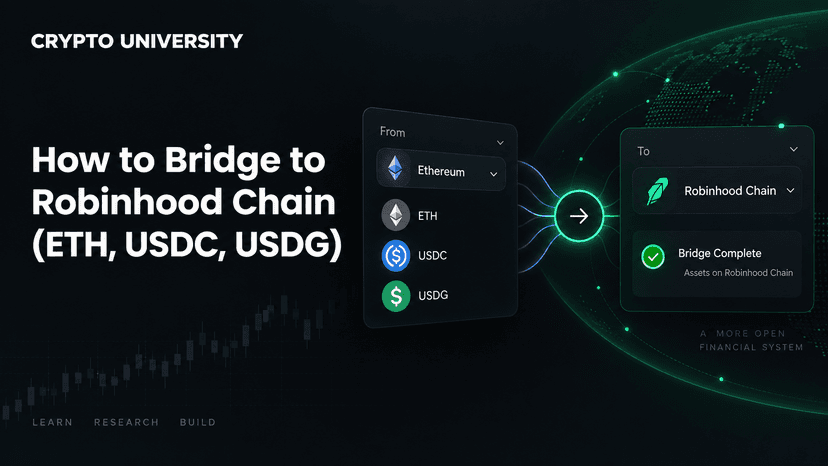
Connect your wallet. Set the source chain in the "From" field and Robinhood Chain in the "To" field.
Step 5: Choose the Asset and Amount
Select ETH, USDC, or USDG. Review what you will receive. If you send USDC, check whether the output is USDG. If you plan to hold only stablecoins, consider bridging a small amount of ETH too, so you can pay gas.
Step 6: Review Fees, Output, and Time
Check the estimated fee, the minimum amount received, and the expected arrival time before signing.
Step 7: Approve and Confirm
Tokens like USDC may require an approval transaction first, followed by the bridge transaction. ETH usually needs only one transaction.
Step 8: Verify Arrival
Switch your wallet to Robinhood Chain. If a token does not appear, add it using the contract address from Robinhood's official token contracts page. You can also look up your address on the Blockscout explorer.
Fees on Robinhood Chain
Robinhood Chain fees are paid in ETH and include two parts:
L2 execution fee: the cost of running your transaction on Robinhood Chain. This is typically low.
L1 data fee: the cost of posting transaction data to Ethereum. This changes with Ethereum network congestion.
Your wallet combines both into a single fee estimate. Bridge fees are separate and depend on the route, asset, and amount.
Bridging Back Out
Method | Process | Time |
|---|---|---|
Canonical bridge | Start withdrawal on Robinhood Chain, wait for the challenge period, then claim on Ethereum | About 7 days, plus an Ethereum gas fee to claim |
Intents-based bridge | Deposit on Robinhood Chain, receive funds on the destination chain | Usually seconds to minutes |
The final claim step on the canonical bridge is required. If you skip it, your funds stay pending.
Common Mistakes and Safety Tips
Arriving with no ETH. Without ETH, you cannot approve, swap, or send tokens on the chain.
Trusting look-alike tokens. A token with the right name but a different contract address may be fake. Robinhood's docs note that a matching ticker with a different address is not a Robinhood Stock Token.
Using unverified bridge sites. Some search results and documents promote little-known bridge sites. Start from official documentation.
Sending from an exchange without checking support. Not every exchange supports withdrawals to Robinhood Chain. Confirm before sending.
Skipping a test transfer. For larger amounts, send a small test first.
Panicking over a delayed canonical deposit. Deposits use Arbitrum's retryable ticket system. If the L2 part fails, the funds are not lost and can be manually redeemed in the bridge interface within 7 days.
Remember that bridges carry smart contract risk. No route is completely risk free.
FAQ
What is the chain ID for Robinhood Chain?
Robinhood Chain mainnet uses chain ID 4663. The testnet uses chain ID 46630. Gas is paid in ETH on both.
Can I bridge USDC directly to Robinhood Chain?
Yes, through several partner bridges. However, many routes convert USDC into USDG on arrival, because USDG is the chain's main stablecoin. Always check the output token before confirming.
How long does it take to bridge to Robinhood Chain?
Intents-based bridges like Across and Relay often complete in seconds. The canonical bridge usually takes about 10 minutes for deposits and about 7 days for withdrawals to Ethereum.
Do I need ETH to use Robinhood Chain?
Yes. ETH is the native gas token, so every transaction requires a small amount of ETH, even if you only hold stablecoins or tokenized stocks.
Is the canonical bridge safer than third-party bridges?
The canonical bridge is generally considered trust-minimized because it inherits security from Ethereum and does not rely on outside validators. Partner bridges are faster but add their own contract and operational risks.
Sources
Robinhood Chain Documentation, Bridging: https://docs.robinhood.com/chain/bridging/
Robinhood Chain Documentation, Add Network to Your Wallet: https://docs.robinhood.com/chain/add-network-to-wallet/
Robinhood Chain Documentation, Token Contracts: https://docs.robinhood.com/chain/contracts/
Robinhood Chain Documentation, Gas and Fees: https://docs.robinhood.com/chain/gas-and-fees/
Robinhood Newsroom, Robinhood Chain Mainnet Launch (July 1, 2026): https://robinhood.com/us/en/newsroom/robinhood-accelerates-global-expansion-robinhood-chain-mainnet-stock-tokens-agentic-trading/
Robinhood Newsroom, Robinhood Chain Launches Public Testnet (February 10, 2026): https://robinhood.com/us/en/newsroom/robinhood-chain-launches-public-testnet
Across Blog, Bridge to Robinhood Chain with Across: https://across.to/blog/bridge-to-robinhood-chain-with-across
ArbitrumDAO Forum, Robinhood Chain Mainnet Launch Factsheet: https://forum.arbitrum.foundation/t/arbitrumdao-factsheet-robinhood-chain-mainnet-launch/31041
More Reading
Best Robinhood Chain Trading Platforms in 2026: FOMO, GMGN, Uniswap and OpenSea Compared
Is Robinhood Chain Safe? Custody, Sequencer Risk, and Ethereum Settlement
How to Buy Robinhood Tokenized Stock: HOOD Tokens and Available Platforms
Disclaimer: This article is for educational purposes only and is not financial, legal, or investment advice. Bridge routes, supported assets, and availability can change. Always verify details on official sources before moving funds.