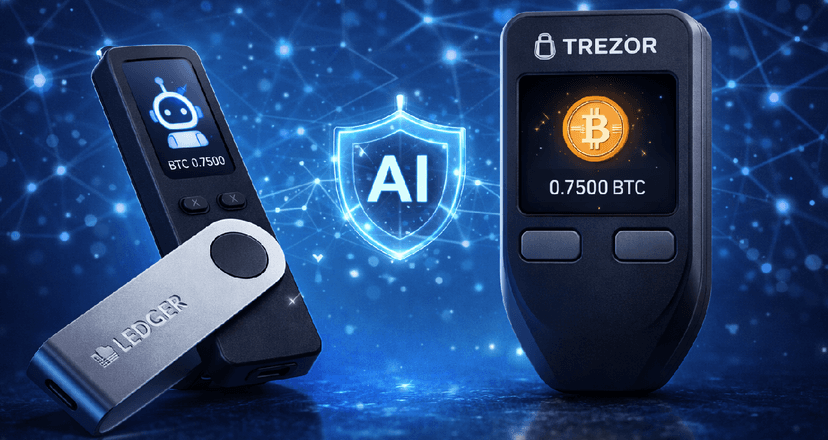
Selecting a wallet in 2026 involves balancing security, usability and compatibility with AI agents. Here are two leading hardware wallets and considerations for AI integration.
Ledger Nano S Plus
Ledger’s Nano S Plus is a hardware wallet supporting about 100 crypto assets across 100 networks. It connects via USB‑C and works with the Ledger Live app for DeFi and NFT interaction. Pros include support for thousands of coins, integration with DeFi protocols and a compact, tamper‑resistant design . Cons: it cannot connect directly to iOS devices and must be plugged in to transact. For AI integration, users can connect the device to an agent through the Ledger Connect extension, granting limited signing rights to the agent while retaining control.
Trezor Safe 3
The Trezor Safe 3 uses open‑source firmware and a secure element to store private keys. It features on‑device confirmation and USB‑C compatibility across desktop operating systems. Pros include support for thousands of coins, transparent open‑source software and strong security . Cons include limited DeFi integration and minimal free customer support. AI agents can connect via Trezor’s browser extension; ensure you whitelist only necessary addresses.
AI wallet considerations
Non‑custodial design: Your private keys remain on the device or local app, which is essential when delegating tasks to AI agents.
Cross‑chain support: Multi‑chain wallets support assets on Ethereum, Bitcoin and other networks, enabling agents to rebalance across ecosystems.
Biometric security: Choose wallets that offer biometric locks on mobile to prevent unauthorized agent interactions.
Agent permissions: Limit the scope of your agent’s signing authority. Start with read‑only or transaction‑specific permissions and avoid giving full account access.
Comparison Table
Feature | Ledger Nano S Plus | Trezor Safe 3 |
Supported Assets | Thousands of coins across 100+ networks | Thousands of coins |
Connection | USB-C | USB-C |
DeFi/NFT Integration | Strong via Ledger Live | Limited |
Open-Source Firmware | No | Yes |
AI Integration | Ledger Connect extension (limited signing) | Browser extension (whitelist addresses) |
Mobile Direct Support | No direct iOS | Desktop-focused |
Key Security Features | Tamper-resistant, secure element | Secure element, on-device confirmation |
Customer Support | Standard | Minimal free |