Key Takeaways
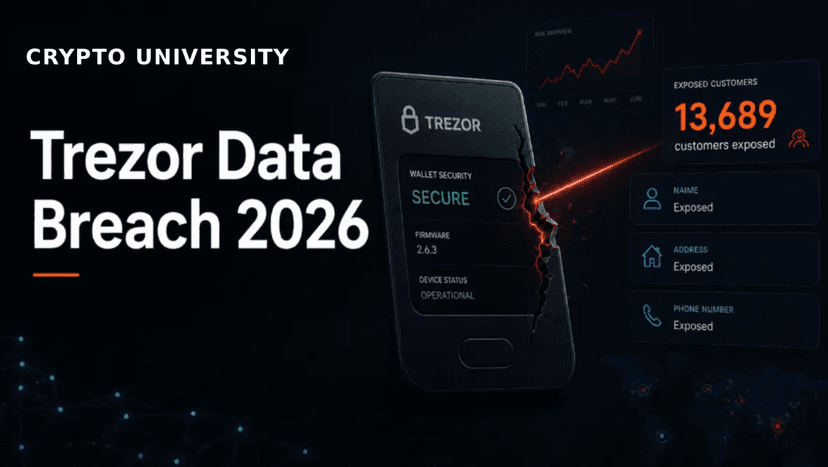
Trezor itself was not hacked. The breach happened at ShipMonk, a shipping and fulfilment partner. Around 13,689 customers had contact and shipping details exposed. Devices, private keys, and recovery seeds remain safe.
This is a familiar pattern. Ledger faced almost the same situation with its Global-e partner in January 2026, and a far larger leak in 2020. In every case the danger was not stolen crypto but leaked personal data that fuels phishing and, in rare cases, physical threats.
Your best defense costs nothing. Never enter your recovery seed anywhere, distrust urgent or unexpected messages, and confirm everything through official channels.
What Happened: The Trezor ShipMonk Breach
On August 13, 2026, Trezor disclosed that one of its shipping providers, ShipMonk, had suffered a data breach that exposed customer order information. ShipMonk told Trezor on August 10 that an unauthorized party had accessed systems holding customer order data. Later reporting indicated the intrusion traced back to a vulnerability in Metabase, a third-party analytics tool used by ShipMonk.
Trezor was clear on one point: its own infrastructure, firmware, and devices were not touched. What leaked was simply the information a company needs to ship a physical parcel to your door. That still matters, because of who the affected customers are and what that data reveals about them.
The exposure was contained by Trezor's 90-day data retention policy, which requires fulfilment partners to delete or anonymize order data 90 days after delivery. Anything older than that had already been removed, which is why the leak stopped at roughly 13,700 people rather than every buyer in the company's history. Trezor noted this was the first breach since its 2013 founding to expose customer phone numbers and shipping addresses.
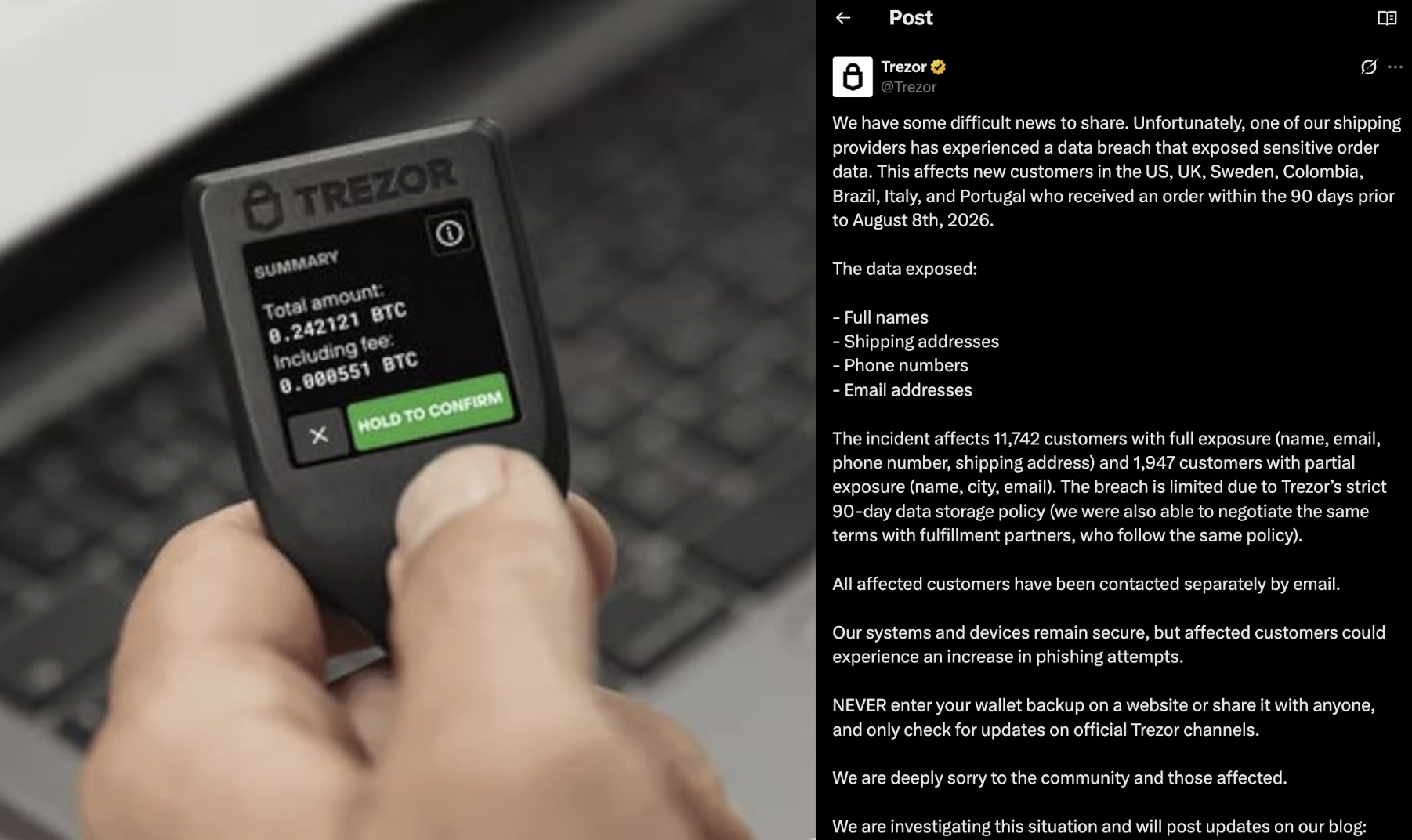
What Data Was Exposed
Group | Data leaked | Approx. customers |
|---|---|---|
Full exposure | Name, email, phone number, shipping address, order number | 11,742 |
Partial exposure | Name, city, email address | 1,947 |
Total affected | Contact and shipping data (no crypto, keys, or card data) | ~13,689 |
Affected orders were placed between May 10 and August 8, 2026, across seven countries: the US, UK, Sweden, Colombia, Brazil, Italy, and Portugal. Trezor emailed every affected customer directly from help@trezor.io. If you did not receive that email, you were not on the list.
This Has Happened Before: The Ledger Precedents
Trezor is not the first hardware wallet brand to be hit through a partner. Its main rival, Ledger, has been through nearly the same story twice, and the second case is a useful warning about how long this kind of data can hurt people.
In January 2026, Ledger disclosed that customer data was exposed through Global-e, a third-party "Merchant of Record" that handles international checkout, taxes, and order processing for many well-known brands. Names, email addresses, postal addresses, and phone numbers of Ledger shoppers were accessed. As with Trezor, no recovery phrases, balances, or payment card details were involved. Ledger stressed that its self-custodial design means no partner ever holds your 24 words.
The more sobering case is Ledger's 2020 breach. An exposed e-commerce database put the personal details of around 270,000 customers online, alongside roughly a million newsletter email addresses. The data was dumped on hacking forums and never "aged out." Years later it was still being used for phishing and extortion. In 2024, French regulator CNIL fined Ledger 750,000 euros over the data protection failures.
Incident | Date | Third party | What leaked | Crypto stolen? |
|---|---|---|---|---|
Trezor / ShipMonk | Aug 2026 | ShipMonk (fulfilment) | Name, email, phone, address | No |
Ledger / Global-e | Jan 2026 | Global-e (merchant of record) | Name, email, phone, address | No |
Ledger e-commerce leak | 2020 | E-commerce database / API | Name, email, phone, address (~270k) | No |
The lesson across all three is the same: the wallets were never the weak point. The commerce and shipping layer was. A shipping address is just metadata until it is attached to a confirmed hardware wallet order. Then it becomes a map of who owns crypto and where to find them.
The Exact Risk: What Criminals Can Actually Do
This is the part that matters most. No one can move your crypto with a shipping address. The value of this data to a criminal is that it confirms one thing: this specific person owns a hardware wallet, and here is how to reach them. That turns "non-sensitive" contact details into a targeting list.
Here is how leaked wallet-buyer data has been used in practice, drawn from both the Trezor warning and years of documented Ledger fallout:
Phishing emails that impersonate Trezor, Ledger, a bank, or an exchange. Many reference "the breach" itself and push a fake "security check," "account verification," or "firmware update."
Smishing and vishing (scam texts and phone calls). With a real name and phone number, a caller can sound convincing and claim to be support staff who already know your details.
Fake letters and "replacement" devices. After the 2020 Ledger leak, criminals mailed physical letters and even tampered hardware wallets to leaked addresses, instructing victims to enter their recovery phrase on a modified device.
Extortion. Ledger victims received ransom emails demanding a few hundred to a thousand dollars in Bitcoin, sometimes with threats to expose or harm them.
Physical risk. This is rare but real. Because the data links a name and home address to confirmed wallet ownership, security firms have documented home invasions and "wrench attacks" aimed at forcing owners to hand over keys. CertiK verified dozens of physical attacks on crypto holders in the first half of 2026.
The goal behind almost every one of these is identical: get you to reveal your recovery seed, or approve a transaction you did not intend. The hardware wallet stays secure. You become the target.
What to Watch Out For: Red Flags
Any message about "the data breach" that gives you a link to "verify," "secure," or "check" your wallet.
Urgency and fear. "Act now or lose your funds" is the oldest trick in the book.
Any request for your 12 or 24-word recovery seed, in any form, on any website. No legitimate company will ever ask for it.
Prompts to "update firmware" through an emailed link instead of the official app.
Unexpected calls or texts from "support," especially ones that already know your name.
Physical mail or a "replacement device" you did not request.
What to Do Now: A Practical Checklist
Confirm whether you were affected. Check your inbox for an email from help@trezor.io. Trezor contacted every affected person directly.
Treat all unexpected crypto messages as suspicious by email, phone, text, or post.
Never enter your recovery seed anywhere. Not on a website, not in an app, not to "support." Your seed only ever goes into the device itself.
Verify through official channels. Type the official URL yourself instead of clicking links, and cross-check any warning against Trezor's blog and verified social accounts.
Strengthen adjacent accounts. Turn on two-factor authentication for your email and exchange logins, ideally with an authenticator app rather than SMS.
Protect your phone number. SIM-swap fraud becomes easier once a number is tied to a known crypto owner. Ask your carrier about a port-out PIN or account lock.
Consider a passphrase (a "25th word") for larger holdings, and store your seed only offline.
Do not engage with extortion. Do not pay. Report threats to local police and, where relevant, national cybercrime units.
How to Reduce Your Exposure on Future Orders
Because the weak point is the commerce and shipping layer, you can limit how much data is exposed next time:
Use an email address that is not tied to your real identity for hardware purchases.
Where possible, pay with crypto or a disposable virtual card rather than your primary credit card.
Consider a P.O. box or parcel locker to keep your home address off the order. Note that ID may still be needed for collection.
Watch for privacy-focused shipping. Trezor says it is rolling out an "Anonymous Delivery" option with neutral packaging and automatic deletion of shipping identifiers, targeting the EU by September 2026 and the US by the end of 2026.
None of this removes risk entirely. Shipping a physical product requires an address somewhere. The goal is to reduce how much identifying data any single partner holds, and for how long.
Frequently Asked Questions
Was my crypto stolen?
No. This breach exposed contact and shipping data only. Private keys, recovery seeds, balances, and payment card numbers were not involved, and no Trezor device was compromised.
How do I know if I was affected?
If you received a notification email from help@trezor.io about the incident, your details were among those exposed. If you did not get that email, you were not affected.
Is my Trezor device still safe to use?
Yes. The breach happened at a shipping partner, not on Trezor's systems. Your device, firmware, and offline keys are unaffected. The change is that you may now see more phishing attempts.
Should I move my coins to a new wallet?
It is not required, because your keys were never exposed. However, if you have ever typed your recovery seed into a website or an app that was not the device itself, treat that seed as compromised and move funds to a new wallet with a fresh seed.
Why did a shipping company have my personal data?
To deliver your parcel, a fulfilment partner needs your name, address, phone number, and email. Under Trezor's policy they are required to delete or anonymize that data 90 days after delivery.
Will this leaked data ever disappear?
Probably not. Leaked personal data tends to circulate for years, as the 2020 Ledger case showed. It is safest to assume the exposure is permanent and to stay alert to phishing over the long term.
Related Terms
Phishing - fraudulent messages designed to trick you into revealing sensitive information.
Recovery seed (seed phrase) - the 12 or 24-word backup that controls a crypto wallet. Whoever holds it controls the funds.
Hardware wallet - a physical device that stores private keys offline, away from internet-connected systems.
Merchant of Record - a third party that processes payments and orders on a brand's behalf, and therefore holds customer order data.
SIM-swap attack - fraud in which a criminal takes over your phone number to intercept codes and calls.
Sources
• Trezor blog: Recent customer data exposed in shipping provider incident
• BleepingComputer: Trezor discloses data breach affecting nearly 14,000 customers
• The Block: Trezor shipping provider breach exposes personal data of nearly 14,000 customers
• CoinDesk: Third-party breach exposes shipping addresses of 14,000 Trezor buyers
• BleepingComputer: Ledger customers impacted by third-party Global-e data breach
• CryptoSlate: New Ledger breach exposed the one thing that leads criminals to your door
• DailyCoin: Ledger users see justice four years after 2020 breach (CNIL fine)
• Bitdefender: Hacker publishes stolen data of 270,000 Ledger users
Disclaimer: This content is for educational and informational purposes only and is not financial advice. Nothing here is a recommendation to buy or sell any asset or use any platform. Do your own research and manage your risk. Figures such as customer counts are the numbers reported by Trezor and cited by the outlets above and may be updated as investigations continue. This article is educational and is not financial, legal or security advice.
How to Spot a Crypto Scam in 2026: The Complete Red Flag Checklist
How to Verify a Stablecoin's Reserves Yourself (Before the Rules Change)
How BonkDAO Lost $20M Without a Hack
Are Tokenized Stocks Legal? Regulations, Restrictions and Investor Rights