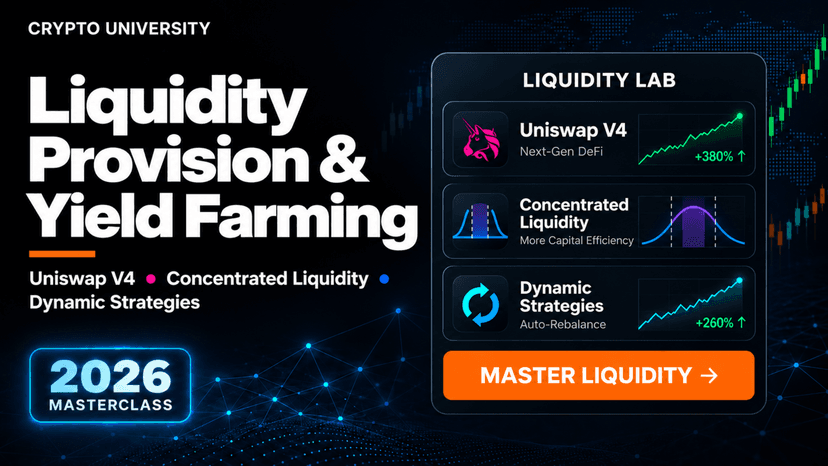
Mastering Advanced Liquidity Provision and Yield Farming: Uniswap V4, Concentrated Liquidity, and Dynamic Strategies in 2026
The early days of decentralized finance (DeFi) yield farming were characterized by reckless capital deployment into inflationary, unsustainable "ponzi-nomics" protocols. By 2026, the landscape has matured into a highly sophisticated, mathematically optimized ecosystem focused on Real Yield and Capital Efficiency.
The introduction of modular decentralized exchange (DEX) architectures (like Uniswap V4 with custom "hooks") and advanced concentrated liquidity models has fundamentally transformed how liquidity is provided. Today, sophisticated retail investors, quantitative desks, and institutional yield aggregators no longer blindly deposit assets into wide-range pools. Instead, they utilize dynamic, data-driven strategies to maximize fee generation, actively manage Impermanent Loss (IL), and capture yield from genuine trading volume rather than speculative token emissions.
This comprehensive guide breaks down the core mechanics of modern liquidity provision, the top-tier platforms dominating the space in 2026, and the strict operational risk management frameworks required to farm yield safely and profitably.
The 3 Pillars of Modern Liquidity Provision in 2026
To generate sustainable yield in DeFi, you must understand the technological innovations that separate professional liquidity providers (LPs) from retail capital that gets consistently arbitraged.
Concentrated Liquidity and Active Range Management:
Legacy Automated Market Makers (AMMs) spread liquidity across a price range from zero to infinity, resulting in massive capital inefficiency. Modern concentrated liquidity protocols allow LPs to allocate capital only within specific, high-probability price ranges (e.g., BTC between $60,000 and $70,000). This amplifies fee generation by up to 100x compared to legacy models, but requires active monitoring or automated rebalancing bots to prevent the position from going "out of range" and earning zero fees.
Custom "Hooks" and Dynamic Fee Tiers:
The latest generation of DEX infrastructure supports modular "hooks"—custom smart contract logic that executes before or after a swap. In 2026, LPs utilize hooks to implement dynamic fee tiers (raising fees during high volatility to protect against toxic flow), automated limit orders, and built-in Impermanent Loss protection mechanisms, creating highly tailored yield environments.
Real Yield vs. Inflationary Emissions:
Sustainable yield farming in 2026 focuses on protocols that distribute a portion of actual trading fees, borrowing interest, or MEV (Maximal Extractable Value) rebates to LPs in blue-chip assets (ETH, BTC, or stablecoins), rather than printing worthless governance tokens. This "Real Yield" model ensures that LP returns are directly correlated to genuine platform usage and market demand.
Top Platforms for Advanced Liquidity Provision in 2026
Deploying capital into liquidity pools requires platforms with deep trading volume, robust smart contract security, and advanced LP management tools.
1. GMX: Best for Real Yield and Single-Sided Liquidity Provision
GMX remains the gold standard for LPs who want to earn sustainable, real yield without exposing their capital to the complex Impermanent Loss dynamics of traditional two-sided AMM pools.
Core Features: GMX utilizes a unique multi-asset liquidity pool (GLP/GM). LPs deposit a basket of blue-chip assets (e.g., 50% stablecoins, 50% BTC/ETH). In return, they earn 70% of all trading fees and borrowing costs generated by the platform's perpetual futures traders.
Single-Sided Exposure: Because the pool acts as the counterparty to traders, LPs do not suffer from traditional Impermanent Loss. Instead, their yield is directly tied to the volume and profitability of the platform's derivatives market.
Why LPs Choose It: It offers a "set-and-forget" Real Yield model with transparent, on-chain fee distribution, making it the premier choice for conservative, long-term liquidity providers.
👉 Earn Real Yield by Providing Liquidity to the GMX Ecosystem
2. Bybit: Best for Simplified, Centralized Liquidity Mining and Dual Investment
For investors who want to capture yield without managing the technical complexities of gas fees, range monitoring, and decentralized smart contracts, Bybit offers highly optimized, institutional-grade liquidity products.
Core Features: Bybit’s "Dual Investment" and "Liquidity Mining" programs allow users to provide liquidity to major trading pairs (e.g., BTC/USDT) with predefined parameters. The platform handles all the complex rebalancing and fee collection behind the scenes, presenting the user with a clear, projected Annual Percentage Yield (APY).
Capital Efficiency: Funds deployed in Bybit’s earning products can often be used simultaneously as cross-margin collateral within their Unified Trading Account (UTA), maximizing capital efficiency without locking up assets.
Why LPs Choose It: It provides the yield benefits of market-making with the user experience, deep liquidity, and regulatory compliance of a top-tier centralized exchange.
👉 Access Simplified, High-Yield Liquidity Mining Products on Bybit
3. Uniswap V4 Ecosystem Aggregators (e.g., Arrakis, Gamma): Best for Automated Concentrated Liquidity
For DeFi natives who want the amplified returns of concentrated liquidity but lack the time to actively manage price ranges, specialized liquidity management protocols are essential.
Core Features: Platforms like Arrakis Finance or Gamma Strategies act as "vaults" for Uniswap V3/V4 concentrated liquidity. Users deposit a single asset or a pair, and the protocol’s algorithmic managers automatically rebalance the liquidity ranges based on real-time volatility and volume data, compounding the earned fees back into the principal.
Why LPs Choose It: It democratizes access to institutional-grade market-making strategies, allowing retail users to earn the high fees of concentrated liquidity without the constant manual intervention.
Top Tools for Supporting Your Liquidity Provision Workflow
A professional yield farming setup requires a broader technology stack to ensure precise analysis, security, and compliance.
4. TradingView: Best for Analyzing Price Ranges and Volatility
Successful concentrated liquidity provision is essentially a volatility forecasting game. TradingView is the indispensable command center for this analysis.
Core Features: Advanced LPs use TradingView to identify strong support and resistance levels, Average True Range (ATR), and Bollinger Bands to determine the optimal, widest-safe range for their liquidity positions. Custom indicators can also track the historical fee generation of specific DEX pools to project future yield.
Why LPs Choose It: It provides the technical visibility needed to set liquidity ranges that capture maximum trading volume while minimizing the risk of the asset price escaping the range and halting fee generation.
👉 Analyze Volatility and Set Optimal Liquidity Ranges with TradingView
5. Ledger: Best for Securing Complex DeFi Liquidity Positions
Interacting with concentrated liquidity protocols and custom hooks requires signing complex, multi-step smart contract transactions. This makes LP wallets a prime target for sophisticated drainers.
Core Features: Ledger hardware wallets ensure that every interaction with a DeFi liquidity protocol—whether depositing assets, minting an LP position, or claiming compounded fees—requires physical cryptographic approval on the device’s secure, tamper-proof screen.
Clear Signing: Ledger’s integration parses these complex transactions, displaying human-readable details (e.g., "Deposit 1 ETH and 3000 USDC to Uniswap V4 Pool") to prevent "blind signing" attacks where malicious contracts disguise token drains as routine deposits.
Why LPs Choose It: It provides the ultimate physical circuit breaker. Even if your browser is compromised by a perfect phishing replica of a DEX, the attacker cannot drain your liquidity position without your physical button press.
👉 Secure Your DeFi Liquidity Positions with a Ledger Hardware Wallet
6. Koinly: Best for Tracking the Complex Tax Implications of Yield Farming
Liquidity provision is one of the most tax-complex activities in crypto. Every time you earn trading fees, compound rewards, or rebalance a concentrated liquidity position, it can trigger a taxable event.
Core Features: Koinly seamlessly integrates with major DEXs and liquidity management vaults. Its advanced heuristic engine accurately categorizes LP rewards, distinguishes between non-taxable deposits and taxable fee income, and calculates the complex cost basis adjustments that occur when a concentrated liquidity position is rebalanced or withdrawn.
Why LPs Choose It: It transforms a chaotic ledger of hundreds of micro-transactions, fee claims, and IL adjustments into a clean, audit-ready tax report, ensuring you don't overpay or underreport your tax liabilities to authorities.
👉 Automate Your Complex Liquidity Provision Tax Tracking with Koinly
Step-by-Step: How to Deploy Capital into a Concentrated Liquidity Pool
Deploying capital as a liquidity provider requires a disciplined, data-driven workflow. Follow this exact blueprint:
Step 1: Analyze the Asset Pair and Volatility
Choose a pair you are fundamentally comfortable holding long-term (e.g., ETH/USDC or stETH/ETH). Use TradingView to analyze the asset's historical volatility and identify a logical, wide-enough price range that will capture consistent trading volume without requiring daily rebalancing.
Step 2: Select the Right Protocol and Vault
Decide whether to manage the position manually on a native DEX (for maximum control and fee retention) or to deposit into an automated liquidity management vault (for passive, algorithmic rebalancing). Ensure the protocol has a proven track record, deep liquidity, and multiple top-tier smart contract audits.
Step 3: Execute the Deposit via Hardware Wallet
Navigate to the official protocol interface. Connect your Ledger-secured wallet. Verify the contract addresses. When prompted to approve the token spend, approve only the exact amount you are depositing. Verify the final transaction details on the Ledger’s physical screen before signing.
Step 4: Monitor and Compound
Set up alerts for when the asset price approaches the boundaries of your liquidity range. If the price breaches the range, your position will convert entirely into the underperforming asset, and fee generation will stop. Decide in advance whether you will rebalance the position (realizing Impermanent Loss) or simply wait for the price to return to the range. Claim and compound fees regularly to maximize the power of compounding.
Risk Management: The Hidden Dangers of Liquidity Provision
Yield farming is not "free money." It is a sophisticated financial strategy that carries distinct risks you must actively manage:
Impermanent Loss (IL): This is the most significant risk in two-sided AMM pools. If the price of one asset diverges significantly from the other, the value of your LP position will be less than if you had simply held the assets in your wallet. Mitigation: Provide liquidity to highly correlated pairs (e.g., stablecoin pairs or wrapped/native asset pairs like ETH/stETH) to minimize divergence, or use single-sided Real Yield protocols like GMX.
Smart Contract and "Hook" Risk: Depositing into a DeFi protocol means trusting its code. Custom "hooks" in newer DEX architectures introduce additional attack vectors. Mitigation: Only use battle-tested protocols with significant Total Value Locked (TVL), multiple audits from top-tier firms (e.g., Trail of Bits, OpenZeppelin), and active bug bounty programs.
Rebalancing Fee Drag: If you actively manage a concentrated liquidity position and rebalance it too frequently during choppy market conditions, the gas fees and realized Impermanent Loss can completely erase the trading fees you earned. Mitigation: Set wider ranges to reduce the need for rebalancing, or utilize automated vaults that optimize rebalancing for gas efficiency.
Tax Complexity: As mentioned, the tax reporting for LPs is notoriously difficult. Mitigation: Rely on automated tracking via Koinly from day one to ensure every fee claim and rebalance is logged accurately.
Frequently Asked Questions (FAQ)
Q: What is Impermanent Loss, and can it become permanent?
A: Impermanent Loss (IL) occurs when the price ratio of the two assets in a liquidity pool changes compared to when you deposited them. It is "impermanent" because if the price returns to the original ratio, the loss disappears. However, if you withdraw your liquidity while the prices are diverged, the IL becomes a permanent realized loss.
Q: Are liquidity provision fees taxed as ordinary income or capital gains?
A: In most major jurisdictions, trading fees earned from providing liquidity are treated as ordinary income at the fair market value of the tokens at the time they are claimed. Withdrawing your principal may also trigger a capital gains or losses event depending on how the protocol handles the underlying asset swap. Automated tracking via Koinly is essential to navigate this.
Q: Is it safer to provide liquidity on a centralized exchange (CEX) or a decentralized exchange (DEX)?
A: It depends on the risk you prioritize. CEX liquidity programs (like Bybit) eliminate smart contract risk and gas fees but introduce counterparty risk (the exchange could freeze funds or face insolvency). DEX provision eliminates counterparty risk but introduces smart contract risk and requires rigorous self-custody security (using a Ledger).
Q: How do I know if a yield farming APY is sustainable?
A: Look at the source of the yield. If the APY is paid in the protocol’s native governance token and the token’s price is artificially inflated, the yield is unsustainable (inflationary). If the APY is generated from real trading fees, borrowing interest, or MEV rebates paid in stablecoins or blue-chip crypto (Real Yield), it is fundamentally sustainable.
Risk Warning: Providing liquidity and yield farming in decentralized finance carry significant risks, including Impermanent Loss, smart contract vulnerabilities, dynamic fee changes, and extreme market volatility. You could sustain a partial or total loss of your deposited capital, and realized Impermanent Loss can result in a net negative return compared to simply holding the assets.
Not Financial Advice: The information provided in this article is for educational and informational purposes only. It does not constitute financial, investment, legal, or tax advice. Always conduct your own research (DYOR) and consult with a qualified, licensed professional before deploying capital into any liquidity provision or yield farming protocol.
Affiliate Disclaimer: This article contains affiliate links. If you click on these links and sign up for a service or make a purchase, we may earn a commission at no additional cost to you. We only recommend platforms, tools, and services that we have thoroughly vetted and believe provide genuine value, security, and utility to our readers.
Recommended reading:
Mastering Crypto Structured Products
DEX Aggregators & Cross-chain Swaps