Key Takeaways
# | What you need to remember |
|---|---|
1 | You do not need anything special because you live in Abu Dhabi. The route is always the same: move your crypto to a regulated platform that accepts UAE customers, sell it for AED, then withdraw to a bank account in your own name. |
2 | The bank account must belong to you. Third-party accounts are one of the most common reasons transfers get rejected or frozen, and they are the biggest risk in peer-to-peer trading. |
3 | For larger amounts, talk to your bank before the money lands, ask the platform about OTC pricing, and keep every screenshot, receipt, and statement. Paperwork is what turns a suspicious transfer into a routine one. |
Getting Started
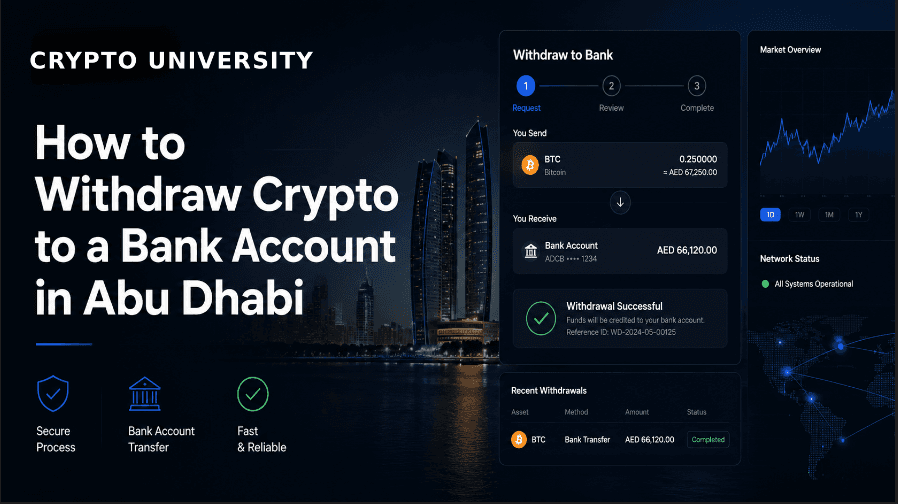
If you are sitting in Abu Dhabi wondering how to actually get your crypto profits into your bank account, here is the good news: there is no secret local blockchain and no special trick. The process is the same one people use everywhere in the UAE.
You move your crypto to a regulated platform that supports UAE customers, you sell it for dirhams, and you withdraw those dirhams to a bank account in your own name. That is it. Everything else in this guide is about doing those three things without running into compliance trouble.
The platforms most people compare are OKX UAE, BitOasis, and Fasset.
One thing that confuses newcomers is the regulation. The UAE does not have a single crypto rulebook. There are federal frameworks, Dubai has its own VARA regime, and Abu Dhabi Global Market operates under the FSRA. Before you send anything, check which legal entity is actually serving you and what that entity is permitted to do.
The Step-by-Step Process
Here is the whole journey at a glance, then we will walk through each step properly.
Step | What you do | Why it matters |
|---|---|---|
1 | Choose an eligible platform | Not every exchange serves UAE residents or supports AED withdrawals |
2 | Complete verification | Mismatched details cause delays and rejections |
3 | Add your bank account | It must be in your own name |
4 | Deposit your crypto | A small test transfer prevents expensive mistakes |
5 | Sell into AED | The rate you get is not always the rate you see |
6 | Withdraw the AED | Timing and compliance checks affect arrival |
Step 1: Choose an eligible platform
Do not pick a platform because a friend mentioned it. Spend ten minutes checking the things below, because these are what actually determine whether your money arrives.
What to check | What you are looking for |
|---|---|
UAE customer eligibility | Confirmation that residents in your emirate can open an account |
Licence and regulator | The named legal entity and the regulator that oversees it |
Supported crypto | That your specific coin or token can be sold there |
Supported deposit network | The exact network for your transfer, since sending on the wrong one loses funds |
AED withdrawal | Direct withdrawal to a UAE bank, not just a conversion to another currency |
Limits | Daily and monthly caps that might slow a large cash-out |
Fees | Trading fees, withdrawal fees, and the spread built into the price |
Processing time | How long the AED takes to reach your account |
Step 2: Complete verification
Use the same personal details on the exchange as your bank has on file. If your Emirates ID says one spelling of your name and your exchange account says another, expect friction. It sounds trivial, and it delays more transfers than anything else.
Step 3: Add your bank account
Only add an account you personally own. Sending money to a friend, a relative, or a company account you are not a signatory on is one of the fastest ways to trigger a compliance review or an outright rejection.
Step 4: Deposit your crypto
Send a small test amount first, then check it on a block explorer before you send the rest. Yes, it costs a second network fee. It is far cheaper than sending your full balance to the wrong address or the wrong network.
Step 5: Sell into AED
Compare the execution rate, not the headline price. If you are selling a large amount, ask the platform about OTC pricing instead of dumping your order into a thin retail order book, where you will quietly lose money to slippage.
Step 6: Withdraw the AED
Double-check the beneficiary details and ask what arrival time to expect. UAE bank processing can be affected by daily cut-off times, weekends, compliance checks, and the intermediary banks sitting in the middle. A transfer that looks stuck is often just waiting for the next business day.
An Abu Dhabi-Specific Point Worth Understanding
Do not assume that a company regulated in ADGM automatically offers every service to every UAE resident. Licences are permission-specific.
A firm might be authorised to hold your crypto in custody but not to run a retail exchange. Another might be permitted to arrange transactions but not to pay fiat directly into your bank. The marketing page will not tell you this. The public register will.
Living in Abu Dhabi does not mean your provider must be licensed by ADGM. What matters is that the specific legal entity serving you holds the specific permissions your transaction needs. Look it up before you commit.
What to Tell Your Bank
If a meaningful sum is about to land in your account, tell your bank in advance. Banks react far better to a heads-up than to a surprise. Here is what they will want to know.
Question the bank will ask | What to have ready |
|---|---|
Where did the money come from? | The name of the regulated platform you used |
What did you sell? | The specific crypto asset and the date of sale |
How much? | The exact AED amount arriving |
Why are you receiving it? | A short, honest explanation of the transaction |
Where did the crypto originally come from? | Purchase records, mining income, salary, or client payments |
Is this personal or business? | A clear answer, because the two are treated very differently |
If they ask for documents, send them quickly. Slow responses look worse than large numbers.
Business Money Versus Personal Money
If the crypto belongs to a company, do not casually route it through your personal account because it is easier. Mixing personal and corporate funds creates problems that are painful and expensive to unwind later.
Use this | Instead of this |
|---|---|
A company exchange account | Your personal exchange login |
A company bank account | Your personal current account |
Proper invoices | An informal note or verbal agreement |
Board or treasury records | Nothing written down |
Accounting entries | A spreadsheet nobody maintains |
Professional tax advice | Guesswork and forum posts |
A Serious Warning About P2P Trades
Peer-to-peer trading looks convenient and cheap. It is also where most horror stories begin.
The danger is simple. A buyer can pay you from a compromised or unrelated bank account. Your AED arrives, you release the crypto, and weeks later your bank freezes the funds because they were traced to fraud. You lose the crypto and the cash.
If you insist on trading P2P, follow strict rules and never bend them.
Rule | Reason |
|---|---|
The payer name must match the trader name | Third-party money is the number one source of frozen accounts |
Always use platform escrow | It is your only protection if the deal goes wrong |
No off-platform WhatsApp deals | You lose every dispute mechanism you had |
No third-party transfers | You cannot verify where that money came from |
No cash meetings | Unsafe, undocumented, and impossible to explain to a bank |
Ignore the "my cousin will pay" story | It is the oldest excuse for a third-party payment |
Which Platform Should You Choose?
All three are worth comparing, and the right answer depends on how you trade and how much you are moving.
Platform | Best suited to | What to check first |
|---|---|---|
OKX UAE | Active traders who want a large, full-featured exchange with AED withdrawal support OKX Card: Pay anywhere, straight from your stablecoin balance. | Current UAE entity, withdrawal limits, and fee schedule |
Users who want regional familiarity and straightforward local bank-transfer workflows | Supported banks and verification requirements | |
Users exploring an additional regulated option in the region | Its current UAE cash-out features and which legal entity serves you |
A quick overview of deeper detail on How to Cash Out Crypto.
Final Recommendation
Take the regulated, documented path every single time. It is slower on day one and much faster on the day someone asks questions.
For meaningful amounts, work through this order:
Order | Action |
|---|---|
First | Verify the platform and the exact legal entity serving you |
Second | Pre-clear the incoming transfer with your bank |
Third | Use an OTC desk rather than a thin retail order book |
Fourth | Preserve the full transaction trail from purchase to payout |
The goal is not simply to receive AED. The goal is to receive AED without creating a compliance problem for yourself six months from now.
Frequently Asked Questions
Do I have to use a platform licensed in Abu Dhabi?
No. Living in Abu Dhabi does not mean your provider must be regulated by ADGM. What matters is that the legal entity serving you is properly licensed and permitted to offer the specific service you need, whether that oversight comes from ADGM, VARA, or a federal framework.
How long does the AED take to reach my bank?
It varies. Some transfers land the same day, others take a few business days. Cut-off times, weekends, public holidays, compliance checks, and intermediary banks all add delay. Ask the platform for its expected processing time before you withdraw.
Can I withdraw to my wife’s or my father’s account?
You should not. The receiving account must be in your own name. Third-party bank accounts are one of the most common triggers for rejection, compliance review, and frozen funds.
Will my bank freeze my account if I sell crypto?
Not automatically. Problems usually arise when a large sum appears with no explanation or when funds are traced back to a suspicious source. Using a regulated platform, telling your bank in advance, and keeping records dramatically reduces the risk.
What is an OTC desk and do I need one?
An over-the-counter desk executes large orders privately at an agreed price rather than through the public order book. If you are selling a large amount, it usually gets you a better overall rate and avoids moving the market against yourself.
Is P2P trading worth the better rate?
For most beginners, no. The small saving does not compensate for the risk of receiving funds from a compromised account and having your money frozen afterwards. If you do trade P2P, never accept payment from anyone other than the verified trader.
What records should I keep?
Keep everything: purchase records, exchange statements, trade confirmations, withdrawal receipts, and any correspondence with the platform. If your bank or an auditor asks questions later, a complete trail turns a stressful conversation into a short one.
Research Notes and Sources
Source | Link |
|---|---|
VARA public register for Dubai-regulated VASPs | https://www.vara.ae/en/licenses-and-register/public-register/ |
ADGM FSRA public register | https://www.adgm.com/public-registers |
OKX UAE withdrawal documentation | https://www.okx.com/help/where-do-i-find-limits-fees-and-processing-time-details-for-cash-withdrawal-uae |
BitOasis help centre | https://support.bitoasis.net/ |
Fasset | https://fasset.com/ |
Community discussion reviewed | r/UAE cash-out threads covering OKX, BitOasis, verification friction, and informal cash trades |
Disclaimer: This content is for educational and informational purposes only and is not financial advice. Nothing here is a recommendation to buy or sell any asset or use any platform. Do your own research and manage your risk.
How to Cash Out Crypto in Dubai in 2026
How to Get Started on Robinhood Chain: A Complete Beginner's Guide
Best Robinhood Chain Trading Platforms in 2026: FOMO, GMGN, Uniswap and OpenSea Compared
Best RugCheck Alternatives Every Beginner Trader Needs
MiCA Explained: What the End of the EU Crypto Transition Period Means
Need deeper training?
Join our structured modules with live examples and expert checklists for effective implementation.
JOIN THE ACADEMY