KEY TAKEAWAYS
Always use a platform licensed to serve UAE customers, and check the exact legal entity on the regulator's public register. A familiar logo is not proof of a licence.
Match the USDT network exactly. Sending Tron USDT to an Ethereum address is the single most common way people lose money, and it usually cannot be undone.
Keep records of where your USDT came from. Banks ask, and a tidy paper trail is what keeps your AED withdrawals flowing smoothly.
WHY YOU'D WANT TO DO THIS
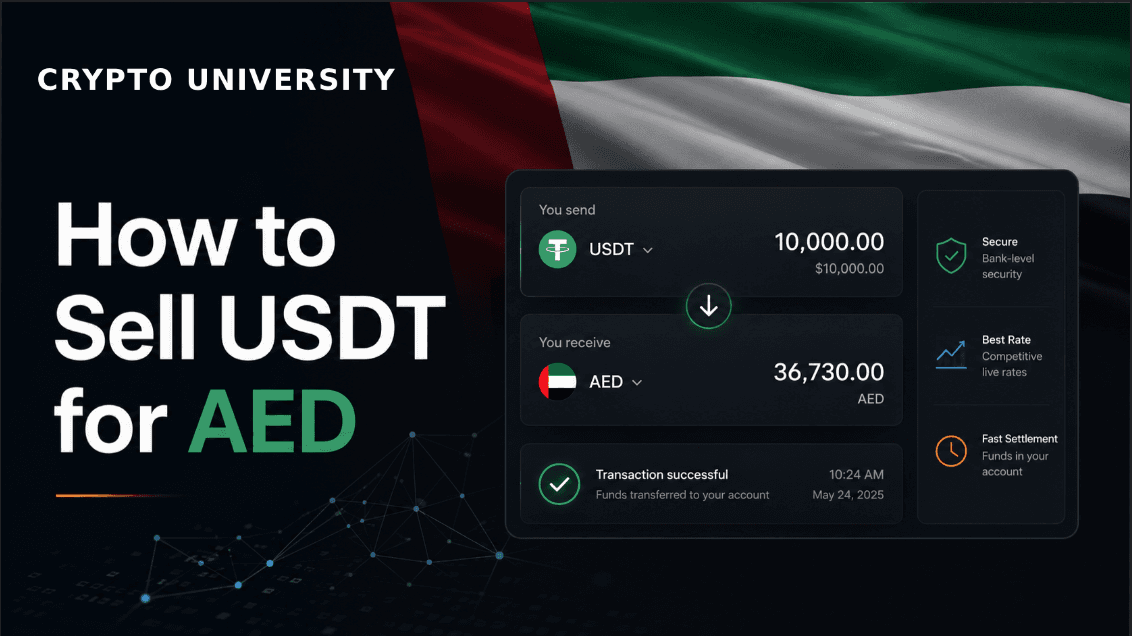
USDT is handy because it moves at crypto speed while staying pegged to the US dollar. The problem is that your rent, your staff salaries, your card bill and your bank account all run on dirhams.
So at some point you need to turn USDT into AED. The good news is that it's fairly simple once you understand the steps. The bad news is that beginners tend to trip over the same few things, and this guide is built around avoiding exactly those.
To make the conversion you need a platform that supports both the network you're sending USDT on and AED withdrawals to a UAE bank. The three worth comparing are OKX UAE, BitOasis and Fasset.
THE SIX STEPS AT A GLANCE
Step | What you do | Why it matters |
1 | Verify the platform | Confirms you're dealing with a licensed entity, not just a familiar brand |
2 | Complete KYC | Unlocks fiat withdrawals and prevents account freezes later |
3 | Confirm the USDT network | Wrong network equals lost funds |
4 | Send a small test transfer | Cheap insurance before moving the full amount |
5 | Convert USDT to AED | Where spreads quietly eat your money |
6 | Withdraw AED to your bank | Final step, subject to limits and cut-off times |
STEP 1: VERIFY THE PLATFORM
Before you deposit anything, look up the platform on the regulator's public register and confirm which legal entity actually serves UAE customers.
This matters more than people expect. A global exchange brand often operates through several different companies, and only one of them may be licensed here. The logo is not the licence.
STEP 2: COMPLETE KYC
Every regulated platform will ask you to prove who you are. Have these ready:
Document | Notes |
Emirates ID | Front and back, clear photo |
Passport | Photo page |
Selfie or liveness check | Done in the app |
UAE address proof | Tenancy contract or utility bill |
Source of funds | Where the money originally came from |
One small tip that saves a lot of headaches: register using your legal name exactly as it appears on your bank account. If the names don't match, your AED withdrawal will bounce.
STEP 3: CONFIRM THE USDT NETWORK
USDT is not one single thing. The same token exists on several blockchains, and they are not interchangeable.
Network | Common label |
Tron | TRC-20 |
Ethereum | ERC-20 |
Solana | SPL |
BNB Chain | BEP-20 |
Arbitrum | Arbitrum One |
The deposit screen on your platform must support the exact network you're sending from. Simply knowing you're sending "USDT" is not enough information. Read the network line twice.
STEP 4: SEND A TEST
Send a small amount first. Always. Even experienced traders do this.
Once it arrives, check the address was correct, the network matched, the confirmations completed, the balance was credited, what deposit fee was charged, and whether you met the minimum deposit.
If everything looks right, send the rest.
STEP 5: CONVERT USDT TO AED
Depending on the platform, you'll have one of three routes: selling on a USDT/AED market, converting USDT straight to AED with a one-click tool, or selling USDT into another asset that the platform supports for fiat.
Here's the part beginners miss. Don't compare trading fees. Compare the final amount of AED that lands in your account.
A conversion advertised as "zero fee" can quietly build the cost into a wider spread, and you end up worse off than a platform charging a visible fee with a tighter price. Run the numbers on the actual output.
STEP 6: WITHDRAW AED
Add a UAE bank account held in your own name. Not your spouse's, not your company's unless the account itself is a business account, not a friend's.
With OKX UAE, the account may need to be verified first through a prior deposit or a linking process. BitOasis likewise requires withdrawals to go to a personal bank account owned by the customer.
Before you press confirm, check these:
Check | Why |
Minimum withdrawal | Small amounts may be rejected |
Withdrawal fee | Flat or percentage based |
Processing time | Same day or next business day |
Daily limit | Large sums may need splitting |
Beneficiary name | Must match your platform account name |
Bank cut-off times | Late transfers land the next working day |
OKX VERSUS BITOASIS VERSUS FASSET
Platform | Best for | Watch out for |
OKX UAE | Traders who want deep liquidity, advanced order types and integrated AED banking. OKX Card: Pay anywhere, straight from your stablecoin balance. | More features than a beginner needs at first |
Users who prefer a regional platform with a straightforward local AED workflow | Compare pricing against larger exchanges | |
Regional access and product availability | Confirm the exact AED cash-out route shown in your own account |
Whichever you choose, check current eligibility and terms before you move funds. Products in this region change quickly.
A quick overview of deeper detail on How to Cash Out Crypto.
MARKET ORDER OR LIMIT ORDER?
A market order sells right away at whatever price is available. It's fast, but on larger amounts you can lose value to slippage.
A limit order lets you name your price. The trade-off is that it might never fill.
Amount | Suggested approach |
Small and liquid | Market order, the difference is usually minor |
Medium | Limit order at a sensible price |
Large | Request an OTC quote from the platform |
AVOID THESE MISTAKES
These are the ones that actually cost people money:
Sending TRC-20 USDT to an ERC-20 address.
Using someone else's bank account.
Accepting third-party payments in a P2P trade.
Releasing escrow because the buyer sent a screenshot.
Ignoring the spread and only looking at the fee.
Withdrawing repeatedly without keeping records.
Using an unlicensed cash shop or informal dealer.
Being unable to explain where your USDT originally came from.
BUILD A SOURCE-OF-FUNDS FILE
Keep a simple folder, digital is fine, containing your original fiat deposit record, the exchange purchase confirmation, your wallet addresses, transaction hashes, trade history, withdrawal receipts, the matching bank statement, and any invoices if the funds are business related.
This isn't paperwork for the sake of paperwork. It's what protects your relationship with your bank. Compliance teams don't ask because they suspect you, they ask because they're required to, and the person who can answer in five minutes keeps their account open.
FINAL VERDICT
The clean route looks like this:
USDT wallet, then a regulated UAE platform, then a USDT to AED conversion, then a verified UAE bank account in your own name.
Use OKX UAE, BitOasis or Fasset only after confirming current eligibility and terms for your situation. And if you're moving a significant sum, have a quick conversation with both the platform and your bank first. Five minutes on the phone beats a frozen transfer.
FAQ
Is it legal to sell USDT for AED in the UAE?
Yes, when you do it through a platform licensed to serve UAE customers. Informal cash dealers and unlicensed shops are where the legal risk sits.
How long does an AED withdrawal take?
Usually the same or next business day, depending on the platform and your bank's cut-off time. Your first withdrawal often takes longest because the account is being verified.
Which USDT network is cheapest to send?
Tron and Solana transfers are typically cheaper than Ethereum. Just make sure your receiving platform supports the network before you send.
What happens if I send USDT on the wrong network?
In most cases the funds are unrecoverable. Some platforms offer a paid recovery service for certain chains, but there's no guarantee. This is why the test transfer matters.
Can I withdraw AED to my friend's or company's account?
No. Regulated platforms require the bank account to be in the same name as your verified account. Third-party withdrawals get rejected or frozen.
Do I need to pay tax on this?
The UAE does not levy personal income tax on individuals, but business activity may fall under corporate tax rules. Speak to a qualified tax advisor about your specific situation.
Why does the platform ask where my crypto came from?
Regulations require it. Having your records organised in advance turns a stressful request into a quick email.
Disclaimer: This content is for educational and informational purposes only and is not financial advice. Nothing here is a recommendation to buy or sell any asset or use any platform. Do your own research and manage your risk.
How to Cash Out Crypto in Dubai in 2026
How to Get Started on Robinhood Chain: A Complete Beginner's Guide
Best Robinhood Chain Trading Platforms in 2026: FOMO, GMGN, Uniswap and OpenSea Compared
Need deeper training?
Join our structured modules with live examples and expert checklists for effective implementation.
JOIN THE ACADEMY