Key Takeaways
1. DePIN turns everyday people into infrastructure owners.
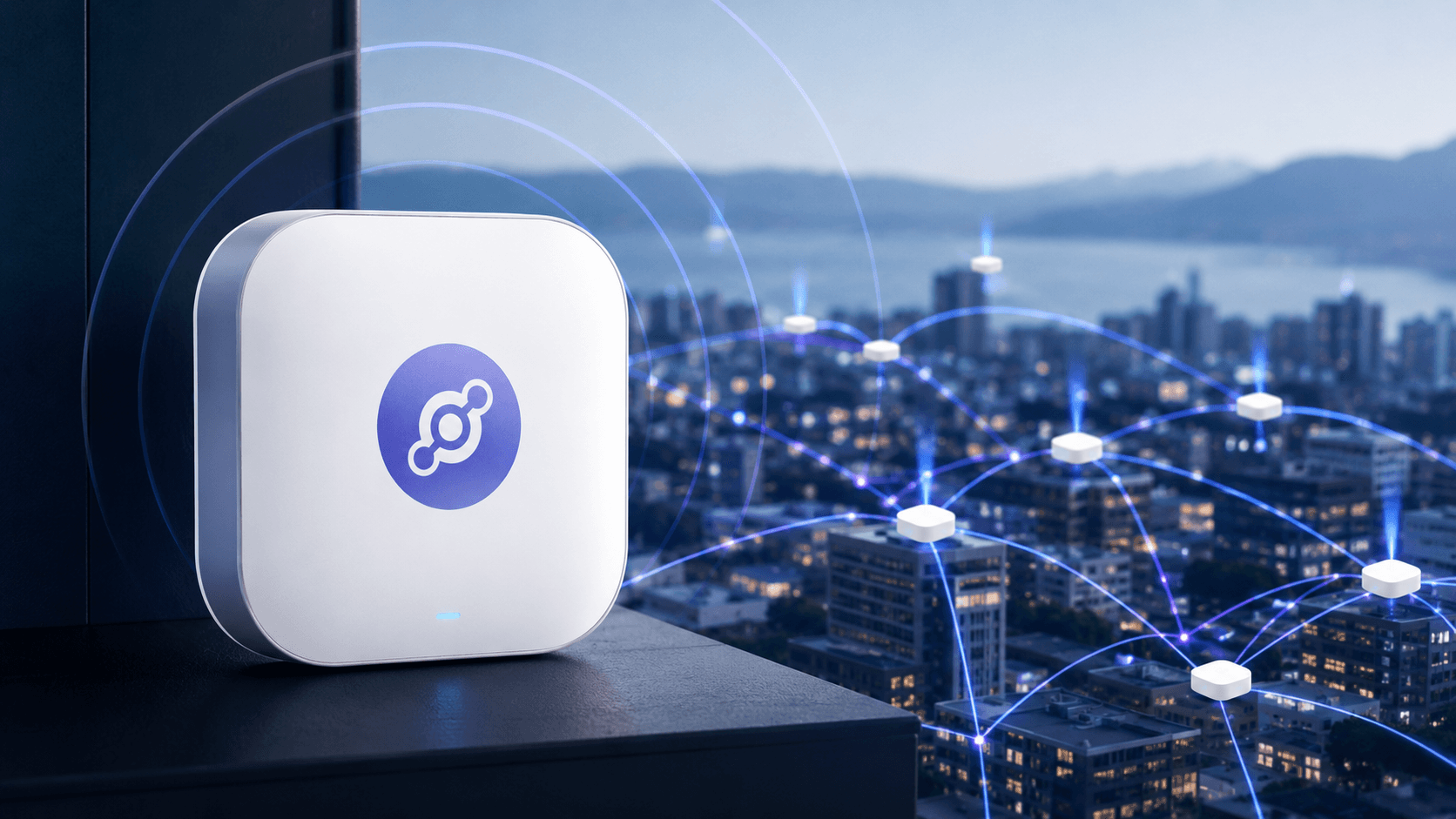
Instead of relying on giant telecom companies to build expensive cell towers, Helium lets anyone buy a small hotspot, plug it in, and earn tokens for providing real wireless coverage. This crowdsourced model has already powered a mobile network with hundreds of thousands of paying subscribers.
2. Token incentives only work when they’re tied to real usage.
Helium’s system burns HNT to create Data Credits that pay for actual data transfer. Hotspots earn rewards based on verified Proof of Coverage and real traffic—not hype. This “burn-and-mint” design links token economics directly to network growth and keeps incentives sustainable.
3. Location and utility beat speculation for long-term success.
Not every hotspot earns the same. Earnings depend on where you place it, how much data it carries, and whether the network actually needs more coverage there. The same evaluation rules apply to any DePIN project: check real demand, token utility, and hardware payback before investing time or money.
What Is DePIN?
Decentralized Physical Infrastructure Networks, or DePIN, apply blockchain and token incentives to build and operate real-world hardware networks. Instead of a single company owning cell towers, data centers, or sensors, DePIN lets individuals and businesses deploy the physical devices themselves. Participants earn tokens for providing coverage, storage, compute power, or other services.DePIN turns infrastructure into a permissionless, crowdsourced system. Anyone with the right hardware and internet connection can join, earn rewards, and help expand the network. The result is often faster growth, lower costs, and coverage in places traditional providers overlook.Helium is one of the clearest, longest-running examples of DePIN in action. It has built a nationwide wireless network for Internet of Things (IoT) devices and, more recently, mobile phones—entirely powered by user-owned hotspots.
The Problem DePIN Solves
Traditional telecom networks rely on expensive cell towers, heavy regulation, and centralized operators. Building coverage is slow and costly, especially in rural areas or indoors. Customers pay high prices, and innovation moves at the pace of a few large companies.DePIN flips this model. By rewarding everyday people for buying and running small, low-power devices, networks can grow organically wherever demand exists. No single company needs to raise billions for infrastructure. The economics shift from capital-intensive to incentive-driven.
How DePIN Works: Token Incentives and Proof of Contribution
DePIN projects share a common structure:
Hardware layer: Participants buy and install physical devices (hotspots, storage nodes, GPUs, etc.).
Blockchain layer: A public ledger records contributions and distributes rewards.
Token layer: Native tokens reward useful work and pay for network usage.
Proof mechanism: The network verifies that hardware is doing real work (not faking coverage).
Rewards come from two main sources:
Emissions – New tokens minted and distributed to participants.
Usage fees – Customers or enterprises pay for data or services; a portion flows back to providers.
This creates a flywheel: more hardware improves coverage → more users join → more fees → higher rewards → even more hardware.
Helium Case Study: From IoT to Mobile Service
Helium launched in 2019 with a simple idea: replace expensive LoRaWAN gateways with small, user-owned hotspots that provide long-range, low-power wireless coverage for IoT devices.Anyone could buy a Helium hotspot (roughly the size of a router), plug it in, and connect it to the internet. The device would:
Broadcast wireless coverage.
Relay data from nearby sensors, trackers, or smart devices.
Earn HNT tokens for “Proof of Coverage” (verified wireless signals) and actual data transfer.
The network grew rapidly because the incentive was clear and the hardware was affordable. Hotspots became a popular way for individuals, businesses, and even cities to earn passive income while improving local connectivity.In 2021–2022 Helium expanded into 5G cellular service through a sub-network called Helium Mobile. Users could now deploy 5G-compatible hotspots (called Mobile Hotspots or CBRS devices in some markets) to provide actual phone coverage. Helium Mobile operates as a mobile virtual network operator (MVNO), combining the decentralized Helium network with traditional carrier partnerships for nationwide redundancy.Subscriber milestone as proof of concept
Helium Mobile’s growth demonstrates how quickly DePIN can scale user adoption. It reached 100,000 sign-ups in mid-2024 and surpassed 250,000 by May 2025. By the end of 2025 the service had over 595,000 total accounts. These figures reflect real customers choosing an alternative carrier built on crowdsourced infrastructure rather than traditional towers.Helium Mobile offers affordable plans (starting with low-cost or even promotional zero plans in some periods) and rewards subscribers with Cloud Points for usage. Coverage comes from hundreds of thousands of community-deployed hotspots plus partner networks, creating a hybrid model that improves indoor and rural service where big carriers have gaps.
Helium’s Token Mechanics
Helium uses three interoperable tokens on the Solana blockchain:
Token | Purpose | How It’s Earned / Used | Key Feature |
HNT | Primary network token | Burned to create Data Credits; rewards hotspot operators | Burn-and-mint equilibrium ties supply to real usage |
IOT | Rewards for LoRaWAN/IoT sub-network | Earned by IoT hotspots for coverage and data | Redeemable for HNT |
MOBILE | Rewards for 5G/mobile sub-network | Earned by Mobile hotspots for cellular coverage | Redeemable for HNT |
Data Credits (DCs) are the actual “gas” of the network. Users or enterprises burn HNT to buy DCs at a fixed rate of $0.00001 per credit. DCs pay for data transmission and have a stable USD value. This burn mechanism reduces HNT supply as network usage grows, creating a direct link between real-world demand and token economics.Hotspot owners earn tokens based on:
Proof of Coverage (verified radio signals).
Data transferred through their device.
Location and demand (hotspots in high-usage areas earn more).
The system is designed so that rewards flow to those who provide genuine utility, not just those who deploy first.
How to Participate in Helium (Step-by-Step)
Choose hardware – Buy an approved IoT or Mobile hotspot from official vendors.
Install and onboard – Plug in power and internet, then use the Helium app or wallet to claim the device on the blockchain.
Map coverage – The network uses location data and radio proofs to verify your hotspot is providing real service.
Earn rewards – Receive IOT or MOBILE tokens (convertible to HNT) based on performance.
Use the service – As a subscriber, activate a Helium Mobile plan and benefit from the same network you help build.
No technical expertise is required beyond basic setup. The model lowers barriers so teachers, small businesses, and homeowners can participate.
How to Evaluate Any DePIN Project
When looking at DePIN projects beyond Helium, ask these practical questions:
Real usage – Is there measurable demand for the service (data transferred, devices connected)?
Token utility – Do tokens get burned or spent for actual network services?
Hardware economics – Can participants realistically earn back their investment without relying on speculative token price?
Decentralization level – How easy is it for new participants to join versus early insiders?
Regulatory clarity – Does the project comply with local telecom or radio-frequency rules?
Sustainability – Does the reward schedule decrease over time to avoid hyper-inflation?
Helium scores well on most of these because it ties rewards directly to verified wireless coverage and data usage rather than pure speculation.
Challenges Facing DePIN Projects
DePIN is not without risks. Hardware costs money upfront. Regulatory hurdles around radio spectrum can slow deployment. Token prices fluctuate, affecting earnings. Competition from traditional carriers and other DePIN projects exists. Finally, not every hotspot earns equally—location and network density matter.These challenges explain why successful DePIN projects emphasize transparency, verifiable proofs, and real-world utility over marketing hype.
Why DePIN Represents a Shift in Infrastructure
DePIN shows that blockchain can coordinate physical resources at global scale without a central owner. Helium’s growth from a niche IoT network to a carrier with hundreds of thousands of subscribers proves the model works in one of the hardest industries: telecom.As more projects apply the same logic to storage, compute, energy, and mapping, everyday users gain new ways to own and earn from the infrastructure they use daily.Ready to go deeper? Take our free Web3 Infrastructure mini-course to explore how DePIN, Layer-1 blockchains, and token design fit together.
FAQ
What does DePIN stand for?
Decentralized Physical Infrastructure Networks. It uses crypto tokens to incentivize people to deploy and maintain real-world hardware.
Do I need to own crypto to use Helium Mobile?
No. Regular users simply sign up for a phone plan like any other carrier. Only hotspot operators interact directly with tokens.
How much can a hotspot earn?
Earnings vary by location, network demand, and hardware type. The network publishes transparent reward data so participants can estimate returns before buying hardware.Is Helium’s network only in the US?
It started in the US but has expanded internationally through partnerships and local hotspot deployments.
What happens if the token price falls?
The burn-and-mint mechanism and fixed Data Credit pricing help tie long-term value to actual network usage rather than pure speculation.
This article is part of Crypto University’s Education-First library. All information is based on publicly reported network data and official documentation as of 2026. Always verify the latest figures directly on helium.com or heliummobile.com before making hardware or service decisions.
Disclaimer: This content is for educational and informational purposes only and is not financial advice. Nothing here is a recommendation to buy or sell any asset or use any platform. Do your own research and manage your risk.
How to Verify a Smart Contract on Etherscan: A Beginner's Walkthrough
AI + Crypto Convergence in 2026: What It Means for Web3 Developers and Users
AI Meets DAOs: How Artificial Intelligence Is Changing On-Chain Governance in 2026
Need deeper training?
Join our structured modules with live examples and expert checklists for effective implementation.
JOIN THE ACADEMY