Key Takeaways
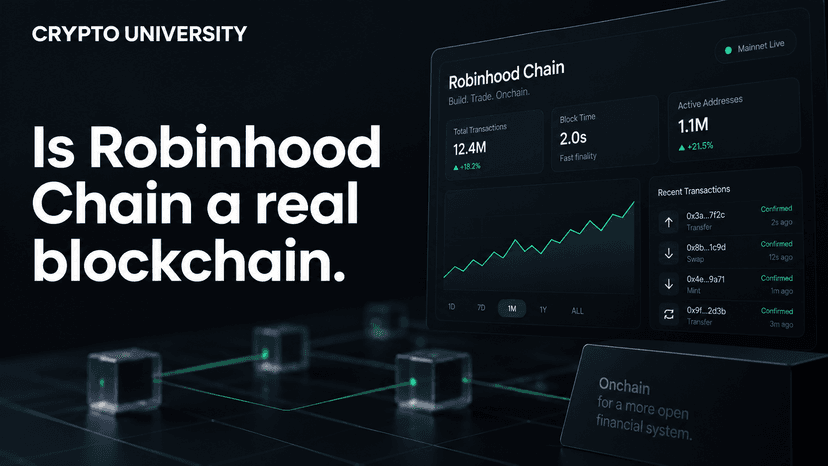
Robinhood Chain is a real blockchain by the technical definition. It is an Ethereum Layer 2 built with Arbitrum Orbit software, anyone can deploy a smart contract on it, and its transaction data is published to Ethereum where anyone can read and verify it.
It is not a decentralized blockchain. Robinhood runs the only sequencer, can upgrade core contracts with no waiting period, allows only two whitelisted addresses to challenge invalid states, and can make specific transactions fail at the protocol level. L2Beat rates it below Stage 0, its lowest maturity tier.
The "database" criticism applies hardest to the Stock Tokens, not to the chain itself. Those tokens are debt securities issued by a Jersey company, and the controlling contracts can pause, burn, or confiscate holder balances.
Robinhood Chain is a blockchain, and it is also heavily controlled by Robinhood. Both statements are true at the same time, which is why the argument keeps repeating online.
The useful question is not "blockchain or database." It is "which blockchain properties does this network actually give me, and which ones does it not." This guide answers that with checkable facts.
What Separates a Blockchain From a Company Database
A private database has four qualities a public blockchain is supposed to remove. Only the operator can write to it. Only the operator can read all of it. The operator can rewrite past records. And users have no independent copy to check the operator against.
A public blockchain inverts all four. Anyone can submit transactions, anyone can read the full state, history is hard to rewrite, and outsiders can verify the operator's work. Real networks land on a spectrum between those poles rather than at one end.
How Robinhood Chain Is Actually Built
Robinhood Chain launched a public testnet on 10 February 2026 and a public mainnet on 1 July 2026. It uses Arbitrum Orbit, the same rollup software stack behind Arbitrum One.
Property | Detail |
|---|---|
Network type | Optimistic rollup, Ethereum Layer 2 |
Software stack | Arbitrum Orbit, Nitro, ArbOS 61 |
Chain ID | 4663 |
Gas token | ETH, no native network token |
Block time | Roughly 100 milliseconds |
Data availability | Posted to Ethereum as blobs or calldata |
Value secured | About 2.9 billion US dollars as of early September 2026 |
Oracle provider | Chainlink |
Main applications | Uniswap, Morpho, Lighter, and a meme coin launchpad called Pons |
These choices matter. Using ETH for gas rather than a company token, and publishing data to Ethereum rather than a private server, are not things a firm building a marketing gimmick would bother with.
Where Robinhood Chain Behaves Like a Real Blockchain
All transaction data goes to Ethereum. Roughly 77 gigabytes had been posted by early September 2026, around 600 megabytes a day. Anyone can download it and rebuild the chain state without asking Robinhood. A private database cannot be rebuilt by outsiders.
Deployment is open. Any developer with a small amount of ETH can deploy an ERC-20 token or any other contract. Robinhood did not approve the meme coin launchpad that became one of the chain's busiest applications, and could not have blocked it without changing the chain's rules.
Verification is independent. Third parties such as L2Beat and Blockscout publish metrics, contract permissions, and risk reports that Robinhood does not control. That kind of outside audit is impossible for a closed ledger.
Fraud proofs exist. The dispute system is fully deployed. If someone publishes an incorrect summary of the chain's state, a challenger can prove it wrong on Ethereum within a challenge period of six days and eight hours.
Assets can leave. Users can withdraw to Ethereum through the canonical bridge, and once a state root is confirmed the withdrawal completes on Ethereum without Robinhood's cooperation.
Where Robinhood Chain Behaves Like Company Infrastructure
One sequencer. A single address orders every transaction. There is no backup operator and no rotation. If it stops, the chain stops.
Force inclusion has a hole in it. Rollups normally give users an escape hatch: if the sequencer censors you, you submit your transaction through Ethereum instead. Robinhood Chain has that mechanism, but it also runs a transaction filtering feature in ArbOS 61. An authorised filterer can register a transaction hash in a system contract, after which the network forcibly fails that transaction even when it arrives through the Ethereum escape hatch. L2Beat therefore treats force inclusion as an unreliable protection here. The filter list held roughly 6,000 entries in September 2026, most of which were added in July when Robinhood blocked a single scam wallet linked to a fake seed phrase leak.
Two whitelisted validators. Only two addresses may propose and challenge state updates. L2Beat's concern is that a challenger set this small could in principle collude with the proposer.
Instant upgrades and no exit window. A seven of eight multisignature wallet can upgrade the core contracts with no delay. Users therefore have no guaranteed period in which to withdraw before a change they dislike takes effect. L2Beat lists a malicious upgrade as a critical risk on this chain.
Why L2Beat Rates It Below Stage 0
L2Beat grades rollup maturity from Stage 0 to Stage 2. Stage 0 is the entry level, not a badge of decentralization. As of September 2026 the tracker states that Robinhood Chain does not meet even Stage 0 requirements, and lists further issues blocking Stage 1 and Stage 2.
L2Beat is explicit that stages measure maturity, not overall safety. A young chain run by a large regulated broker can be low risk in practice and still rank poorly here.
The September 2026 Outage Made the Difference Visible
On 4 September 2026, Robinhood Chain stopped producing blocks for at least 14 minutes. At a 100 millisecond block time, that is roughly 8,400 blocks that never existed. Robinhood did not publish a cause at the time. Liveness monitoring recorded several gaps in data submission that day, against a background of about 98 percent normal uptime over the prior 30 days.
Ethereum and Bitcoin have not had comparable halts, because no single operator can stop them. That is the practical meaning of a single sequencer.
Stock Tokens Are Where the Criticism Bites Hardest
The chain and the assets on it are two different questions, and beginners often merge them. Robinhood Stock Tokens are ERC-20 tokens issued by Robinhood Assets (Jersey) Limited, registration number 162428. Robinhood's own documentation describes them as tokenised debt securities that give economic exposure to shares and ETFs but grant no legal or beneficial rights in the underlying securities. Holders are not shareholders. They are not registered under US securities law and are not offered to US persons.
The contract permissions are equally important. The shared access control registry behind these tokens allows privileged roles to mint, to burn an arbitrary holder's balance, to confiscate balances even while a token is paused or an address is blocked, to pause individual tokens or all of them, and to upgrade the shared implementation.
That is a legitimate design for a regulated securities product. It is also the exact set of powers a database administrator has. If your test for "real crypto" is that nobody can take your balance, Stock Tokens fail it even though they sit on a genuine blockchain.
Explore more: What Are Tokenized Stocks? Robinhood Chain Stock Tokens Explained
Side by Side Comparison
Property | Private database | Robinhood Chain | Ethereum mainnet |
|---|---|---|---|
Anyone can read full state | No | Yes | Yes |
Anyone can deploy code | No | Yes | Yes |
Data verifiable by outsiders | No | Yes, via Ethereum | Yes |
Multiple block producers | No | No, single sequencer | Yes |
Censorship escape hatch | No | Partial, can be filtered | Yes |
Operator can halt the network | Yes | Yes, seen in practice | No |
Instant rule changes possible | Yes | Yes, via multisig | No |
Balances can be confiscated | Yes | For Stock Tokens, yes. For ETH, no | No |
How to Check This Yourself
Open the L2Beat page for Robinhood Chain and read the risk summary and permissions sections.
Open the Blockscout explorer for the chain and look at who posts blocks.
Read Robinhood's chain documentation, especially the pages on differences from Ethereum and on Stock Tokens.
Compare the same fields against a chain you already trust, such as Arbitrum One or Base.
Doing this once is a good habit for evaluating any new network.
A quick overview of deeper detail on Robinhood Chain: How to Get Started. How to Get Started on Robinhood Chain: A Complete Beginner's Guide.
What This Means for Learners
Treat Robinhood Chain as a regulated company running public blockchain infrastructure, rather than as a decentralized network or a marketing wrapper. It gives real benefits a database cannot: open development, external verification, portable assets, and settlement to Ethereum. It does not yet give censorship resistance or protection from unilateral rule changes.
That is a description, not a recommendation. It is what the network is today, and every fact above can be rechecked whenever the design changes. A quick overview of deeper detail on Best RugCheck Alternatives Every Beginner Trader Needs.
FAQ
Is Robinhood Chain a real blockchain?
Yes. It is an Ethereum Layer 2 rollup with public state, open contract deployment, and transaction data published to Ethereum. It is a real blockchain that is currently operated in a centralized way.
Is Robinhood Chain decentralized?
No. Robinhood runs the only sequencer, only two whitelisted addresses can challenge state updates, and core contracts can be upgraded without delay. L2Beat rates the chain below Stage 0.
Can Robinhood freeze or take my tokens?
For Robinhood issued Stock Tokens, the controlling contracts do allow pausing, burning, and confiscation of balances. For ETH and third party tokens on the chain, no such issuer power exists, although the sequencer can still refuse or fail specific transactions.
Do Stock Tokens make me a shareholder?
No. Robinhood describes them as tokenised debt securities from Robinhood Assets (Jersey) Limited that give economic exposure to a share price without legal or beneficial rights in the underlying security. They are not available to US persons.
Why does Robinhood Chain have no native token?
Robinhood chose ETH as the gas token and has not launched a network token. Activity on the chain is intended to benefit the listed company rather than a separate crypto asset.
Related Terms
Sequencer: the operator that orders transactions and produces blocks on a Layer 2.
Force inclusion: a mechanism letting users push transactions through the Layer 1 when a sequencer censors them.
Fraud proof: a challenge process for proving that a published state update is wrong.
Data availability: the guarantee that the data needed to verify or rebuild a chain is publicly obtainable.
Exit window: the time users have to withdraw before an upgrade to the system contracts takes effect.
Sources
L2Beat, Robinhood Chain project page, risk summary, stage analysis and permissions. https://l2beat.com/layer2s/projects/robinhood
Robinhood Chain documentation, Stock Tokens and differences from Ethereum. https://docs.robinhood.com/chain
CoinDesk, Robinhood rolls out public blockchain as it expands deeper into crypto, 1 July 2026.
BeInCrypto, Robinhood Chain briefly stops producing blocks, September 2026.
Decrypt, coverage of the AMC dispute over Robinhood Stock Tokens, September 2026.
Further Reading
Best Robinhood Chain Trading Platforms in 2026: FOMO, GMGN, Uniswap and OpenSea Compared
How to Get Started on Robinhood Chain: A Complete Beginner's Guide
What Are Tokenized Stocks? Robinhood Chain Stock Tokens Explained
Robinhood Chain: How to Get Started
Best RugCheck Alternatives Every Beginner Trader Needs
How to Get Started on Robinhood Chain: A Complete Beginner's Guide
Best RugCheck Alternatives Every Beginner Trader Needs
Solana vs Robinhood Chain: Which Network Has the Better Future?