Key Takeaways
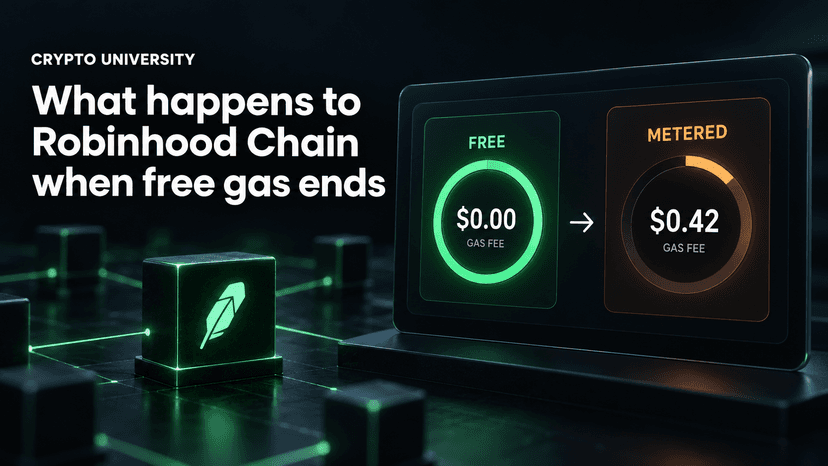
Robinhood has paid the network fee on qualifying swaps made inside Robinhood Wallet on Robinhood Chain since the mainnet launch on July 1, 2026. The offer is scheduled to end at 11:59pm EST on September 29, 2026.
The offer never covered everything. Bridges, wallet-to-wallet transfers, in-app dapp browser activity and third-party wallets have always paid full price, and those costs rose sharply in late August 2026.
The expiry is mainly a measurement event. It offers the first clean read on how much Robinhood Chain activity reflects real demand and how much was pulled forward by free transactions.
Robinhood Chain is an Ethereum Layer 2 network built with Arbitrum's Orbit framework. It went live on mainnet on July 1, 2026. Users pay gas in ETH, and the network has no token of its own.
Since launch, Robinhood has run a promotion that pays the network fee for certain transactions. The scope is narrower than the phrase "free gas" suggests. According to Robinhood's own support page for the promotion, coverage works like this.
Transaction type | Network fee covered? |
|---|---|
Crypto swaps inside Robinhood Wallet, above $0.50 | Yes |
Stock Token swaps inside Robinhood Wallet, above $0.50 | Yes |
One-time ERC-20 approval before a first swap of a token | Yes |
Wallet-to-wallet transfers | No |
Bridging from Robinhood Chain to another network | No |
Anything done through the in-app dapp browser | No |
Any activity from a third-party wallet | No |
Any network other than Robinhood Chain | No |
Robinhood states there are no caps, limits or frequency restrictions for transactions that meet those conditions. The company also lowered the minimum qualifying swap from $5 to $0.50 in early August 2026, which widened the number of trades that qualified. The terms allow Robinhood to change or end the promotion at any time without notice.
Two points matter for readers working out their own costs. Coverage depends on where you transact, not who you are, so there are no account tiers. And a large share of on-chain activity was never covered at all, because traders using external tools and bots sit outside the Robinhood Wallet app.
A quick overview of deeper detail on How to Get Started on Robinhood Chain: A Complete Beginner's Guide. Robinhood Chain: How to Get Started
Why the Timing Matters
For most of the chain's first two months, the subsidy was cheap to run. That changed in late August 2026, when trading activity around memecoin launchpads pushed the network's fee market well above its floor.
Measure | August 22, 2026 | September 2, 2026 |
|---|---|---|
Daily gas fees paid on the chain | About $54,000 | About $4.45 million |
Median base fee | About 0.02 gwei | About 0.467 gwei |
Execution cost per transaction | Under $0.01 | About $0.32 |
Gas as a share of all fees paid on the chain | 2.5% | 23.3% |
These figures come from DefiLlama and on-chain sampling reported by The Defiant. They are point-in-time readings on a young network and move quickly.
To put the September 2 number in context, Robinhood Chain collected more in gas that day than several far larger networks. Reported daily totals included roughly $874,000 on Tron, $613,000 on Solana, $480,000 on BNB Chain and $304,000 on Ethereum. A two-month-old Layer 2 was briefly the most expensive major chain to use.
Why the Fees Rose
The increase was mostly price, not volume. Transaction counts rose about 36% over the same stretch, while the cost of the average transaction rose far more.
Robinhood Chain uses Arbitrum's Nitro fee mechanism. The chain sets a minimum gas price of 0.02 gwei, the same default Arbitrum One uses. When demand pushes gas consumption above the network's targets, a backlog builds and the base fee climbs steeply to discourage further usage. When the backlog clears, the fee falls back toward the floor.
That design worked as intended. Launchpad and bot activity created sustained demand, the backlog grew, and the base fee moved roughly 23 times above its minimum. Users outside the Robinhood Wallet felt this immediately. Users inside it did not, because Robinhood absorbed the difference.
What Changes on September 30
If the offer expires as written, the practical effect is narrower than headlines suggest, because it only shifts costs for one group.
Group | Before September 30 | After September 30 |
|---|---|---|
Robinhood Wallet users doing qualifying swaps | Paid no network fee | Pay the prevailing network fee in ETH |
Robinhood Wallet users bridging or transferring | Already paid | No change |
Third-party wallet and bot users | Already paid | No change |
Application fees on launchpads and DEXs | Always paid | No change |
Two clarifications are worth stating plainly. The offer covers the network fee only. It never covered application-level fees charged by launchpads, trading bots or decentralized exchanges, which for many traders were the larger cost. And qualifying wallet users will need ETH on Robinhood Chain to transact, where previously they could swap without holding a gas balance.
Robinhood Cannot Simply Turn the Fees Down
One common assumption is that Robinhood can lower costs by raising the chain's throughput. That decision is not Robinhood's alone.
Robinhood Chain's parameters sit with a Security Council of eight signers. Robinhood holds two seats. The remaining six are held by BitGo, Chainlink Labs, Fireblocks Trust Company, Offchain Labs, Paxos and Talos. Routine changes require six of eight approvals plus a seven-day on-chain timelock. Emergency actions require seven of eight and skip the delay.
This matters for anyone reading commentary that treats a fee fix as a simple product decision. Parameter changes involve independent parties and a built-in delay.
What to Watch After the Deadline
The expiry is useful precisely because it removes a variable. Every headline metric from the chain's first quarter was recorded while a portion of transactions were free. Analysts have flagged a few things worth tracking in October and beyond.
Transaction counts and daily active wallets. These are the metrics most inflated by free execution, so they are the most likely to move.
DEX volume composition. Whether trading holds up, and whether it shifts between memecoins and tokenized assets.
Stock Token share of activity. Tokenized real-world assets fell from roughly a third of the chain's total value locked in early July to around 6% by mid-August, even as their absolute value grew. This is the use case Robinhood says the chain was built for.
Whether the offer is extended. The terms permit Robinhood to change the end date without notice.
Robinhood's third-quarter results, due in late October 2026, the first reporting period covering a full quarter of mainnet operation.
One accounting detail is worth knowing. Reporting suggests the subsidy has been recorded as a marketing expense rather than netted against chain revenue. That structure resembles the economics of commission-free brokerage, where low execution costs attract users and the parent company earns from adjacent products.
What This Does Not Tell You
It is easy to read the deadline as a verdict. It is not one. A drop in transaction counts after a free-transaction promotion ends is expected, not evidence of failure, and stable counts would not by themselves prove durable demand. Networks routinely see activity settle once launch incentives end, and one month is a narrow window.
Nobody currently has post-subsidy data for this chain, including Robinhood. October will produce the first sample.
Practical Notes for Users
If you use Robinhood Wallet on Robinhood Chain, a few steps are straightforward:
Check the current terms on Robinhood's support page before the deadline, since the company can change the offer date.
Hold a small ETH balance on Robinhood Chain if you intend to keep transacting after coverage ends.
Check live gas prices on a block explorer for the chain rather than relying on any static figure, including the ones in this article.
Read the fee breakdown on any swap. Application fees and network fees are separate line items with separate causes.
Understand what you hold. Stock Tokens are debt securities issued by Robinhood Assets (Jersey) Limited. They track share prices without conveying ownership or voting rights, and they are not available to US persons.
Frequently Asked Questions
When exactly does the Robinhood Chain gas offer end?
The stated offer period runs from the launch of Robinhood Chain to 11:59pm EST on September 29, 2026. Robinhood reserves the right to change or end the promotion at any time without notice, so the live support page is the authoritative source.
Does the offer mean all Robinhood Chain transactions are free?
No. It covers network fees on qualifying crypto and Stock Token swaps made inside the Robinhood Wallet app, plus one-time ERC-20 approval fees, for swaps above $0.50. Bridges, wallet-to-wallet transfers, dapp browser activity and third-party wallets are excluded.
What will gas cost after the offer ends?
That depends entirely on demand at the time. The chain enforces a 0.02 gwei minimum, and the base fee rises above it when the network is congested. In early September 2026 the median sat well above the floor, but fee markets fall back as congestion clears.
Does Robinhood Chain have its own token?
No. Gas is paid in ETH and Robinhood has not announced a token or airdrop. Tokens using the Robinhood Chain name are unaffiliated. Robinhood Markets stock trades on Nasdaq under HOOD.
Where does the gas revenue go?
Robinhood receives gas fees after covering Ethereum data costs. Under the Arbitrum Expansion Program licence, 10% of net chain fees goes to the Arbitrum ecosystem, split 8% to the Arbitrum DAO treasury and 2% to a developer fund.
Related Terms
Gas fee: The payment made to a blockchain network to process a transaction, separate from any fee charged by an application.
Base Currency: The base currency is the first asset listed in a trading pair.
Layer 2: A network that processes transactions separately and posts compressed records back to a main chain such as Ethereum for settlement.
Sequencer: The server that orders transactions on a Layer 2. Robinhood operates the only sequencer on the Robinhood Chain.
Gas sponsorship: An arrangement where a third party, usually an app or wallet provider, pays a user's network fee on their behalf.
Sources
Robinhood Support, "Covered Robinhood Chain network fees in Robinhood Wallet" (promotion terms and conditions)
The Defiant, "Robinhood Chain Gas Fees Jump 82-Fold In 11 Days To Top Every Other Chain," September 3, 2026
DefiLlama, Robinhood Chain chain and fee dashboards
Datawallet, "Robinhood Chain Statistics and Trends for 2026," updated September 2026
Arbitrum Documentation, "Gas and fees" (Nitro base fee mechanism)
Robinhood Chain governance documentation (Security Council structure)
This article is educational and does not constitute financial advice. Figures cited are widely reported estimates from third-party dashboards and were accurate at the dates stated. Metrics on a network this young change quickly. Verify against live sources before relying on any number.
Further Reading
Best Robinhood Chain Trading Platforms in 2026: FOMO, GMGN, Uniswap and OpenSea Compared
What Are Tokenized Stocks? Robinhood Chain Stock Tokens Explained
Best RugCheck Alternatives Every Beginner Trader Needs
Solana vs Robinhood Chain: Which Network Has the Better Future?
Is Robinhood Chain a Real Blockchain or Just Robinhood's Database?