Key Takeaways
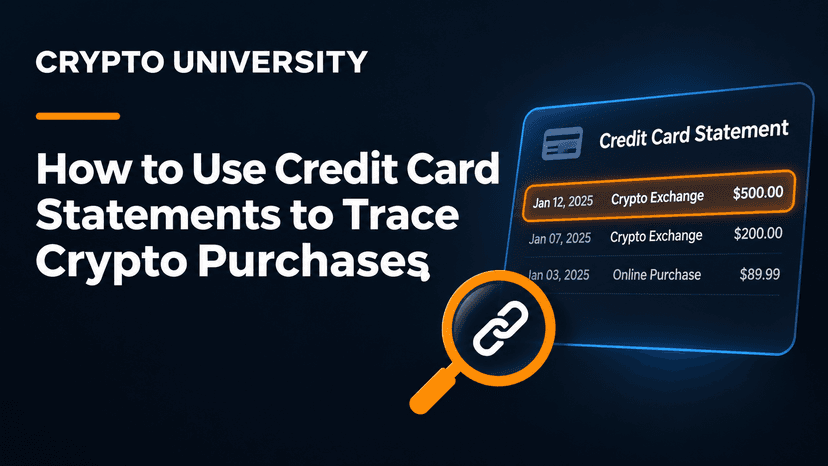
Your bank and card statements are a reliable paper trail. Every time you funded an exchange with money from a bank account or card, a line was recorded with a date, an amount, and a merchant name.
The descriptor is the clue. The short text next to each charge, plus related lines such as cash advance fees and tiny verification deposits, can reveal which exchange or payment provider you used.
A statement shows money in, not coins held. Use what you find to locate the account, then recover access only through the official platform and rebuild your purchase records.
Why Bank Statements Are Useful for Tracing Crypto
Most people bought their first crypto with regular money. That money had to leave a bank account or a card, and banks record every one of those movements. Even if you deleted the app, lost the password, or no longer use the email linked to the account, your bank still has a record of where the money went.
People usually look for these records for three reasons:
To find a forgotten exchange account. A charge from years ago can remind you which platform you signed up for.
To rebuild tax records. In the US, the IRS explains on its digital assets page that basis is generally your cost in US dollars, and that you need the date, amount, and value of each acquisition. A statement line is strong supporting evidence of what you paid.
To check a charge you do not recognize. A crypto descriptor you never authorized can be a sign that someone used your card or bank details.
Step 1: Get Your Old Statements
Start with whatever you can download, then request what is missing.
Source | How far back it usually goes | How to get it |
|---|---|---|
Online banking or card app | Varies by bank, often limited to recent years | Download PDF statements, not just the transaction list |
Paper statements at home | As far back as you kept them | Check files, drawers, and tax folders |
Bank records request | Many US banks keep records for at least 5 years | Call the official number or visit a branch and ask for specific months |
Closed accounts | Same retention rules usually apply | Bring ID, the account number or last 4 digits, and the date range |
DocuClipper's guide on getting statements from a closed account notes that US banks must keep many records for at least five years under the Bank Secrecy Act, and that some charge a research fee for older copies. Ask about fees before you place the request.
Tip: Download the official PDF statement where possible. Mobile apps sometimes shorten descriptors or hide small transactions. Coinbase's own help center makes the same point: its unauthorized transaction guide suggests using a desktop view or paper statement to see the full payment code.
Step 2: Understand What a Card Descriptor Is
A card descriptor (also called a merchant descriptor) is the short text that appears next to a charge on your statement. It is set by the merchant and its payment processor, and banks may shorten or reformat it.
A typical crypto descriptor has three parts:
Part | Example of what it may look like | What it tells you |
|---|---|---|
Brand or website | COINBASE.COM, a brand name, or a processor name | Which company took the payment |
Product hint | /BTC, BITCOIN, LITECOIN | Sometimes the asset or product |
Reference code | A string of letters and numbers | An internal ID that links the charge to one transaction |
Coinbase's help center shows an example descriptor in the format "COINBASE.COM/BTC" followed by a phone number and a reference code. Statement lookup services such as the Emma app's Coinbase page list several other versions reported by users, including variations that mention a city or a coin name. The exact wording depends on your country, your bank, the year, and the payment method.
Step 3: Learn the Patterns That Point to an Exchange
Exchanges do not always show their consumer brand name. Look for these patterns.
The exchange brand or website
This is the easiest case. Names like a well-known exchange or its web address appear directly in the descriptor.
The legal company name
Some platforms operate through a parent company with a different name. Kraken, for example, is run by Payward. Its electronic fund transfer disclosures name Payward Interactive, Inc. as the responsible US entity, and its UK funding page explains that bank transfers may show Payward Services Limited as the recipient. If you see an unfamiliar company name next to a large transfer, search for it together with the word "crypto."
A third-party payment provider
Many exchanges let outside companies handle card payments. Binance announced card purchases through a partnership with Simplex in 2019, and in 2023 Binance.US turned to MoonPay after losing banking partners. In cases like these, your statement may name the provider rather than the exchange. Once you know the provider, think about which app or website sent you to it.
Bank transfer references
ACH transfers, wires, and local bank transfers often show a payee name and a reference number instead of a merchant descriptor. The payee may be the exchange, its legal entity, or a partner bank.
Step 4: Look for Supporting Clues Around the Charge
The main charge is not the only line worth reading. Related entries can confirm what happened.
Clue on the statement | What it usually means |
|---|---|
Cash advance fee on the same day | A credit card purchase coded as crypto. Card networks classify crypto as quasi-cash under codes such as MCC 6051, and many issuers treat it like a cash advance |
Two or more tiny deposits under $1 | Bank account verification. Coinbase explains that it sends small verification amounts that appear on your statement |
Foreign transaction fee | The exchange or processor was based abroad |
Recurring charge on the same day each month | A recurring buy or a paid subscription on the platform |
Incoming transfer from an exchange name | A withdrawal or sale that sent money back to your bank |
The quasi-cash rule matters because it explains why crypto charges look different from normal shopping. A September 2026 analysis from Didit describes how Visa's merchant data rules require crypto purchases to use MCC 6012 or 6051 and carry a crypto indicator. The merchant category code is not always printed on statements, but your card issuer can usually tell you which code a charge used.
Step 5: Turn the Clues Into a Record
Once you have found the relevant lines, organize them in one place. A simple spreadsheet works well.
Column | What to record |
|---|---|
Date | The posting date and, if shown, the transaction date |
Amount | The amount in your home currency, including fees |
Descriptor | Copy the text exactly as printed |
Payment method | Debit card, credit card, ACH, wire, or other |
Likely platform | The exchange or provider you matched it to |
Matched record | The exchange receipt or trade ID, once you find it |
Matching statements to exchange records
Log in or recover the account on the official website you identified.
Download the transaction history from the platform, usually as a CSV file.
Match each bank line to a deposit or purchase on the platform by date and amount.
Note the units bought and the price, which the bank statement cannot show.
Keep both records together for your tax files.
If the platform has closed, your statement may be the best remaining proof of what you paid. Keep a copy of the official PDF rather than a screenshot.
What Statements Cannot Tell You
Statements are helpful, but they have limits:
They show money, not coins. You will see how much you spent, not how much crypto you received or where it went next.
They miss crypto-only activity. Trades between coins, transfers between wallets, and peer-to-peer purchases paid in cash leave no bank trace.
Descriptors change over time. The same exchange may have used different processors and different descriptor formats across the years.
Banks shorten text. Some cut descriptors to a fixed length or merge small transactions.
If You Find a Charge You Did Not Make
Coinbase's charge help page explains that an unrecognized charge can mean someone connected your bank account without permission. If you see a crypto descriptor you do not recognize:
Contact your bank or card issuer through the number on your card or official app and report it.
Contact the platform through its official help center with the date, amount, and full descriptor.
Secure your online banking by changing your password and turning on two-factor authentication.
Ignore anyone who contacts you first offering to reverse the charge or recover funds for a fee.
FAQ
How do I know which crypto exchange I used from my bank statement? Look at the descriptor next to each charge. It may show the exchange name, its website, its legal company name, or a payment provider. Search any unfamiliar name together with "crypto" to identify it.
Why does my credit card show a cash advance fee for a crypto purchase? Card networks classify crypto purchases as quasi-cash, often under MCC 6051. Many card issuers treat these as cash advances, which can add a separate fee and interest from the day of purchase.
Can I use a bank statement as proof of cost basis for taxes? A statement can support what you paid, but it does not show how many units you bought or the exact price. Pair it with the exchange's transaction history where possible, and ask a tax professional about your situation.
How far back can I get old bank statements? It depends on the bank. Many US banks keep records for at least five years, and some keep them longer. Older statements may need a formal request and a small fee.
Why does my statement show a company I have never heard of? Many exchanges use parent companies or outside payment providers. The name on your statement may be that company rather than the app you used.
Related Terms
Cost Basis: The original value of an asset for tax purposes, usually what you paid for it including fees.
KYC: Know Your Customer, the identity checks that regulated exchanges and payment providers carry out before you can buy crypto.
Fiat On-Ramp: A service that lets you convert regular money, such as dollars or euros, into crypto.
Disclaimer
This article is for educational purposes only and is not financial, legal, or tax advice. Descriptor formats, bank policies, and card rules vary by country and can change. Contact your bank or the platform directly for records about your own account.
Sources
The IRS digital assets page explains basis and the records taxpayers should keep.
Coinbase's unauthorized transaction guide shows an example descriptor and suggests checking the full statement.
Coinbase's bank verification article describes small verification amounts on statements.
Coinbase's charge help page covers unrecognized charges.
The Emma app lists user-reported Coinbase descriptor variations.
Kraken's EFT disclosures and UK funding update name its Payward entities.
Binance's Simplex announcement and The Block's MoonPay report cover third-party card processing.
Didit's merchant code analysis summarizes Visa's crypto MCC rules, and TechCrunch covered the 2018 cash advance change.
DocuClipper explains bank record retention and how to request old statements.