Key Takeaways
UST was backed by demand for LUNA, not by outside assets. Its peg relied on traders swapping UST for newly minted LUNA. When confidence in LUNA fell, the mechanism printed more LUNA and made the problem worse.
Most UST demand came from one yield product. Anchor Protocol paid close to 20% a year on UST deposits and held most of the UST in circulation. That yield was subsidized, not earned, and it could not last.
The best test of any stablecoin is what happens under stress. Look at what backs it, who can redeem it, where any yield comes from, and whether the stabilizing mechanism depends on its own token.
Introduction
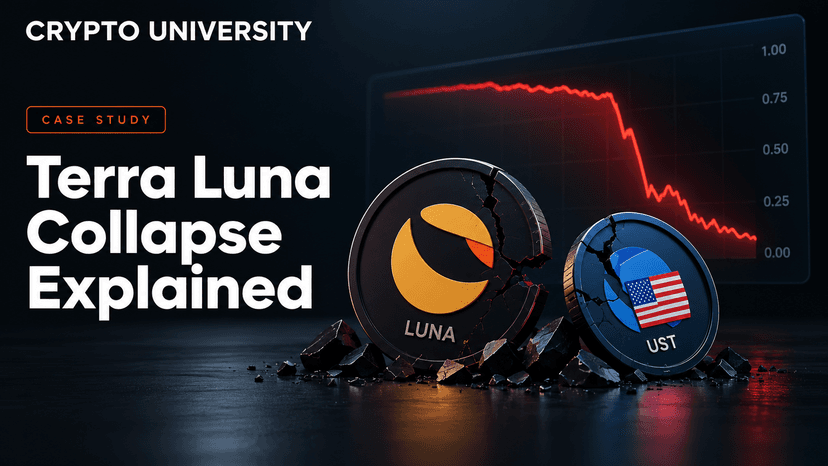
In May 2022, TerraUSD (UST), then one of the largest stablecoins in crypto, lost its $1 peg and failed within about a week. Its sister token, LUNA, went from roughly $80 to a fraction of a cent. An estimated $40 billion in market value was erased, and the damage spread to lenders and funds across the industry.
This case study explains how the system worked, why it broke, and how to apply the lessons to any stablecoin. It is educational content, not investment advice.
What Terra, UST, and LUNA Were
Terra was a blockchain developed by Terraform Labs, a company co-founded by Do Kwon. It had two main tokens:
UST (TerraUSD): an algorithmic stablecoin designed to stay at $1 without holding dollars in a bank.
LUNA: a volatile token used for staking, governance, and, most importantly, absorbing changes in UST supply.
UST grew fast. Its circulating supply rose from about $2 billion to roughly $18.5 billion in a single year, and LUNA reached a peak near $119 in early April 2022.
Timeline of the Collapse
Date | Event |
|---|---|
May 2021 | UST briefly loses its peg. Court filings later showed that a trading firm secretly bought UST to restore it, while the recovery was publicly credited to the protocol. |
Feb 2022 | The Luna Foundation Guard (LFG) commits about $450 million to refill Anchor's shrinking yield reserve. |
Mar to May 2022 | LFG buys Bitcoin as an emergency reserve for UST. By May 7 it holds 80,394 BTC. |
May 7, 2022 | Large amounts of UST leave Anchor and are sold on Curve Finance. UST starts to slip below $1. |
May 8 to 10, 2022 | LFG converts nearly all of its Bitcoin into UST purchases to defend the peg. |
May 9 to 11, 2022 | Anchor deposits fall from about $14 billion to $8.7 billion by May 9. By May 11, over 11 billion UST has been withdrawn. |
May 12 to 13, 2022 | LUNA falls below one cent. Validators halt the Terra chain twice. Many exchanges suspend trading. |
May 16, 2022 | LFG reports that only 313 BTC remain in its reserve. |
May 28, 2022 | A new chain, Terra 2.0, launches. The original chain becomes Terra Classic (LUNC and USTC). |
Mid 2022 | Contagion hits lenders and funds, including Three Arrows Capital, Celsius, and Voyager. |
Jun 2024 | Terraform Labs and Do Kwon agree to settle the SEC's civil fraud case, with a reported total of about $4.47 billion. |
Dec 11, 2025 | After pleading guilty to fraud charges in August 2025, Do Kwon is sentenced to 15 years in US federal prison. |
How the Mint and Burn Mechanism Worked
UST had no bank account full of dollars behind it. Instead, the Terra protocol always treated 1 UST as worth exactly $1 of LUNA. Anyone could swap between the two at that rate, and arbitrage traders were expected to keep the price at $1.
Situation | What traders could do | Effect on supply | Intended result |
|---|---|---|---|
UST trades above $1 | Burn $1 of LUNA to mint 1 UST, then sell the UST for a profit | UST supply rises, LUNA supply falls | UST price falls back to $1 |
UST trades below $1 | Buy cheap UST, burn it, and receive $1 of newly minted LUNA | UST supply falls, LUNA supply rises | UST price rises back to $1 |
In calm markets this worked. The weakness was in the second row. When UST fell below $1, the system defended the peg by creating new LUNA. That only works if the market is willing to buy that LUNA at a fair price. In other words, UST was only as strong as confidence in LUNA, and LUNA's value depended heavily on UST's growth.
This is called endogenous backing: the collateral comes from inside the same system it is meant to protect. Fiat-backed stablecoins use exogenous backing, meaning assets such as cash and government bonds that exist independently of the token.
Why the Anchor Yield Was Unsustainable
Anchor Protocol was a lending market on Terra. Depositors earned a target rate of roughly 19.5% a year on UST, far above typical rates in traditional finance or other crypto lending markets.
The rate was paid from three sources:
Income source | How it worked | Problem |
|---|---|---|
Borrower interest | Borrowers paid interest on UST loans | Deposits far exceeded borrowing, so interest income was too small |
Staking rewards | Borrowers posted staked assets such as bonded LUNA as collateral, and the rewards went to Anchor | Rewards fell when markets fell |
Liquidation fees | Fees from liquidated loans | Irregular and unreliable |
Because income did not cover payouts, Anchor drew on a yield reserve to make up the gap. Reports from early 2022 showed the reserve losing roughly $1 million to $1.6 million per day. LFG added about $450 million in February 2022, but by April the reserve was again shrinking faster than planned.
The bigger problem was concentration. By May 2022, Anchor held around $14 billion of UST, widely estimated at 70% to 80% of all UST in circulation. Most people did not hold UST to make payments. They held it to earn Anchor's yield. That meant demand for UST could disappear the moment the yield looked risky.
The lesson: a high, fixed yield that is not funded by real economic activity is a subsidy. Subsidies end, and when they do, the capital they attracted often leaves at once.
The Death Spiral, Step by Step
A "death spiral" describes a feedback loop where each attempt to stabilize a system makes it weaker. Terra's unfolded in this order:
Confidence cracks. Large UST withdrawals from Anchor and sales on Curve push UST below $1.
Holders rush to exit. Depositors fear a deeper depeg and withdraw from Anchor. Billions of UST hit the market.
The protocol mints LUNA. Arbitrage traders burn UST for newly created LUNA and sell that LUNA immediately.
LUNA's price falls. More LUNA supply plus selling drives its price down, which weakens the backing for UST.
The outside reserve fails. LFG sells about 80,000 BTC to buy UST. The defense slows the fall but cannot stop it.
Hyperinflation. LUNA's circulating supply grows from roughly 350 million tokens to around 6.5 trillion in days.
Redemption becomes impossible. Once LUNA's total market value falls below UST's, the system cannot honor $1 for every UST. Holders sell at any price, and UST drops to a few cents.
The key insight is reflexivity. UST's stability depended on LUNA's price, and LUNA's price depended on UST's stability. In a crisis, both moved down together.
UST vs Fiat-Backed Stablecoins Like USDC
Fiat-backed stablecoins take a different approach.
Feature | UST (algorithmic) | USDC (fiat-backed) |
|---|---|---|
What backs it | Market demand for LUNA | Cash and short-term US government securities held by the issuer |
Type of backing | Endogenous (inside the system) | Exogenous (outside the system) |
Redemption | Swap for $1 worth of LUNA | Eligible customers redeem with the issuer for US dollars |
Transparency | On-chain supply, but no independent reserve of equal value | Regular third-party reserve reports |
Built-in yield | Around 19.5% through Anchor | None paid to ordinary holders |
Main risk | Loss of confidence triggers a death spiral | Bank, custody, issuer, and regulatory risk |
Stress example | May 2022: fell to a few cents and did not recover | March 2023: fell to about $0.87 and recovered within days |
Fiat-backed does not mean risk-free. In March 2023, Circle disclosed that $3.3 billion of roughly $40 billion in USDC reserves was held at Silicon Valley Bank, which had just failed. USDC briefly traded near $0.87. It recovered after the deposits were confirmed to be accessible.
The difference is what happened next. USDC had real assets that could be recovered. UST had only more LUNA to offer.
Lessons: How to Evaluate Any Stablecoin
Use these questions before relying on any stablecoin:
Question | What to look for | Red flag |
|---|---|---|
What backs it? | Assets that exist outside the token's own ecosystem | Backing depends on a sister token or the project's own governance token |
Can holders redeem at $1? | Clear redemption rules, who qualifies, and any limits | No direct redemption, or redemption only into a volatile token |
How transparent are reserves? | Frequent third-party reports and published reserve breakdowns | Vague or infrequent disclosures |
Where does the yield come from? | Real, explainable revenue | High fixed rates funded by reserves or token incentives |
Who holds it and why? | Broad use for payments, trading, and settlement | Most supply sits in one protocol for yield |
How did it handle stress? | Past depegs and how quickly it recovered | A history of quiet interventions or unexplained recoveries |
Who is accountable? | A known issuer, legal structure, and regulatory status | Key-person risk and no clear legal recourse |
A stablecoin that fails several of these checks at once deserves extra caution, however stable its price has looked so far.
Go deeper with our Stablecoins: A quick overview of deeper detail on Compare Places to Buy Stablecoins Worldwide.
Frequently Asked Questions
What caused the Terra Luna collapse?
Large UST withdrawals and sales in May 2022 pushed UST below $1. The mint and burn mechanism then created huge amounts of new LUNA, which crashed LUNA's price and removed the backing UST depended on.
Was UST backed by Bitcoin?
Partly, and only late. The Luna Foundation Guard bought about 80,000 BTC in 2022 as an emergency reserve. It was worth far less than the UST supply and was almost fully spent within days of the depeg.
Are all algorithmic stablecoins doomed to fail?
Not necessarily, but designs that rely on their own token for backing carry reflexive risk. Many newer designs add outside collateral or overcollateralization to reduce that risk.
Is USDC completely safe?
No stablecoin is risk-free. USDC is backed by outside assets, but it carries bank, custody, issuer, and regulatory risk, as the brief March 2023 depeg showed.
What happened to Do Kwon?
Do Kwon was arrested in Montenegro in 2023, extradited to the United States, pleaded guilty to fraud charges in August 2025, and was sentenced to 15 years in prison in December 2025.
Related Terms
Algorithmic Stablecoin: A stablecoin that tries to hold its price through code-driven supply changes rather than full reserves of outside assets.
Depeg: When a stablecoin's market price moves meaningfully away from the value it is designed to track, such as $1.
Death Spiral: A feedback loop in which falling prices trigger actions that push prices down even further.
Arbitrage: Buying an asset in one place and selling it in another to profit from a price difference.
Reserve Attestation: A report from an independent accounting firm confirming the assets a stablecoin issuer says it holds at a point in time.
Sources
CoinDesk, "Luna Foundation Guard Left With 313 Bitcoin After UST Crash" (May 16, 2022): https://www.coindesk.com/business/2022/05/16/luna-foundation-guard-left-with-313-bitcoin-after-ust-crash
CoinDesk, "Investors Flee Terra's Anchor as UST Stablecoin Repeatedly Loses $1 Peg" (May 9, 2022): https://www.coindesk.com/markets/2022/05/09/investors-flee-terras-anchor-as-ust-stablecoin-repeatedly-loses-1-peg
CoinDesk, "LUNA, UST Issuer Terra Restarts Blockchain After Brief Shutdown" (May 12, 2022): https://www.coindesk.com/business/2022/05/12/luna-issuer-terra-halts-blockchain-after-week-of-losses
Chainalysis, "UST's Collapse and the Trades That Triggered It": https://www.chainalysis.com/blog/how-terrausd-collapsed/
Bitstamp Learn, "Terra Network Collapse": https://www.bitstamp.net/en-gb/learn/crypto-101/terra-network-collapse/
Yahoo Finance (CoinDesk), "Anchor Protocol Reserves Slide as Money Market's Founder Talks Down Concerns" (Jan 2022): https://finance.yahoo.com/news/anchor-protocol-reserves-slide-money-132554340.html
BeInCrypto, "Luna Foundation Proposes $450M Cash Injection to Boost Anchor DeFi Protocol Reserves" (Feb 2022): https://beincrypto.com/luna-foundation-450m-cash-injection-boost-anchor-defi-reserves/
Xangle Research, "Anchor's Yield Reserve is Not Looking Well" (Apr 2022): https://xangle.io/en/research/detail/659
Reuters via Yahoo Finance, "TerraUSD creator Do Kwon sentenced to 15 years over $40 billion crypto collapse" (Dec 11, 2025): https://finance.yahoo.com/news/terrausd-creator-kwon-sentenced-over-111455036.html
Decrypt, "USDC Stablecoin Falls to 87 Cents After Circle Discloses Exposure to Silicon Valley Bank" (Mar 2023): https://decrypt.co/123211/usdc-stablecoin-depegs-below-87-cents-amid-silicon-valley-bank-exposure
Forkast, "Circle says US$3.3 bln USDC reserve at SVB available Monday" (Mar 2023): https://forkast.news/?p=88981
Disclaimer: This content is for educational and informational purposes only and is not financial, investment, legal, or tax advice. Nothing here is a recommendation to buy or sell any asset or use any platform. Do your own research and manage your risk. Cryptocurrency involves risk, including the permanent loss of funds.