Mastering Stablecoin Yield Strategies: RWA-Backed, DeFi Lending, and Liquidity Provision in 2026
In the volatile world of cryptocurrency, stablecoins serve as the essential bedrock of capital preservation and trading liquidity. However, holding idle stablecoins in a centralized exchange wallet or a non-yielding self-custody wallet represents a significant opportunity cost due to inflation. By 2026, the landscape of stablecoin yield has matured from the reckless, unsustainable "ponzi-nomics" of the early 2020s into a sophisticated, multi-tiered ecosystem driven by Real-World Asset (RWA) integration, over-collateralized decentralized lending, and highly optimized liquidity provision.
For High-Net-Worth Individuals (HNWIs), family offices, and sophisticated retail investors, generating sustainable, risk-adjusted yield on stablecoins is a core portfolio management objective. The key is no longer chasing the highest advertised Annual Percentage Yield (APY), but rather understanding the underlying mechanics of that yield, the associated risk tranches, and the regulatory frameworks governing the protocols.
This comprehensive guide breaks down the three primary pillars of modern stablecoin yield generation, the top-tier platforms for deploying capital safely in 2026, and the strict operational security frameworks required to protect your principal while compounding returns.
The 3 Pillars of Modern Stablecoin Yield in 2026
To build a resilient stablecoin yield strategy, you must diversify across different yield-generation mechanisms, each with its own risk-reward profile.
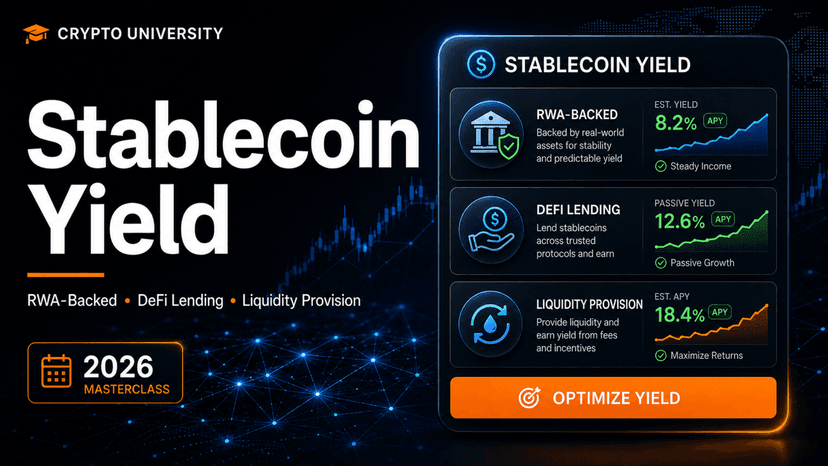
RWA-Backed Stablecoin Yields (The "Risk-Free" Baseline):
Following the maturation of global stablecoin regulations (like the EU’s MiCA and evolving US frameworks), the safest stablecoin yields are now directly backed by tokenized short-term U.S. Treasuries and regulated money market funds. Protocols pass the yield from these underlying traditional finance (TradFi) assets directly to the token holder, offering a sustainable, inflation-hedged return that is largely decoupled from crypto market volatility.
Over-Collateralized Decentralized Lending:
Platforms like Aave and Morpho allow users to supply stablecoins to decentralized liquidity pools, which are then borrowed by other users who must over-collateralize their loans with volatile crypto assets (like BTC or ETH). The yield is generated from the borrowers' interest payments. In 2026, "Isolated Lending Markets" ensure that risky collateral types are siloed, protecting stablecoin suppliers from contagion if a specific altcoin market crashes.
Concentrated Liquidity Provision (Stable Pairs):
Providing liquidity to Automated Market Makers (AMMs) like Uniswap V3 or Curve for highly correlated pairs (e.g., USDC/USDT or USDC/DAI) remains a viable yield strategy. By concentrating liquidity in a tight price range around the $1.00 peg, liquidity providers (LPs) capture the vast majority of trading fees with minimal capital, significantly boosting capital efficiency compared to legacy, wide-range AMMs.
Top Platforms and Tools for Stablecoin Yield in 2026
Deploying stablecoin capital requires a stack that balances regulatory compliance, deep liquidity, and uncompromising security.
1. Kraken: Best for Regulated, RWA-Integrated Stablecoin Yield
For investors who prioritize regulatory compliance, transparency, and institutional-grade custody, Kraken offers the most secure gateway to stablecoin yield in 2026.
Core Features: Kraken’s "Simple Earn" and institutional products provide competitive, transparent yields on major stablecoins (USDC, USDT, PYUSD). Crucially, Kraken has integrated RWA-backed yield products, allowing users to earn returns derived from tokenized government securities while maintaining the liquidity of a major exchange.
Proof of Reserves & Compliance: Kraken publishes frequent, attested Proof of Reserves reports and operates under strict regulatory frameworks globally, ensuring that client stablecoin deposits are fully backed and segregated from corporate operational funds.
Why Investors Choose It: It eliminates smart contract risk and DeFi complexity. Investors get the yield benefits of stablecoin lending and RWA integration, wrapped in the security and regulatory compliance of a top-tier, publicly audited financial institution.
👉 Earn Regulated, Transparent Yield on Your Stablecoins with Kraken (Use referral code: QjZ0L3)
2. Bybit: Best for Flexible Savings and DeFi Yield Aggregation
For traders who want higher yield potential and the ability to instantly deploy stablecoins into trading strategies, Bybit offers a highly versatile, user-friendly suite of stablecoin earning products.
Core Features: Bybit’s "Flexible Savings" allows users to deposit stablecoins and earn competitive, daily-compounding interest with instant withdrawal capabilities. Additionally, Bybit’s Web3 wallet integrates with decentralized yield aggregators, allowing users to access higher-yielding DeFi lending markets directly from the platform’s interface.
Unified Margin Utility: Stablecoins earned or held in Bybit’s Earn products can often be instantly utilized as cross-margin collateral for futures trading, maximizing capital efficiency without the need to manually transfer funds between accounts.
Why Investors Choose It: It provides a seamless bridge between passive yield generation and active trading, offering deep liquidity and the flexibility to pivot strategies as market conditions change.
👉 Access Flexible, High-Yield Stablecoin Savings and DeFi Aggregation on Bybit (Use referral code: 46164)
3. Ledger: Best for Securing Self-Custodied Stablecoin Operations
For DeFi natives who prefer to interact directly with decentralized lending protocols or AMMs, securing the wallet is the absolute highest priority. Stablecoins are the primary target for wallet drainers due to their universal liquidity.
Core Features: Ledger hardware wallets provide FIPS 140-2 Level 3 certified Secure Element protection. When interacting with a DeFi lending protocol or liquidity pool, Ledger ensures that every token approval and deposit transaction requires physical cryptographic verification on the device’s secure screen.
Clear Signing for DeFi: Ledger’s ecosystem actively parses complex smart contract interactions, displaying human-readable details (e.g., "Approve 10,000 USDC for Aave V4") to prevent "blind signing" attacks where malicious contracts disguise unlimited token drains as routine yield deposits.
Why Investors Choose It: It provides the ultimate physical circuit breaker. Even if you navigate to a sophisticated phishing site mimicking a popular DeFi protocol, your stablecoins cannot be drained without your explicit, physical consent on the Ledger device.
👉 Secure Your Self-Custodied Stablecoin Yield Operations with a Ledger Hardware Wallet
Step-by-Step: How to Build a Resilient Stablecoin Yield Portfolio
Generating sustainable yield requires a disciplined, risk-aware workflow. Follow this exact blueprint:
Step 1: Define Your Risk Tranche Allocation
Do not chase the highest APY. Allocate your stablecoin capital based on your risk tolerance:
Tier 1 (Core Capital, 60-70%): Deploy into regulated, RWA-backed yields (via Kraken) or blue-chip, over-collateralized lending markets (like Aave main markets). Target: 4% - 6% APY.
Tier 2 (Yield Enhancement, 20-30%): Deploy into isolated DeFi lending markets or flexible savings products (like Bybit) for slightly higher returns. Target: 6% - 10% APY.
Tier 3 (Active Management, 10%): Deploy into concentrated liquidity pools (e.g., USDC/USDT on Uniswap V3) to capture trading fees. Target: 8% - 15% APY (highly variable).
Step 2: Vet the Protocol and Peg Stability
Before depositing into any decentralized protocol, verify its Total Value Locked (TVL), audit history (e.g., OpenZeppelin, Trail of Bits), and the specific stablecoins it accepts. Avoid protocols that offer abnormally high yields for accepting obscure, algorithmic, or lightly collateralized stablecoins.
Step 3: Execute with Hardware Security
If using DeFi, connect your Ledger hardware wallet to the official protocol interface. Verify the URL via a trusted bookmark. When approving the stablecoin spend limit, approve only the exact amount you are depositing, never "unlimited." Verify the transaction details on the Ledger’s physical screen before signing.
Step 4: Monitor and Rebalance
Stablecoin yields are dynamic. Monitor your positions weekly. If a lending market’s utilization rate spikes (driving borrowing rates, and thus your supply APY, to unsustainable levels), or if a stablecoin shows signs of peg weakness, be prepared to rotate your capital back to Tier 1 safe havens.
Risk Management: The Hidden Dangers of Stablecoin Yield
Stablecoin yield is not risk-free. You must actively manage these specific pitfalls:
Stablecoin De-pegging Risk: Not all stablecoins are created equal. Algorithmic or under-collateralized stablecoins can lose their peg during market panic, turning a "safe" yield strategy into a catastrophic principal loss. Mitigation: Stick exclusively to fully reserved, fiat-backed, or heavily over-collateralized stablecoins with transparent, real-time attestations (e.g., USDC, USDT, PYUSD, DAI).
Smart Contract and Protocol Risk: Depositing into a DeFi lending protocol or AMM exposes your funds to the risk of a smart contract exploit. Mitigation: Only use battle-tested, "blue-chip" protocols with billions in TVL, multiple top-tier audits, and active, well-funded bug bounty programs.
Regulatory and Freezing Risk: Regulated stablecoin issuers (like Circle for USDC) retain the ability to freeze addresses associated with illicit activity or sanctions. Furthermore, regulatory shifts could impact the legality of certain DeFi yield structures. Mitigation: Diversify across multiple stablecoin issuers and utilize a mix of regulated CeFi and decentralized DeFi platforms to avoid a single point of regulatory failure.
Tax Complexity: In most jurisdictions, yield earned from stablecoin lending, staking, or liquidity provision is classified as ordinary income at the fair market value when received. Mitigation: Use automated crypto tax software to track these events accurately.
👉 Automate Your Stablecoin Yield and DeFi Tax Tracking with Koinly
Frequently Asked Questions (FAQ)
Q: What is the safest way to earn yield on stablecoins in 2026?
A: The safest method is utilizing regulated, RWA-backed stablecoin yield products offered by compliant, proof-of-reserves-audited platforms like Kraken, or supplying stablecoins to the most established, over-collateralized decentralized lending markets (like Aave) while self-custodying the assets with a Ledger hardware wallet.
Q: Is providing liquidity to a USDC/USDT pool truly risk-free?
A: No. While the risk of impermanent loss is extremely low as long as both tokens maintain their $1.00 peg, you are still exposed to smart contract risk (the AMM could be hacked) and de-pegging risk (if one of the stablecoins loses its peg, you will be left holding 100% of the depreciating asset).
Q: How is stablecoin yield taxed?
A: Generally, interest earned from lending or rewards from liquidity provision are treated as ordinary income based on the fair market value of the tokens at the time they are received or compounded. When you eventually swap or spend those stablecoins, there is typically no capital gain/loss if the value remains at $1.00, but the initial income must be reported. Automated tracking via Koinly is essential to avoid missing these micro-income events.
Q: What should I do if a stablecoin I hold starts to de-peg?
A: Do not panic, but act swiftly. First, verify the cause of the de-peg (e.g., temporary market dislocation vs. fundamental collapse of the issuer). If it is a fundamental issue, immediately withdraw your funds from any yield protocol and swap the stablecoin for a more resilient alternative (like USDC or fiat) on a deep-liquidity exchange, accepting the minor loss to preserve the majority of your principal.
Risk Warning: Earning yield on cryptocurrencies, including stablecoins, carries inherent risks such as smart contract vulnerabilities, stablecoin de-pegging events, regulatory changes, and platform insolvency. While stablecoins are designed to maintain a stable value, they are not completely risk-free, and you could sustain a partial or total loss of your initial investment.
Not Financial Advice: The information provided in this article is for educational and informational purposes only. It does not constitute financial, investment, legal, or tax advice. Always conduct your own research (DYOR) and consult with a qualified, licensed professional before deploying capital into any yield-generating protocol or financial product.
Affiliate Disclaimer: This article contains affiliate links. If you click on these links and sign up for a service or make a purchase, we may earn a commission at no additional cost to you. We only recommend platforms, tools, and services that we have thoroughly vetted and believe provide genuine value, security, and utility to our readers.