Key Takeaways
Most of the work happens before the trade. Choosing an available platform, passing identity checks, and securing the account take far longer than the purchase itself, which is usually a single confirmation screen.
Cost is rarely one number. Beginner "buy now" screens typically bundle a commission with a spread, and on the same platform the advanced order book often costs a fraction of that for an identical purchase.
Buying is not the last decision. Whether the crypto stays with the exchange or moves to a wallet you control is a separate choice with a completely different risk profile.
Most people expect buying crypto to feel like trading. In practice, a first purchase is closer to opening a bank account. The order itself usually takes under a minute. Everything around it, including verification, funding, and security setup, is where the time and the mistakes actually live.
This guide walks through the process in the order you will meet it, explains what each fee is for, and flags the errors beginners most commonly make. It is educational only. It does not recommend a platform, an asset, or an amount, and nothing here is financial advice.
What a Crypto Exchange Actually Does
A centralised exchange, often shortened to CEX, performs three jobs at the same time:
On-ramp. It converts government-issued money such as dollars, euros, or pounds into crypto.
Marketplace. It matches buy and sell orders from users on an order book, which is a live list of what people are willing to pay and accept.
Custodian. It holds the crypto for you after the purchase.
That third job matters more than most beginners realise. While coins sit on an exchange, the platform controls the private keys. What you hold is an account balance and a claim against a company, not the asset itself. That arrangement works for many people, but it is legally and technically different from holding the asset in a wallet you control.
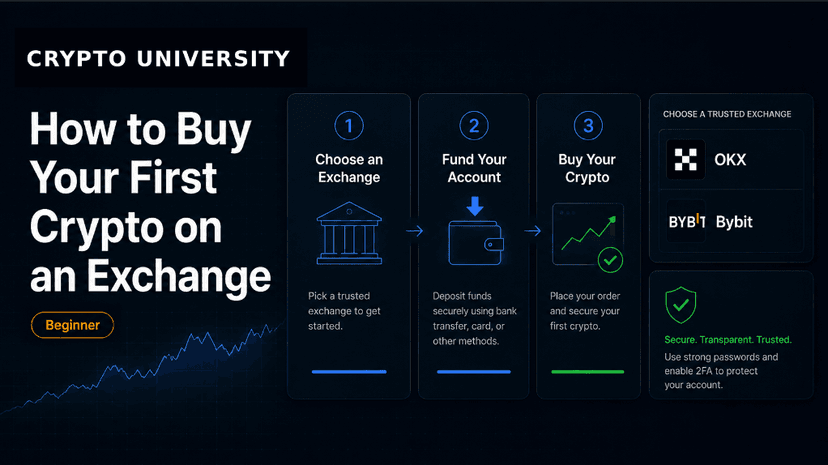
Step 1: Choose an Exchange That Is Legally Available Where You Live
Availability is the first filter, not price. Exchanges operate under regional licences, so the same brand can offer different products, assets, and protections depending on the country you are in.
Checkpoint | Why it matters | Where to check |
|---|---|---|
Local availability | Some assets and features are restricted or absent in certain countries. | The platform's supported-countries page |
Registration or licence | In the EU, crypto-asset service providers were required to hold MiCA authorisation by 1 July 2026. US platforms register with FinCEN as money services businesses and usually hold state money transmitter licences. UK firms require FCA registration. | Public regulator registers, not the marketing page |
Fiat support | If your currency or banking rails are unsupported, you pay conversion costs on every deposit. | The deposit page before signing up |
Withdrawal rights | A few platforms limit moving crypto off-platform, which locks you into custodial storage. | Support documentation on withdrawals |
Published fee schedule | A transparent maker and taker table is easier to audit than a "zero commission" claim. | The official fee page |
Security and disclosure history | Past incidents, insurance arrangements, and reserve reporting show how the platform behaves under stress. | Company disclosures and news archives |
Table 1: Pre-signup checklist for selecting a crypto exchange.
A licence is a signal, not a guarantee. It means the platform is subject to supervision and reporting duties. It does not promise the business is well run or that customer funds are protected in an insolvency. A quick overview of deeper detail on EU MiCA License Tracker.
Step 2: Complete Identity Verification
Almost every regulated exchange requires KYC, short for Know Your Customer, before you can deposit or trade. Expect to provide:
A government-issued photo identity document such as a passport or driving licence
A selfie or short video for a liveness check that confirms a real person is present
Proof of address, such as a utility bill or bank statement, at higher tiers
Source-of-funds information for larger accounts or unusual activity
Verification is normally tiered. A basic tier opens the account with modest limits, and higher tiers unlock larger deposits and withdrawals. Approval can be instant or take several days.
Two rules shape the experience. The FATF Travel Rule requires platforms to attach sender and recipient information to transfers above a threshold, commonly the equivalent of 1,000 US dollars or euros, and the EU Transfer of Funds Regulation applies it to transfers between providers regardless of size. Separately, the EU DAC8 framework began requiring providers to report customer transaction data to tax authorities from January 2026. It is reasonable to assume exchange activity is visible to your tax authority, so keep your own records from day one.
Step 3: Secure the Account Before You Fund It
Do this before money arrives, not after.
Use a long, unique password stored in a password manager.
Enable app-based two-factor authentication, a hardware security key, or a passkey. Avoid SMS codes, which can be defeated by SIM-swap attacks.
Secure the email address attached to the account with its own strong password and two-factor authentication. That inbox is the recovery path for everything else.
Turn on withdrawal address allowlisting and any anti-phishing code the platform offers.
Never install remote-access software or share your screen because someone asked you to, including anyone claiming to be support staff.
The scale of the problem is documented. The FBI Internet Crime Complaint Center recorded 181,565 cryptocurrency-related complaints in 2025 with reported losses above 11.36 billion US dollars, and crypto investment fraud alone accounted for roughly 7.2 billion of that. The overwhelming majority of those cases were social engineering, not broken cryptography.
Step 4: Deposit Funds
Method | Typical speed | Typical cost | Notes |
|---|---|---|---|
Bank transfer (ACH, SEPA, Faster Payments) | Same day to 3 days | Free or low | Usually the cheapest route. New deposits are often held before crypto withdrawal is allowed. |
Debit or credit card | Instant | Highest of the common methods | Some card issuers treat crypto purchases as a cash advance with extra interest. |
Bank wire | Same day to 2 days | Flat fee, often on both sides | More common for larger transfers. |
Stablecoin or crypto transfer | Minutes | Network fee only | Requires an existing wallet and the correct network selected. |
Peer-to-peer marketplace | Varies | Cost is built into the quoted price | Common where banking rails are limited. Carries counterparty risk. |
Table 2: Common funding methods and what they usually cost.
If your first deposit is frozen for a few days before you can withdraw crypto, that is a standard fraud control rather than a fault. A deeper detail on Compare Places to Buy Stablecoins Worldwide.
Step 5: Understand What You Are Actually Paying
The simplified "buy" screen is the most expensive place to purchase on almost every major platform. Same account, same asset, different pricing.
Cost | What it is | What to know |
|---|---|---|
Commission or trading fee | A percentage of the trade value. | Kraken's instant buy and sell service charges 1% on instant and recurring trades and 1.5% on custom orders, per its published fee schedule. |
Spread | The gap between the market price and the price you are quoted, folded into the price itself. | Rarely itemised on a receipt. Kraken states that its instant service includes a spread and that the size varies with volatility, asset, and order size. |
Maker and taker fee | Order-book pricing. A maker adds an order to the book, a taker removes one immediately. | Kraken Pro's entry tier is 0.40% maker and 0.80% taker. Binance's standard spot rate is widely reported at 0.10% on both sides, cut by about 25% when fees are paid in BNB. |
Deposit fee | Charged by funding method rather than by trade. | Card funding is usually the most expensive and bank transfer the cheapest. |
Withdrawal or network fee | A flat charge to move crypto off the platform. | Varies by asset and network. Moving a stablecoin over a low-cost network is usually far cheaper than over a congested one. |
Table 3: The five costs attached to a first purchase. Rates are as published in mid-2026 and change frequently.
A simple illustration: on a 500 dollar purchase, an all-in cost of 1.5% is 7.50 dollars, while 0.4% is 2.00 dollars. The asset received is identical. The only difference is which screen was used to buy it.
Fee schedules change often, and headline rates differ from the rate you personally receive because most exchanges tier pricing by 30-day volume. Open the platform's official fee page before your first trade rather than relying on a third-party summary.
Step 6: Place the Order
You do not need to buy a whole coin. Exchanges sell fractions, so a 50 dollar Bitcoin purchase simply buys a small fraction of one BTC. Minimum order sizes are usually only a few dollars.
Order type | How it works | Suited to | Trade-off |
|---|---|---|---|
Market order | Fills immediately at the best available price. | Small purchases where speed matters more than precision. | Pays the higher taker fee. On thinly traded pairs the fill price can drift, known as slippage. |
Limit order | Fills only at your chosen price or better. | Larger or fee-conscious purchases. | May not fill at all if the market never reaches your price. |
Recurring buy | A fixed amount purchased on a fixed schedule, often called dollar-cost averaging. | People who do not want to make timing decisions. | Frequently priced through the simple interface, so the convenience can carry a higher rate. |
Table 4: Order types available to most retail buyers.
Before confirming, check four things: the asset name in full, the trading pair, the quantity, and the total including fees. Ticker confusion is a common and expensive error, because similar symbols, wrapped versions, and copycat listings all exist. Confirm the full asset name, not just the three or four letters.
Step 7: Decide Where the Crypto Will Live
There are two options, and neither is universally safer. They simply fail in different ways.
Exchange custody. Convenient and recoverable if you lose your password, but exposed to platform failure, account freezes, and insolvency risk.
Self-custody. A wallet where you hold the keys. This removes platform risk and replaces it with personal responsibility. A lost recovery phrase means permanently lost funds, with no support line to call.
If you decide to move funds off the exchange, work through this sequence:
Send a small test amount first and confirm it arrives.
Check that the network matches on both sides. An Ethereum-standard address is not a Bitcoin address, and sending to the wrong network is often unrecoverable.
Verify the first and last characters of the pasted address, since clipboard-hijacking malware swaps addresses silently.
Expect a network fee, and check it before confirming.
Store the recovery phrase offline. Never photograph it, type it into a website, or store it in a notes app.
Common First-Time Mistakes
Using the simplified buy screen for every purchase and never checking the advanced interface on the same account.
Funding with a credit card, which stacks a card fee on top of an already higher purchase fee.
Buying an asset first seen in an advertisement or a message from a stranger.
Leaving two-factor authentication on SMS.
Keeping no record of the purchase date, price, and fee, which makes later tax reporting difficult.
Treating an exchange balance as identical to holding the asset.
Paying a "recovery service" after a loss. The IC3 logged more than 10,500 recovery-scam complaints in 2025, with roughly 1.4 billion dollars in further losses.
Frequently Asked Questions
How much money do I need to start?
Minimum order sizes on major exchanges are usually only a few dollars or the local equivalent. The practical floor is set by fees rather than minimums, because a fixed deposit or withdrawal charge is a large percentage of a very small purchase.
Do I have to provide identity documents?
On regulated exchanges, yes. Anti-money-laundering rules in the EU, US, UK, and most of Asia require identity verification before trading. Platforms that offer meaningful fiat access without any verification are operating outside those frameworks, which carries its own risks.
Is it safer to leave crypto on the exchange or move it to a wallet?
Neither is automatically safer. Exchange custody protects you from your own mistakes but exposes you to the platform. Self-custody removes the platform but makes you solely responsible for key management. Many people split holdings between the two.
Why is my purchase price different from the price on a market data site?
Price sites show an average across many venues. Your exchange quotes its own order book, and simplified buy screens add a spread on top. A small gap is normal, but a large one usually means the spread is doing the work.
What happens if I send crypto on the wrong network?
In many cases the funds are unrecoverable. Some exchanges can recover certain cross-network errors as a manual, chargeable service, but there is no guarantee. This is why a small test transfer is standard practice.
Do I owe tax when I buy crypto?
In most jurisdictions, buying crypto with government-issued currency is not itself a taxable event, while selling, swapping, or spending it may be. Rules vary significantly by country and change often. Consult a qualified tax professional where you live.
Can I buy part of a coin?
Yes. Every major asset is divisible. Bitcoin divides to eight decimal places, so purchases are routinely made in fractions rather than whole units.
Related Terms
Term | Definition |
|---|---|
A wallet where a third party such as an exchange holds the private keys on your behalf. | |
The identity verification process financial platforms are required to run before onboarding a user. | |
A pricing model that charges less for orders that add liquidity to the order book and more for orders that remove it. | |
Spread | The difference between the buy and sell price of an asset, often built silently into a quoted price. |
A sequence of words that restores a self-custody wallet. Anyone who has it controls the funds. |
Table 5: Terms worth knowing before your first purchase.
Sources
Kraken, "Fee Schedule" (official fee page, accessed August 2026) — kraken.com/features/fee-schedule
FBI, "Cryptocurrency and AI Scams Bilk Americans of Billions," press release on the 2025 Internet Crime Report, April 2026 — fbi.gov
FBI Internet Crime Complaint Center, 2025 IC3 Annual Report — ic3.gov
European Commission / MiCA Regulation (EU) 2023/1114, crypto-asset service provider authorisation requirements and the 1 July 2026 transitional deadline
Financial Action Task Force, Recommendation 16 (Travel Rule) guidance for virtual asset service providers, and the EU Transfer of Funds Regulation
Published Binance spot fee schedule and multiple industry fee summaries, mid-2026 (base rate 0.10% with a BNB payment discount)
Disclaimer: fee rates, licensing deadlines, and platform availability change frequently. Figures in this article reflect publicly available information as of August 2026 and should be verified against official sources before acting. This article is educational and is not financial, legal, or tax advice.
Read More
Top 5 Crypto Exchanges for New Crypto Traders
Best Crypto Trading Competitions in 2026: OKX vs Bybit
The 5-Minute Token Safety Check: How to Use RugCheck, GoPlus and Bubblemaps
Best Crypto Off-Ramps in the UAE: OKX, BitOasis and Fasset Compared