Key Takeaways
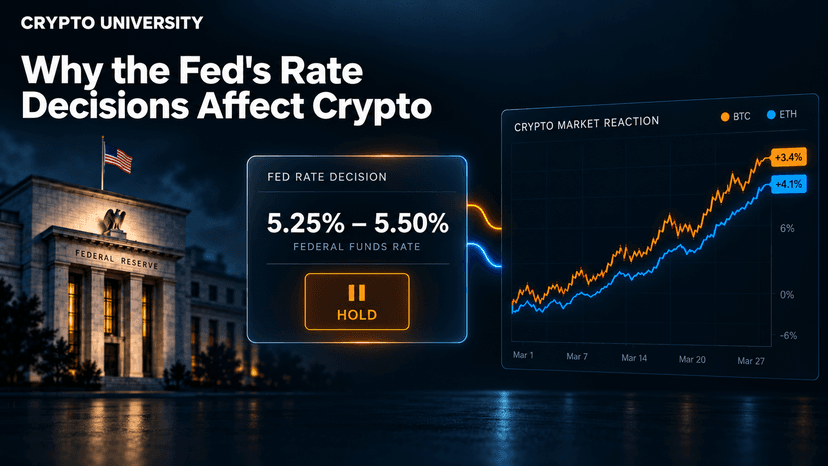
The Fed sets the price of money. When US interest rates change, the cost of borrowing and the reward for holding cash change too, and that shifts how investors treat higher-risk assets like crypto.
Expectations matter more than the decision itself. Markets usually price in a rate move before it happens. The biggest reactions tend to come from surprises in the Fed's guidance, not the announced rate.
Rates are one force, not the only force. Regulation, ETF flows, security events, and crypto-specific news can outweigh monetary policy, so no single Fed meeting explains crypto prices on its own.
What Does the Federal Reserve Actually Decide?
The Federal Reserve is the central bank of the United States. Its main policy tool is the federal funds rate, the interest rate banks charge each other for overnight loans. This rate acts as a base layer for many other rates in the economy, from savings accounts to mortgages to business loans.
The rate is set by the Federal Open Market Committee (FOMC), which holds eight scheduled meetings per year. The Fed's goal, known as its dual mandate, is to keep prices stable (it targets 2% inflation) and support maximum employment.
At four of those meetings each year, the Fed also publishes the Summary of Economic Projections, which includes the "dot plot." Each dot shows one official's view of where rates should be in the future. The dots are projections, not promises.
Fed Tool | What It Does | Why Crypto Watchers Care |
|---|---|---|
Federal funds rate | Sets the base cost of short-term borrowing | Changes the appeal of cash versus risk assets |
Balance sheet policy | Buying (QE) or shrinking (QT) bond holdings | Adds or removes liquidity from markets |
Forward guidance | Signals future policy in statements and press conferences | Moves market expectations before rates change |
Dot plot | Shows officials' rate projections | Hints at how long rates may stay high or low |
The Current Context (September 2026)
As a dated reference point: on September 16, 2026, the FOMC voted 12 to 0 to raise the target range by 0.25 percentage points to 3.75% to 4.00%. It was the first hike since July 2023. The Fed said inflation remained elevated and that the move would support a faster return to its 2% goal.
According to widely reported market data, Bitcoin traded in a narrow range around $75,000 to $76,000 near the announcement. Futures markets had priced in a hike probability above 90% on the day of the decision, which helps explain the muted reaction. The next scheduled meeting is October 27 to 28, 2026.
This snapshot will age. The mechanisms explained below will not.
Five Ways Fed Decisions Reach Crypto
1. Opportunity Cost: Cash Starts Paying More
When rates rise, low-risk options such as Treasury bills and money market funds pay higher yields. Bitcoin does not pay interest. So when a "risk-free" return goes up, some investors need a stronger reason to hold a volatile asset that pays nothing. When rates fall, the reverse happens.
2. Liquidity: How Much Money Is Sloshing Around
Low rates and bond buying (quantitative easing) make money cheaper and more plentiful. Some of that money flows into speculative assets. Higher rates and balance sheet reduction (quantitative tightening) drain liquidity. Crypto, as a relatively small and young market, tends to be sensitive to these shifts.
3. The US Dollar
Higher US rates often strengthen the dollar because global investors chase better dollar returns. Since most crypto is priced in dollars, a stronger dollar can act as a headwind. This relationship is loose and does not hold every day.
4. Risk Appetite and Correlation with Stocks
Crypto often trades like a "risk-on" asset, meaning it tends to rise when investors feel confident and fall when they get defensive. IMF research published in January 2022 found that the correlation between daily Bitcoin and S&P 500 returns rose from 0.01 in 2017 to 2019 to 0.36 in 2020 to 2021. When Fed policy moves stocks, crypto often moves in a similar direction.
5. Leverage and Borrowing Costs
Many crypto traders use borrowed money. Higher rates make leverage more expensive, which can reduce speculative positions. When sharp moves happen, leveraged positions can be forcibly closed (liquidated), which can make price swings larger than the news itself would suggest.
Channel | Rate Hike Tends To | Rate Cut Tends To |
|---|---|---|
Opportunity cost | Make cash and bonds more attractive | Make non-yielding assets more attractive |
Liquidity | Tighten financial conditions | Loosen financial conditions |
US dollar | Strengthen the dollar | Weaken the dollar |
Risk appetite | Push investors toward safety | Encourage risk-taking |
Leverage | Raise the cost of borrowing | Lower the cost of borrowing |
Note: these are general tendencies, not rules. Real markets often break them.
Why "Priced In" Matters More Than the Headline
Markets are forward-looking. Traders use tools like the CME FedWatch Tool, which estimates rate move probabilities from federal funds futures prices. If a hike is almost certain, prices usually adjust days or weeks ahead.
That means the real market-moving events are often:
Surprises: a bigger or smaller move than expected
Guidance: what the statement and press conference imply about future meetings
Projections: whether the dot plot shows more hikes or cuts ahead
Follow-through: how Treasury yields and the dollar react in the hours after
The September 2026 meeting is a useful example. The hike itself was expected, so attention shifted to the dot plot, where most officials projected at least one more increase before year end.
A Short History: Rates and Crypto
Period | Fed Policy | What Happened in Crypto |
|---|---|---|
March 2020 | Rates cut to near zero, large-scale bond buying | Crypto and stocks both rallied strongly in 2020 to 2021 |
March 2022 to July 2023 | Fastest hiking cycle in decades, to 5.25% to 5.50% | Bitcoin fell roughly 60% to 65% in 2022, alongside major crypto failures |
September 2024 to December 2025 | Series of cuts, ending near 3.50% to 3.75% | Crypto recovered amid easing conditions and spot ETF demand |
September 2026 | First hike since 2023, to 3.75% to 4.00% | Muted immediate reaction, as the move was widely expected |
An important caution: 2022 was not only about rates. The collapse of Terra (LUNA) and the failure of FTX were crypto-specific events that deepened the decline. Correlation with Fed policy does not mean the Fed caused every move.
How Rates Affect Stablecoins
Rates matter for stablecoins in a less obvious way. Major dollar stablecoin issuers hold large reserves in short-term US Treasuries and cash. When rates rise, issuers earn more interest on those reserves. When rates fall, that income shrinks.
In the US, the GENIUS Act, signed in July 2025, prohibits payment stablecoin issuers from paying interest directly to holders. This is one reason debates over "stablecoin yield" and who captures that reserve income remain active.
What Fed Decisions Do Not Explain
Monetary policy is a big background force, but crypto also responds to factors the Fed does not control:
Regulation and legislation, such as market structure bills or enforcement actions
ETF flows, which show institutional demand through spot Bitcoin and Ether funds
Security events, such as exchange hacks or smart contract exploits
Network events, such as the Bitcoin halving or major protocol upgrades
Company treasury activity, such as public companies buying or selling Bitcoin
A sound understanding treats the Fed as one input among several.
How to Follow a Fed Meeting: Step by Step
Check the calendar. The Fed publishes its FOMC schedule on federalreserve.gov. Decisions are released at 2:00 p.m. Eastern Time.
Note expectations beforehand. Look at the CME FedWatch Tool to see what markets expect.
Read the statement. Compare the wording to the previous statement. Small changes in language can carry meaning.
Watch the press conference. The Fed Chair's answers often move markets more than the statement.
Review the dot plot (quarterly). See whether officials expect more hikes, holds, or cuts.
Watch yields and the dollar. Treasury yields and the dollar index show how markets are interpreting the decision.
Avoid overreacting to the first hour. Early moves can reverse once the full message is absorbed.
The Bottom Line
The Fed does not set crypto prices, but it shapes the environment every asset trades in. Interest rates influence the reward for holding cash, the supply of liquidity, the strength of the dollar, and how much risk investors are willing to take. Understanding these channels helps you read the news calmly, instead of reacting to headlines. This article is educational and is not financial advice.
Frequently Asked Questions
Do rate hikes always make Bitcoin go down?
No. Hikes tend to create headwinds, but prices often move before the decision, and other factors can outweigh rate policy. The September 2026 hike, for example, was followed by a muted reaction because it was widely expected.
Why does crypto sometimes rise after a rate hike?
If the hike was fully priced in, or if the Fed signals that the hiking cycle may be close to ending, markets can react with relief. This is sometimes described as "sell the rumor, buy the news."
Is Bitcoin a hedge against Fed policy or inflation?
This is debated. Some investors view Bitcoin as a long-term store of value, but in the short term it has often traded like a risk asset that moves with stocks. Evidence on its hedging properties is mixed.
What is the dot plot?
It is a chart the Fed publishes four times a year showing each official's projection for the federal funds rate. It signals the possible direction of policy but is not a commitment.
Where can I track upcoming Fed decisions?
The official FOMC calendar is on the Federal Reserve website. The CME FedWatch Tool shows market-implied probabilities for each upcoming meeting.
Related Terms
Federal Funds Rate: The target interest rate the Fed sets for overnight lending between banks, which influences borrowing costs across the economy.
FOMC: The Federal Open Market Committee, the Fed body that votes on interest rate policy at eight scheduled meetings each year.
Quantitative Tightening: A policy where a central bank shrinks its balance sheet, reducing the amount of liquidity in financial markets.
Risk Asset: An asset with meaningful price volatility, such as stocks or crypto, that tends to perform better when investors feel confident.
Liquidation: The forced closing of a leveraged trading position when losses exceed the collateral backing it.
Sources
Federal Reserve Board, "Federal Reserve issues FOMC statement," September 16, 2026: https://www.federalreserve.gov/newsevents/pressreleases/monetary20260916a.htm
CNBC, "Fed rate decision September 2026," September 16, 2026: https://www.cnbc.com/2026/09/16/fed-rate-decision-september-2026.html
International Monetary Fund, "Crypto Prices Move More in Sync With Stocks, Posing New Risks," January 11, 2022: https://www.imf.org/en/blogs/articles/2022/01/11/crypto-prices-move-more-in-sync-with-stocks-posing-new-risks
Yahoo Finance, "Fed Hikes Rates for the First Time Since 2023," September 16, 2026: https://finance.yahoo.com/economy/policy/articles/fed-hikes-rates-first-time-181538441.html
Federal Reserve Board, FOMC meeting calendars: https://www.federalreserve.gov/monetarypolicy/fomccalendars.htm
CME Group, FedWatch Tool: https://www.cmegroup.com/markets/interest-rates/cme-fedwatch-tool.html
Disclaimer: This content is for educational and informational purposes only and is not financial, investment, legal, or tax advice. Nothing here is a recommendation to buy or sell any asset or use any platform. Do your own research and manage your risk.