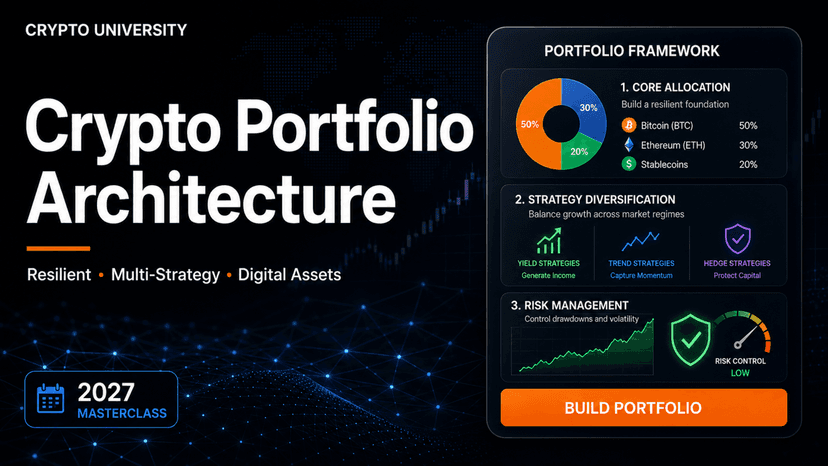
The Ultimate Crypto Portfolio Architecture: Building a Resilient, Multi-Strategy Digital Asset Portfolio in 2027
The era of the simplistic "60% Bitcoin, 40% Ethereum" HODL portfolio is over. As the cryptocurrency market has matured into a recognized, institutional-grade asset class by 2027, sophisticated investors, family offices, and wealth managers have adopted Multi-Strategy Portfolio Architectures.
Just as traditional finance utilizes distinct sleeves for equities, fixed income, alternatives, and cash, the modern digital asset portfolio is deliberately compartmentalized. This architecture is designed to achieve three simultaneous, often competing goals: capital preservation, consistent cash flow generation, and asymmetric alpha capture, all while rigorously managing tax liabilities and counterparty risks.
This comprehensive, capstone guide breaks down the four foundational pillars of a resilient crypto portfolio in 2027, the top-tier platforms required to orchestrate this complexity, and the strict operational frameworks needed to build, monitor, and rebalance a future-proof digital wealth strategy.
The 4 Pillars of Modern Crypto Portfolio Architecture
To build a portfolio that can withstand 80% drawdowns while capturing 10x upside, capital must be allocated across four distinct, uncorrelated (or negatively correlated) strategy sleeves.
1. The Core Sleeve (Preservation & Baseline Growth: 50-60%)
Objective: Long-term capital appreciation with minimal counterparty risk. This is the bedrock of the portfolio.
Composition: Self-custodied Bitcoin (BTC) and Ethereum (ETH) held in cold storage, supplemented by yield-bearing, Real-World Asset (RWA) backed stablecoins (e.g., tokenized U.S. Treasuries).
Mechanics: The crypto assets are never touched except for periodic, strategic rebalancing. The stablecoin portion generates a baseline 4-5% "risk-free" yield, providing dry powder for market dislocations without forcing the sale of core appreciating assets.
2. The Yield Engine Sleeve (Cash Flow Generation: 20-30%)
Objective: Generate consistent, compounding, market-neutral cash flow to fund lifestyle expenses, tax liabilities, or reinvestment into the Alpha sleeve.
Composition: Liquid Restaking Tokens (LRTs), over-collateralized DeFi lending (e.g., Aave, Morpho), and institutional structured products (e.g., Dual Investment, Principal-Protected Notes).
Mechanics: This sleeve actively deploys capital to capture "real yield" derived from network security fees, borrowing demand, or options premiums. It is strictly managed to avoid directional market risk (Delta-Neutral) and excessive smart contract layering.
3. The Alpha Sleeve (Asymmetric Upside: 10-15%)
Objective: Capture outsized, venture-style returns to drive the portfolio’s overall performance.
Composition: Early-stage IDOs/Launchpad allocations, Decentralized Physical Infrastructure Networks (DePIN), Decentralized Science (DeSci) IP-NFTs, and targeted on-chain "smart money" copy trades.
Mechanics: This is the highest-risk portion of the portfolio. It requires active management, rigorous fundamental due diligence, and strict position sizing. A single 10x winner in this sleeve can materially impact the entire portfolio, while a total loss of this sleeve should not threaten the investor's financial security.
4. The Risk Management & Compliance Layer (Protection: Integrated)
Objective: Protect the portfolio from black swan events, regulatory shifts, and tax drag. This is not a separate allocation, but an overlapping framework applied to all sleeves.
Composition: Tail-risk hedging (OTM Put Options), automated tax-loss harvesting bots, Multi-Party Computation (MPC) estate planning, and institutional-grade custody solutions.
Mechanics: This layer operates continuously. It triggers hedges when macroeconomic volatility spikes, harvests losses to offset Alpha sleeve gains, and ensures that all multi-sig and inheritance protocols are tested and up to date.
Top Platforms for Orchestrating a Multi-Strategy Portfolio in 2027
Managing four distinct sleeves requires a technology stack that balances institutional security, deep liquidity, and automated compliance.
1. Kraken: Best for the Core Sleeve and Regulated RWA Yield
For the foundational, capital-preservation portion of the portfolio, regulatory compliance and institutional custody are non-negotiable. Kraken remains the gold standard.
Core Features: Kraken provides deep liquidity for accumulating core BTC and ETH positions, alongside highly vetted, RWA-backed stablecoin yield products. Their institutional custody services offer segregated cold storage and dedicated estate planning support for HNWIs.
Why Architects Choose It: It eliminates counterparty risk for the most critical portion of the portfolio, providing audited Proof of Reserves and a clear, legally compliant pathway for wealth transfer.
👉 Establish Your Regulated Core Portfolio and RWA Yield with Kraken (Use referral code: QjZ0L3)
2. Bybit: Best for the Yield Engine and Active Risk Management
The Yield Engine and Risk Management layers require dynamic execution, deep derivatives liquidity, and capital efficiency. Bybit excels in this active domain.
Core Features: Bybit’s Unified Trading Account (UTA) allows seamless deployment of capital into structured products, delta-neutral perpetual hedges, and high-yield flexible savings, all while using the same collateral pool.
Why Architects Choose It: The ability to instantly pivot from earning passive stablecoin yield to deploying a protective short futures hedge—without moving funds between accounts—provides unmatched operational agility during market volatility.
👉 Orchestrate Your Yield Engine and Hedging Strategies on Bybit (Use referral code: 46164)
3. Ledger: Best for Securing the Alpha Sleeve and Core Cold Storage
The Alpha sleeve requires interacting with experimental DeFi protocols, while the Core sleeve requires absolute, long-term security. Ledger is the unifying hardware solution for both.
Core Features: Ledger’s FIPS 140-2 Level 3 Secure Element protects the private keys for both long-term cold storage vaults and active, multi-chain DeFi wallets. Its "Clear Signing" technology is essential for safely approving complex Alpha sleeve transactions (like IDO claims or DeSci governance votes).
Why Architects Choose It: It provides the ultimate physical circuit breaker. Whether securing $10 million in BTC or interacting with a new Layer 2 airdrop farm, the Ledger device ensures no digital asset can move without explicit, physical authorization.
👉 Secure Your Multi-Strategy Portfolio with a Ledger Hardware Wallet
4. Koinly: Best for Holistic Tax Optimization and Rebalancing
A multi-strategy portfolio generates a massive, complex web of taxable events: staking rewards, options premiums, airdrops, and hedge liquidations. Koinly is the central nervous system for portfolio compliance.
Core Features: Koinly aggregates data from centralized exchanges, DeFi protocols, and self-custody wallets. Its advanced algorithms automatically identify tax-loss harvesting opportunities across the entire portfolio and correctly classify complex income streams (e.g., distinguishing between ordinary income from RWA yield and capital gains from an Alpha sleeve exit).
Why Architects Choose It: It transforms a logistical nightmare into an optimized, audit-ready tax strategy, ensuring that tax drag does not silently erode the portfolio’s net compounded returns.
👉 Automate Holistic Crypto Portfolio Tax Optimization with Koinly
Step-by-Step: How to Architect and Rebalance Your Portfolio
Building this architecture requires a disciplined, institutional workflow. Follow this exact blueprint:
Step 1: Define Your Target Allocation and Risk Tolerance
Determine your exact percentages for the Core, Yield, and Alpha sleeves based on your time horizon and risk capacity. Example: 60% Core, 25% Yield, 15% Alpha. Document this as your "Investment Policy Statement" (IPS).
Step 2: Establish the Security and Tax Infrastructure
Before deploying a single dollar, set up your Ledger hardware wallets for the Core and Alpha sleeves. Connect all your existing and new exchange accounts (like Kraken and Bybit) to Koinly via read-only APIs to establish a baseline tax and performance dashboard.
Step 3: Deploy Capital Systematically
Core: Purchase BTC/ETH and transfer to cold storage. Allocate stablecoins to regulated RWA yield products.
Yield: Deploy capital into blue-chip DeFi lending markets or Bybit structured products, ensuring you understand the underlying mechanics and lock-up periods.
Alpha: Reserve capital for high-conviction, early-stage opportunities, utilizing strict position sizing (e.g., no single Alpha investment exceeds 2% of the total portfolio).
Step 4: Implement Automated Rebalancing and Tax-Loss Harvesting
Set up rules for rebalancing. If the Alpha sleeve outperforms and grows to 25% of the portfolio, systematically trim the winners and rotate the profits into the Core or Yield sleeves. Simultaneously, use Koinly to identify underperforming Alpha assets that can be sold at a loss to harvest tax deductions, immediately rotating the capital into a correlated (but not "substantially identical") asset to maintain market exposure.
Risk Management: The Hidden Dangers of Portfolio Over-Engineering
While a multi-strategy approach is robust, it introduces specific operational risks that must be actively managed:
Complexity and Operational Risk: Managing four sleeves across multiple platforms increases the attack surface for phishing, lost credentials, and user error. Mitigation: Rigorously enforce the use of Ledger hardware wallets for all self-custody, utilize password managers, and conduct semi-annual "fire drills" to ensure all access methods work.
Hidden Correlation in Crisis: In a severe macroeconomic liquidity crisis, all crypto assets (including LRTs, DeFi governance tokens, and stablecoins) may correlate to 1.0 and dump simultaneously. Mitigation: Ensure the Core sleeve’s stablecoin allocation is held in heavily regulated, fiat-backed assets (or short-term Treasuries via Kraken), not algorithmic or DeFi-native stablecoins.
Regulatory Reclassification: A strategy that is legal today (e.g., a specific DeFi yield farm or structured product) may be reclassified as an unregistered security tomorrow. Mitigation: Favor platforms and protocols that proactively engage with regulators (like MiCA-compliant entities) and avoid opaque, anonymous DeFi projects for significant capital allocations.
Frequently Asked Questions (FAQ)
Q: How often should I rebalance a multi-strategy crypto portfolio?
A: Rebalancing should be triggered by threshold deviations, not arbitrary time intervals. For example, rebalance only when a sleeve deviates by more than 5% from its target allocation (e.g., the Alpha sleeve grows from 15% to 20%). This prevents unnecessary trading fees and taxable events during minor market noise.
Q: What is the ideal crypto allocation for a traditional, diversified investor?
A: For a traditional investor with an existing portfolio of equities and bonds, financial advisors typically recommend a 1% to 5% allocation to digital assets. Within that 1-5%, the "Ultimate Architecture" suggests weighting it heavily toward the Core sleeve (e.g., 80% of the crypto allocation in BTC/ETH, 20% in Yield/Alpha) to maximize the Sharpe ratio of the addition.
Q: Can I use the same wallet for my Core and Alpha sleeves?
A: Absolutely not. The Core sleeve should be held in a deeply cold, air-gapped Ledger wallet that rarely, if ever, interacts with the internet. The Alpha sleeve requires a separate, dedicated "hot" or "warm" wallet (also Ledger-secured) for frequent DeFi interactions. Mixing them exposes your long-term wealth to the elevated smart contract risks of the Alpha sleeve.
Q: How do I handle the tax complexity of four different strategy sleeves?
A: Manual tracking is impossible and highly prone to error. By connecting all your wallets and exchanges to a comprehensive platform like Koinly, the software automatically categorizes transactions by type (e.g., ordinary income from Yield, capital gains from Alpha, non-taxable transfers to Core). This allows you and your CPA to optimize your tax strategy holistically, rather than in isolated silos.
Risk Warning: Constructing and managing a multi-strategy cryptocurrency portfolio involves significant risks, including market volatility, smart contract vulnerabilities, regulatory shifts, and operational complexity. Diversification does not guarantee against loss, and you could sustain a partial or total loss of your initial investment.
Not Financial Advice: The information provided in this article is for educational and informational purposes only. It does not constitute financial, investment, legal, or tax advice. Always conduct your own research (DYOR) and consult with a qualified, licensed financial advisor, estate planner, and CPA before constructing or altering a multi-strategy investment portfolio.
Affiliate Disclaimer: This article contains affiliate links. If you click on these links and sign up for a service or make a purchase, we may earn a commission at no additional cost to you. We only recommend platforms, tools, and services that we have thoroughly vetted and believe provide genuine value, security, and utility to our readers.