Key Takeaways
- Treat “send crypto and get more back” giveaways as scams. Do not transfer money to an organizer to verify your address or unlock a promised prize.
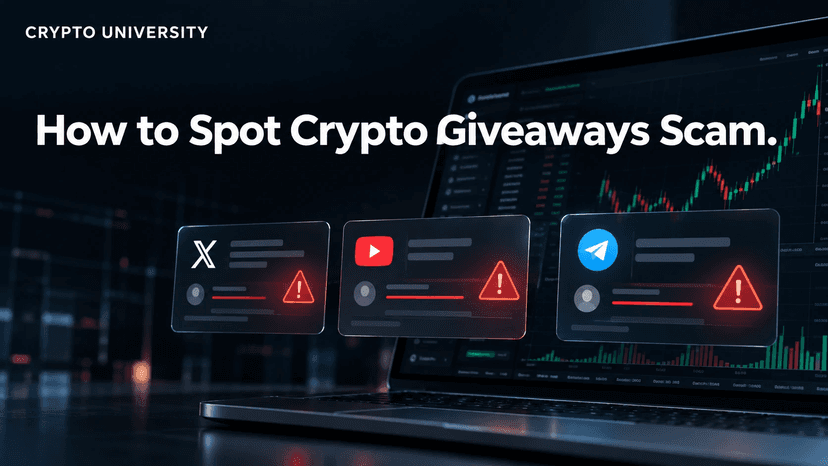
- The same scam looks different on each platform. On X it often comes from hacked or look-alike accounts, on YouTube from hijacked channels running deepfake livestreams, and on Telegram from fake admins and cloned groups.
- Crypto transfers are usually final. Prevention matters far more than recovery, so learn the red flags and verify every offer through official channels before you act.
What Is a Crypto Giveaway Scam?
A crypto giveaway scam is a fraud where criminals pretend to be a famous person, company, or crypto project and promise free crypto. In the classic version, you must send crypto to a wallet address to “join,” with a promise to receive double or more. Other versions use a fake reward page to steal your seed phrase or trick you into approving token transfers. You may receive nothing, or a small bait payment intended to prompt a much larger transfer.
The U.S. Federal Trade Commission (FTC) describes these as giveaway scams that claim to be sponsored by celebrities or crypto figures and promise to instantly multiply whatever you send. The pay-first version is often called a crypto doubling scam. The FTC documented this tactic in its May 2021 fraud analysis.
Why These Scams Still Work
Giveaway scams are old, but they keep evolving. Scammers now use hacked accounts with large followings, AI-generated video, and fake live transaction feeds to look believable.
| Data point | What it measures |
|---|---|
| FTC: more than $2 million reportedly lost to Elon Musk impersonators, October 2020–March 2021 | Historical consumer reports; not an estimate of all giveaway losses |
| FBI IC3: about $11.37 billion in 2025 losses in complaints with a cryptocurrency nexus | A broad descriptor spanning crime types, not a giveaway-only total |
| Chainalysis: at least $14 billion in identified on-chain scam receipts for 2025 | Its January 13, 2026 analysis projected the figure could exceed $17 billion as more addresses were identified |
| Chainalysis: more than 1,400% year-over-year growth in impersonation-scam inflows in its 2025 analysis | Growth in tracked receipts, not a count of giveaway victims |
| Chainalysis: 4.5 times higher average revenue for operations with visible on-chain links to AI vendors | An observed association; it does not establish that AI alone caused the difference |
Sources: FTC, FBI IC3, and Chainalysis. These datasets have different dates, scopes, and methods. Do not add them together or use them as a measure of giveaway fraud alone.
How a Fake Giveaway Works: The Basic Script
A typical crypto-doubling scam follows these four steps. Fake claim pages may replace the deposit request with a dangerous signature request.
- Borrow trust. The scammer hacks or copies a well-known account, such as a celebrity, an exchange, or a crypto founder.
- Create urgency. The post says the giveaway is limited, ending soon, or capped at a fixed amount of BTC or ETH.
- Ask for a deposit. You are told to send crypto to “verify your address” and receive a larger amount back. The exact amount varies.
- Fake social proof. Replies, comments, or a live counter show other people "receiving" their rewards. These are bots or fabricated animations.
Once you understand this script, you can recognize it on any platform.
Fake Crypto Giveaways on X (Twitter)
A prominent example occurred on July 15, 2020, when X was still called Twitter. Attackers socially engineered Twitter employees and took over high-profile accounts, including those of Barack Obama, Joe Biden, Elon Musk, Apple, Binance, and Coinbase. They posted messages promising to double bitcoin payments. New York's Department of Financial Services documented about $118,000 in stolen bitcoin in its investigation report.
The important lesson is that a genuine, established account can publish a scam after a takeover. Its familiar handle and past reputation do not authenticate a new offer.
Common patterns on X today:
- Hacked verified accounts. Brands and public figures get compromised, renamed, and used to post giveaway links. A checkmark does not prove an account is safe.
- Look-alike handles. A small spelling change, an extra underscore, or a swapped letter (such as "elonmuskk").
- Reply hijacking. Bot accounts copy a real person's name and photo, then reply under their genuine posts with a giveaway link.
- Fake "claim" pages. Links lead to sites that ask you to connect your wallet. Signing a transaction there can let a wallet drainer empty your funds.
Fake Crypto Giveaways on YouTube
On YouTube, one documented version is a fake livestream. In its 2024 stream-jacking research, security firm Bitdefender described hijacked channels used for stream-jacking. Criminals steal login tokens from real creators, often through malware, then rename the channel, change its logo, hide the old videos, and start a "live" stream.
How it typically looks:
- A recycled recording or deepfake of a well-known figure, such as Elon Musk, Michael Saylor, or a Ripple executive, promotes a supposed crypto event.
- The video tells viewers to scan a QR code or visit a website.
- The website shows a fake live feed of people sending crypto and receiving double back.
- Live chat is restricted so viewers cannot warn each other.
Bitdefender reported one hijacked channel had about 12.5 million subscribers. A large subscriber count can make the stream look official, but it may belong to a stolen channel.
Fake Crypto Giveaways on Telegram
Telegram scams rely on groups, direct messages, and impersonation. Verify each company's actual channels rather than assuming every platform presence is genuine. For example, Bitvavo warns that it does not contact customers through Telegram, WhatsApp, or Facebook.
Common patterns on Telegram:
- Fake admins. After you post a question in a group, someone with a name like "Support Admin" messages you privately. Treat the message as unverified until you check through the organization's own website or support channel.
- Cloned groups and channels. A copy of an official community, often with a similar name and logo, posts a giveaway or "airdrop."
- "Send 1, get 2" comments. Scammers reply under real posts with doubling offers.
- Bots that ask for your seed phrase. A bot claims you must "validate" or "sync" your wallet to receive rewards. Anyone with your seed phrase controls your funds.
Platform Comparison
| Platform | Main scam format | What it borrows | Biggest warning sign |
|---|---|---|---|
| X (Twitter) | Posts and replies from hacked or look-alike accounts | Celebrity and brand identity | Pay-first reward or unexpected wallet-approval request |
| YouTube | Hijacked channels running deepfake livestreams | Faces and voices of famous figures | QR code leading to a "doubling" website |
| Telegram | Fake admins, cloned groups, scam bots | Community trust and support roles | Unsolicited DM or a request for your seed phrase |
10 Red Flags of a Crypto Giveaway Scam
| Red flag | Why it matters |
|---|---|
| You must pay an organizer to unlock a prize | Advance-payment demands are a core giveaway-scam tactic |
| Promise to double or multiply funds | A guaranteed windfall is used to justify a transfer to the promoter |
| Extreme urgency or countdown timers | Pressure stops you from checking facts |
| QR code leading to a reward page | The destination is not obvious until inspected; a QR code is not proof of safety |
| Recently renamed channel or account | A common sign of a hijacked account |
| Misspelled handle or odd characters | Look-alike accounts copy real names |
| Comments or chat turned off | Prevents other viewers from warning you |
| Request for your seed phrase or private key | Gives full control of your wallet |
| Unsolicited direct message from “support” | Display names and photos are easy to copy |
| No matching announcement on an independently verified official channel | The promotion may be an impersonation or account takeover |
If you see even one of these, stop and verify.
How to Verify a Giveaway: Step by Step
- Pause. Do not send anything, scan any code, or connect any wallet yet.
- Go to the source directly. Type the company's website address yourself instead of clicking a link.
- Check official channels. Look for the announcement on the project's verified website, blog, or help center.
- Inspect the account history. Look at the account's age, past posts, and whether its name or handle changed recently.
- Check for independent warnings. A search may reveal a known scam, but no search results does not mean an offer is safe. Avoid sponsored results and unsolicited “verification” links.
- Reject pay-first prizes. Do not send money to an organizer to unlock, verify, or multiply a reward.
- Inspect any wallet request. A genuine on-chain claim may involve a network gas fee, which is different from paying a promoter. Gas fees, wallet connections, and approvals are not evidence that an offer is legitimate. Reject any transfer or permission you cannot explain.
What to Do If You Already Sent Crypto
Recovery is difficult, but acting fast can still help you and others.
- Stop sending more. Scammers often ask for a second "fee" to release your reward.
- Match the response to what you did. A normal wallet connection alone does not grant spending rights; disconnect and review whether you signed anything. Disconnecting does not cancel existing approvals. Follow your wallet provider's official revocation guidance if you approved a malicious spender. An unused Permit signature or account delegation may need separate remediation.
- Treat exposed keys as compromised. If you disclosed a seed phrase or private key, use a clean device to create a wallet with a new recovery phrase and safely move remaining assets. Do not keep adding gas funds if a sweeper is stealing deposits. See MetaMask's incident guidance.
- Save evidence. Keep the wallet address, transaction hash, screenshots, and links.
- Report it. Contact your exchange, the platform (X, YouTube, or Telegram), and your local authorities through independently verified channels. In the U.S., use the FBI's IC3 and the FTC fraud-reporting service.
- Beware of recovery scams. People who promise to recover your crypto for a fee are often running a second scam.
FAQ
Are any crypto giveaways real? Some projects run legitimate airdrops or promotions. A network fee for an on-chain claim is different from sending a promoter money to unlock a prize, but neither a fee nor a professional-looking site proves safety. Verify the offer and any transaction or permission independently.
Can a verified account post a scam? Yes. Verified accounts can be hacked, and some badges can be bought. A checkmark is not proof that an offer is safe.
Why do scammers use deepfakes of famous people? A familiar face and voice can make a false offer seem credible. Treat a recording, livestream, or video call as something to verify, rather than proof of who is behind the request.
Can I get my crypto back after a giveaway scam? There is no guaranteed way to reverse a completed blockchain transfer. Prompt reports can sometimes support freezing, tracing, or recovery, but an investigation or frozen balance does not ensure reimbursement.
Will an exchange ever message me on Telegram about a giveaway? Policies vary by exchange. Treat unsolicited reward messages as unverified and check the exchange's official website and support channels yourself. Never provide a seed phrase or send funds to unlock a prize.
Related Terms
- Phishing: A trick that uses fake messages or websites to steal passwords, keys, or funds.
- Seed Phrase: A list of words that can restore a crypto wallet and gives full control of its funds.
- Deepfake: An AI-generated video or audio clip that imitates a real person's face or voice.
- Wallet Drainer: Malicious code that steals assets using a harmful transaction, approval, or other authorization.
- Social Engineering: Manipulating people into giving up access or information instead of hacking systems directly.
Sources
- FTC: Cryptocurrency investment-scam data, May 17, 2021
- FBI: 2025 IC3 Annual Report
- Chainalysis: 2025 scam-revenue analysis, January 13, 2026
- New York DFS: July 2020 Twitter hack investigation
- Bitdefender: Stream-Jacking 2.0 research
- Bitvavo: Recognizing impersonation scams
- MetaMask: Disconnecting a wallet does not revoke approvals
- MetaMask: Responding to a compromised wallet
Sources checked October 16, 2026. This guide is educational and does not guarantee the safety or recovery of funds.