Key Takeaways
Whether you can legally buy tokenized stocks depends on three things at once: whether the product itself is lawfully issued, whether the platform is licensed to serve your market, and whether you are an eligible person in an allowed country. All three must be a yes.
US investors are shut out of the major offshore products for now, while the EU and EEA offer the clearest path for everyday investors. The UK, Canada and Australia are currently excluded, and the Gulf is a patchwork.
Being able to reach a token through a crypto wallet or a decentralized exchange is not the same as being legally allowed to own it. A VPN changes your IP address, not where you actually live or what the product permits.
Start Here: It Is Really Three Questions
“Are tokenized stocks legal?” looks like a simple yes-or-no question, but it isn’t. It’s really three smaller questions hiding inside one big one. A product can pass two of them and still be off-limits to you because of the third. Most of the confusion you see online, including half the arguments on Reddit, comes from squashing these three questions into one.
Let’s pull them apart, then walk through what the rules look like region by region as of July 2026.
The Three Questions That Decide Everything
Before you buy anything, run through these checks in order. Every one of them needs to come back “yes.”
The question | What you’re really checking | Example |
|---|---|---|
1. Is the product lawfully issued? | Whether a real, regulated entity actually created it | xStocks are issued by a Jersey company under an EU-approved prospectus. |
2. Is the platform licensed for your market? | Whether the exchange can legally offer it where you live | Kraken serves EU users through a Cyprus-licensed firm. |
3. Are you an eligible person? | Whether the offer covers your country and situation | xStocks exclude US persons and are restricted in the UK, Canada and Australia. |
Think of it like getting into a concert. The band has to be real and booked (the product), the venue has to be licensed to host the show (the platform), and your ticket has to be valid for your seat (you). If any one of those fails, you’re not getting in, no matter how good the other two look.
One important point that catches people out: a VPN only changes the IP address your computer shows the world. It does not change where you legally live or what the product’s terms allow. Pretending to be somewhere you’re not usually breaks the platform rules you agreed to when you signed up.
Tip: Want to see which platforms are verified for each stock? The Crypto University Tokenized Stocks Directory tracks availability per asset.
The Main Products, and Who Stands Behind Them
These aren’t anonymous DeFi experiments. Each of the big tokenized-stock products has a named, regulated entity somewhere in the chain. Here’s a quick map.
Product | How it’s structured | Regulated through |
|---|---|---|
xStocks | Tracker certificates issued by a Jersey company (a special-purpose vehicle) | An EU base prospectus approved by Liechtenstein’s FMA |
Ondo | Notes backed by real shares held at US broker-dealers, sold offshore | US broker-dealers in the chain |
Dinari | Blockchain-based shares | US broker-dealer registration |
Robinhood (EU) | Over 2,000 stock tokens issued as derivatives, plus a newer debt-security version | Robinhood’s EU-licensed entities |
Why These Are Treated Like Stocks, Not Just Crypto
Here’s the thing a lot of newcomers miss: putting a stock on a blockchain doesn’t magically pull it out of the rules that govern stocks. Most tokenized stocks are legally “securities” or instruments closely tied to them, whether they’re called tracker certificates, notes or derivatives.
The US SEC said this plainly in its Statement on Tokenized Securities on January 28, 2026: tokenized securities are still subject to federal securities law. In Europe, these products fall mainly under prospectus and market rules known as MiFID II, not under the crypto rulebook called MiCA. That’s because MiCA specifically leaves out crypto-assets that are really financial instruments.
This is why one exchange might hold a MiCA license and still run its stock-token trading through a separate, differently licensed arm. A crypto license on its own usually isn’t enough to offer tokenized stocks.
The Regional Picture at a Glance
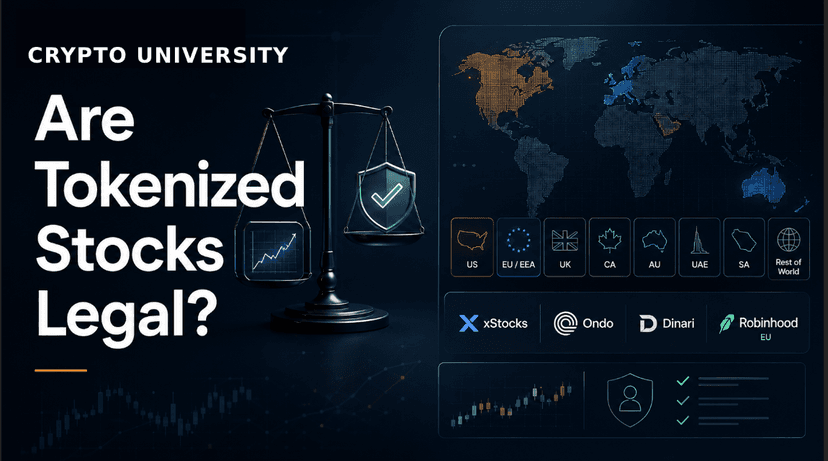
Rules differ sharply depending on where you live. This table gives you the big picture as of July 2026, and the sections below fill in the detail.
Region | Retail access to major products? | What’s going on |
|---|---|---|
United States | No (offshore products) | US persons are excluded today. A regulated US version is being built through proper channels. |
EU / EEA | Yes | The most developed retail market, via prospectus tokens (xStocks) and derivative tokens (Robinhood). |
United Kingdom | No | The FCA restricts retail crypto derivatives, and no compliant product has launched. |
Canada | No | Excluded from xStocks. |
Australia | No | Excluded from xStocks. |
UAE | Partly | Several regulators run separate frameworks. OKX lists the MENA region; check per emirate and product. |
Saudi Arabia | Largely no | The CMA hasn’t authorized retail tokenized-equity products. |
Much of Asia, Africa, Latin America | Often yes | Access depends on offshore or locally licensed platforms, minus your country’s own rules. |
The United States: Closed for Now, but Changing
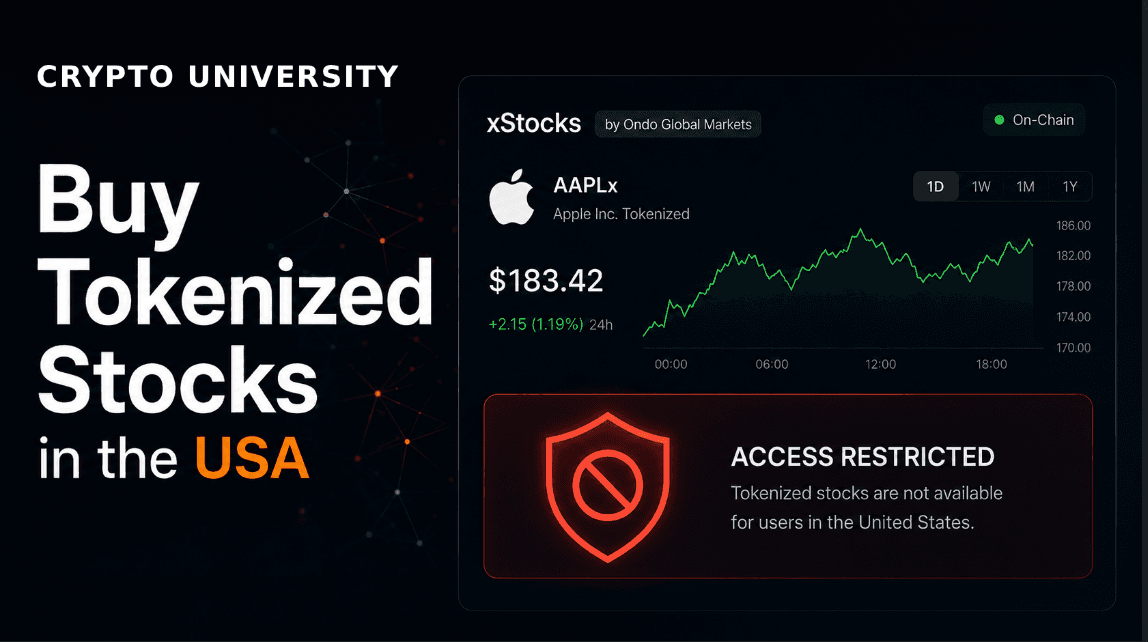
Right now, the mainstream offshore tokenized stocks are simply not available to US persons. Issuers block them, platforms geoblock, and the SEC has confirmed these products are securities that would need registration (or a valid exemption) to be offered.
But things are moving. SEC leadership has sketched out an “innovation exemption” that would let tokenized public shares trade in fractional sizes with extended hours, under conditions such as volume caps and vetted participants, while leaving out traditional shareholder rights. DTCC, the big US settlement backbone, started limited live trades of tokenized securities in July 2026, with a wider rollout planned for October. A company called Dinari already holds the broker-dealer registration needed for blockchain-based shares.
None of this means you can log in and buy a Tesla token in the US today. It means the lawful US version of this market is being built through regulated channels. In the meantime, Kraken offers US users ordinary shares through Kraken Securities, which is a traditional product, not xStocks.
Europe: The Friendliest Place for Everyday Investors
For now, the EU and EEA are the most open major region for retail tokenized stocks, and they get there through two routes. The first is prospectus-based tokens: xStocks are sold under an approved base prospectus, with Kraken’s Cyprus-licensed arm handling EU customers and Gemini offering Dinari-powered tokens to European users. The second is derivative tokens: Robinhood’s EU entities offer more than 2,000 stock tokens across 30 EU and EEA countries.
Even inside Europe it isn’t identical everywhere. National regulators can step in with their own restrictions, and platforms switch countries on one at a time. The Netherlands, for example, has slightly different expectations from its regulator (the AFM) than Lithuania does, which is why individual country guides exist.
The UK, Canada and Australia: Outside the Door for Now
xStocks are specifically restricted in all three of these countries. The UK’s regulator, the FCA, has long limited crypto derivatives for everyday investors, and the current tokenized-stock products simply haven’t launched there. This could change, since the FCA has been consulting on tokenization in fund and market-infrastructure settings, but as of July 2026 a UK retail investor cannot lawfully access the major products.
The Middle East: Patchy and Moving Fast
The UAE isn’t a single system. Several regulators run their own frameworks: VARA in Dubai, the federal SCA, ADGM’s FSRA and DIFC’s DFSA. Security tokens sit differently under each one. OKX lists the MENA region among the places it serves, which makes the UAE one of the more accessible Gulf markets in practice, but you should still check eligibility per emirate and per product.
Saudi Arabia is stricter. Its regulator, the CMA, hasn’t approved retail tokenized-equity products, so treat any “you can buy here” claims with a healthy dose of caution.
Everywhere Else: Your Local Rules Do the Talking
For most of Africa, Asia and Latin America, the practical rule is simple. What you can buy equals whatever a licensed-for-you or offshore platform will offer, minus whatever your own country’s securities and currency rules block. OKX covers much of Asia and MENA, Kraken’s xStocks cover a wide area outside the restricted list, and Ondo serves non-US users across Asia-Pacific, Africa and Latin America.
Even so, your local law still applies to you as the buyer. Pay special attention to rules about how investments can be marketed to you, currency controls, and tax. Country guides are the place to check the fine detail for where you live.
Can I Just Buy It on a DEX? Access Is Not Permission
Tokens like xStocks live on public blockchains, so technically anyone with a crypto wallet can swap for them on a decentralized exchange such as Jupiter. This creates the single most common misunderstanding in the whole space: people assume that if they can reach it, they’re allowed to own it.
They are not the same thing. The product’s terms still exclude restricted people, and the identity checks live at the platform layer. If a restricted person picks up these tokens onchain, they’re holding something the issuer never actually offered them, which can badly weaken their ability to redeem the token or make a legal claim later. Being technically able to do something and being legally allowed to do it are two very different facts.
What Protection Do You Actually Get?
This is the part beginners often skip, and it matters a lot. Your rights depend entirely on how the product is built, and none of them work like a normal brokerage account in your home country.
Product type | What protection you get | What you don’t get |
|---|---|---|
Prospectus products (xStocks) | Disclosure rules, collateral backing, defined redemption terms | No deposit insurance, no shareholder rights; claims run against a Jersey company |
EU derivative tokens (Robinhood) | MiFID conduct-of-business protections through a licensed firm | It’s a private contract with that firm, not real shares |
US broker-dealer products (Dinari rails) | The closest thing to normal securities protection, including custody rules | Still not identical to a domestic brokerage account |
Tokens bought outside an offer made to you | Very little | Weak footing for redemption and any legal claim |
The big takeaway: none of these come with the safety net you get from bank deposit insurance or, in the US, SIPC-covered brokerage accounts. That’s a solid reason to keep your position sizes sensible.
Don’t Forget Taxes
“Legal to buy” and “taxed nicely” are completely separate questions. Most countries tax gains on tokenized stocks, but they don’t agree on how. Some treat them as securities, some as crypto, and some haven’t made it clear at all. It deserves its own deep dive.
And to be clear, this article is general information, not legal or tax advice. Rules change and everyone’s situation is different, so check with a qualified professional for your own circumstances before you act.
Before You Buy, Remember
Run the three questions in order and make sure all three are a yes: a lawful product, a platform licensed for you, and an eligible you. Remember that tokenized stocks are securities-law products, so a MiCA crypto license alone doesn’t cover them in the EU. US persons are excluded from the major products today, the EU and EEA offer the clearest retail path, and onchain access is never a substitute for actually being eligible.
FAQ
Are tokenized stocks legal in the US?
Offshore retail products like xStocks exclude US persons. Tokenized securities are legal in the US only through registered or exempt channels. The SEC is developing an exemption framework, and DTCC began limited tokenized settlement in July 2026. For now, US retail access runs through ordinary brokerage products instead.
Why are xStocks not available in the UK?
The current offer excludes the UK, in line with the FCA’s cautious stance on retail crypto-linked investment products. UK availability would need a UK-compliant offer, which doesn’t exist yet.
Are tokenized stocks legal in Europe?
Broadly yes for retail investors, through prospectus-based tokens (xStocks, and Dinari via Gemini) and MiFID derivative tokens (Robinhood), with variation from country to country. Check your local guide for the details where you live.
Is buying tokenized stocks on a DEX legal?
The swap may be technically possible almost anywhere, but the product’s terms still exclude restricted jurisdictions, and your local securities law still applies to you. Onchain access is not the same as being eligible, and this guide doesn’t advise trying to bypass restrictions.
Do tokenized stocks come with investor protection?
Some, and it varies by structure: prospectus disclosure and collateral for xStocks, MiFID conduct rules for Robinhood’s EU tokens, and broker-dealer custody rules on Dinari rails. None of them fully replicate the protections of a domestic brokerage account, such as SIPC.
Can my country ban tokenized stocks after I buy them?
Regulators can force platforms to stop serving a market. You’d usually keep your tokens and the ability to withdraw or exit, but a forced exit at poor pricing is a real risk. It’s one more reason to size your positions carefully.
Sources
SEC Statement on Tokenized Securities, January 28, 2026 (sec.gov), and coverage of the innovation-exemption plans.
DTCC tokenization service announcements (July and October 2026 phases).
xStocks legal overview and jurisdiction restrictions (docs.xstocks.fi and xstocks.fi).
Kraken xStocks risk disclosure and entity structure (kraken.com).
Robinhood EU stock-token disclosures (robinhood.com).
ESMA and MiCA scope provisions on the financial-instruments exclusion.
Disclaimer: This content is for educational and informational purposes only and is not financial advice. Nothing here is a recommendation to buy or sell any asset or use any platform. Do your own research and manage your risk.
Explore the Crypto University Tokenized Stocks Directory.
Tokenized Stocks Explained: A Simple Guide for Beginner Traders
How to Buy Tokenized Stocks: A Step by Step Guide for Beginners
Best Platforms for Tokenized Stocks: Exchanges, Brokers and Onchain Apps