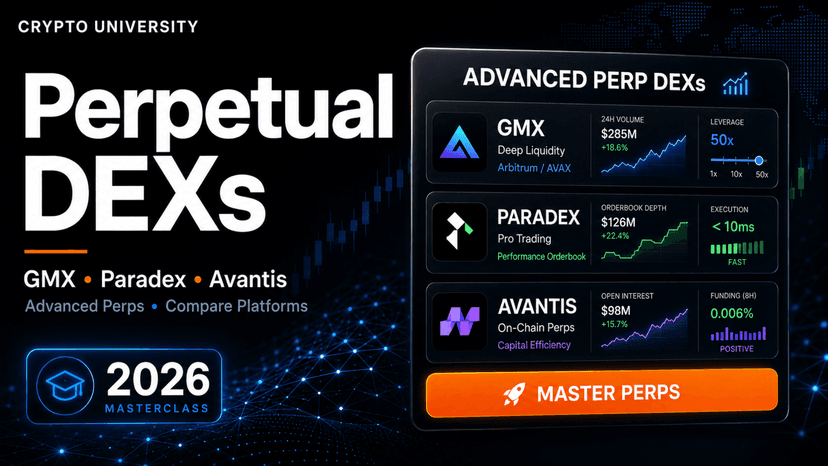
Mastering Advanced Perpetual DEXs: GMX, Paradex, and Avantis in 2026
The decentralized finance (DeFi) derivatives market has undergone a massive technological leap. In the early 2020s, perpetual decentralized exchanges (DEXs) were plagued by high slippage, clunky user interfaces, and reliance on vulnerable, centralized price oracles. By 2026, advanced Perpetual DEXs have evolved into institutional-grade, non-custodial trading venues that rival centralized exchanges (CEXs) in speed, liquidity, and feature sets, while completely eliminating counterparty and withdrawal risks.
For sophisticated retail traders, quantitative desks, and privacy-conscious investors, migrating to Perpetual DEXs is no longer just about ideology; it is a strategic imperative. These platforms offer transparent funding rates, zero-liquidity-fragmentation routing, and advanced order types (like TWAP and trailing stops) directly on-chain or via hybrid Layer 2 (L2) architectures.
This comprehensive guide breaks down the core architectures of modern Perpetual DEXs, the top-tier platforms dominating the space in 2026, and the strict operational security frameworks required to trade on-chain derivatives safely and profitably.
The 3 Pillars of Advanced Perpetual DEXs in 2026
To trade effectively in this environment, you must understand the mechanical advantages that separate modern Perpetual DEXs from their predecessors.
Decentralized Clearing and Non-Custodial Settlement: Unlike CEXs, where you deposit funds into a corporate black box, Perpetual DEXs allow you to trade directly from your self-custodied wallet. The smart contract acts as the clearinghouse, matching trades or acting as the counterparty, ensuring you maintain absolute ownership of your collateral until the exact millisecond of settlement.
Advanced Order Types and Intent-Based Routing: Modern Perpetual DEXs no longer rely solely on basic market swaps. They support sophisticated order types, including limit orders, trigger stops, and Time-Weighted Average Price (TWAP) executions. Furthermore, many now integrate "intent-based" solvers that find the most capital-efficient route across multiple liquidity pools, guaranteeing your minimum output and protecting you from MEV (Maximal Extractable Value) sandwich attacks.
Real Yield and Transparent Fee Structures: Instead of paying opaque, hidden fees to a centralized entity, traders on Perpetual DEXs pay transparent, on-chain fees (often as low as 0.05% to 0.10%). A significant portion of these fees, along with borrowing costs, is distributed directly to liquidity providers (LPs) in the form of "Real Yield" (paid in stablecoins or the underlying asset, not inflationary governance tokens).
Top Platforms for Advanced Perpetual DEX Trading in 2026
Executing on-chain derivatives requires platforms with deep liquidity, robust oracle networks, and audited, battle-tested smart contracts.
1. GMX: Best for Zero-Slippage vAMM Trading and Real Yield
GMX remains the gold standard for the shared liquidity pool (vAMM) model, offering a uniquely stable and predictable trading environment primarily on Arbitrum and Avalanche.
Core Features: Traders open leveraged positions against the GMX liquidity pool. Because the pool acts as the direct counterparty, trades are executed at the "mark price" with zero price impact (zero slippage), regardless of trade size (up to the pool's capacity limits).
Real Yield for LPs: Liquidity providers who deposit blue-chip assets (like ETH or BTC) or stablecoins (like USDC) into the GLP or GM pools earn 70% of all trading fees and borrowing costs generated by the platform. This creates a sustainable, non-inflationary yield loop that has attracted billions in TVL.
Why Traders Choose It: For traders executing large block sizes or those who want to earn passive, real yield without managing complex, active liquidity ranges, GMX provides an unmatched, robust, and transparent infrastructure.
👉 Trade with Zero Slippage or Earn Real Yield on GMX
2. Paradex: Best for Hybrid CLOB Execution and Institutional Liquidity
For traders who demand the precise order book dynamics of a centralized exchange but refuse to sacrifice self-custody, Paradex has emerged as the premier hybrid Central Limit Order Book (CLOB) DEX.
Core Features: Built on high-performance Layer 2 networks (like Starknet), Paradex utilizes an off-chain matching engine for lightning-fast order execution and cancellation, while all funds and settlements remain securely anchored in on-chain smart contracts.
Advanced Trading Tools: Paradex supports post-only, immediate-or-cancel (IOC), and advanced trigger orders. This allows professional traders to implement complex, multi-leg strategies and precise risk management without suffering the latency or slippage common in pure AMM models.
Why Traders Choose It: It perfectly replicates the CEX trading experience with CEX-level depth, while maintaining the transparency, censorship resistance, and self-custody guarantees of decentralized finance.
👉 Access Institutional-Grade CLOB Perpetuals on Paradex
3. Avantis: Best for Advanced Synthetic Leverage and Custom Risk Parameters
Avantis pushes the boundaries of decentralized derivatives by offering highly customizable synthetic perpetual trading, allowing users to tailor their risk exposure with unprecedented granularity.
Core Features: Avantis allows traders to select custom leverage levels and dynamically adjust their risk parameters. Its unique architecture separates the liquidity provision from the trading engine, ensuring that even in highly volatile market conditions, traders can access deep, stable liquidity for both major pairs and select high-conviction altcoins.
Capital Efficiency: By optimizing how collateral is margined and how funding rates are calculated, Avantis provides a highly capital-efficient environment for both directional traders and those looking to hedge existing spot portfolios.
Why Traders Choose It: It caters to advanced traders who want more control over their leverage and margin mechanics than traditional vAMM or CLOB platforms offer, all within a secure, non-custodial framework.
👉 Execute Advanced Synthetic Perpetual Strategies on Avantis
Top Tools for Supporting Your Perpetual DEX Workflow
A professional DEX trading setup requires more than just an exchange; it requires a secure, analytical, and compliant technology stack.
4. TradingView: Best for Analyzing Perp DEX Basis and Funding Rates
Successful perpetual trading requires rigorous market analysis. TradingView is the indispensable command center for monitoring the unique metrics of decentralized derivatives.
Core Features: Advanced traders use TradingView to chart the "basis" (the price difference between the DEX perpetual price and the global spot index) and to monitor historical funding rate trends. Custom Pine Script indicators can overlay on-chain data, such as open interest spikes or liquidation heatmaps, directly onto price charts.
Why Traders Choose It: It provides the macro and micro-level visibility needed to time entries, identify over-leveraged market conditions, and avoid trading during periods of extreme, unpredictable volatility.
👉 Analyze Perp DEX Metrics and Funding Rates with TradingView
5. Ledger: Best for Securing On-Chain Derivative Operations
When interacting with any DeFi protocol, the security of the source wallet is paramount. Ledger provides the essential hardware layer to protect your capital from the sophisticated drainers that target active DEX traders.
Core Features: By connecting your Ledger hardware wallet to platforms like GMX or Paradex, you ensure that every trade execution, token approval, and withdrawal requires physical confirmation on the device’s secure, tamper-proof screen.
Clear Signing: Ledger’s integration with major DeFi protocols allows it to parse and display human-readable transaction details (e.g., "Approve 5000 USDC for GMX Vault"), preventing "blind signing" attacks where malicious contracts disguise token drains as routine actions.
Why Traders Choose It: It provides the ultimate physical circuit breaker. Even if your browser is compromised by a perfect phishing replica of a DEX, the attacker cannot drain your funds without your physical button press.
👉 Secure Your On-Chain Trading Operations with a Ledger Hardware Wallet
6. Koinly: Best for Tracking Complex Perpetual DEX Tax Events
Every time you open, close, or get liquidated from a perpetual position, it is a taxable event. Furthermore, if you provide liquidity to a pool like GMX, the compounding fees generate dozens of micro-taxable events.
Core Features: Koinly seamlessly ingests data from your self-custody wallets and DEX interactions via read-only public keys. Its advanced heuristic engine is specifically trained to decode complex DeFi transactions, accurately categorizing perpetual trading profits, funding fee payments, and liquidity pool yields.
Why Traders Choose It: It transforms the chaotic, high-frequency nature of DEX trading into a clean, compliant, and easily auditable ledger, ensuring you don't overpay or underreport your tax liabilities.
👉 Automate Your Complex Perp DEX Tax Tracking with Koinly
Step-by-Step: How to Transition to Perpetual DEX Trading
Moving your derivatives trading on-chain requires a deliberate, security-first workflow to avoid costly mistakes.
Step 1: Establish a Secure, Dedicated Web3 Wallet
Do not use your primary, long-term holding wallet for active DEX trading. Create a dedicated wallet using a reputable browser extension (like Rabby or MetaMask). Crucial: Connect this software wallet to your Ledger hardware device to ensure all interactions are physically verified.
Step 2: Bridge Capital to the Target Network
Perpetual DEXs operate on specific networks (e.g., Arbitrum for GMX, Starknet for Paradex). Use a reputable, audited cross-chain bridge (or the native bridge of your chosen DEX) to transfer your collateral (typically USDC or ETH) to the target network. Ensure you retain a small amount of the native gas token to pay for transaction fees.
Step 3: Approve and Deposit Collateral
Navigate to the official DEX interface. Connect your Ledger-secured wallet. You will need to sign a one-time "Approve" transaction, granting the DEX’s smart contract permission to access your specific collateral token. Then, deposit the funds into the platform’s margin or vault contract.
Step 4: Execute with Advanced Order Types
Avoid market orders unless absolutely necessary, as they can be subject to minor oracle latency or temporary liquidity gaps. Instead, use Limit Orders or Trigger Orders (for stop-losses and take-profits). This allows you to define your exact entry and exit prices, ensuring your risk parameters are strictly enforced by the smart contract.
Risk Management: The Hidden Dangers of On-Chain Derivatives
While perpetual DEXs eliminate CEX counterparty risk, they introduce specific, nuanced risks that must be actively managed:
Oracle Manipulation and Lag: Perp DEXs rely on decentralized oracles (like Pyth or Chainlink) to determine mark prices for liquidations. During extreme, second-by-second volatility, oracle feeds can occasionally lag the true spot price, potentially triggering unfair liquidations. Mitigation: Never use maximum leverage on illiquid altcoins. Stick to conservative leverage (3x to 5x) on major pairs to provide a wide buffer against temporary oracle discrepancies.
Smart Contract Vulnerabilities: Your funds are locked in code. While top platforms are heavily audited, zero-day exploits remain a non-zero risk in DeFi. Mitigation: Only trade on battle-tested platforms with billions in Total Value Locked (TVL), multiple top-tier audits (e.g., PeckShield, OpenZeppelin), and active, well-funded bug bounty programs.
Funding Rate Bleed: If you hold a perpetual position in a market with sustained, high positive funding rates, the cost of holding that position can slowly erode your margin balance, inching your liquidation price closer to the current market price. Mitigation: Always check the predicted funding rate before entering a leveraged position. If it is excessively high, wait for a cooldown or consider an alternative hedging strategy.
Frequently Asked Questions (FAQ)
Q: Are perpetual DEXs truly safer than centralized exchanges?
A: They eliminate counterparty risk (the risk of the exchange going bankrupt, halting withdrawals, or engaging in fraudulent trading against you, as seen in past industry collapses). However, they replace it with smart contract risk and user error risk (e.g., losing your seed phrase or approving a malicious contract). Using a hardware wallet like a Ledger drastically mitigates the latter, making reputable perp DEXs highly secure for knowledgeable users.
Q: Do I have to pay high gas fees for every trade on a perpetual DEX?
A: It depends on the network. Ethereum Mainnet perp DEXs can have high gas fees. However, the leading perp DEXs in 2026 operate on Layer 2 networks (like Arbitrum, Base, or Starknet), where transaction fees are typically a fraction of a cent, making high-frequency trading and tight stop-loss adjustments economically viable.
Q: How are perpetual DEX trades taxed?
A: In most jurisdictions, closing a perpetual futures position (whether at a profit or a loss) triggers a capital gains or capital losses event. Additionally, any funding fees paid or received, or yield earned from providing liquidity, may have specific income or deduction implications. Because on-chain trading can generate hundreds of transactions, using a dedicated tax tool like Koinly is essential for accurate, audit-ready reporting.
Q: Can I get liquidated on a perp DEX if the price briefly wicks?
A: Yes. Liquidations are triggered based on the platform's Mark Price (the oracle price), not the Last Traded Price. While reputable oracles are designed to filter out anomalous, exchange-specific wicks, extreme market-wide volatility can still trigger liquidations. This is why setting a hard, on-chain Stop-Loss order is non-negotiable.
Risk Warning: Cryptocurrency trading, especially involving decentralized derivatives and leverage, carries a high level of risk and may not be suitable for all investors. Smart contract vulnerabilities, oracle manipulation, and extreme market volatility can result in the rapid and total loss of your initial investment.
Not Financial Advice: The information provided in this article is for educational and informational purposes only. It does not constitute financial, investment, legal, or tax advice. Always conduct your own research (DYOR) and consult with a qualified, licensed professional before interacting with decentralized finance protocols or making any financial decisions.
Affiliate Disclaimer: This article contains affiliate links. If you click on these links and sign up for a service or make a purchase, we may earn a commission at no additional cost to you. We only recommend platforms, tools, and services that we have thoroughly vetted and believe provide genuine value, security, and utility to our readers.