What Is Kalshi?
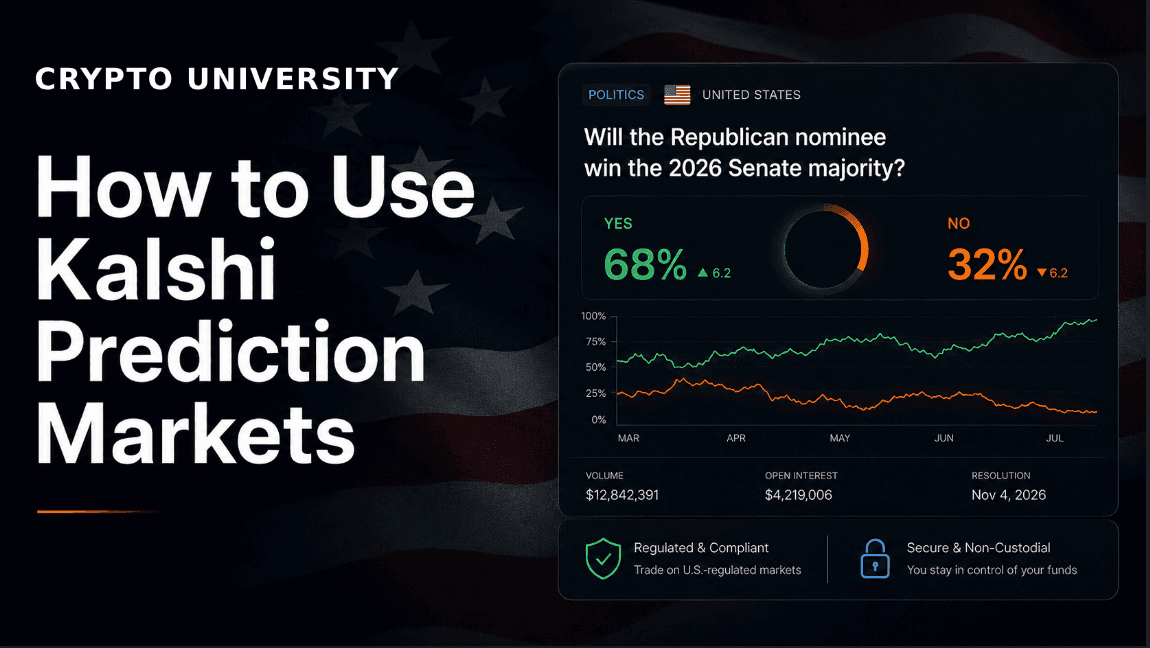
Kalshi is a prediction market exchange based in the United States. Instead of buying shares in companies, you trade contracts on the outcome of real-world events. Each market is a simple Yes or No question, such as whether the Federal Reserve will cut interest rates at its next meeting.
Kalshi is regulated by the Commodity Futures Trading Commission (CFTC) as a Designated Contract Market (DCM) and a Derivatives Clearing Organization (DCO). This is the same category of oversight applied to regulated futures exchanges. Being federally regulated is what allowed Kalshi to offer election and event contracts that some competitors could not.
This guide explains how the platform works, how to set up an account, and how to place a trade responsibly. It is educational only and does not give financial advice.
How Kalshi Works
Every Kalshi market resolves to one of two outcomes. You buy either a Yes contract or a No contract tied to a specific question. Each contract settles at $1.00 if it resolves in your favor and $0.00 if it does not.
Contract prices move between 1 cent and 99 cents. The price can be read as the market's estimate of probability. If a Yes contract trades at 40 cents, the market is collectively suggesting roughly a 40 percent chance that the event happens.
Example: you buy 10 Yes contracts at 40 cents each, spending $4.00 in total. If the event happens, each contract pays $1.00, returning $10.00 before fees. If it does not, the contracts settle at zero and you lose the $4.00. You are trading against other users, not against the house. Kalshi simply runs the marketplace and matches buy and sell orders.
You are not locked in until settlement. If a contract moves in your favor or against you, you can usually sell your position at the current market price before the event resolves.
Supported Markets and Categories
Kalshi lists a wide catalog of event contracts. Widely reported categories include:
Economics: interest rate decisions, inflation (CPI) reports, GDP releases, and unemployment figures.
Politics: elections, party control, approval ratings, and policy or legislation outcomes.
Weather and climate: temperature records, rainfall, and storm activity.
Sports: major US leagues and global events, offered as regulated event contracts.
Crypto and technology: milestone markets and macro contracts that some traders use as proxies for market sentiment.
Culture: entertainment, awards, and other measurable public outcomes.
Main Features
Binary event contracts that settle cleanly at $1 or $0.
Live prices that double as crowd-sourced probability estimates.
The ability to exit a position early by selling at the market price.
Combo trades that bundle multiple outcomes into a single position, similar in structure to a parlay.
A mobile app and web platform with a fee preview shown before each trade.
Member funds held in segregated accounts at regulated banks, separate from company operating capital, as required by CFTC rules. Note that your trading capital is still at risk.
Set-Up Guide: How to Start Using Kalshi
The general process for new users is straightforward. Steps and eligibility can change, so confirm details on the official site.
Check eligibility. You typically need to be at least 18 years old and have a valid US address that is not a PO box.
Create an account on the Kalshi website or app using your email.
Complete identity verification (KYC). This is required before you can deposit or trade.
Enable two-factor authentication (2FA) to secure your account.
Deposit funds. ACH bank transfer is free; other methods may carry a processing fee (see Fees).
Browse markets and pick an event you understand well.
Choose Yes or No, enter the number of contracts, and review the fee preview shown at checkout.
Place the order, then monitor your position. You can hold to settlement or sell early.
Fees
Kalshi charges a trading fee calculated from the contract price rather than a flat percentage. The commonly reported formula is round-up(0.07 x C x P x (1 - P)), where C is the number of contracts and P is the price. The fee is highest on contracts priced near 50 cents and lowest on near-certain contracts near 1 or 99 cents. The platform displays the exact fee before you confirm a trade, so you do not need to calculate it yourself.
Item | Widely reported cost (verify on the official site) |
|---|---|
Trading fee | Formula-based, weighted by price. Peak of roughly 1.75% near 50 cents; usually well below that. |
Settlement fee | None reported. |
ACH deposit / withdrawal | No Kalshi fee. Withdrawals typically arrive in 1 to 3 business days. |
Wire transfer | No Kalshi fee, but your bank may charge (often around $25 to $30 out). |
Debit card | Around 2% processing fee may apply. |
Crypto | No native Kalshi fee, but blockchain network fees apply. |
These figures are widely reported estimates and can change without notice. Always confirm current fees in Kalshi's official fee schedule before trading.
A Note on Regulation
At the federal level, Kalshi is registered with the CFTC. At the state level, the picture is more complex. Several US states have argued that certain contracts, particularly sports-event contracts, resemble unlawful sports wagering under state law. That litigation has been ongoing, and market availability can differ by state. This is informational context, not legal advice; check your local status before trading.
Pros and Cons
Pros | Cons |
|---|---|
CFTC-regulated with segregated member funds. | You can lose your full stake on any trade. |
Simple Yes/No format that is easy to learn. | State-level legal uncertainty for some markets. |
Free ACH deposits and the option to exit early. | Fee formula looks complex until you see the preview. |
Frequently Asked Questions
Is Kalshi gambling or investing?
Kalshi operates as a CFTC-regulated derivatives exchange, so it is legally structured as event-contract trading rather than as a traditional sportsbook. In practice, prices reflect real money placed on outcomes, and any trade can lose money.
How are Kalshi prices set?
Prices come from supply and demand among traders. Kalshi does not set the odds; it matches buy and sell orders.
What is the minimum to start?
Barriers are low. Some sources report no minimum deposit and others cite a $10 minimum, so check the current figure at signup.
Can I sell before an event ends?
Yes. In most active markets you can sell your position at the market price before settlement.
Disclaimer: This content is for educational and informational purposes only and is not financial advice. Nothing here is a recommendation to buy or sell any asset or use any platform. Do your own research and manage your risk.