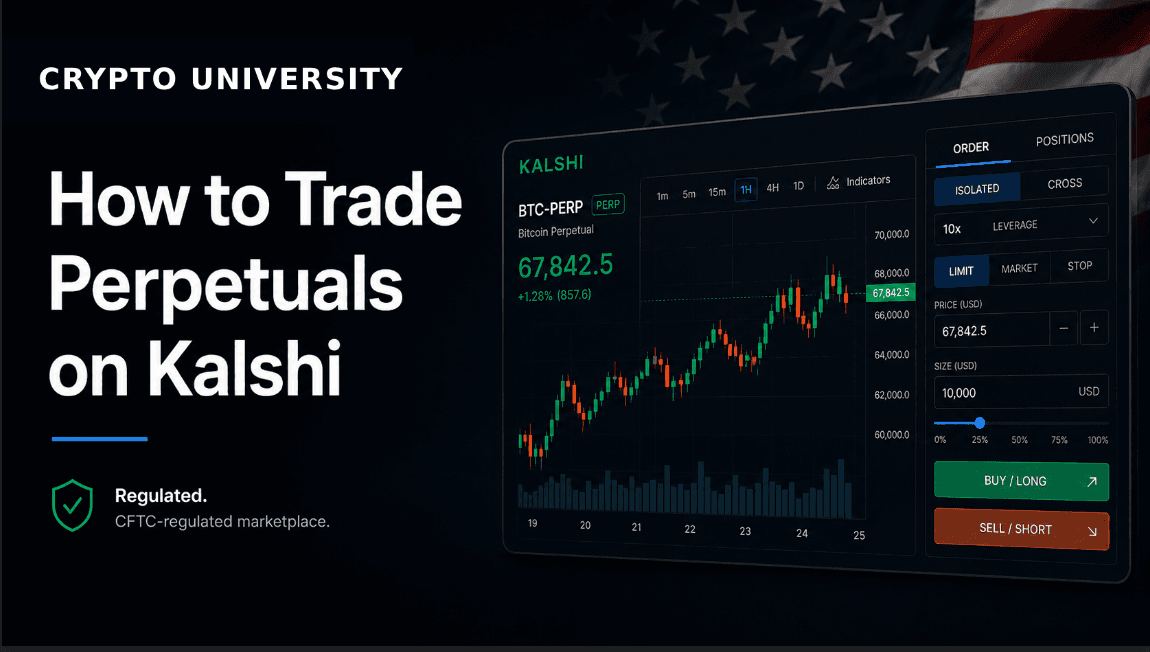
What Are Kalshi Perpetuals?
Kalshi Perpetual futures, often shortened to Kalashi perps, are contracts that let you take a position on the price of a crypto asset such as Bitcoin or Ethereum without owning the coin. You trade Up if you expect the price to rise and Down if you expect it to fall. Unlike traditional futures or options, perpetuals have no expiry date, so you decide when to open and close a position.
Kalshi began as a prediction market for real-world events. In mid-2026 it launched the first perpetual futures contracts approved by a US regulator, the Commodity Futures Trading Commission (CFTC). This matters because, for years, US traders could only reach perps through offshore venues. Kalshi brought the product onshore under US oversight. Trading was reported to pass one billion dollars in volume during its first week, though such figures are widely reported estimates rather than audited totals.
Perpetuals are leveraged products. Leverage can magnify gains, but it magnifies losses just as quickly, and positions can be liquidated. This guide is educational and is not financial advice.
Supported Networks and Assets
Kalshi Perpetuals track major cryptocurrencies, with prices referenced to CF Benchmarks indices. At launch the lineup covered roughly a dozen crypto markets. Assets seen on the platform and in its filings include:
Bitcoin (BTC) and Ethereum (ETH)
Solana (SOL), XRP, and Sui (SUI)
Other listed or filed markets such as Dogecoin, Chainlink, Litecoin, Bitcoin Cash, Polkadot, Stellar, Hedera, and Shiba Inu
Important access note: Kalshi Perpetuals are available to US residents only. There is no international access, and some US states restrict or contest the platform. Availability can change, so check current terms before funding an account.
Main Features
No expiration. Contracts never expire, so you can hold a position for minutes or months.
Two-way trading. Trade Up or Down, meaning you can position for a rising or falling price.
Modest leverage. Leverage caps are set conservatively and adjust with market conditions. Reported figures include roughly 5.7x on Bitcoin, about 4.3x on Ethereum, and lower on mid-cap assets. This is far below the 50x or 100x common on offshore venues.
Onshore regulation. The product is offered under CFTC regulation, with customer margin held in segregated futures accounts.
24/7 access. Markets run around the clock, including weekends when traditional markets are closed.
Transparent funding rate. A periodic payment between Up and Down positions keeps the contract price aligned with the underlying index.
Setup Guide: How to Place Your First Trade
The flow below reflects Kalshi's own walkthrough. Screens may differ slightly between the app and website.
Fund your Kalshi Perpetual account. Deposit using ACH or wire (free) or a debit card (about a 2% processing fee). Kalshi does not accept crypto deposits.
Open the Perps tab. You will see the full list of crypto perpetuals, each with its current price and maximum leverage.
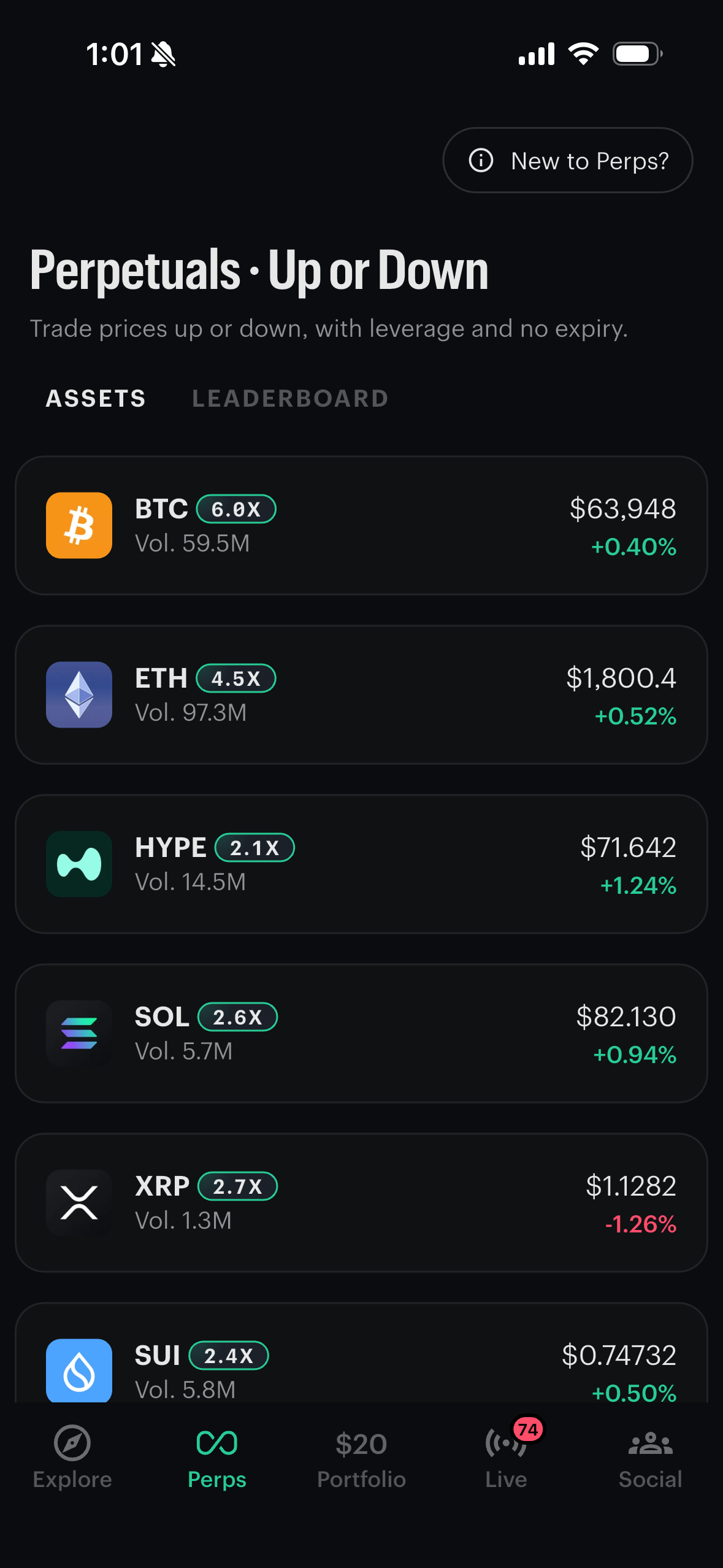
Read the market page. Note the asset, its max leverage (marked with a lightning icon), the price chart, and the Up and Down buttons.
Check the signals. The Insights section shows how traders are positioned, 24-hour volume, open interest, the current funding rate, and the largest open positions.
Place your trade. Tap Up or Down, choose an order type (Quick or Limit), set your upfront cash, and select your leverage. Then slide to open the position.
Set your exits. Use Autosell to set a Take Profit price to lock in gains and a Stop Loss price to cap losses. You can drag these lines on the chart to adjust them.
Manage the position. Watch your liquidation price and the Health meter. If it turns red and shows At Risk, you can add funds to move the position out of liquidation range.
Read more: How to trade Perpetuals on Kalshi
Funding Rates and Liquidation
Funding rates are small periodic payments exchanged between Up and Down positions to keep the contract price close to the underlying index. Kalshi runs three funding cycles a day. The interest-rate component is 0%, and the rate is capped at plus or minus 2.00% per cycle.
Liquidation happens when losses use up the margin backing your position, at which point it is automatically closed with a forced sell. Auto-liquidation is designed to limit losses, but it is not a guaranteed stop. In fast or gapping markets, execution can be worse than the trigger price, and in extreme cases an account balance can go negative, leaving the trader liable for the shortfall.
Fees
Perpetual trading fees are charged on the notional value of your position (the full leveraged size), not on the margin you posted. Because higher leverage means a larger notional position, the fee in dollar terms can look larger than expected. Rates fall as your 30-day trailing volume rises.
Fee type | Rate | Notes |
Taker fee | 12.0 bps down to 2.6 bps | Charged on notional value; falls as 30-day volume rises |
Maker fee | 5.0 bps down to 0.6 bps | Lower than taker; some resting orders are fee-free |
Funding | Capped at ±2.00% per cycle | Three cycles per day; 0% interest-rate component |
Idle collateral | ~3.25% APY (reported) | Interest paid on margin held between trades |
Debit card deposit | ~2% | ACH and wire deposits are free; no crypto deposits |
Figures reflect Kalshi's published perpetual fee schedule effective Aug 2026 and widely reported estimates. Rates and caps can change without notice.
Pros and Cons
Pros
Regulated onshore under the CFTC, with margin held in segregated accounts.
Transparent, capped funding rates and conservative leverage limits.
No expiry and 24/7 trading, with built-in Take Profit and Stop Loss tools.
Cons
Available to US residents only, and restricted in some states.
Leverage still carries real liquidation risk, including possible negative balances.
No crypto deposits, and debit card funding carries a processing fee.
Frequently Asked Questions
Are Kalshi Perpetuals regulated?
Yes. They are offered under CFTC oversight and are described as the first CFTC-regulated perpetual futures in the US.
Do I need to own crypto to trade them?
No. You take a position on the price without owning the underlying coin.
How much leverage can I use?
Caps are set conservatively and adjust with conditions. Reported examples are around 5.7x on Bitcoin and lower on other assets.
What is a funding rate?
It is a periodic payment between Up and Down positions that keeps the contract price aligned with the index. Kalshi uses three cycles a day, capped at plus or minus 2.00% each.
Can I lose more than I deposit?
In extreme market conditions an account can go negative, which means you could owe more than your initial margin. Manage position size and risk carefully.
Disclaimer: This content is for educational and informational purposes only and is not financial advice. Nothing here is a recommendation to buy or sell any asset or use any platform. Do your own research and manage your risk.
Revoke.cash: How to Check and Revoke Token Approvals to Protect Your Wallet
Chainlist: How to Find Chain IDs and Add EVM Networks to Your Wallet
Rugcheck Explained: How to Spot Scam Tokens on Solana in 2 Minutes
Backpack Wallet Review: Multichain Self Custody, Swaps, Staking and Exchange Access