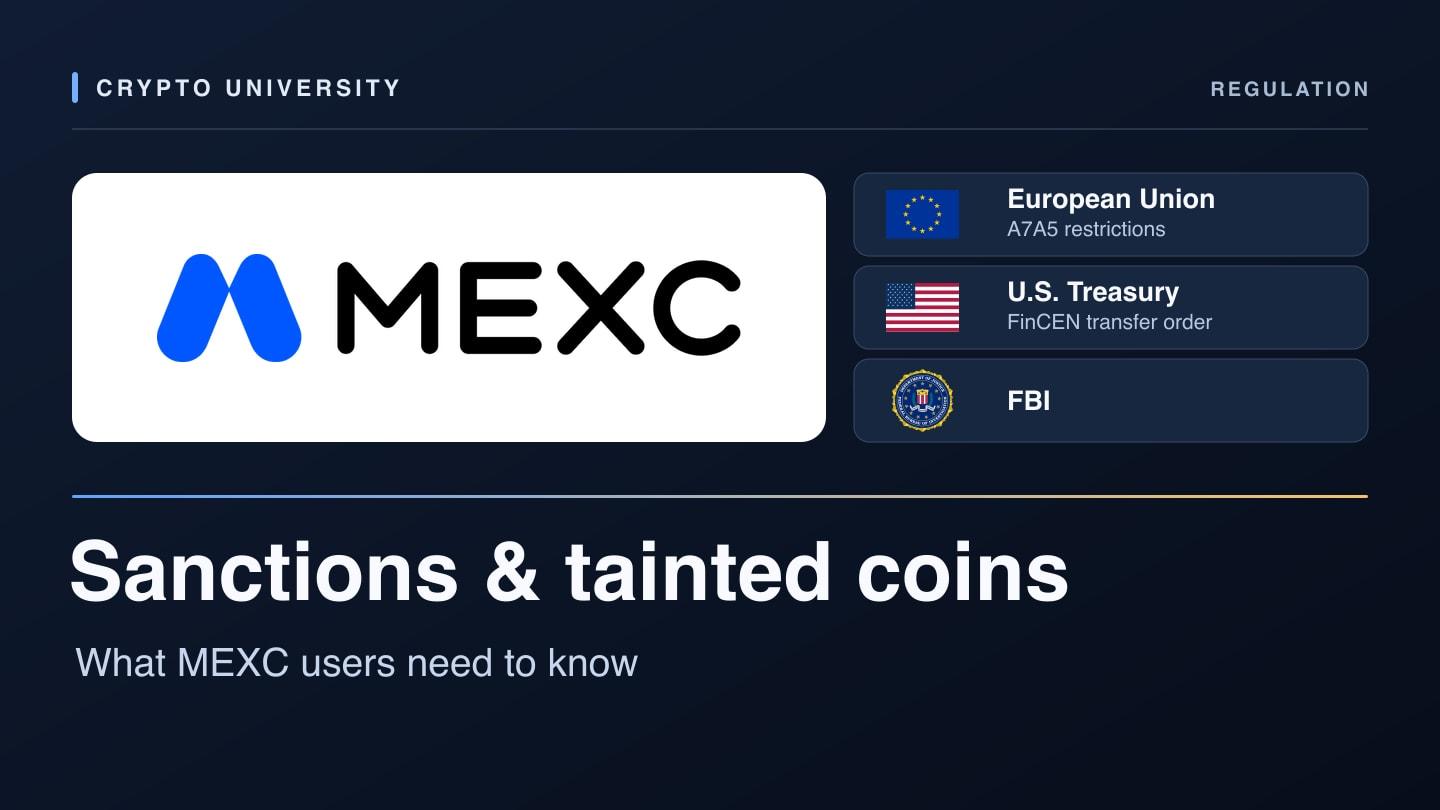
November 8, 2026. A crypto withdrawal can confirm on-chain while the receiving exchange still holds it for review. That distinction matters for MEXC users after the U.S. Financial Crimes Enforcement Network issued its November 6 order. The measure targets transfers to and from MEXC Global by covered U.S. financial institutions, including transfers of cryptocurrency. MEXC says deposits, withdrawals and trading are operating normally and that it has begun an independent review of its anti-money-laundering and sanctions controls. FinCEN order · MEXC response
What the FinCEN order covers
FinCEN identified offshore MEXC Global as a financial institution of primary money laundering concern in connection with Russian illicit finance. The version of the order posted by FinCEN specifies that the transfer prohibition takes effect 30 days after publication in the Federal Register. Its operative provisions govern covered institutions and expressly include virtual currency. Bitcoin falls within that definition. Separate OFAC obligations continue to apply independently. Order, section VI
The order’s discussion recognizes a practical limit of blockchain transfers. A receiving institution may be unable to stop an incoming crypto transaction before receipt. The institution may still have to address the transfer after it arrives, based on the circumstances and its applicable obligations. For a customer, a blockchain explorer can show that the transfer reached an address, while the receiving exchange controls whether the account balance becomes available. FinCEN discussion of incoming crypto transfers
What people mean by “sanctioned coins”
A restricted asset or transaction. A sanctions measure can expressly prohibit transactions involving a named token. The EU’s October 2025 package prohibited transactions involving A7A5, a ruble-backed stablecoin. FinCEN’s MEXC order separately says the exchange sent or received almost $200 million connected to A7A5. That estimate concerns historical flows identified by FinCEN. Council of the EU announcement · FinCEN findings on A7A5
Property connected to a blocked person. OFAC rules can require U.S. persons to block property in which a designated person has an interest. OFAC can list wallet addresses as identifiers for blocked persons. Ownership and the applicable sanctions program matter even when the asset itself is a widely traded currency. OFAC on wallet identifiers · OFAC on blocking digital currency
A provider’s transaction risk flag. “Tainted coins” is informal shorthand for funds a provider or analytics service associates with risky activity. A direct transfer from a known address and indirect exposure through several intermediaries are different facts. A risk flag can trigger a review under a provider’s policy. The label alone cannot determine whether the funds are legally blocked or who controls a wallet. MEXC account risk review guidance
Are BTC or USDT withdrawn from MEXC automatically sanctioned?
The FinCEN order concerns transfers involving MEXC Global. It does not designate BTC, ETH or USDT as assets generally. A particular transfer can still be restricted because of the institution handling it, the counterparty, the source of funds or a separate sanctions obligation. A wallet you control can receive and hold assets, but moving funds into it does not erase transaction history or resolve a legal restriction. FinCEN order scope · OFAC on blocking and rejecting transactions
How an ordinary MEXC user could be affected
Suppose a customer withdraws USDT from MEXC to another exchange. The withdrawal shows as completed and the explorer shows the destination received it. If the account still shows no credit, the receiving exchange may be waiting for its confirmation threshold, investigating a deposit mismatch or reviewing the transfer’s origin. A review can lead to a request for documents, a rejected or returned transfer, or a hold, depending on the provider and the applicable rules. The receiving exchange can explain which category applies to the case. MEXC proof-of-funds and returned-transfer guidance
A review, a rejection and a legal block have different consequences. In a review, the provider assesses the transaction and may ask for evidence. A rejection means the provider declines to process it, and the handling of any already received crypto depends on the circumstances. When applicable OFAC rules require blocking, the institution must hold the property and report it. A token issuer’s technical freeze is another mechanism and depends on the contract and the issuer’s action. OFAC distinction between blocking and rejection · Digital currency blocking guidance
What to do if a deposit or withdrawal is held
Save the transaction hash, asset, network, amount, destination address and UTC timestamp. For a fiat transfer, keep the bank reference.
Check which platform issued the restriction. Ask its official support team whether the issue is a technical deposit problem, an account review, a returned transfer or a legal block.
Keep the original purchase and withdrawal records, trade confirmations and any account statements that explain where the funds came from. Submit requested records only through the provider’s official support flow.
Wait for the provider’s instructions before sending more funds or attempting another route. If a provider identifies a legal block, ask for the authority and case reference and seek qualified advice in the applicable jurisdiction.
Choosing an exchange for future trades
OKX and Bybit are options to evaluate for future eligible trading. Check the local legal entity, asset and network support, and the receiving platform’s policy on transfers from MEXC before initiating a deposit. Global Bybit excludes U.S. customers, and OKX U.S. has separate coverage and terms. A different exchange cannot guarantee acceptance of a flagged transfer. OKX U.S. disclosures · Bybit regional restrictions
Affiliate disclosure. Crypto University may earn a commission through the following signup links. Where eligible, use CRYPTOHUSTLE for OKX and GREYBTC for Bybit. Confirm the referral appears in your regional registration flow. OKX referral · Bybit referral