Key takeaways
August 2026 is a lighter unlock month. Token trackers report a monthly total near $323 million across about 141 projects, the third straight month of decline, with releases led by YZY, PROVE and KAITO.
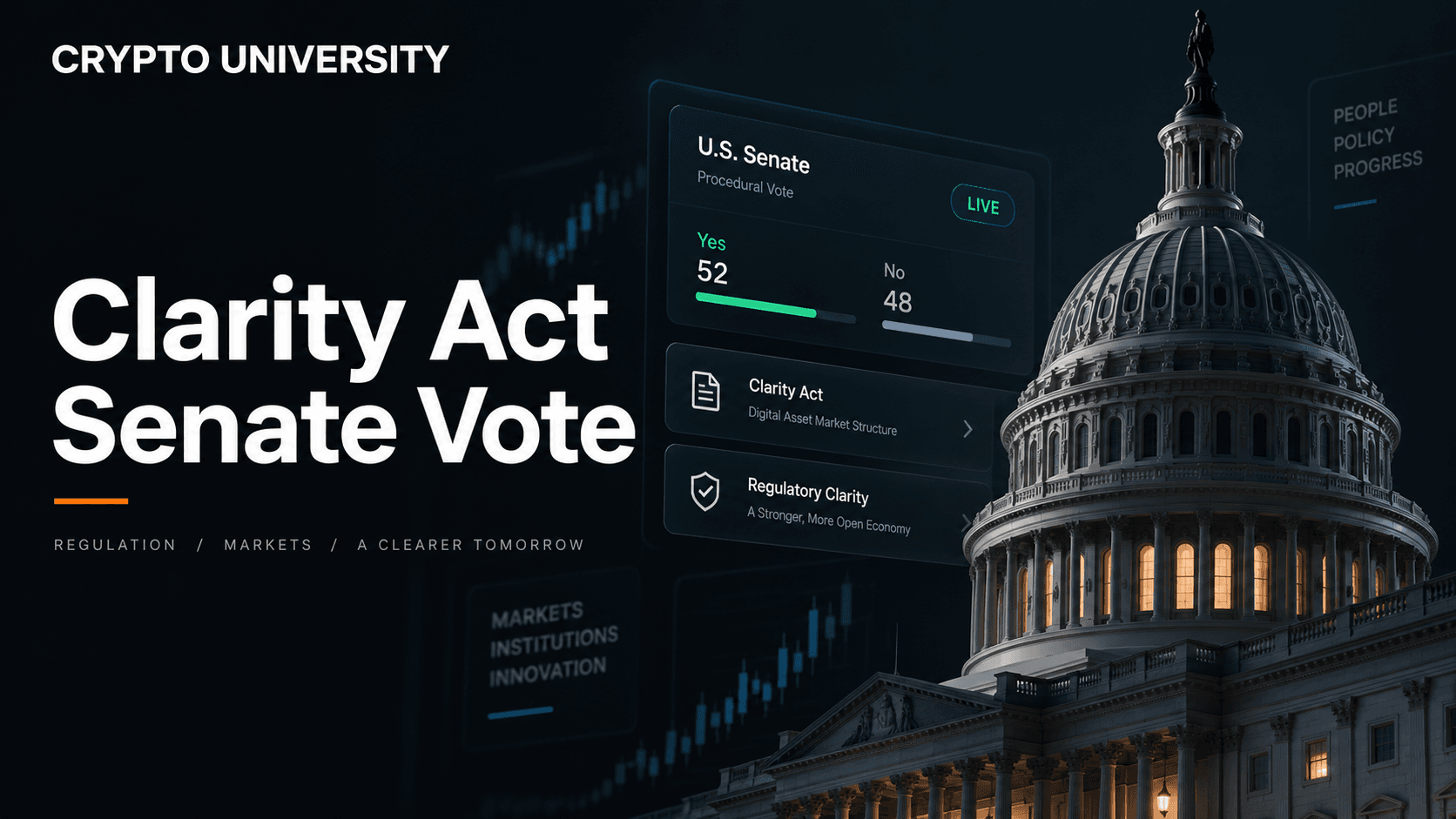
Regulation is mostly about timing. The US Senate's August recess, beginning around August 7 to 10, is widely seen as the practical window for a CLARITY Act floor vote. As of early August no cloture motion had been filed.
ETF flows stayed choppy. Spot Bitcoin ETFs closed July with net outflows, and large holders such as Strategy and the US government continued to shape the institutional backdrop.
How to read a crypto calendar
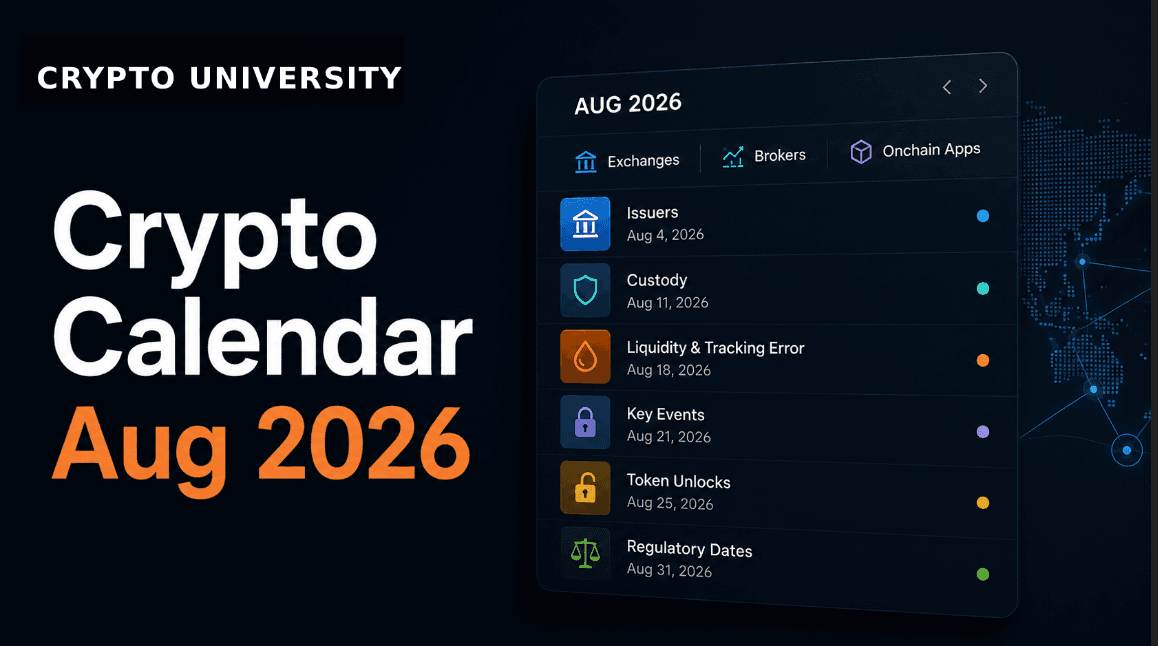
A crypto calendar is simply a schedule of dated events that can affect a market or a specific project. It is a planning tool, not a prediction tool. Reading one well means understanding what each type of event is and why it matters, rather than reacting to every date on the list.
This guide groups August 2026 into four categories that most searchers care about: token unlocks, network and exchange events, regulatory and policy dates, and Bitcoin ETF flows and institutional adoption. Every figure below is an estimate or a widely reported number. Dates for upgrades, votes and exchange deadlines often shift, so treat the official project, exchange or government source as the final word.
Token unlocks in August 2026
A token unlock is the scheduled release of tokens that were previously locked under a vesting schedule, usually held by teams, early investors or ecosystem funds. Once unlocked, those tokens can be moved or sold, which adds to circulating supply. There are two common shapes. A cliff unlock releases a large batch on a single day. A linear unlock drips out smaller amounts gradually.
An unlock is one input into a project's tokenomics, not a guaranteed price move. Markets often price in scheduled releases ahead of time, and the identity of the recipient matters as much as the size. For August 2026, trackers report a monthly total near $323 million across roughly 141 projects, down from about $376 million in July and $580 million in June. Some first-week estimates ran higher because they counted linear releases differently, which is a good reminder that these totals vary by source.
Date (UTC) | Token | Estimated release | Type and notes |
|---|---|---|---|
Aug 2 | Sui (SUI) | ~0.91% of total supply | Foundation-managed drip tied to ecosystem funding |
Aug 5 | Ethena (ENA) | 171.88M ENA (~$15.36M) | About 1.97% of released supply, to core contributors and investors |
Aug 6 | Hyperliquid (HYPE) | 433,000 HYPE (~$22.74M) | About 0.19% of released supply, allocated to core contributors |
Aug 12 | Aptos (APT) | ~11.31M APT (~0.54%) | Recurring monthly vesting event |
Aug 15 | Arbitrum (ARB) | ~0.93% of released supply | Recurring monthly release |
Aug 16 | Story Protocol (IP) | ~$35.47M | Cliff-style, about 22.83% of the scheduled release on one day |
Aug 16 | YZY | ~$35.5M | Largest single scheduled unlock of the month by value |
Figures above are widely reported estimates and move with the token price. PROVE (Succinct) and KAITO are also named among the month's larger vesting events.
Network upgrades, migrations and exchange deadlines
Some August dates are not about supply at all. They are deadlines that ask users to take direct action, or upgrades that change how a network runs. These are the events where missing a date can actually cost access to funds, so they deserve attention even from people who do not trade.
Date | Event | Why it matters |
|---|---|---|
Aug 6 | MultiversX (EGLD) mainnet upgrade | Network improvement intended to make integration easier for exchanges and services |
August | Solana Alpenglow upgrade (expected) | A consensus-related upgrade often discussed for faster finality. Confirm timing with official sources |
August | Pi Network Protocol 26 | Node operators should follow official guidance to stay in sync |
Aug 24 | LayerZero chain wind-down (around) | A cleanup event. Users on affected chains may need to move funds before the cutoff |
Aug 25 to 27 | Zano Hard Fork 6 | Scheduled network upgrade window |
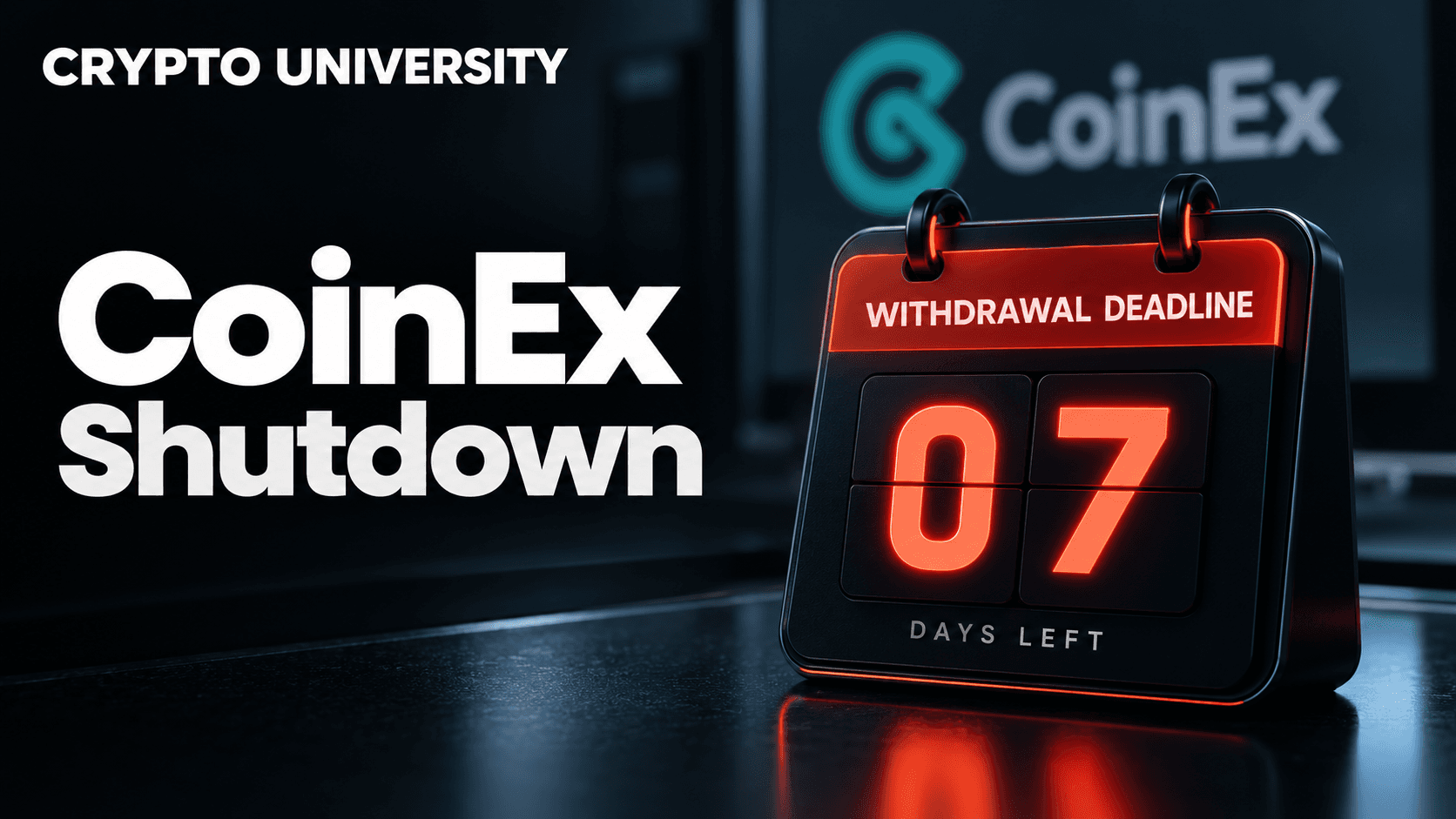
Aug 26 | BitMart trading shutdown | Deadline-driven. Affected users should withdraw before the cutoff |
Exchange wind-downs and chain-support changes sometimes shift by a few days, so watch official announcements in the days before each deadline.
Regulatory and policy dates to watch
The headline regulatory story of August 2026 is timing rather than a single vote. The CLARITY Act (the Digital Asset Market Clarity Act, H.R. 3633) is the most advanced crypto market-structure bill in US history. It passed the House on July 17, 2025 by 294 to 134, and the Senate Banking Committee advanced it 15 to 9 on May 14, 2026. It sits on the Senate Legislative Calendar as No. 423, but as of early August no cloture motion had been filed and no floor time had been allocated.
Analysts point to the Senate's August recess, beginning around August 7 to 10, as the last realistic window for 2026 passage. If the chamber leaves without acting, most observers expect the bill to slip toward late 2026 or into 2027. Prediction-market odds for 2026 passage had fallen to roughly the high-40s percent range from about 74% a month earlier, which shows how uncertain the outcome is.
Date | Item | Status and what to watch |
|---|---|---|
Around Aug 7 to 10 | Senate August recess begins | Seen as the practical deadline for a CLARITY Act floor vote in 2026. Watch whether a cloture motion is filed |
Aug 9 | Cardano (ADA) ETF eligibility milestone | CME's ADA futures complete the six-month regulated trading window under the SEC's streamlined ETF framework. A Grayscale ADA ETF decision is cited for around October 23, 2026 |
July 18 (backdrop) | GENIUS Act rulemaking deadline | The stablecoin law signed July 18, 2025 carried a one-year rulemaking deadline, keeping stablecoin rules active in August |
H2 2026 (backdrop) | SEC 'Regulation Crypto' and innovation exemption | Expected to enter formal rulemaking later in 2026 per the agency's stated agenda |
A useful piece of context: the March 17, 2026 joint SEC and CFTC guidance that classified 16 digital assets is administrative, not statutory. Reporting notes that guidance can be changed by a future administration without a vote, which is part of why the industry has pushed for a law like CLARITY.
Bitcoin ETF flows and what they signal
Spot Bitcoin ETF flows have become one of the most watched short-term signals in crypto because the funds are large. US spot Bitcoin ETFs collectively hold roughly 1.3 million BTC. When new shares are created, authorised participants generally need to source Bitcoin, and redemptions work in reverse. One nuance worth knowing: a reported inflow does not always equal a same-day purchase on a public exchange, because participants can source coins from inventory or over-the-counter desks.
Flows were choppy heading into August. July closed on July 31 with about $265 million in net outflows across the US spot funds. Across 2026 so far, a majority of trading sessions have seen net outflows, a shift from prior years. Even so, cumulative net inflows since the January 2024 launch remain very large, widely reported near $58 to $60 billion, which keeps the product one of the most successful ETF launches on record.
Fund | Net flow, Jul 31 2026 | Note |
|---|---|---|
BlackRock IBIT | About -$122.66M | Largest single-day outflow, roughly 1,948 BTC |
Fidelity FBTC | About -$54.78M | Second-largest outflow that session |
Grayscale GBTC | About -$52.63M | Continued redemptions |
Bitwise BITB | About -$17.77M | Smaller outflow |
ARK 21Shares ARKB | About -$17.54M | Smaller outflow |
Flow direction can reverse within days. Reported figures settle a few sessions behind the headline number, and single-day prints are noisy. Look at multi-week trends rather than one session.
Institutional and government adoption trends
Beyond ETFs, two kinds of large holders shape the institutional picture: corporate treasuries and governments. Strategy (formerly MicroStrategy) remains the largest corporate holder, reporting 842,138 BTC as of August 2, 2026. Notably, the company completed its third Bitcoin sale of 2026 and raised its US dollar reserve to about $4 billion, a sign that even the best-known treasury buyer has been balancing accumulation with balance-sheet management this year. Corporate treasuries as a group added roughly 62,000 BTC in the first quarter of 2026.
On the government side, the US Strategic Bitcoin Reserve, created by executive order on March 6, 2025, holds Bitcoin the government obtained mainly through forfeiture. Total US government holdings were reported near 328,372 BTC, the largest of any nation. Implementation has been slowed by a dispute between the Treasury and Commerce Departments over who should manage the reserve. Two bills, the BITCOIN Act (S.954), which proposes acquiring up to 1 million BTC, and the American Reserve Modernization Act introduced in May 2026, would put the reserve into law, but neither had passed as of mid-2026.
For market context only, and not as a forecast: total crypto market value was reported near $2.28 trillion around July 20, 2026, with Bitcoin about 56% of that and stablecoins near $305 billion. These figures move constantly.
How to use this calendar responsibly
Separate action items from noise. Exchange shutdowns and chain wind-downs need direct action. Most unlocks and ETF prints do not.
Confirm at the source. Upgrade and vote dates shift. Check the project, exchange or government announcement before acting.
Watch trends, not single days. One ETF session or one unlock rarely tells the full story.
Remember this is educational. Nothing here is financial, legal or investment advice, and none of it predicts price.
Frequently asked questions
What is the biggest crypto event in August 2026?
There is no single biggest event. The most watched items are the US Senate's August recess as a deadline for the CLARITY Act, the largest token unlocks (YZY and Story Protocol both around $35 million on August 16), and the direction of Bitcoin ETF flows after July closed with net outflows.
Do token unlocks always lower a token's price?
No. An unlock adds to circulating supply, but markets often price scheduled releases in advance. The effect depends on demand, liquidity, who receives the tokens and overall market conditions. It is one factor in tokenomics, not a guaranteed outcome.
Will the CLARITY Act pass in August 2026?
That was uncertain as of early August. The bill had cleared the House and a Senate committee but had no floor vote scheduled and no cloture motion filed. The August recess is seen as the practical window, and prediction-market odds had fallen well below their earlier highs.
What do Bitcoin ETF outflows mean?
Outflows mean investors redeemed more ETF shares than they created in a session, which can lead to Bitcoin being sold to meet redemptions. A single day is noisy. Multi-week trends are a better read on institutional positioning, and reported figures settle a few sessions late.
How much Bitcoin does the US government hold?
Reported figures put US government holdings near 328,372 BTC in mid-2026, the largest of any nation, mostly obtained through forfeiture and consolidated under the Strategic Bitcoin Reserve created in March 2025.
Where can I verify these dates?
Use primary sources: official project blogs and docs for unlocks and upgrades, exchange notices for deadlines, the US Senate and SEC or CFTC for policy, and established ETF flow trackers for fund data. Calendar figures are estimates and can change.
Disclaimer: This content is for educational and informational purposes only and is not financial advice. Nothing here is a recommendation to buy or sell any asset or use any platform. Do your own research and manage your risk.
Explore the Crypto University Cash Out Crypto Guide
Tokenized Stocks Explained: A Simple Guide for Beginner Traders
How to Buy Tokenized Stocks: A Step by Step Guide for Beginners
Best Platforms for Tokenized Stocks: Exchanges, Brokers and Onchain Apps