Key Takeaways
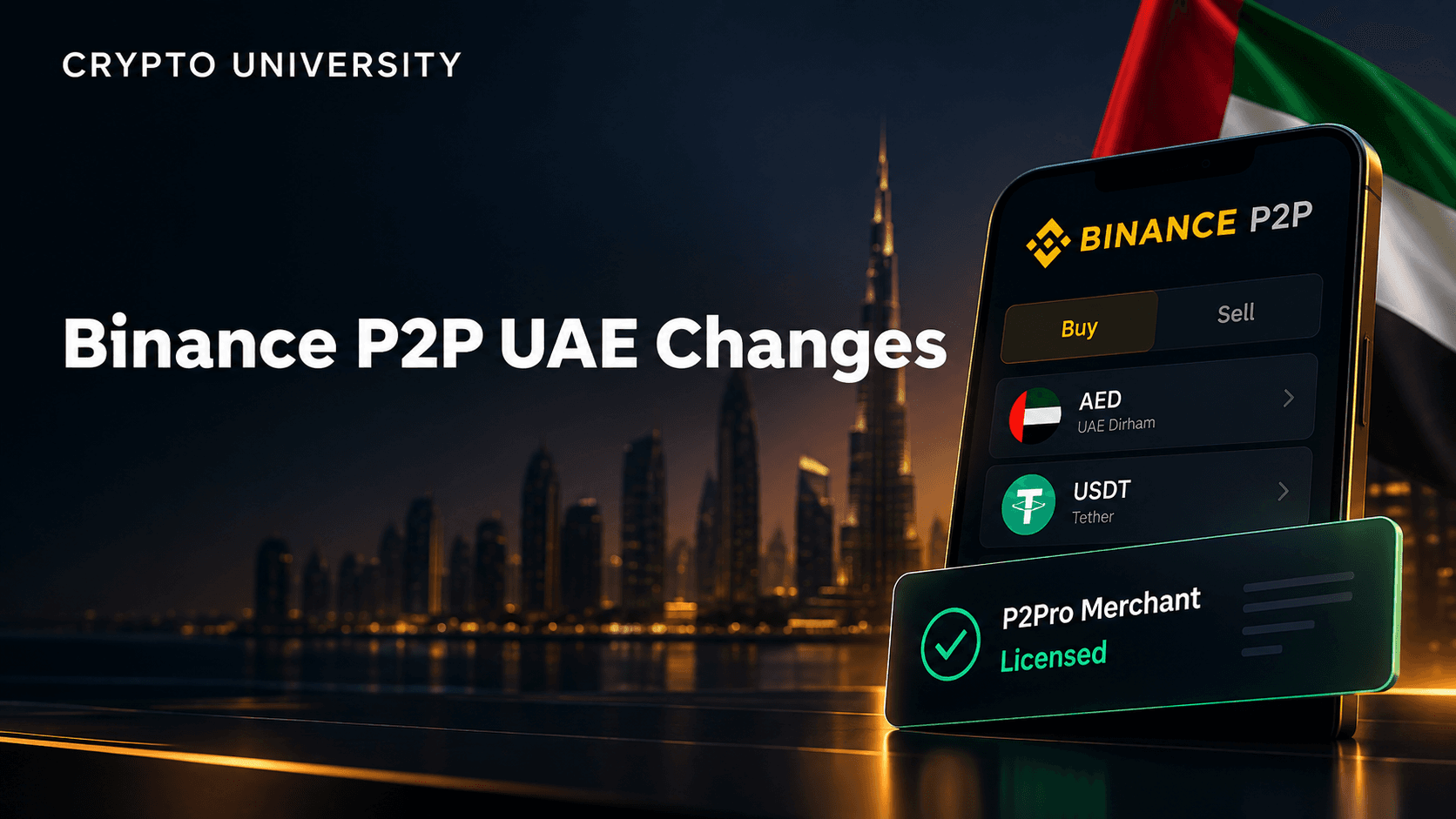
- Since 21 September 2026, UAE users can only trade AED on Binance P2P with approved P2Pro merchants. Standard and retail merchants can no longer offer AED ads to UAE users.
- P2Pro merchants must be licensed UAE companies. They need a proprietary trading licence (such as DMCC or equivalent), a VARA No Objection Certificate, KYB verification, and a corporate bank account.
- This merchant-policy change does not force liquidation of your funds. Balances, withdrawals, escrow, and dispute processes continue as before, and non-AED P2P trading is unchanged.
Introduction
Binance has changed how AED peer-to-peer (P2P) trading works for users in the United Arab Emirates. Binance’s official FAQ was published on 24 August 2026, updated on 31 August 2026, and lists 21 September 2026 as the effective date.
In short, AED P2P trading for UAE users now runs only through licensed corporate merchants called P2Pro merchants. Individual traders who used to post AED buy and sell ads can no longer serve the UAE market in AED.
This guide explains what changed, who P2Pro merchants are, what stays the same, and what both everyday users and former retail merchants should know. It is for information only and is not legal or financial advice.
What Is Binance P2P?
Binance P2P is a marketplace where users buy and sell crypto directly with each other, usually paying in local currency through bank transfer or other payment methods.
Here is how a typical P2P trade works:
- A merchant (also called a maker) posts an ad, for example "Selling USDT for AED."
- A user (the taker) picks the ad and places an order.
- Binance holds the seller's crypto in escrow until the buyer confirms payment and the seller confirms receipt.
- If something goes wrong, either side can open a dispute, which Binance reviews.
P2P is popular because it lets people convert between crypto and local currency without a traditional exchange order book. However, it has also drawn regulatory attention around the world because it involves direct fiat payments between strangers.
What Changed for AED P2P Trading in the UAE
The core change is simple: who is allowed to provide AED liquidity to UAE users.
| Area | Before 21 September 2026 | From 21 September 2026 |
|---|---|---|
| Who can post AED ads for UAE users | Standard, retail, and P2Pro merchants | Approved P2Pro merchants only |
| Can retail users act as makers in the UAE (AE) market | Yes | No |
| AED ads from non-P2Pro merchants | Visible to UAE users | Hidden from UAE users |
| Retail merchants in non-AED markets | Allowed | Still allowed |
| Chat during trades | Limited to fixed prompts | Free chat re-enabled across P2P |
| Balances, escrow, withdrawals, disputes | Normal | Unchanged |
Two points are worth highlighting:
- The restriction is about AED trading for UAE users. According to Binance, AED P2P activity between non-UAE participants is not affected.
- Free chat is back. Users and merchants can now message each other directly during transactions instead of choosing from preset prompts. This can make trades easier, but it also means users should stay alert to scams (more on this below).
What Is a P2Pro Merchant?
A P2Pro (P2P Pro) merchant is an approved corporate merchant that meets regulatory and eligibility requirements and is permitted to provide AED P2P liquidity to UAE users. Binance describes this as a licensed business-to-consumer (B2C) model.
In practical terms, UAE users now trade AED with an approved company that has gone through business verification and meets the relevant licensing requirements. Individual retail merchants were already subject to Binance’s identity checks; KYC is required to trade on Binance P2P.
P2Pro Eligibility Requirements for UAE AED Trading
| Requirement | What It Means |
|---|---|
| UAE corporate entity | Only eligible UAE companies can apply for this UAE AED merchant role. Individuals cannot. |
| KYB verification | Know Your Business checks confirm the company's identity, owners, and structure. |
| Corporate bank account | The merchant must hold a valid business bank account. |
| Proprietary trading licence | Issued by a UAE licensing authority, such as DMCC or an equivalent body. |
| VARA No Objection Certificate (NOC) | A VARA NOC covering the relevant P2Pro activity. |
| Additional requirements | Further licensing may apply depending on activity type and trading volume. |
VARA is Dubai’s Virtual Assets Regulatory Authority. Its remit covers Dubai’s mainland and free zones, except the Dubai International Financial Centre (DIFC). VARA’s public register lists Binance FZE as holding an active VASP licence, issued on 15 April 2024.
A proprietary-trading commercial licence, a VARA NOC, and a VASP licence are different approvals. VARA explains that proprietary trading requires an NOC and may require registration above certain volumes; other virtual-asset activities can require a VASP licence. Merchants should confirm the requirements for their own activities rather than treating an NOC as permission for every crypto service.
Key Dates and Timeline
| Date | What Happened |
|---|---|
| 24 August 2026 | Binance published the announcement. |
| 31 August 2026 | Advance notice issued (announcement updated). |
| 14 September 2026 | Reminder date listed in Binance’s published timeline. |
| 21 September 2026 | New AED P2P requirements took effect. |
From the effective date, existing AED ads from non-P2Pro merchants became invisible to UAE users, and UAE users could no longer place orders against them. Binance asked merchants and users to complete outstanding AED orders and resolve open disputes before that date where possible.
Binance also advised existing P2Pro merchants to take their ads offline and put them back online right after the restriction started, so that UAE users could continue to see them.
What Stays the Same
Binance stated that the following are not affected by this UAE AED merchant-policy change:
- Existing balances. The policy change does not force liquidation or itself cause a loss of funds.
- Withdrawals. These continue as normal.
- Escrow and disputes. These processes work as before.
- Non-AED P2P trading. Other currency pairs and flows remain unchanged.
- AED P2P between non-UAE participants. This activity is not impacted.
What This Means for UAE Users
If you are a UAE user who buys or sells crypto with AED on Binance P2P, your experience changes in a few practical ways.
You May Be Asked for More Verification
P2Pro merchants may request extra documents before completing a trade. Binance gives examples such as:
- Emirates ID (EID)
- Source of Funds (SoF) information, which explains where your money comes from
These requests may relate to the merchant’s regulatory requirements. Read the ad’s terms before placing an order. Binance’s verification guidelines explain that information supplied for these checks goes directly to the independent merchant, under that merchant’s own privacy terms, rather than to Binance. Check who will receive your documents and why, and verify any unfamiliar request through official support before sharing sensitive information.
How to Trade AED on P2P Under the New Rules
- Open Binance P2P and select AED as your fiat currency.
- Review the available ads. As a UAE user, you should only see ads from approved P2Pro merchants.
- Check the merchant's details, including completion rate, number of trades, and payment methods.
- Prepare documents such as your Emirates ID in case the merchant asks for verification.
- Place your order and follow the payment details on the active order. When buying, pay through the listed bank or payment service using an account in your own verified Binance name. Do not accept a request to pay an unrelated third party.
- Keep the order and communication on Binance. Mark payment as complete only after actually paying. If selling, verify receipt in your own bank or payment account before releasing crypto. See Binance’s P2P transaction policy.
Safety Checklist
Even with licensed merchants, basic caution still matters, especially now that free chat is enabled.
- Keep the order and communication on Binance. Fiat payment normally happens through the bank or payment service shown on the active order; do not agree to a separate off-platform deal.
- Do not share passwords, two-factor codes, or seed phrases with anyone.
- Be careful with links or files sent through chat.
- Only release crypto after you confirm the payment has arrived in your own bank account.
- Use the dispute process if something looks wrong.
What Existing Retail Merchants Can Do
If you were a retail (non-licensed) merchant serving UAE users in AED, Binance outlined three paths:
| Option | Who It Suits | What to Do |
|---|---|---|
| Apply for P2Pro status | UAE companies that meet licensing requirements | Complete KYB, hold a trading licence and VARA NOC, then apply |
| Move to other markets | Merchants who want to keep trading as makers | Continue posting ads in non-AED markets or non-UAE AED flows |
| Wind down AED ads | Merchants without a licensed entity | Complete open orders and resolve disputes, then stop AED ads for UAE users |
Individual retail account holders are not eligible for the UAE AED P2Pro merchant role.
Why the Licensed Merchant Model Matters
For UAE AED trading, Binance’s requirements now place business verification, a corporate bank account, and the relevant regulatory approvals at the centre of merchant eligibility. These requirements give users a company counterparty whose business identity has been checked.
For users, this may mean more paperwork. For individual retail merchants, it changes whether they can serve UAE users in AED. The policy does not guarantee better prices or eliminate fraud and payment risks. Compare the terms of available offers and keep following safe trading practices.
Conclusion
Binance P2P in the UAE has moved from an open retail merchant model to a licensed corporate model for AED trading. UAE users now trade AED only with approved P2Pro merchants, may face additional verification, and can chat freely with merchants during trades. This merchant-policy change does not force liquidation; Binance says balances, escrow, withdrawals, and disputes continue as before. These protections do not eliminate trading, fraud, or payment risks.
If you trade P2P in the UAE, read Binance’s official FAQ, check your account settings, and keep following safe trading habits.
FAQ
Can I still buy USDT with AED on Binance P2P in the UAE?
Yes. You can still trade crypto with AED, but only through approved P2Pro merchants.
Will I lose my funds because of this change?
Binance says this merchant-policy change does not force liquidation or itself cause a loss of funds. Existing balances, withdrawals, escrow, and disputes continue as before. This is not a guarantee against losses from trading, fraud, or payment disputes.
Can an individual become a P2Pro merchant for UAE AED trading?
No. Only eligible UAE corporate entities with the required licences, a VARA NOC, KYB verification, and a corporate bank account can apply.
Why is a merchant asking for my Emirates ID?
P2Pro merchants may request extra verification, such as Emirates ID or Source of Funds information, to meet their regulatory obligations.
Does this affect P2P trading in other currencies?
No. Binance says this UAE AED merchant-policy change does not alter non-AED P2P trading or other supported currency flows.
Related Terms
- Peer-to-Peer (P2P) Trading: A way of buying and selling crypto directly between users, usually with a platform acting as a middleman.
- Escrow: A system where a third party holds assets until both sides of a trade meet the agreed conditions.
- KYC (Know Your Customer): The process of verifying an individual's identity before they can use a financial service.
- KYB (Know Your Business): The process of verifying a company's identity, ownership, and legal status.
- Liquidity: How easily an asset can be bought or sold without causing a large change in its price.
Sources
- Binance Support: Binance P2P: AED Merchant Changes in the UAE. Published 24 August 2026; updated 31 August 2026.
- Binance Support: P2P User Transaction Policy. Updated 12 June 2026.
- Binance Support: P2P Additional Verification Requirements & Guidelines. Updated 7 January 2025.
- Binance: Why Some P2P Merchants Require Additional Identity Verification.
- VARA: Binance FZE public-register entry. Active licence checked 8 October 2026.
- VARA: Licensed Activities and Proprietary Trading.