
Key Takeaways
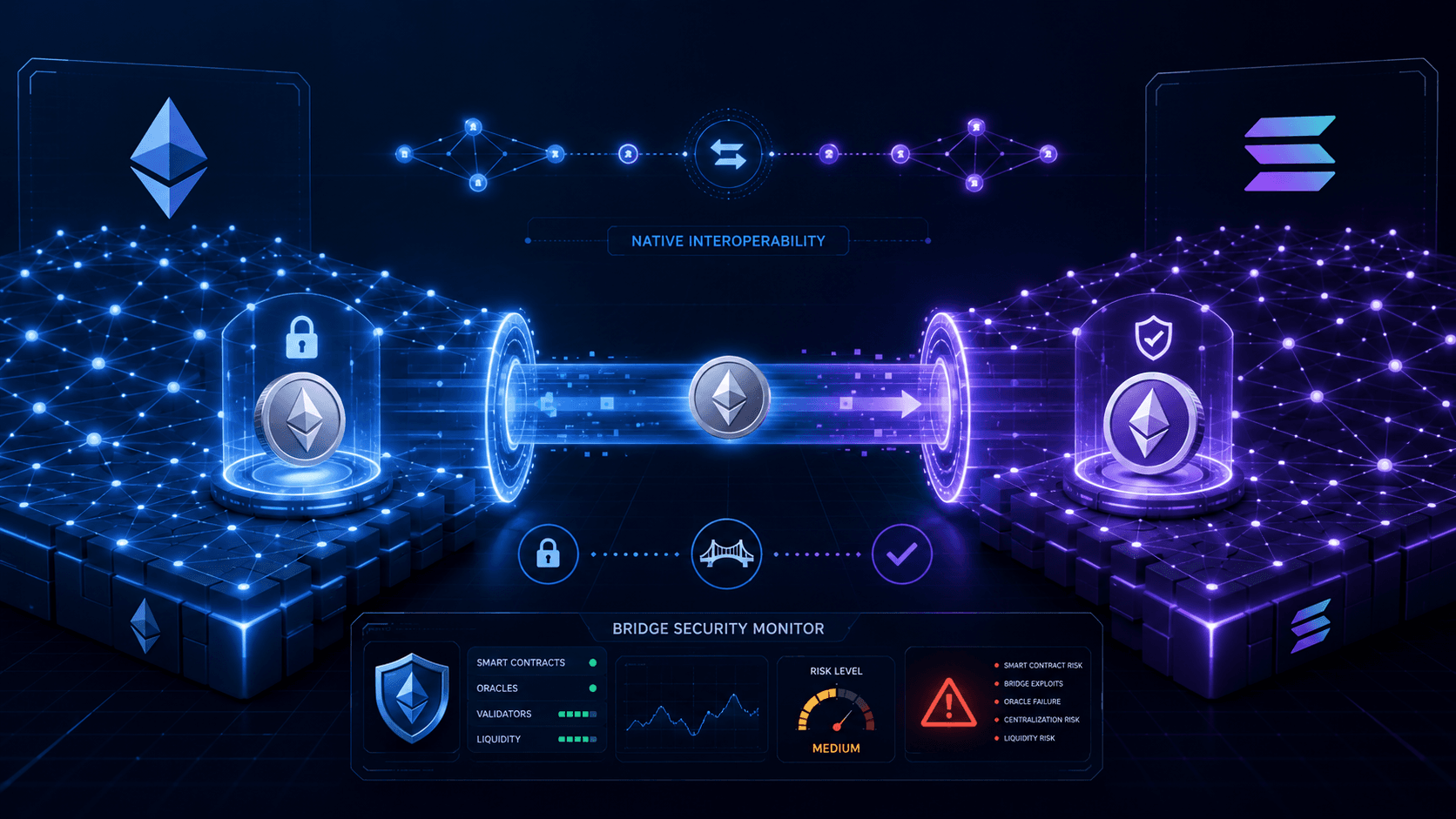
Cross-chain bridges allow assets to move between separate blockchain networks by locking tokens on one chain and minting equivalent representations on another.
Bridge TVL exceeded $20 billion in early 2026, and daily cross-chain transaction volumes now exceed $4 billion, up from $500 million in 2022.
Bridges are also the most exploited infrastructure in DeFi. Over $2.5 billion has been lost to bridge hacks since 2021, with major attacks continuing into 2026.
The Multi-Chain Problem
For most of crypto's history, the narrative focused on which blockchain would win. Ethereum versus Solana. Solana versus Avalanche. The question assumed a single dominant network would eventually absorb most activity.
That framing has largely collapsed. The industry has settled, reluctantly at first and then decisively, on a different answer: multiple blockchains will co-exist, each serving different use cases, and the infrastructure connecting them will matter as much as the chains themselves.
The result is that moving assets between blockchains has gone from a niche technical challenge to everyday user behavior. Understanding how it works, and where it can fail, is now a basic competency for anyone using DeFi or holding assets across multiple networks.
Why Blockchains Cannot Talk to Each Other Natively
Each blockchain is, by design, a closed system. Ethereum has no visibility into the Solana ledger. BNB Chain cannot read an Avalanche block. These networks use different consensus mechanisms, different address formats, and different rules for validating transactions.
This isolation is intentional. It makes each chain internally consistent and secure. But it means that an asset created on one chain, such as ETH on Ethereum, cannot simply be sent to an address on a different chain. The destination chain has no way to verify that the asset existed or that it was properly transferred.
Cross-chain interoperability protocols solve this problem by creating a trusted verification layer between networks.
How Bridges Work: The Core Mechanism
The most common bridge design is called lock-and-mint. It works like this:
A user deposits an asset (for example, ETH) into a smart contract on the source chain. The contract locks those funds.
The bridge detects this deposit and instructs the destination chain to mint a wrapped version of the asset (for example, wETH on BNB Chain).
The user receives the wrapped token on the destination chain. It represents a claim on the locked funds.
To reverse the process, the user burns the wrapped token, and the bridge releases the original asset on the source chain.
The critical security question in this design is: who or what decides that the deposit on Chain A actually happened before releasing funds on Chain B? The answer to that question determines how secure and how decentralized a bridge is.
Trusted vs. Trustless Bridges
Type | How Verification Works | Risk Level | Examples |
Trusted (centralized) | A company or small group of validators confirms transfers | Higher: single point of failure | Early Ronin, early Multichain |
Externally verified | A decentralized committee of validators reaches consensus | Medium: validator compromise possible | Wormhole, LayerZero, Axelar |
Light client (trust-minimized) | On-chain cryptographic proofs verify the source chain state | Lower: mathematically enforced | Cosmos IBC |
Natively integrated | Shared security model; chains verified at the protocol level | Low: no third-party bridge needed | Polkadot parachains |
The Bridge Hack Problem
Cross-chain bridges have been the most exploited category of infrastructure in blockchain history. The numbers are significant.
Since 2021, bridge exploits have resulted in estimated losses exceeding $2.5 billion. Major incidents include the Ronin Bridge hack in 2022 ($620 million, caused by compromised validator keys), the Wormhole exploit in 2022 ($326 million, caused by a signature verification bug), and the Nomad bridge collapse in 2022 ($190 million, caused by an update error). In 2026, bridge-related attacks continued, with DeFi losses topping $750 million through April alone. |
The April 2026 KelpDAO incident is a useful case study. Attackers linked to North Korea's Lazarus Group stole approximately $292 million from a LayerZero-powered bridge. The attack did not exploit a flaw in LayerZero's core code. Instead, attackers compromised the off-chain infrastructure that fed data to the bridge's verification system, tricking it into releasing funds based on a transaction that never actually happened on the source chain.
This illustrates a consistent pattern: bridges fail not only when smart contracts have bugs, but also when the humans and infrastructure around them are targeted or poorly designed.
Beyond Bridges: Native Interoperability
The term 'bridge' is increasingly seen as describing only one approach to a broader problem. In 2026, the more precise framing is cross-chain interoperability, which includes several architectures that work differently from the classic lock-and-mint bridge.
Cosmos IBC (Inter-Blockchain Communication)
Cosmos IBC allows chains built on the Cosmos SDK to exchange messages and assets directly, verified through on-chain cryptographic proofs called light clients. Each chain maintains a light client of the other, allowing it to verify the state of the remote chain without trusting a third party.
The strength of IBC is its trust-minimized design. The weakness is scalability: adding a new chain requires implementing a custom light client, which involves significant development work.
Polkadot Parachains
Polkadot uses a shared security model where multiple chains (parachains) are validated by a central relay chain. Assets can move between parachains without wrapped tokens or third-party bridges, because all parachains share the same security guarantees from the relay chain validators.
Chainlink CCIP
Chainlink's Cross-Chain Interoperability Protocol (CCIP) uses a layered architecture: a decentralized oracle network monitors source chains, a separate execution network submits transactions on destination chains, and an independent Risk Management Network monitors for anomalies and can halt processing if something looks wrong.
Kraken, one of the world's largest exchanges, adopted CCIP as its cross-chain standard in May 2026, replacing its previous LayerZero integration following the KelpDAO incident. The move was described as aligning bridge security with the risk tolerance of a regulated exchange handling billions in daily user assets.
LayerZero
LayerZero focuses on cross-chain messaging rather than simple asset transfers. It allows applications to pass arbitrary data and instructions between chains. The protocol has faced scrutiny following incidents where bridges built on it were exploited, though the core LayerZero protocol itself was not the source of those vulnerabilities.
The Current Landscape: Key Numbers
Metric | Figure | Source / Notes |
Bridge TVL | $21.94 billion | DeFiLlama, March 2026 |
Daily cross-chain volume | Over $4 billion | Widely reported estimate, April 2026 |
Total bridge hack losses (since 2021) | Over $2.5 billion | DeFiLlama aggregated data |
DeFi losses in 2026 (through April) | Over $750 million | Phemex security report |
x402 transactions on Base | Over 119 million cumulative | March 2026 |
Intent-solver cross-chain volume | $4.1 billion (90-day period) | SpottedCrypto, 2026 estimate |
Chain Abstraction: Where the Industry Is Heading
The user experience of cross-chain activity today still requires users to know which chain they are on, manage multiple wallets, and manually initiate bridge transactions. Chain abstraction is the design goal that eliminates those requirements.
In a fully abstracted environment, a user simply holds assets and interacts with applications. The routing, bridging, and chain selection happens automatically in the background. The user never needs to know whether their transaction settled on Ethereum, a Layer 2, or an entirely different network.
Several products in 2026 are moving toward this experience. Intent-based systems, where a user states what they want to achieve and solver networks find the best execution path, are one of the more practical near-term approaches. These solvers accumulated $4.1 billion in cross-chain volume over a 90-day period in early 2026.
Interoperability protocols like CCIP and LayerZero are increasingly described by their developers as general-purpose messaging layers rather than bridges. At that level of abstraction, users may no longer need to think about bridging as a distinct action. It becomes infrastructure, like how your phone's internet traffic routes through multiple servers without you managing any of it. |
Practical Guidance: What to Know Before You Bridge
For users who move assets between chains today, a few practical points reduce risk.
Use bridges with public audits and a verifiable track record. Check DeFiLlama's bridge data for TVL and transaction history as a rough indicator of ecosystem trust.
Prefer bridges with decentralized or trustless verification over those relying on a small validator set.
Understand what you receive. Bridged assets are often wrapped tokens, not native assets. Verify that the wrapped version is widely accepted before using it in DeFi protocols.
Be cautious with large amounts. Bridge smart contracts hold concentrated liquidity and are high-value targets. Consider using multiple transactions rather than a single large transfer.
Check current network conditions. Gas costs and bridge fees can vary significantly. Some routes are far cheaper at certain times of day.
Frequently Asked Questions
What is a cross-chain bridge?
A cross-chain bridge is a protocol that allows users to move assets from one blockchain to another. Most bridges work by locking the original asset on the source chain and minting a wrapped equivalent on the destination chain.
What is the difference between a bridge and native interoperability?
A bridge is a third-party layer added on top of blockchains to connect them. Native interoperability means chains are designed from the start to communicate securely, such as in the Cosmos IBC model or Polkadot's parachain architecture. Native solutions generally carry less trust assumption than third-party bridges.
Why have so many bridges been hacked?
Bridges concentrate large amounts of liquidity in smart contracts that must accept instructions from external sources. This creates a large attack surface. Vulnerabilities have included compromised validator keys, flawed smart contract logic, and attacks on the off-chain infrastructure that feeds data to bridge verification systems.
What is CCIP?
CCIP stands for Cross-Chain Interoperability Protocol, developed by Chainlink. It uses a defense-in-depth architecture with separate networks for monitoring and execution, plus an independent Risk Management Network that can halt suspicious activity. Kraken adopted it as its cross-chain standard in May 2026.
What is a wrapped token?
A wrapped token is a representation of an asset from one blockchain issued on another blockchain. For example, wETH (wrapped ETH) on the BNB Chain represents ETH locked in a bridge contract on Ethereum. Wrapped tokens are redeemable for the underlying asset through the same bridge.
What is chain abstraction?
Chain abstraction is a design approach that hides the complexity of multi-chain operations from end users. In an abstracted environment, users interact with applications without needing to know which underlying blockchain is processing their transaction. The routing and bridging happen automatically.
How do I check if a bridge is safe to use?
There is no guarantee of safety, but you can reduce risk by checking whether a bridge has been publicly audited, reviewing its TVL and transaction history on DeFiLlama, understanding its validation model, and avoiding bridges that have not been independently reviewed. Larger, more established protocols have generally earned more scrutiny.
Disclaimer: This content is for educational and informational purposes only and is not financial advice. Nothing here is a recommendation to buy or sell any asset or use any platform. Do your own research and manage your risk.
Read More
The Crypto Anti-Phishing Checklist: 12 Habits That Stop Wallet Drainers in 2026
How Cross-Chain Bridges Work: A Security Guide for New Crypto Traders
Cross-Chain Bridges: A Plain-English Guide to How They Work and When to Avoid Them
How to Safely Use Crypto Bridges in 2026: Risk Assessment Checklist and Best Practices
Need deeper training?
Join our structured modules with live examples and expert checklists for effective implementation.
JOIN THE ACADEMY