Key Takeaways
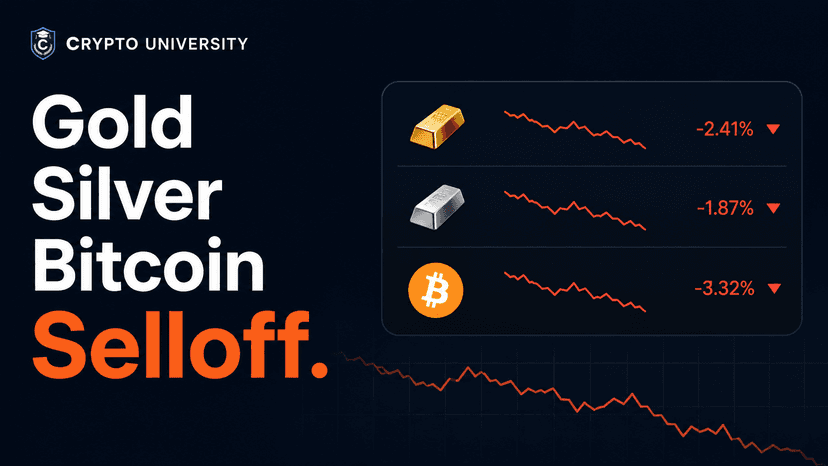
1 | Gold, silver, and Bitcoin were treated as one "debasement trade" basket through much of 2025. When the macro conditions that supported that trade shifted, all three fell together. |
2 | A hawkish Federal Reserve raises real yields, strengthens the dollar, and makes non-yielding assets like gold and Bitcoin less attractive to investors. These mechanics affect all three assets. |
3 | Bitcoin and gold are not the same asset. Research increasingly shows gold behaves as a real-rate hedge and crisis store of value, while Bitcoin responds more to liquidity conditions, risk appetite, and crypto-specific factors. |
If you have watched Bitcoin's price drop on the same day gold and silver sold off, you might have wondered whether that was a coincidence or something more structural. It is usually the latter.
Bitcoin, gold, and silver are regularly grouped together by investors and analysts as "hard assets" or "debasement hedges." That grouping is not arbitrary. It comes from a specific macro trade that became popular over the past several years. Understanding how this trade works, and why it unwinds, explains a lot about Bitcoin's behavior during periods of market stress.
This article breaks down the relationship between Bitcoin and precious metals, explains the mechanics behind correlated selloffs, and clarifies how these assets are similar in some ways and fundamentally different in others.
What Is the Debasement Trade?
The debasement trade is a macro investment strategy built on one core idea: governments spending beyond their means and central banks expanding the money supply will gradually erode the purchasing power of fiat currencies. To protect against this, investors move capital into assets that cannot be printed or created at will.
The term "debasement" refers to the loss of value in a currency. Historically, it described Roman emperors reducing the silver content of coins to fund military campaigns. Today, it is used to describe the slow dilution of purchasing power that can result from persistent deficit spending, quantitative easing, and above-target inflation.
The assets most commonly associated with this trade are:
Gold, which has functioned as a store of value for thousands of years and is largely immune to government interference
Silver, which shares gold's monetary characteristics but also has significant industrial demand, making it more volatile
Bitcoin, which has a fixed supply cap of 21 million coins baked into its code and is often described as "digital gold" for this reason
When investors believe that governments will continue running deficits and central banks will keep real rates low, money flows into all three. They become, in practice, different expressions of the same bet.
Why They Often Move Together
Through much of 2025, gold, silver, and Bitcoin were widely treated as one basket by institutional investors and macro funds. A weaker dollar, low real interest rates, persistent inflation concerns, and geopolitical uncertainty all supported the thesis that holding scarce assets was prudent. Capital flowed into all three.
What groups assets on the way up also groups them on the way down. When the conditions that support the debasement trade reverse, the exit tends to happen in sync because the same investor base that bought all three is now selling all three.
What triggers a reversal? Several macro factors can shift the trade:
A hawkish central bank signaling rate hikes rather than cuts
A strengthening U.S. dollar, which raises the cost of holding non-dollar assets
Rising real yields, which make yield-bearing assets like government bonds more attractive relative to non-yielding ones like gold and Bitcoin
Fading inflation expectations, which reduce the urgency of hedging against currency erosion
When these forces combine, investors who are positioned across all three assets tend to reduce exposure across all three. The result is a correlated selloff that can look puzzling if you do not know what is driving it.
Key Terms to Understand
Term | What It Means |
Real Yields | The return on a bond or savings instrument after subtracting inflation. When real yields rise, investors can earn a positive return just by holding safe assets, making gold and Bitcoin less attractive by comparison. |
Hawkish Fed | A Federal Reserve that signals tighter monetary policy, meaning higher interest rates. This tends to strengthen the dollar and push up real yields, which puts pressure on hard assets. |
Fiat Currency | Government-issued money that is not backed by a physical commodity. The U.S. dollar, euro, and Japanese yen are all fiat currencies. Their value depends on trust and policy decisions. |
Currency Debasement | The process by which a currency loses purchasing power over time, often as a result of excessive money printing or persistent fiscal deficits. |
Opportunity Cost | The value of what you give up by choosing one investment over another. When real yields rise, the opportunity cost of holding non-yielding assets like gold or Bitcoin increases. |
How Interest Rates and the Dollar Drive Bitcoin and Metals
Of all the macro variables that affect Bitcoin and precious metals, real interest rates are arguably the most important. Research from asset managers including NYDIG has described gold as a "real-rate hedge" and Bitcoin as a "liquidity barometer," reflecting how each asset responds to the macro environment.
For gold, the relationship is well established and long-running. When real yields fall, the cost of holding a non-yielding asset decreases, making gold more attractive. When real yields rise, the reverse applies. This is why a hawkish central bank, one that signals higher rates ahead, tends to pressure gold prices.
For Bitcoin, the relationship is less consistent. Bitcoin responds to real yields but is also heavily influenced by:
Overall liquidity in financial markets and investor risk appetite
Institutional flows, including ETF inflows and outflows
Regulatory developments that affect accessibility and confidence
Crypto-specific positioning, including leverage in futures markets
The U.S. dollar adds another layer. A stronger dollar makes dollar-priced commodities more expensive for buyers in other currencies, reducing international demand for gold, silver, and Bitcoin alike. When the Federal Reserve turns hawkish and markets begin pricing in rate hikes, the dollar tends to strengthen, creating a headwind across all three assets simultaneously.
Bitcoin vs. Gold vs. Silver: How Each Asset Behaves
Factor | Gold | Silver | Bitcoin |
Supply | Finite (mined), grows ~1.75% per year | Finite (mined), significant industrial use | Fixed cap: 21 million coins |
Volatility | Low to moderate | Moderate to high | Very high |
Crisis behavior | Consistent safe-haven; often rises in crises | Amplifies gold moves; can fall sharply | Variable; often falls with risk assets |
Industrial demand | Limited | Significant (solar, EVs, semiconductors) | None |
Primary macro driver | Real interest rates, dollar strength | Same as gold plus industrial demand | Liquidity, risk sentiment, regulation |
Central bank demand | Yes, significant and growing | No | Limited |
Bitcoin Lagged Going Up, Then Fell Going Down
One of the more notable patterns from the 2024 to 2026 period was that Bitcoin largely missed the gains that gold and silver posted during 2025. While gold climbed roughly 65 percent and silver gained even more, Bitcoin spent much of the year trading sideways around the $100,000 level before falling sharply alongside metals when the debasement trade began to unwind in 2026.
This asymmetry, missing the upside while still tracking the downside, raised legitimate questions about Bitcoin's role in the debasement trade. Several explanations have been offered:
Bitcoin had already priced in much of the debasement narrative earlier, during its 2024 rally driven by ETF launches and institutional adoption
Gold and silver benefited from central bank buying, which has no equivalent in Bitcoin markets
When geopolitical or systemic risk is the primary driver of demand, investors tend to favor tangible, well-understood assets with long track records over newer digital alternatives
Bitcoin increasingly trades like a liquidity-sensitive risk asset rather than a pure crisis hedge, meaning it struggles when fear dominates sentiment
None of this means Bitcoin is permanently excluded from the debasement narrative. It means the market assigns different roles to each asset, and those roles do not always align perfectly.
When the Debasement Trade Unwinds: What Happens
A debasement trade unwind typically happens when one or more of the conditions that made hard assets attractive begin to reverse. In mid-2026, the sequence looked something like this:
The Federal Reserve, under new chair Kevin Warsh, signaled a more hawkish stance, with markets pricing in rate hikes rather than the cuts many had expected
The U.S. dollar strengthened, rising against major currencies and putting pressure on commodity prices
Real yields climbed, raising the opportunity cost of holding non-yielding assets like gold and Bitcoin
Capital began rotating into assets that could offer yield, particularly government bonds
The result was a broad selloff across all three assets. The fact that they fell together was not a coincidence. It was the mechanical consequence of the same investor base exiting the same trade at the same time.
Silver's decline was particularly sharp because it carries additional complexity. Leverage in futures markets, margin calls, and the dual role of both monetary asset and industrial commodity can amplify moves in both directions.
Are Bitcoin and Gold Really the Same Asset?
The short answer is no, though they share some structural similarities.
Both have finite supply. Both are denominated in dollars, so a stronger dollar affects both. Both carry no yield. And both attract investors who are skeptical about the long-term purchasing power of fiat currencies.
But the differences are significant:
Gold has a multi-decade track record as a crisis hedge and benefits from central bank buying, a demand source that has no Bitcoin equivalent
Bitcoin is significantly more volatile, with drawdowns of 20 to 50 percent being common even within broader bull markets
Bitcoin's behavior increasingly correlates with liquidity and risk appetite rather than inflation expectations alone
Gold is trusted by institutional allocators globally; Bitcoin is still building that institutional credibility, though ETF adoption has accelerated the process
Research from institutions including Duke University and NYDIG has found that gold demonstrates more consistent safe-haven behavior across different types of macro shocks, while Bitcoin's hedge characteristics are more conditional, appearing in some environments and not others.
A useful framing: gold functions primarily as a real-rate hedge. Bitcoin functions more as a liquidity barometer. They can trade together when the same macro forces drive both, and they can diverge sharply when the relevant conditions differ.
Macro Factors and Their Effect on Gold, Silver, and Bitcoin
Macro Factor | Gold | Silver | Bitcoin |
Rising real yields | Negative | Negative | Negative |
Falling real yields | Positive | Positive | Mixed |
Stronger U.S. dollar | Negative | Negative | Negative |
Weaker U.S. dollar | Positive | Positive | Mixed |
Hawkish Fed | Negative | Negative | Negative |
Geopolitical crisis | Positive | Mixed | Uncertain |
High risk appetite | Neutral/Negative | Neutral | Positive |
Market liquidity tightening | Mildly Negative | Negative | Strongly Negative |
What This Means for People Learning About Crypto
Understanding the debasement trade is not about knowing when to buy or sell. It is about understanding why Bitcoin's price sometimes moves in ways that seem disconnected from anything happening in the crypto market specifically.
When Bitcoin drops sharply and news headlines cannot identify an obvious crypto-specific cause, the answer is often in the macro environment. Rising real yields, a strengthening dollar, or a hawkish central bank can all create selling pressure across the entire hard asset complex, including Bitcoin.
A few practical things to understand:
Bitcoin trades around the clock, seven days a week. When macro news breaks outside of traditional market hours, Bitcoin often reacts first because it is the most liquid market available at any given moment.
The correlation between Bitcoin and traditional assets is not fixed. It can be high during certain macro regimes and low in others. Treating it as permanent in either direction is likely to be misleading.
Gold is not the same as Bitcoin, even though both are sometimes described as inflation hedges. They respond to similar macro forces but have different track records, different volatility profiles, and different demand drivers.
When institutional investors de-risk portfolios broadly, Bitcoin is often sold quickly because it is highly liquid and trades at any hour. This can amplify short-term moves beyond what fundamentals would suggest.
Frequently Asked Questions
Why does Bitcoin go down when gold goes down?
When gold sells off due to macro factors such as rising real yields or a stronger dollar, Bitcoin often follows. This is because both are non-yielding assets that attract similar types of investors. During broad debasement trade unwinds, the same capital exits both simultaneously, pushing both prices lower.
Is Bitcoin the same as digital gold?
Bitcoin shares some characteristics with gold, including a fixed supply and independence from government money creation. However, they behave differently in practice. Gold has a stronger track record as a crisis hedge, benefits from central bank buying, and tends to be less volatile. Bitcoin responds more to liquidity conditions and investor risk appetite.
What does the Federal Reserve have to do with Bitcoin's price?
The Federal Reserve sets the direction of U.S. interest rates. When the Fed raises rates or signals it may do so, real yields tend to rise and the dollar often strengthens. Both of these forces create headwinds for non-yielding assets like gold and Bitcoin. The reverse is also true: expectations of rate cuts can support both.
What is the debasement trade?
The debasement trade is a macro investment strategy that involves buying assets with fixed or limited supply, such as gold, silver, and Bitcoin, in anticipation that government deficit spending and money printing will erode the purchasing power of fiat currencies over time. When conditions change and this scenario seems less likely, investors unwind the trade and prices can fall.
Why did Bitcoin miss gold's 2025 rally but still fall with it in 2026?
This is a fair question that does not have a single clean answer. Bitcoin had already priced in much of the debasement narrative during its 2024 ETF-driven rally. Through 2025, gold and silver benefited from central bank buying and safe-haven demand that Bitcoin could not easily replicate. When both assets eventually fell due to hawkish Fed signals in 2026, Bitcoin tracked the decline because it had remained in the same "debasement basket" for many institutional investors even while lagging on the way up.
Should I watch gold prices to understand Bitcoin?
Watching traditional asset markets, including gold, treasury yields, and the U.S. dollar, can provide useful context for understanding Bitcoin's macro environment. When real yields are rising and the dollar is strengthening, these are headwinds for Bitcoin regardless of what is happening in crypto markets specifically. However, Bitcoin also has its own drivers, including ETF flows, regulatory news, and on-chain activity, that operate independently of the precious metals market
Disclaimer: This content is for educational and informational purposes only and is not financial advice. Nothing here is a recommendation to buy or sell any asset or use any platform. Do your own research and manage your risk.
What Is a Liquidity Pool? How AMMs Replace Order Books