Key Takeaways
On-chain metrics are publicly verifiable data points read directly from a blockchain or its connected derivatives markets, not predictions or trading signals.
Active addresses measure network usage, while open interest measures outstanding derivatives positions. They describe different things and should never be read as the same kind of signal.
Rising on-chain activity or a price holding a level can be interesting context, but on-chain data describes what already happened. It does not forecast what an asset will do next.
What Are On-Chain Metrics?
On-chain metrics are statistics calculated from data that is permanently recorded on a public blockchain. Every transaction, wallet balance, and transfer on networks like Bitcoin, Ethereum, or the XRP Ledger is stored in a transparent, auditable ledger. Anyone with the right tools can read this data directly, which is why on-chain metrics are considered more objective than opinions or social media sentiment.
These metrics are used by researchers, journalists, and analysts to describe how a network is actually being used, separate from how its price is moving. A network can be heavily used while its price falls, or lightly used while its price rises. Understanding the difference between usage data and price action is one of the most useful skills a crypto learner can develop.
It helps to think of on-chain data in two broad categories:
Network-level metrics, which come directly from the blockchain itself, such as active addresses, transaction counts, and wallet balances.
Market-level metrics, which come from exchanges and derivatives venues that interact with the asset, such as open interest, funding rates, and exchange order flow.
The example used later in this article, involving XRP, blends both categories. That is common in market commentary, but it is also where confusion often starts, because the two categories answer different questions.
Common On-Chain and Market Metrics at a Glance
The table below summarizes the most frequently cited metrics in crypto research and news coverage.
Metric | What It Measures | Data Source |
Active addresses | Number of unique wallet addresses that sent or received a transaction in a given period | Blockchain itself |
Transaction count | Total number of transactions processed in a period | Blockchain itself |
Open interest | Total value of outstanding (not yet closed) derivatives contracts, such as futures or perpetual swaps | Derivatives exchanges |
Exchange netflow | Net amount of an asset moving into or out of exchange wallets | Exchange wallet tracking |
Whale transactions | Transactions above a defined size threshold, often used as a proxy for large holder activity | Blockchain itself |
Hash rate / validator activity | Computing power or stake securing a network | Blockchain itself |
Active Addresses: What They Show and What They Hide
An active address is any wallet address that took part in at least one transaction during a chosen time window, usually a day. A rising count of active addresses is often described as a sign of growing network usage. A falling count can indicate reduced usage, but it can also reflect normal seasonal or market-wide slowdowns that affect most crypto assets at once.
Active address counts are useful, but they have well documented limitations that any careful reader should keep in mind.
One person can control many addresses. A single user moving funds between several of their own wallets can inflate the count without representing new users.
Exchanges and custodians often consolidate or shuffle funds between internal wallets for security or accounting reasons, which can show up as address activity unrelated to organic demand.
Address activity does not distinguish between a long-term holder checking a balance, a trader moving funds, or a business processing payments. The metric counts activity, not intent.
For these reasons, active address data is best treated as one input among several, not as standalone proof that a network is being adopted in a meaningful or lasting way.
Open Interest: What It Measures in Derivatives Markets
Open interest refers to the total number of derivative contracts, such as futures or perpetual swaps, that remain open and have not yet been settled or closed. It is a separate measurement from spot trading volume and does not exist for an asset unless that asset has an active derivatives market on at least one exchange.
Open interest is often discussed alongside price moves because it offers a rough sense of how much leveraged speculation is present in a market.
Scenario | Common Interpretation | Important Caveat |
Open interest rising with price rising | New leveraged positions are being opened, often described as confirming a trend | Can also reflect speculative excess that increases the risk of sharp reversals |
Open interest falling with price stable or rising | Leveraged traders are closing positions or reducing risk while price holds steady | Reduced leverage does not guarantee future price direction |
Open interest falling sharply with price falling | Often associated with forced liquidations of leveraged positions | Can mark the end of a leverage-driven move, but is not a reliable timing tool on its own |
A common explanation in market commentary is that falling open interest alongside a stable price suggests that speculative, leveraged trading is decreasing while the asset is held more by spot buyers and sellers. This is a reasonable description of market structure, but it describes positioning, not future direction. Open interest can fall for many reasons, including traders simply taking profit, reducing exposure ahead of a known event, or rotating capital into other markets.
Case Study: Reading Combined On-Chain Signals With Caution
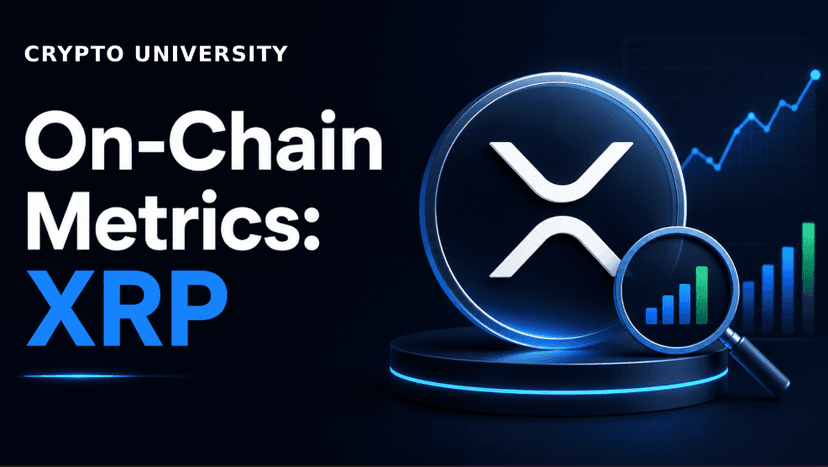
In mid-2026, several crypto news outlets, including CoinDesk, reported that XRP had maintained the $1 price level while its number of active addresses on the XRP Ledger increased and open interest in XRP derivatives markets declined. This combination was presented in some coverage as a sign of network resilience or fundamental strength.
This example is useful for learning purposes because it shows how multiple metrics are often combined into a single narrative. It is worth breaking that narrative down into its separate parts:
A price holding a specific level is a price observation, not an on-chain metric. Levels like $1 are psychologically significant to traders but are not inherently meaningful to the underlying network.
Rising active addresses suggest more wallets transacted on the XRP Ledger during the period measured. This could reflect more individual users, more automated activity, or internal movement by a small number of large holders.
Falling open interest suggests that leveraged derivatives positions were being reduced. This is commonly read as lower speculative pressure, which can mean fewer forced liquidations in either direction.
Put together, these data points describe a market with less leverage and more measured wallet activity at a specific point in time. They do not establish why those changes happened, and they do not indicate what will happen to the price afterward. Treating this kind of combination as a buy or sell signal would go beyond what the underlying data can support. The responsible way to use this kind of reporting is as a snapshot of market structure, not as a forecast.
Where to Find On-Chain and Market Data
Several tools allow learners to look up these metrics directly instead of relying solely on secondhand commentary.
Tool | Type | Best For |
Blockchain explorers (e.g., XRPL explorers, Etherscan, Mempool.space) | Free, direct ledger lookup | Checking individual transactions, addresses, and basic network statistics |
Glassnode | On-chain analytics platform | Historical active address data, holder behavior, and supply distribution |
IntoTheBlock | On-chain and market analytics | Combining on-chain data with exchange flow and derivatives data |
CryptoQuant | Exchange flow and derivatives analytics | Open interest, funding rates, and exchange netflow tracking |
Exchange data pages (e.g., derivatives exchange dashboards) | Direct market data | Real-time open interest and funding rate figures for a specific exchange |
When using any of these tools, it is worth checking the time window being measured, since daily, weekly, and monthly figures for the same metric can tell very different stories about the same asset.
Common Misreadings to Avoid
Treating rising active addresses as proof of new user adoption, when it may reflect existing users or automated wallet activity.
Assuming falling open interest always signals reduced risk, when it can also reflect traders closing profitable positions or simply waiting for new information.
Combining unrelated metrics, such as a price level and a derivatives statistic, into a single narrative without explaining how each one was measured.
Using short time windows, such as a single day, to draw conclusions about long-term network health or investor behavior.
How to Use On-Chain Data Responsibly
On-chain and market data are most useful when treated as descriptive context rather than predictive tools. A practical approach is to look at multiple metrics over multiple time frames, understand what each one technically measures, and avoid drawing firm conclusions from any single data point. None of these metrics, individually or combined, can reliably predict future price movement, and no educational resource should present them that way.
This article does not provide financial advice and does not make any prediction about the future price of XRP or any other asset. The XRP example above is used solely to illustrate how on-chain and derivatives metrics are commonly discussed in crypto media, and how a careful reader can separate description from speculation.
Frequently Asked Questions
What is the difference between on-chain data and market data?
On-chain data comes directly from a blockchain, such as transaction counts or active addresses. Market data comes from exchanges and derivatives platforms, such as trading volume, open interest, and funding rates. Both are useful, but they measure different things and come from different sources.
Does a rising number of active addresses mean a cryptocurrency will go up in price?
No. Active addresses measure wallet activity, not price direction. A network can see rising activity while its price falls, or falling activity while its price rises. The two are related to the same asset but are not the same measurement.
What does it mean when open interest falls while price stays stable?
It generally means that leveraged derivatives positions are being closed or reduced while spot demand and supply remain balanced. This is often read as a sign of lower speculative pressure, but it does not predict what the price will do next.
Are on-chain metrics reliable?
The raw data is reliable because it comes directly from a public, auditable blockchain. The interpretation of that data is where caution is needed, since the same numbers can be explained in different, sometimes contradictory, ways.
Can I check on-chain data myself without paying for a tool?
Yes. Free blockchain explorers exist for most major networks and allow anyone to look up addresses, transactions, and basic network statistics directly, without needing a paid analytics subscription.
Is this article recommending XRP or predicting its price?
No. XRP is used only as a real-world example to explain how on-chain and derivatives metrics are reported in crypto media. This article does not recommend buying, holding, or selling any asset, and does not predict future prices.
Disclaimer: This content is for educational and informational purposes only and is not financial advice. Nothing here is a recommendation to buy or sell any asset or use any platform. Do your own research and manage your risk.
AI Agents and Crypto: A Beginner's Guide to Autonomous On-Chain Payments
Stop-Loss Orders in Crypto: When They Help, When They Hurt, and How to Set Them Properly
How to Evaluate a Crypto Whitepaper: A 7-Point Framework for Spotting Vapor from Value