Key Takeaways
Everything you need is already public. A stablecoin's reserve report, redemption policy, issuer licence and freeze code are all published or readable on a block explorer. Four checks, roughly fifteen minutes, no paid tools.
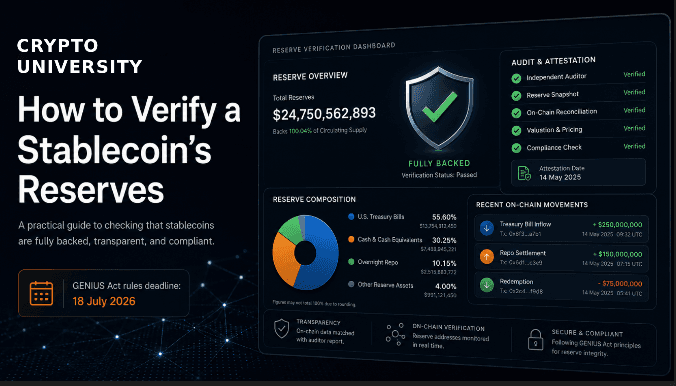
18 July 2026 is a deadline for regulators, not for you. Six federal agencies must finalise GENIUS Act rules by that date. The law itself only bites 120 days after final rules are issued, or on 18 January 2027, whichever comes first. Nothing changes for holders on the day.
An attestation is not an audit. It confirms what sat in the reserve on one specific date. It says nothing about tomorrow, about the bank holding the cash, or about who inside the company can move it.
Why This Question Suddenly Has a Right Answer
For most of stablecoin history, asking whether a token was really backed produced a shrug. Issuers published what they wanted, in the format they wanted, on the schedule they wanted. There was no legal definition of a good reserve, so there was no way to fail.
That is changing. The GENIUS Act, signed into law on 18 July 2025, created the first federal framework for payment stablecoins in the United States. It gave regulators one year to write the implementing rules. That year runs out on 18 July 2026, five days from the date of this article.
Six agencies are on the clock: the OCC, the FDIC, the NCUA, the Treasury, FinCEN and OFAC. All major comment periods closed on 9 June 2026. As of publication, the Federal Reserve Board, which is also a designated regulator for certain issuer categories, has still not published a proposed rule of its own. Whether every agency lands on time is genuinely uncertain, and missing a statutory deadline would not be unprecedented.
What matters for you is that the standard is now written down, even in draft form. You can hold any stablecoin up against it today and see where it sits. This article shows you how.
The Four Checks
Reserve backing is only one of four things that decide whether a dollar token behaves like a dollar. Run all four.
Check | What you are testing | Where to find it |
|---|---|---|
1. Reserve composition | Is there a real dollar behind each token, and is it parked in something that can be sold at par tomorrow morning? | Issuer transparency page: the monthly attestation PDF |
2. Redemption mechanics | Can anyone actually get the dollar back, how fast, and who is allowed to ask? | Issuer terms of service and redemption policy |
3. Issuer status | Which entity is legally on the hook, and which regulator supervises it? | Issuer legal page, OCC news releases, state regulator registries |
4. Freeze capability | Can the issuer immobilise your balance, and under whose order? | The token's smart contract on a block explorer |
Check 1: Reserve Composition
Pull the attestation
Every major issuer keeps a transparency page. Circle publishes monthly attestation reports signed by Deloitte and Touche, along with weekly reserve holdings. Tether publishes quarterly attestations prepared by BDO Italia. Paxos publishes monthly attestations from an independent accounting firm. Find the most recent PDF and open it. It is usually two to four pages.
Read it in this order
The reporting date. An attestation is a photograph, not a video. A report dated 30 June tells you nothing about 12 July.
Who signed it, and under what standard. Agreed-upon-procedures reports under AICPA standards, or ISAE 3000 engagements, are narrower than a full financial statement audit. The accountant checks the issuer's own assertion about the reserve on a given day. That is useful. It is not the same as auditing the company.
Two numbers, side by side. Fair value of reserve assets, and tokens in circulation. The first must be equal to or greater than the second. If the report makes this comparison hard to find, treat that as information.
The asset breakdown. This is the part the law now has an opinion about.
The eligible-asset test
The GENIUS Act limits reserves to a narrow menu of highly liquid instruments. The OCC's proposed rule, a 376-page document published in the Federal Register on 2 March 2026 creating a new 12 CFR Part 15, spells the list out. Hold the attestation's asset table next to it.
Eligible under the proposed federal standard | Not eligible as reserve backing |
|---|---|
US currency and coins | Bitcoin or other crypto assets |
Demand deposits at insured institutions | Gold and precious metals |
US Treasury bills with 93 days or less to maturity | Secured loans to third parties |
Repos and reverse repos collateralised by Treasuries | Corporate bonds or commercial paper |
Government money market fund shares | Equity in affiliated companies |
Central bank reserve deposits | Anything the issuer cannot sell at par on short notice |
This one table explains most of the strategic behaviour in the market. It is why Tether launched a separate token, USA₮, in January 2026 rather than reshaping USDT: USDT's reserves have historically included bitcoin, gold and secured loans, none of which clear the federal bar. It is also why USDC, whose reserves sit roughly 80 percent in a BlackRock-managed government money market fund and the remainder in cash at large banks, needed no redesign.
Token | Disclosure cadence | Reserve assets reported | What that means |
|---|---|---|---|
USDC (Circle) | Weekly holdings, monthly attestation (Deloitte) | Short-dated Treasuries via the Circle Reserve Fund, plus cash at large banks | Already shaped to the federal asset list |
USDT (Tether) | Quarterly attestation (BDO Italia) | Mostly Treasury bills, plus bitcoin, gold, secured loans and other investments | Reserve mix sits outside the federal list |
USA₮ (Tether via Anchorage) | Monthly, per the GENIUS Act cadence | Cash and short-duration Treasury instruments | Built for the federal regime from day one |
One more line to look for: yield
The GENIUS Act bans permitted issuers from paying interest or yield to holders. The OCC proposal goes further and creates a rebuttable presumption that an issuer is violating the ban if it pays an affiliate or partner who in turn pays yield to holders. If a dollar token is advertising a return simply for holding it, understand that the product is being marketed against the direction the rules are travelling.
Check 2: Redemption Mechanics
Redemption speed is the peg
This is the single most useful idea in the article. A stablecoin does not hold its price because of the reserve. It holds its price because someone can profitably buy the token below a dollar and redeem it for a dollar. Take away fast, reliable, at-par redemption and the reserve is just a number on a PDF. The arbitrage stops, and the price drifts.
That is why the OCC's draft spends so much effort on redemption timing rather than on backing alone.
Proposed requirement | What it does |
|---|---|
Redeem at par within two business days | Sets a hard ceiling on how long an issuer can sit on a redemption request |
Automatic extension to seven calendar days if redemptions exceed 10 percent of outstanding issuance in any 24 hours | Acknowledges that a run is possible and builds a circuit breaker, rather than pretending it is not |
Notify the OCC within 24 hours of hitting that 10 percent threshold | Gives the supervisor a live tripwire |
Proposed liquidity floors: a portion of reserves immediately available, a larger portion convertible within five business days | Forces the reserve to be shaped like the redemption promise, not just sized like it |
Halt on new issuance if reserves fall short; forced wind-down after prolonged shortfall | Removes the option of issuing your way out of a hole |
Note the framing. Regulators are not asking whether a run can happen. They are asking what the issuer does at hour twenty-four of one.
What to check on the issuer's own terms
Who can redeem directly? For most large stablecoins, the answer is only verified institutional accounts, not retail holders.
Is there a minimum redemption size, and a fee?
What are the cutoff times, and does the clock run on business days only?
Has the issuer reserved a right to suspend redemptions, and under what conditions?
If you are a retail holder, you almost certainly exit through an exchange, not through the issuer. That is fine. But it means your safety depends on institutions being able to redeem quickly enough to keep buying the token whenever it trades below a dollar. Their access is your peg.
The worked example
In March 2023, USDC fell to roughly 87 cents. The reserve was not fake. Around 3.3 billion dollars of the cash leg was sitting inside Silicon Valley Bank, which failed on a Friday, and nobody could confirm access until the FDIC backstopped depositors that Sunday. USDC repegged within days. Backing was never the problem. Access to backing was. Redemption is where reserve quality either becomes real or stays theoretical.
Check 3: Issuer Status
Ask a plain question: which legal entity owes me a dollar, and who supervises it? Marketing pages blur this. Regulatory filings do not.
Issuer | Status as of July 2026 | What it does and does not mean |
|---|---|---|
Circle | Received final OCC approval on 10 July 2026 to open Circle National Trust, after conditional approval in December 2025 | A national trust bank can custody assets. It cannot take deposits or lend. USDC issuance is slated to sit with a New York limited-purpose trust company, not the national trust bank |
Paxos | Conditionally approved in December 2025 to convert its New York trust company into a national trust bank | Conditional means pre-opening conditions are still being met |
Tether (USA₮) | Issued by Anchorage Digital Bank NA, a federally chartered bank supervised by the OCC, since 27 January 2026 | The bank is the issuer. Tether is the partner and brand |
Tether (USDT) | Offshore issuer, not a permitted payment stablecoin issuer | Long-term US market access would depend on a Treasury comparability determination for its home jurisdiction, which has not been made |
State-licensed issuers | No state regime has yet been certified as substantially similar to the federal framework | Treasury only proposed the certifying principles in April 2026. The Stablecoin Certification Review Committee, made up of Treasury, the Federal Reserve and the FDIC, must approve unanimously |
One correction worth carrying with you: a bank charter is not deposit insurance. The FDIC has been explicit that stablecoin holders are not insured depositors, whoever the issuer is. What a charter buys you is a supervisor, an examination cycle and an enforcement path. Those are worth something. They are not a government guarantee, and any issuer implying otherwise is breaking the GENIUS Act's marketing rules.
Check 4: Freeze Capability
Every compliant dollar stablecoin has an off switch. This is not a bug that survived into the regulated era. It is a legal requirement.
The GENIUS Act requires issuers to hold the technical capability to seize, freeze, burn or prevent the transfer of the stablecoins they issue, and to comply with lawful orders to do so. The joint FinCEN and OFAC proposal published in April 2026 goes further, extending the obligation to block, freeze and reject transactions into the secondary market, meaning transfers the issuer is not party to at all.
What that looks like in practice
On 1 July 2026, the Treasury's Office of Foreign Assets Control expanded its designation of ISIS-K to include 134 crypto wallet identifiers: 131 addresses on TRON and three on Monero. Tether froze the USDT balances across all 131 TRON addresses, reportedly within hours, by adding them to the blacklist function inside its token contract. Chainalysis reported the frozen wallets had received more than 1.4 million dollars since 2023.
The three Monero addresses were untouched, because Monero has no issuer and no admin key. Designating them creates legal prohibitions for anyone who transacts with them, but no one can freeze the coins.
The honest trade-off
Those two outcomes, from a single enforcement action, are the clearest illustration available of what a fiat-backed stablecoin actually is. The mechanism that lets an issuer immobilise terrorist financing in an afternoon is the same mechanism that can immobilise any address, including yours, on the strength of an order you never see. There is no version of a GENIUS-compliant stablecoin without it. That is a design decision made in law, not an accident of implementation.
You are not being asked to approve or condemn it. You are being asked to price it. A regulated stablecoin is a claim on an issuer, and it carries issuer control. If what you want is an asset no third party can freeze, a fiat-backed stablecoin is the wrong instrument, and no amount of reserve quality changes that.
How to check it yourself
Open the token's contract address on a block explorer, go to the contract tab, and read the functions. USDT and USDC both expose blacklist or blocklist functions and the addresses authorised to call them. You do not need to read Solidity fluently. You are looking for whether the capability exists, and who holds the key.
What 18 July Actually Changes
Very little, on the day. Here is the sequence.
Date | What happens |
|---|---|
18 July 2025 | GENIUS Act signed into law. One-year rulemaking clock starts |
9 June 2026 | All major agency comment periods closed |
18 July 2026 | Statutory deadline for agencies to finalise implementing rules. This is a deadline for regulators, not for issuers or holders |
Roughly mid-November 2026 | If final rules land on time, the Act takes effect 120 days later |
18 January 2027 | Backstop date. The Act takes effect no later than this, regardless |
So an issuer that looks non-compliant today is not breaking any rule today. The framework is not yet live. What the deadline gives you is a fixed, published standard to measure against, months before it applies. That is a rare position for a retail holder to be in, and it is the reason to run these checks now rather than later.
The 15-Minute Checklist
Open the issuer's transparency page and download the newest attestation. Note the date and the accounting firm.
Compare reserve fair value against tokens in circulation. Reserves must equal or exceed circulation.
Check the asset breakdown against the eligible-asset table above. Flag anything that is not cash, short-dated Treasuries, repos or government money market funds.
Read the redemption policy. Who can redeem, how fast, at what minimum, for what fee, and can it be suspended?
Identify the legal issuer and its regulator. A brand name is not an issuer.
Confirm no yield is being paid for simply holding the token.
Open the contract on a block explorer and confirm the freeze function exists. It almost certainly does. Decide whether you are comfortable with that.
What These Checks Cannot Tell You
Be clear-eyed about the limits, because the checks are only as good as your understanding of what they miss.
Attestations are backward-looking. Circle's reserves were fully attested the month before Silicon Valley Bank failed.
They do not cover operational risk. Who holds the minting keys, who authorises redemptions, what happens if an employee goes rogue. That is the domain of controls audits, not reserve reports.
They do not cover counterparty risk. A reserve is only as sound as the bank, broker or fund holding it.
They do not evaluate the business. There is no going-concern assessment in a reserve attestation.
Chain concentration is invisible at the token level. A single attestation covers all chains at once, and tells you nothing about the bridge risk attached to a wrapped version of the token on a smaller network.
These checks move you from trusting a brand to reading a document. That is a real upgrade. It is not the same as certainty, and nothing in this article is investment advice or a recommendation to hold or avoid any particular token.
Frequently Asked Questions
Is an attestation the same as an audit?
No. An attestation is an accountant's report on a specific assertion, usually that reserves equalled or exceeded tokens in circulation on one date. An audit examines a company's full financial statements over a period. Under the GENIUS Act, issuers with more than 50 billion dollars outstanding also face annual audited financial statements, which is a meaningfully higher bar.
Does the GENIUS Act mean my stablecoin is government-guaranteed?
No. The Act explicitly states that payment stablecoins are not backed by the full faith and credit of the United States and are not federally insured. Issuers are barred from suggesting otherwise. What holders do get is priority over other creditors in an issuer insolvency.
Can the issuer freeze my wallet?
If you hold a centrally issued, fiat-backed stablecoin, yes. Issuers must have the technical capability to freeze, seize or burn tokens on receipt of a lawful order. Freezes in practice have targeted sanctioned addresses, hacks and criminal investigations, not ordinary users, but the capability applies to every address.
What happens to USDT in the United States?
As of now, nothing. USDT trades freely. Longer term, the Act restricts US digital-asset service providers from offering stablecoins from foreign issuers that do not meet its conditions, including a Treasury determination that the issuer's home regime is comparable. That determination has not been made. Tether's response has been to launch USA₮, a separate token issued by a federally chartered US bank.
Why does redemption speed matter more than the reserve?
Both matter, but redemption is what transmits reserve quality into price. The peg is maintained by arbitrageurs who buy the token below a dollar and redeem it for a dollar. If redemption is slow, gated or uncertain, that trade stops being attractive, and the price can drift even when the reserve is intact.
What if the agencies miss the 18 July deadline?
The GENIUS Act contains no automatic fallback for a missed rulemaking deadline. Agencies have missed statutory deadlines before. The practical effect would be continued uncertainty for new applicants, foreign issuers and state-qualified issuers, rather than any immediate change for people holding stablecoins.
Disclaimer: This content is for educational and informational purposes only and is not financial advice. Nothing here is a recommendation to buy or sell any asset or use any platform. Do your own research and manage your risk.
Solana Alpenglow Explained: How Votor and Rotor Achieve 100x Faster Finality