Key Takeaways
When people say “tokenized S&P 500,” they really mean a token that tracks an ETF (usually SPY), which in turn tracks the index. That’s three layers, and the token layer is the one to keep an eye on.
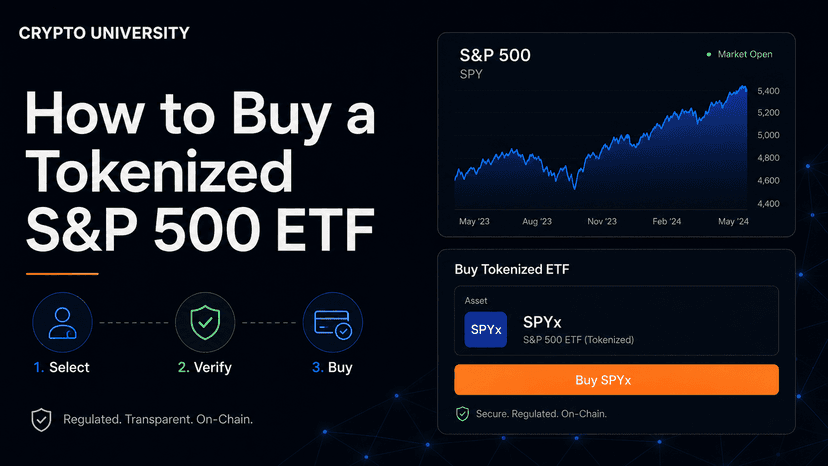
SPYx is the easiest version to buy right now, and it’s backed one-to-one by real SPY shares held in regulated custody. Always check who issues the token on your exchange before you buy.
Tokenization fixes the access problem, not the risk problem. You gain easy entry with crypto, but you also take on issuer, platform, and tax uncertainty on top of normal market risk.
The S&P 500 is about as boring and sensible as investing gets, yet for a long time it has been surprisingly hard to buy if you live outside the United States. US index funds usually will not sign up overseas retail investors, European fund wrappers come with their own hoops, and local brokers often charge a premium for access. Tokenized S&P 500 ETFs cut straight through all of that. If you can hold a stablecoin like USDT, you can hold broad US stock market exposure starting from just a few dollars. Before you jump in, there is one detail worth getting straight, because it changes what you are actually buying.
You’re Buying a Token of an ETF, Not the Index Itself
The S&P 500 is an index, which is really just a number calculated from the share prices of 500 companies. You cannot actually buy a number. Instead, investors buy funds that copy the index. The most famous is SPY (the SPDR S&P 500 ETF Trust), a huge fund listed on the New York Stock Exchange. Tokenization then adds a third layer on top.
Layer | What it is | Example |
|---|---|---|
Index | A single number based on 500 company share prices | S&P 500 |
ETF | A fund that copies the index | SPY |
Token | A token that tracks the ETF | SPYx |
So when you buy a tokenized S&P 500 position, you are holding a token that tracks a fund that tracks an index. Each layer has its own small tracking gap. In practice the ETF layer barely matters, but the token layer is the one to watch, because its price can drift into small premiums or discounts when the underlying market is closed. At the time of research, SPY was trading around $738.11 (July 24, 2026).
Your Token Options
There are a few tokenized S&P 500 products out there, and they are not all built the same way. Here is how the main ones compare.
Token | Issuer / structure | Where it trades | Who’s restricted |
|---|---|---|---|
SPYx (xStocks) | Tracker certificate from Backed Assets, backed 1:1 by SPY shares in regulated custody | US persons excluded; UK, Canada, Australia restricted | |
Ondo S&P 500 token | Secured-note structure on ETF shares held at US broker-dealers, total-return design | Ondo’s platform | Non-US users |
Robinhood EU tokens | Derivative (ETP-linked), one of 2,000+ names on offer | Robinhood (EU) | EU users only |
VTIx (Backed) | Token on a total-market ETF for broader-than-500 exposure | Kraken xStocks | Same as SPYx |
SPYx is by far the most widely available, so it is usually the one beginners end up buying. Whichever venue you use, take a moment to check who issues the token you are buying before you commit.
You can compare index-token prices, issuers, and venues side by side in the Crypto University Tokenized Stocks Directory.
How to Buy, Step by Step
Pick a venue for your region. Kraken covers most non-restricted countries, including the EU. OKX serves parts of Asia, the CIS, MENA, and Turkey. Bybit and Gate are options too, and EU users who are comfortable with derivatives can use Robinhood.
Complete KYC, then fund your account with USDT, USDC, or regular currency. On Kraken, xStocks orders in USD or USDG carry no trading fee, though a spread still applies.
Place a limit order for SPYx. Index tokens are among the calmest tokens to trade, and buying during US market hours keeps your price within pennies of what the fund is actually worth.
Decide where to keep it. You can leave it on the exchange or withdraw it to your own Solana wallet. A tokenized index fund sitting in a hardware wallet is about as close as crypto gets to a boring, long-term retirement holding, as long as you keep the wrapper risks below in mind.
What About Dividends?
SPY pays out dividends every quarter from its 500 companies. With SPYx, you do not receive that as cash. Instead, the value shows up as your token balance quietly growing (after any tax withheld further up the chain), so it compounds automatically. If you are building wealth over time, that is convenient. If you were hoping for regular cash income, this will not give you that.
More reading: Do Tokenized Stocks Pay Dividends? How xStocks and Stock Tokens Handle Payouts
What Tokenization Gives You, and What It Takes Away
What you gain | What you give up |
|---|---|
Access without needing a US broker | The simplicity that made index investing famous |
Buy $1 fractions of a roughly $738 share | Added issuer risk |
Fund the purchase with stablecoins | Added platform risk |
Trade 24/5 on exchanges and 24/7 onchain | Token liquidity risk |
Self-custody and DeFi uses where supported | Unsettled tax treatment |
If you already have cheap access to a local index fund, tokenization is usually a poor trade. But if your only other option is no S&P 500 access at all, or an expensive offshore account, it can be an excellent one. Be honest with yourself about which situation you are actually in.
One more thing that trips people up: the S&P 500 spreads your money across 500 companies, but it does nothing to spread out the wrapper. There is still one issuer, one custody chain, and one platform sitting between you and those companies. That is a completely different kind of risk, and it is easy to confuse the two.
The Bottom Line
Tokenized “S&P 500” almost always means a token on an ETF, usually SPY, so remember the three layers: index, then ETF, then token. SPYx is the most accessible version, dividends quietly compound into more tokens, and tokenization solves the access problem rather than the risk problem. Weigh that trade-off honestly before you buy, and check live pricing on the S&P 500 directory page.
Frequently Asked Questions
Can I buy the S&P 500 index directly with crypto?
Not the index itself. You buy a token that tracks an S&P 500 ETF like SPY. The economic result is the same, just with one extra wrapper layer in between.
Is SPYx backed by real SPY shares?
Yes. It is collateralized one-to-one with SPY held by regulated custodians, and you can verify this through proof-of-reserve. Keep in mind it is a tracker certificate, not an ETF share registered in your name.
What is the minimum investment?
About $1 on Kraken, compared with roughly $738 for a single SPY share.
Do tokenized index funds pay dividends?
The value passes through as an automatic increase in your token balance, net of any withholding, rather than as a quarterly cash payment.
Can Americans buy SPYx?
No. US persons are excluded, but they can simply buy SPY (or a cheaper index fund) at any domestic broker.
Tokenized SPY or tokenized QQQ?
They give you different exposures. SPY covers 500 large companies across many sectors, while QQQ concentrates in 100 Nasdaq names and leans heavily toward tech.
Sources
xStocks documentation: docs.xstocks.fi
Kraken xStocks (SPYx, VTIx listings): kraken.com/xstocks
Backed legal documentation: assets.backed.fi/legal-documentation
SPDR S&P 500 ETF Trust (SPY) official fund page: ssga.com
Disclaimer: This content is for educational and informational purposes only and is not financial, investment, legal, or tax advice. Nothing here is a recommendation to buy or sell any asset or use any platform. Do your own research and manage your risk.
More Reading:
How to Buy Tokenized Stocks in Europe: Platforms, Rules and a Simple Step-by-Step Guide
What Is Entropy in a Crypto Wallet? Why Seed Randomness Matters
Can You Buy Tokenized Stocks in the UK? Platforms, FCA Rules and Access
How to Trade Tokenized Stocks on a DEX
Can You Trade Tokenized Stocks 24/7? Market Hours and Weekend Pricing Explained