Key Takeaways
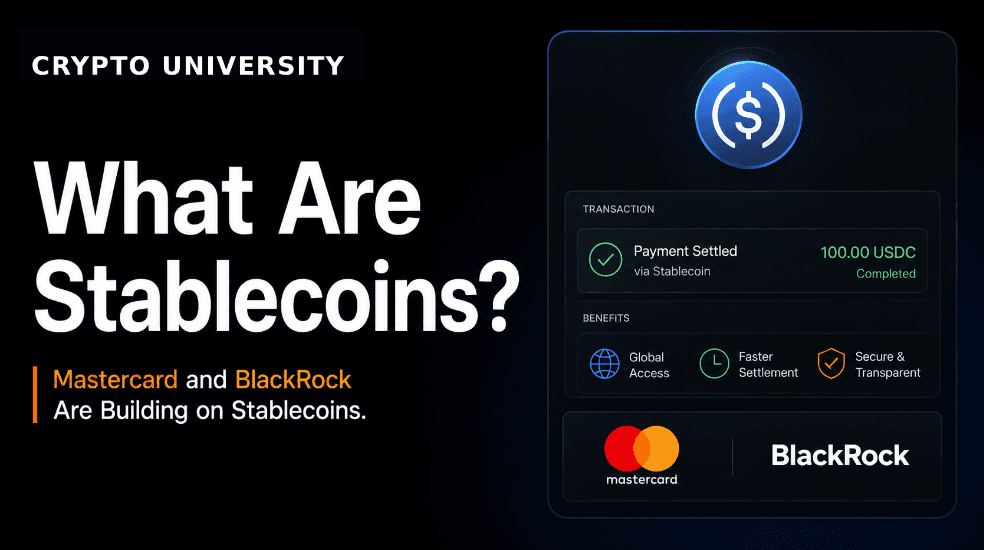
A stablecoin is a crypto token designed to hold a steady value, usually pegged one-to-one to a currency like the US dollar and backed by reserves.
In early August 2026, Mastercard began a pilot to bring trusted identity and compliance checks to cross-border stablecoin payments, while BlackRock launched tokenized money-market funds built to serve as stablecoin reserves.
Institutions care less about token prices and more about “rails”: moving money and holding reserves on blockchains around the clock under new rules such as the US GENIUS Act.
The two moves that put stablecoins back in the headlines
In early August 2026, two of the largest names in traditional finance made stablecoin announcements within 48 hours of each other.
On 3 August, BlackRock, the world’s largest asset manager, launched tokenized money-market products built to serve as reserves for stablecoins. On 5 August, Mastercard began a pilot to bring standardized identity and compliance checks to cross-border stablecoin payments.
Neither move was about betting on a coin’s price. Both were about infrastructure: the plumbing that lets money move and be held on blockchain networks. This guide uses those two announcements as a way to explain three things every beginner should understand: what a stablecoin is, how a tokenized money-market fund works, and why large institutions care about settlement “rails.”
What are stablecoins?
A stablecoin is a type of cryptocurrency designed to keep a steady value. Most are pegged to a national currency, usually the US dollar, at a one-to-one rate. One unit is meant to always be worth about one dollar.
That stability is the whole point. Bitcoin and Ether can move sharply in a single day, which makes them hard to use for everyday payments or savings. A stablecoin aims to combine the speed and openness of crypto with the predictability of regular money.
Stablecoins hold their peg in different ways. The table below shows the three main models.
Model | How it stays stable | Examples | Key risk |
|---|---|---|---|
Fiat-backed | Backed one-to-one by cash and safe assets such as short-term government debt held in reserve | USDT (Tether), USDC (Circle) | Depends on the issuer holding real, redeemable reserves |
Crypto-collateralized | Backed by other crypto locked as collateral, usually over-collateralized | DAI | Collateral can fall in value quickly |
Algorithmic | Uses code and market incentives to manage supply, often with little or no reserve | Mostly discontinued | Can lose its peg and collapse, as TerraUSD did in 2022 |
Fiat-backed stablecoins dominate the market. As of early August 2026, stablecoins in circulation totaled roughly 300 billion dollars, with Tether’s USDT the largest at around 183 billion and Circle’s USDC second at around 72 billion, according to industry tracker DefiLlama. These are widely reported estimates that change daily.
The rule change behind the institutional interest: the GENIUS Act
Much of the recent activity traces back to one law. The GENIUS Act, signed in the United States on 18 July 2025, created the first federal framework for payment stablecoins.
In plain terms, a US payment stablecoin issuer must:
Hold reserves worth at least 100 percent of the coins it has issued, on a one-to-one basis.
Keep those reserves in safe assets only, such as cash, insured bank deposits, short-term US Treasury bills, and government money-market funds.
Publish monthly reports on its reserves, examined by an accounting firm.
Avoid paying interest to coin holders.
Be able to freeze or seize coins under a court order.
The law does two things at once. It gives issuers clear rules to follow, and it defines exactly what a “safe” reserve asset is. That second point is the opening BlackRock is stepping into.
How tokenized money-market funds work
A money-market fund is a familiar, low-risk investment. It pools money and invests only in short-term, high-quality assets such as US Treasury bills and cash. It aims to keep a stable value while paying a small yield.
A tokenized money-market fund is the same product, but ownership is recorded on a blockchain instead of only in a traditional register. Each token represents a share of the fund. Because the record lives on-chain, shares can move between approved parties quickly and around the clock.
BlackRock’s new products show why this matters for stablecoins:
BUIDL, launched in March 2024, was BlackRock’s first tokenized money-market fund. It now holds roughly 2.5 to 2.6 billion dollars and is widely used across crypto markets.
BRSRV (the BlackRock Daily Reinvestment Stablecoin Reserve Vehicle), launched on 3 August 2026, is a new fund built specifically to serve as a reserve asset for stablecoin issuers.
BSTBL (the BlackRock Select Treasury-Based Liquidity Fund) is an existing fund now offered as tokenized on-chain shares.
All three invest in cash and short-term US government debt, not in crypto. BlackRock recorded ownership of the new funds on three networks, Ethereum, Solana, and Tempo, and structured them to qualify as reserves under the GENIUS Act. Access is limited: the funds require a 3 million dollar minimum investment, and only approved, identity-verified wallets can hold them.
The logic is simple. A stablecoin issuer must park its reserves somewhere safe and productive. A tokenized Treasury fund lets the issuer hold those reserves on the same kind of network where the stablecoin itself lives, ready for settlement without moving money back through slow banking rails. BlackRock’s finance chief has said the firm wants to be the industry’s leading stablecoin reserve manager, and it already manages around 60 billion dollars of reserves for Circle, the issuer of USDC.
Why institutions care about “rails,” not price
In finance, a “rail” is a system for moving value from one party to another. Card networks, wire transfers, and correspondent banking are all rails. They work, but many are slow, run only on business days, and add fees at each step, especially across borders.
Stablecoins offer a different kind of rail. They settle in minutes, run 24 hours a day, and can carry programmable instructions. For a large payments company, that is the appeal, not speculation on token prices.
This is what Mastercard’s pilot is really about. Working with the stablecoin network Borderless.xyz, Mastercard is testing its Crypto Credential system, a way to verify who is on each end of a transaction and confirm they meet compliance standards.
It is important to be precise about what Mastercard is and is not doing here. In this pilot, Mastercard does not hold or settle the funds. It provides a trust and verification layer on top of stablecoin payments. The problem it targets is that compliance does not scale as easily as a network does. Today, every time two stablecoin providers connect, they often repeat the same identity checks. Mastercard wants checks done once at the start to be trusted by others down the line, similar to how correspondent banking has worked for decades.
The pilot’s first participants are three payment firms: Infinia, Walapay, and Koywe. It builds on other Mastercard stablecoin moves, including its roughly 1.8 billion dollar acquisition of the stablecoin infrastructure firm BVNK and a partner program that already counts Circle, PayPal, and Ripple.
The two strategies side by side
Mastercard | BlackRock | |
|---|---|---|
What it launched | A pilot for trusted identity and compliance in cross-border stablecoin payments | Tokenized money-market funds for stablecoin reserves |
Its role | Verification and governance layer; does not settle funds in this pilot | Reserve asset manager |
Networks / partners | Borderless.xyz, with Infinia, Walapay, and Koywe | Ethereum, Solana, and Tempo, with Securitize |
The problem it solves | Repeated compliance checks slow payments down | Issuers need safe, on-chain places to hold reserves |
Together, the two announcements show how traditional finance is dividing the work. BlackRock wants to manage the reserves that back stablecoins. Mastercard wants to secure the payments that move them. Neither is making a price call. Both are building parts of the same emerging system.
What this means, and what to keep in mind
For a newcomer, the takeaway is that stablecoins are moving from a crypto-trading tool toward mainstream financial infrastructure. Clear rules, large asset managers, and global payment networks are all now involved.
That does not remove the risks. Reserves still depend on issuers being honest and well managed. Tokenized funds carry new operational risks, and BlackRock’s own filings warn that blockchain outages or software flaws could interrupt transactions, and that future rule changes could affect how the funds are used. These products are also aimed at institutions, not retail users, given their high minimums and verification requirements.
None of this is a recommendation to buy or use any product. It is a snapshot of how the ground is shifting, and why two of the biggest names in finance decided to build on stablecoins now. A quick overview of deeper detail on Compare Places to Buy Stablecoins Worldwide.
Frequently Asked Questions
Are stablecoins the same as Bitcoin?
No. Bitcoin’s price moves freely with the market. A stablecoin is designed to hold a fixed value, usually one US dollar, and is typically backed by reserves.
Is a stablecoin’s value guaranteed?
No. A well-run, fully backed stablecoin should stay near its peg, but that depends on the issuer holding real, redeemable reserves. Some stablecoins have lost their peg in the past.
What is a tokenized money-market fund?
It is a normal money-market fund, invested in cash and short-term government debt, whose shares are recorded on a blockchain. This lets shares move quickly and around the clock among approved holders.
Can I invest in BlackRock’s BRSRV fund?
It is aimed at institutions. The fund requires a 3 million dollar minimum, and only approved, identity-verified wallets can hold it.
Does Mastercard now settle stablecoin payments?
In this pilot, no. Mastercard provides identity and compliance verification through its Crypto Credential system. It does not hold or move the funds in this test.
What is the GENIUS Act?
It is a US law, signed in July 2025, that sets the first federal rules for payment stablecoins, including a one-to-one reserve requirement and monthly reserve disclosures.
Disclaimer: This content is for educational and informational purposes only and is not financial advice. Nothing here is a recommendation to buy or sell any asset or use any platform. Do your own research and manage your risk.
Explore Compare Places to Buy Stablecoins Worldwide.
Best Platforms for Tokenized Stocks: Exchanges, Brokers and Onchain Apps
The Companies Behind Tokenized Stocks: xStocks, Ondo, Dinari, Robinhood and More