Key Takeaways
Tokenized US Treasuries are blockchain-based tokens that represent exposure to US Treasury assets held in a legal wrapper. They are not a brand-new type of government bond issued directly on-chain.
The Ondo, Ripple, JPMorgan Kinexys, and Mastercard pilot is interesting because it focuses on the harder part of finance, which is moving value across borders and between banks, not just creating another crypto token.
Even if you never plan to buy a tokenized Treasury yourself, this development could quietly shape stablecoins, exchange settlement, and how regulators treat blockchain-based finance.
If you have spent any time in crypto recently, you have probably heard the term "real-world assets," or RWAs. It used to sound like a niche idea, but it has quickly turned into one of the biggest institutional themes in the space. One of the clearest examples is tokenized US Treasuries, which basically take short-term government debt exposure and put it onto blockchain rails.
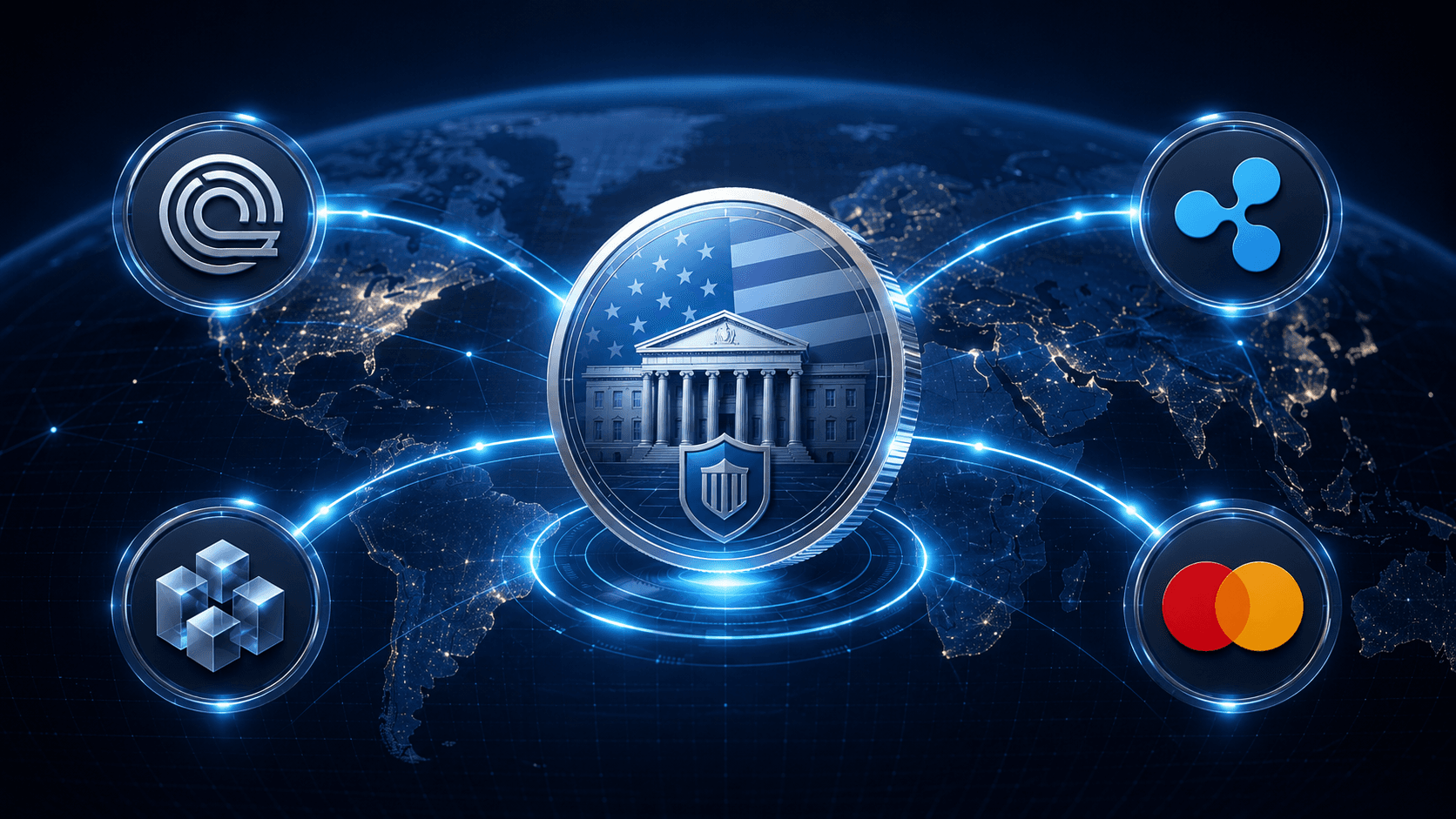
The story making waves right now is a reported pilot involving four major names: Ondo, Ripple, JPMorgan Kinexys, and Mastercard. They are testing how tokenized Treasury exposure could be used for cross-border settlement. That is a big deal because it ties together several important pieces at once, including regulated asset exposure, blockchain settlement, interbank rails, and round-the-clock transferability.
Before you get too excited, let me be honest with you. The headline sounds more dramatic than the reality. A tokenized Treasury is not some new bond invented by crypto people. It is usually just a digital token that represents exposure to a Treasury-based product sitting inside a legal wrapper.
The reason this story really matters is not the asset itself. It is the settlement problem the asset is being used to solve. Let me walk you through what happened, what tokenized Treasuries actually are, and what it all means for you.
What Happened in 60 Seconds
A reported pilot involving Ondo, Ripple, JPMorgan Kinexys, and Mastercard tested how tokenized Treasury assets could be used in a cross-border financial workflow.
Here is the basic idea in plain English:
Step | What is Happening |
1 | Use a tokenized version of Treasury exposure |
2 | Connect it to blockchain-based settlement rails |
3 | Allow more continuous, programmable, and faster movement of value across institutions |
This fits a much larger trend. Institutions are experimenting with tokenized money market products, bank-connected blockchain settlement, near real-time collateral movement, and cross-border payment infrastructure that runs beyond limited banking hours. It also comes at a time when the RWA sector has been growing rapidly, with tracking sites like RWA.xyz reporting that this part of the market has expanded several-fold since early 2025.
What is a Tokenized Treasury?
A tokenized Treasury is a blockchain-based token that represents an interest in an underlying Treasury-related asset or fund structure.
Here is the important nuance: in most cases, the US Treasury did not issue a bond directly on-chain for retail traders. Instead, a legal entity or fund holds the actual Treasury assets, and a digital token represents your claim or exposure under that wrapper.
Tokenized Treasury in Plain English
Component | What It Means |
Underlying asset | Usually short-duration US Treasury bills or related instruments |
Legal wrapper | A fund, SPV, or regulated structure that holds the assets |
On-chain token | A digital representation of your ownership, exposure, or claim |
Redemption mechanism | The rules for entering or exiting the product |
So a tokenized Treasury is really a blend of traditional finance and blockchain infrastructure. It is not pure crypto, and it is not pure TradFi either.
Why People Want Tokenized Treasuries
US Treasuries have always been popular because they are widely seen as high-quality collateral and a relatively conservative yield-bearing asset. When you put that on a blockchain, a few interesting things happen.
Potential Appeal of Tokenized Treasuries
Benefit | Why It Matters |
Blockchain settlement | Can plug directly into digital asset infrastructure |
Programmability | Supports automation and conditional transfers |
24/7 availability | Reduces reliance on traditional banking hours |
Institutional collateral utility | Can improve how efficiently capital moves around |
The key thing to remember is that institutions are not just chasing yield here. They are also testing better settlement mechanics. That is where the real innovation is happening.
Why Cross-Border Bank Settlement is the Harder Problem
The asset itself is only half the story. The much trickier challenge is actually moving value across institutions and jurisdictions in an efficient way.
Traditional cross-border settlement is messy. It usually involves multiple middlemen, limited operating hours, different ledgers and reconciliation processes, settlement delays, and collateral that gets stuck during off-hours.
That is exactly where tokenized infrastructure becomes interesting. If institutions can move tokenized claims or settle against tokenized collateral on interoperable rails, they may be able to cut out a lot of the friction in today's systems.
Cross-Border Settlement Challenge Table
Traditional Problem | Why It Is Hard | Why Tokenized Rails Attract Interest |
Limited banking hours | Cross-border flows pause outside business windows | Tokenized rails can operate continuously |
Reconciliation delays | Multiple systems must all agree | Shared ledgers can reduce mismatches |
Collateral inefficiency | Assets can sit idle during settlement lags | Faster settlement can improve capital use |
Multi-party coordination | Banks, custodians, and payment networks all need to interact | Programmable workflows can simplify movement |
This is why the pilot matters more than just a product launch. It is testing whether tokenized assets can actually help solve a real infrastructure problem.
Where Ondo, Ripple, JPMorgan Kinexys, and Mastercard Fit
Each name in the pilot brings something different to the table.
Role Overview
Participant | Likely Role in the Pilot |
Ondo | Tokenized Treasury or RWA product exposure |
Ripple | Blockchain-based settlement and XRP Ledger-linked infrastructure |
JPMorgan Kinexys | Institutional tokenized payment and settlement rail capability |
Mastercard | Network and payment infrastructure relevance |
Even though every implementation detail is not public, the big picture is clear. This is not just about putting a Treasury-linked product on-chain. It is about making different financial rails actually work together.
What Does XRP Ledger Settlement Mean Here?
If you have heard of Ripple or XRP before, you might be wondering what role they play here. Let me clear that up.
In this context, the important concept is not retail token speculation. It is institutional settlement infrastructure. A blockchain-based ledger can serve as a system for recording tokenized asset movement, coordinating transfers between parties, supporting faster settlement logic, and enabling 24/7 availability compared with traditional rails.
The focus here is operational, not promotional. It is about plumbing, not price action.
Why This Matters Even if You Do Not Trade RWAs
Many crypto users will never directly buy a tokenized Treasury. That is totally fine, and it does not mean this development is irrelevant to you.
Why Everyday Crypto Users Should Care
Area | Why It Matters to Non-RWA Users |
Stablecoins | Better collateral and settlement design may shape future stablecoin systems |
Exchanges | Institutional settlement improvements can influence liquidity flows |
Regulation | RWA growth may affect how regulators view compliant crypto infrastructure |
Market structure | More real-world assets on-chain can change what crypto rails are used for |
In short, RWAs are not just about investment products. They are also about the future role of blockchains in financial plumbing, which is something every crypto user is exposed to whether they realize it or not.
T+0 and 24/7 Settlement: Why Those Phrases Matter
Traditional financial settlement often runs on delayed timelines. You may have heard of T+1, which means settlement happens the next business day, or T+2, which is two business days later. In cross-border situations, the delays can be even longer and a lot messier.
T+0 settlement means same-day or near-instant settlement, and the appeal is pretty straightforward:
Benefit | What It Means |
Lower settlement delay | Funds move quickly between parties |
Faster access to collateral | Assets are not stuck waiting around |
Reduced counterparty timing exposure | Less time for things to go wrong |
Better capital efficiency | Money does not sit idle |
That is especially relevant in a global environment where value moves continuously, even though many financial systems still operate on a schedule.
Risks Readers Should Still Understand
Tokenized Treasuries may sound safer than most crypto products, but they still come with real risks. Let me walk you through the main ones.
Smart Contract Risk
Even if the underlying asset is conservative, the on-chain wrapper itself can still have technical vulnerabilities. Smart contracts can fail or be exploited.
Legal Wrapper Risk
Your actual exposure depends on the legal structure that holds the Treasury assets and defines your rights as an investor. The structure matters as much as the token.
Redemption Gate Risk
Some tokenized products may have restrictions, time windows, or eligibility rules around redemption. You might not be able to exit whenever you want.
Counterparty and Custody Risk
You are still depending on custodians, administrators, issuers, and other service providers. Tokenization does not eliminate counterparty risk.
Regulatory Risk
Cross-border treatment of tokenized RWAs is still evolving, and rules can change across jurisdictions.
Tokenized Treasury Risk Table
Risk | What It Means |
Smart contract risk | On-chain code can fail or be exploited |
Legal structure risk | Investor rights depend on the wrapper |
Redemption risk | Exiting the product may not be smooth |
Counterparty risk | Off-chain service providers still matter |
Regulatory risk | Rules can change across jurisdictions |
This is why I would not call tokenized Treasuries "risk-free crypto." They are hybrid products, and they deserve the same careful research you would give anything else.
Practical Takeaway for Readers
If you are exploring the RWA space, focus on three core questions before doing anything:
Question | Why It Matters |
What exactly does the token represent? | Defines what you actually own |
Who holds the underlying assets and under what legal terms? | Determines your legal protections |
How does settlement or redemption actually work in practice? | Affects whether you can exit easily |
For broader crypto users, it also helps to understand how RWAs relate to custody and portfolio design. Long-term digital assets are often kept in self-custody hardware wallets, while market participants watching institutional narratives may use charting platforms to track sector reaction and liquidity conditions.
Final Thought
The Ondo, Ripple, JPMorgan Kinexys, and Mastercard pilot matters because it points to where crypto infrastructure is heading. Not just speculative tokens, but tokenized claims on traditional assets moving through faster, programmable settlement systems.
That does not mean the future has arrived. There are still legal, technical, and operational questions to work out. But tokenized US Treasuries are clearly becoming part of a bigger conversation about how financial assets move across borders.
For beginners, the lesson is simple. RWAs are not just another sector narrative. They are an early attempt to connect blockchain rails with the machinery of mainstream finance.
FAQ
What is a tokenized US Treasury?
It is a blockchain-based token that represents exposure to underlying US Treasury assets held through a legal wrapper such as a fund or SPV.
Did the US government issue these Treasuries directly on-chain?
Usually no. In most cases, a private issuer creates the token while holding Treasury-related assets off-chain.
Why is cross-border settlement important?
Because moving value between institutions across jurisdictions is slow, fragmented, and often limited by banking hours. Tokenized rails aim to reduce that friction.
What is JPMorgan Kinexys?
Kinexys is JPMorgan's tokenized payments and digital asset infrastructure brand, relevant to institutional settlement workflows.
Why does this matter for normal crypto users?
It may influence stablecoins, institutional liquidity, exchange infrastructure, and how regulators view compliant blockchain-based finance.
Are tokenized Treasuries low risk?
They may be lower risk than many speculative crypto assets, but they still carry smart contract, legal wrapper, redemption, and counterparty risk.
Disclaimer
This content is for educational and informational purposes only and is not financial advice. Nothing here is a recommendation to buy or sell any asset or use any platform. Do your own research and manage your risk.
Read more
Need deeper training?
Join our structured modules with live examples and expert checklists for effective implementation.
JOIN THE ACADEMY