
Key Takeaways
A token unlock is not the same as a sell-off. It just means previously locked coins become free to move, which can change short-term supply but doesn't guarantee a price drop.
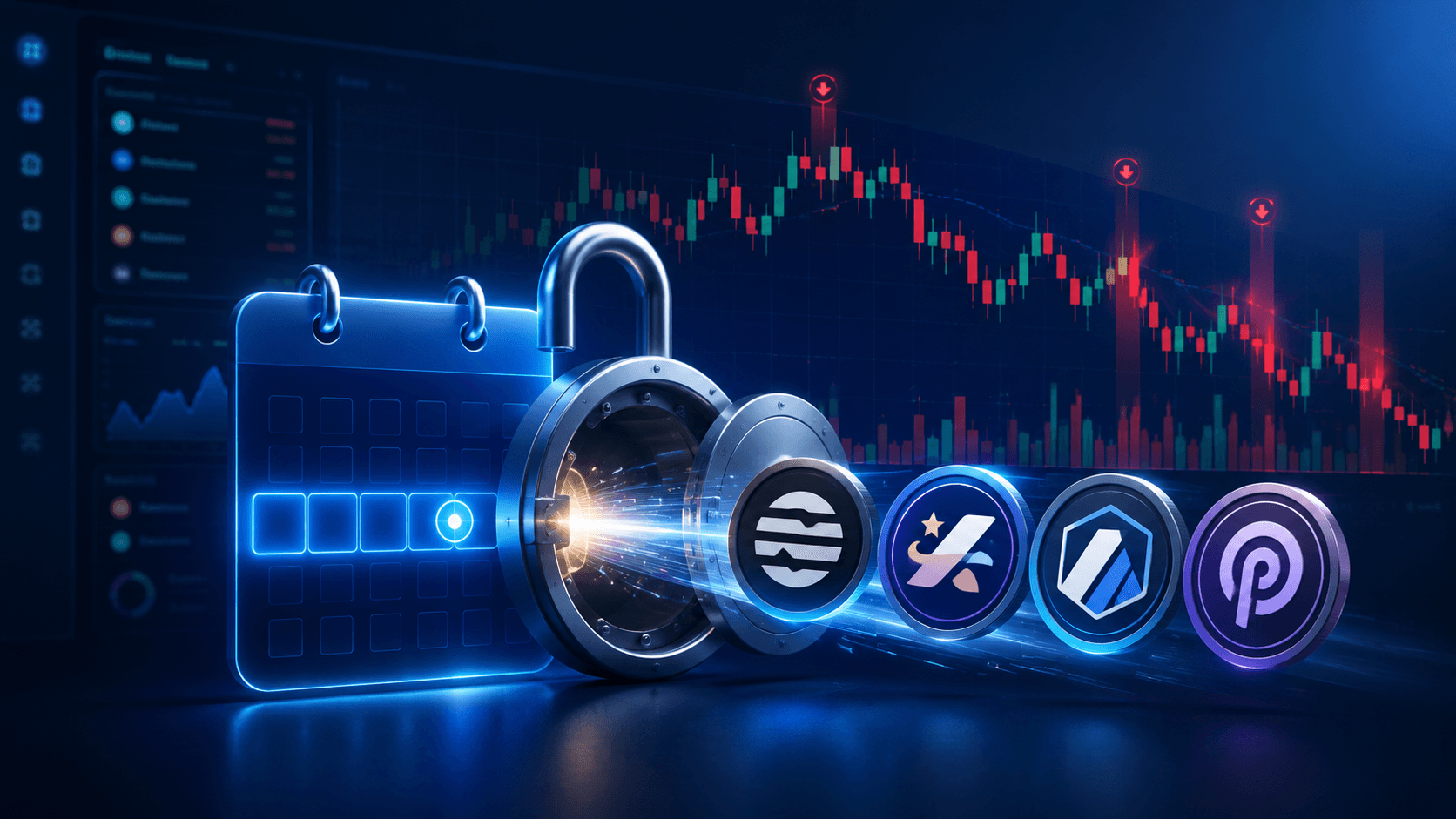
Mid-May 2026 is worth watching because four well-known tokens (APT, STRK, ARB, PYTH) all unlock within roughly a week of each other, creating a short window of concentrated supply.
The size of an unlock is only part of the story. Who receives the tokens, how the unlock is structured, and how liquid the market is at the time matter just as much.
If you're new to crypto trading, "token unlocks" probably sound more intimidating than they actually are. Don't worry. By the end of this article, you'll understand what they are, why traders pay attention to them, and how to read the four big ones coming up in mid-May 2026.
Here's the short version: a token unlock is just a scheduled date when previously restricted coins become free to move. They might get sold, they might get staked, they might just sit there. But the simple fact that more coins can now hit the market is enough to make traders pay attention.
May 2026 is a particularly busy month. Public unlock calendars estimate around 2.24 billion dollars worth of tokens will unlock across the whole month. The first big wave hits early (the week of May 4 to May 10 alone is estimated at around 753 million dollars). The second wave, which is what we're focusing on here, lands in the middle of the month and includes APT, STRK, ARB, and PYTH.
Let's break each one down.
Why Token Unlocks Matter (Plain English Version)
When a crypto project launches, not every coin is in circulation right away. The team, early investors, and ecosystem funds usually have their tokens locked for months or years. This is called a vesting schedule, and it's designed to stop everyone from dumping their coins on day one.
When those locks expire, the coins become available. That moment is the "unlock."
Here's why that matters in practice:
What an unlock can do | Why traders care |
Add new coins to circulating supply | More supply can put downward pressure on price if demand stays the same |
Give early holders the option to sell | Some recipients cash out, others hold or redeploy |
Trigger early positioning | Traders sometimes sell before the unlock date, hoping to get out ahead of others (this is called "front-running" the unlock) |
Shift sentiment | Sometimes the expectation of an unlock moves the market more than the unlock itself |
The big takeaway: unlocks change what's possible, not what's guaranteed.
The May 2026 Mid-Month Unlock Snapshot
Here are the four events drawing the most attention.
Token | Date | Estimated Size | Who Receives It | Why It's Worth Watching |
APT (Aptos) | May 12, 2026 | ~$102M | Contributors and early investors | Investor-related unlocks often raise concerns about near-term selling |
STRK (Starknet) | May 15, 2026 | ~$145M | Ongoing scheduled release | A "linear" release, meaning tokens trickle out steadily rather than all at once |
ARB (Arbitrum) | May 16, 2026 | ~$90M | DAO treasury | Treasury unlocks behave differently from investor unlocks |
PYTH (Pyth Network) | May 19–20, 2026 | ~21.3% of total supply | Broad scheduled release | The percentage size makes this one stand out the most |
These figures are based on public calendars and project documents. The actual market impact will depend on token price, market mood, and how recipients behave on the day.
APT Unlock on May 12: Contributor and Investor Coins
The APT unlock is estimated at around 102 million dollars in tokens, going mostly to contributors and early investors.
Here's why traders pay closer attention to this kind of unlock: when early investors get their tokens, they often have a strong financial incentive to take some profits, especially if they bought in at much lower prices years ago. That doesn't mean everyone sells. But the possibility is enough to keep traders alert.
What to actually look at:
Factor | What it tells you |
Recipient type | Contributor and investor unlocks are usually treated as higher-risk for short-term selling |
Size vs daily volume | If the unlock is large compared to a normal trading day, even moderate selling can move the price |
Past behavior | Has APT historically dipped before or after similar unlock dates? |
Market conditions | A strong, liquid market absorbs new supply better than a weak one |
A simple rule: the bigger the unlock relative to daily trading volume, the more it's likely to matter.
STRK Unlock on May 15: Why "Linear" Doesn't Mean Harmless
STRK is releasing roughly 145 million dollars worth of tokens on a linear schedule. Linear just means the tokens drip into circulation steadily over time rather than all in one big chunk (which is called a "cliff" unlock).
Some traders assume linear unlocks aren't a big deal because the market knows they're coming. That's only half true.
Strengths of a linear unlock | Risks of a linear unlock |
Predictable, easier to plan around | Creates a steady stream of new supply (sometimes called "overhang") |
Easier for the market to price in gradually | Can hold the price down if buying demand is weak |
Less dramatic than a one-time cliff | Traders may still try to sell ahead of major release dates |
The lesson: predictable supply isn't the same as harmless supply. If demand isn't keeping up, even a slow drip of tokens can weigh on the price for weeks.
ARB Unlock on May 16: Why DAO Allocations Are Different
The Arbitrum unlock is estimated at around 90 million dollars, and the tokens are going to the DAO treasury.
This is the part beginners often get wrong. A DAO treasury unlock is not the same thing as a wave of selling. Treasury tokens usually fund grants, ecosystem incentives, governance programs, or strategic spending that gets stretched out over months or years. The tokens become available, but they don't all hit the open market.
Questions worth asking when you see a DAO unlock:
Question | Why it matters |
Is the DAO known for distributing tokens quickly? | Faster spending changes circulating supply faster |
Are these tokens earmarked for grants or programs? | Programmatic spending creates slower, ongoing emissions |
Has this DAO sold treasury tokens in the past? | Past behavior is your best guide to realistic impact |
Is the unlock symbolic or economically significant? | Not every treasury event actually changes market flow |
The key idea: there's a difference between "available supply" and "supply that's about to be sold." Mixing those two up is one of the easiest ways to overreact.
PYTH on May 19–20: When the Percentage Matters More Than the Dollar Figure
The PYTH unlock is the headliner of the mid-month group, and the reason is simple: it's reportedly around 21.3 percent of the total token supply.
Why does that percentage matter so much? Because most unlocks are quoted in dollars (which can be misleading if the token price changes), but a percentage of supply tells you how much the float is actually expanding. A 21.3 percent unlock is huge in relative terms. Even if only a small portion of the new tokens get sold, that's a meaningful amount of new supply hitting a market that may not have buyers ready to absorb it.
A few things to watch with PYTH:
What to check | Why |
How much of the unlock goes to active sellers versus long-term holders | The split shapes real selling pressure |
Trading volume in the days around May 19–20 | Volume spikes often signal positioning |
Price action 1–2 weeks before the unlock | Some of the move usually happens before the date |
Broader market mood | A strong overall market absorbs unlocks more easily |
Big unlocks like this are information events, not automatic trade signals. Some traders cut exposure beforehand, some wait until after, and some skip event-driven trades altogether.
A Practical Tip on Storage
If you hold meaningful amounts of any of these tokens for the long term, separating your long-term holdings from your active trading wallet is just good practice. Self-custody hardware wallets like Ledger are commonly used for exactly this reason. It keeps your bag safe from exchange risks and trading mistakes during volatile event windows.
Final Thought
The mid-May 2026 unlock cluster matters because four well-known tokens are releasing supply within roughly a week of each other, and each one tells a different story.
APT raises the classic question of whether early investors will sell. STRK shows that even a slow, predictable drip of tokens can weigh on price. ARB reminds us that not all unlocks behave the same way (treasury allocations are not investor exits). And PYTH stands out because the percentage of supply being unlocked is unusually large.
The real edge as a beginner trader isn't predicting every price move. It's learning how to read these events properly so you don't panic sell on a DAO unlock or sleep on a quiet one that actually matters.
Match the calendar with the recipient type, the unlock structure, and the liquidity conditions. That's how tokenomics turns from confusing into useful.
FAQ
What are token unlocks in crypto? Token unlocks are scheduled dates when previously restricted coins become available to specific holders, usually team members, early investors, foundations, or DAOs.
Do token unlocks always cause prices to fall? No. Some unlocks are priced in well before the date. Others get absorbed by strong demand. Some create only short-term volatility before the price recovers.
Why is the May 2026 unlock calendar important? Because four widely held tokens (APT, STRK, ARB, and PYTH) all unlock within about a week of each other, creating a concentrated supply window that can affect sentiment.
Which May 2026 unlock looks most significant? PYTH stands out because it reportedly involves 21.3 percent of total supply, which is unusually large compared to most unlock events.
Is a DAO unlock less risky than an investor unlock? Often yes, but not always. DAO treasuries usually distribute tokens gradually rather than selling them all at once, but the size and the DAO's track record both matter.
How can I assess unlock pressure as a beginner? Look at four things: who's receiving the tokens, how big the unlock is compared to daily trading volume, how the price has reacted to past unlocks, and what the broader market mood looks like.
Disclaimer: This content is for educational and informational purposes only and is not financial advice. Nothing here is a recommendation to buy or sell any asset or use any platform. Do your own research and manage your risk.
Read more
Need deeper training?
Join our structured modules with live examples and expert checklists for effective implementation.
JOIN THE ACADEMY