Key Takeaways
|
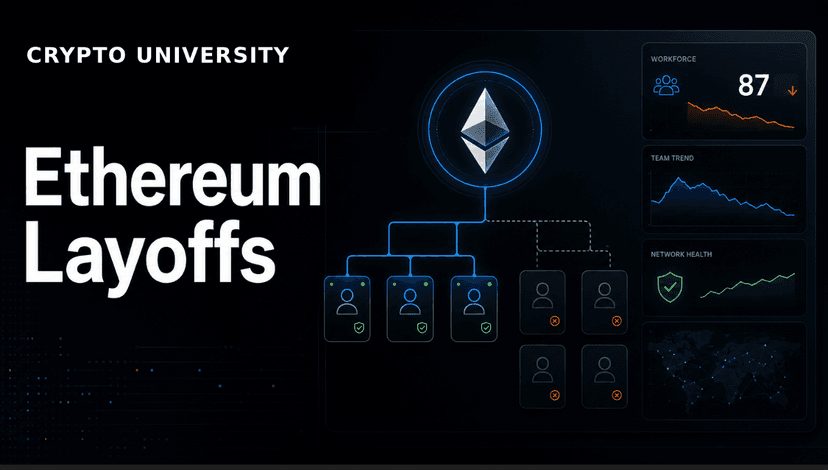
On June 23, 2026, the Ethereum Foundation confirmed it had eliminated 54 positions, representing roughly 20% of its total workforce. This was the final step in a restructuring process that began in June 2025, when the Foundation adopted a new mandate and a stricter treasury policy.
At the same time, Ethereum co-founder Vitalik Buterin disclosed that the Foundation's overall budget for 2026 would be cut by approximately 40%. The goal is to shift from spending around 15% of treasury assets annually to a long-term baseline of about 5% per year after 2030. The Foundation called this approach "Subtraction," meaning a deliberate reduction in its own footprint rather than a response to a single crisis.
Departing staff received a severance package equal to the higher of one month's pay per year of service or the locally required minimum, along with career coaching, transition support, and a small grant to continue contributing to the Ethereum ecosystem.
What is the Ethereum Foundation?
The Ethereum Foundation (EF) is a Swiss nonprofit that has operated since 2014. Its role has been to fund research, coordinate protocol development, support core software client teams, run the annual Devcon developer conference, and provide grants to projects building on Ethereum.
The EF is not a company. It does not own Ethereum. Ethereum is an open, public blockchain that anyone can use, build on, or contribute to. The Foundation exists to support and protect the network's development, especially during periods when there is no commercial incentive to do the work.
The EF holds a treasury of ETH, which it has historically used to fund ongoing operations and grants. The size and value of that treasury fluctuates with ETH's market price.
Why does the EF matter?
Ethereum is the most widely used smart contract blockchain in the world. Stablecoins, decentralized finance, tokenized real-world assets, and a growing share of institutional blockchain infrastructure are built on top of it. The EF has played a central coordination role in keeping that infrastructure secure, upgraded, and well-maintained.
When the EF cuts staff, reduces grants, or changes direction, it has a real effect on the builders, client teams, and researchers who depend on its support.
How the EF Is Now Organized
The restructure created five core work clusters, each with distinct goals and accountability structures:
Cluster | Primary Focus |
|---|---|
Protocol Layer | Core network security, censorship resistance, post-quantum research, zero-knowledge EVM, privacy at the base layer, safer network upgrades |
Access Layer | Wallets, user-facing infrastructure, and tools that allow people to interact with Ethereum |
User Layer | Applications, developer experience, and making Ethereum usable for real-world tasks |
Community Layer | Grants, ecosystem development, education, and global Ethereum outreach |
Institutional Layer | Enterprise engagement, financial infrastructure, and policy coordination |
Two additional operational clusters handle corporate functions and day-to-day management. Bastian Aue now serves as the sole executive director, following the departures of both previous co-executive directors earlier in 2026.
Notably, the Privacy and Scaling Explorations unit (PSE), the EF's in-house applied cryptography and zero-knowledge proof research team, was wound down as part of the restructure. PSE had worked on tools including MACI (private on-chain voting), Semaphore (anonymous credentials), and PlasmaFold (a Layer 2 design for privacy-enabled transfers).
The Context: Leadership Turnover and Funding Pressure
The staff cuts did not happen in isolation. At least nine senior leaders and researchers have left the Ethereum Foundation since the start of 2026. Both co-executive directors departed within months of each other. Longtime contributors to core development also stepped back.
At the same time, the Foundation's four-year Client Incentives Program, which funded the teams building and maintaining Ethereum's core client software, expired in April 2026 without a confirmed replacement. Trent Van Epps, a former EF core development coordinator, publicly warned that Ethereum's developer funding could reach a crisis point within three to nine months, estimating that maintaining more than ten active client teams costs around $30 million per year.
The EF's treasury is denominated in ETH. With ETH trading well below its 2025 peak, the Foundation's real purchasing power has compressed, making the case for spending reduction more urgent from a financial management perspective.
The Bull Case: Leaner, More Focused Execution
Supporters of the restructure argue that a smaller, more focused Ethereum Foundation is better for the network in the long run. The case for optimism rests on several points:
A permanent endowment model protects the EF's ability to operate through extended bear markets without being forced into crisis cuts under worse conditions.
The five-cluster structure gives the remaining teams clearer mandates and more accountability, rather than diffuse responsibility across a large organization.
Reducing the EF's footprint may actually increase Ethereum's credibility as a decentralized network. A smaller, less dominant Foundation means no single organization controls too much of the roadmap.
Vitalik Buterin explicitly framed the rise of independent organizations like Ethlabs as the intended evolution of the ecosystem, not a warning sign.
The Foundation plans to use AI-assisted formal verification to maintain protocol research quality with a smaller team, which, if it works, could partially offset the headcount reduction.
The Bear Case: Funding Gaps and Governance Fragility
Critics and observers have raised legitimate concerns about what the restructure leaves behind:
The closure of PSE removes a dedicated in-house team doing long-term privacy and ZK research. That work may continue in fragmented form across the ecosystem, but without central coordination, progress could slow.
The expiry of the Client Incentives Program, combined with EF budget reductions, creates a real near-term funding gap for the client teams that keep Ethereum running.
Protocol Guild, an independent collective that has distributed roughly $38 million to Ethereum contributors since 2022, relies on voluntary donations and has no guaranteed budget. It cannot reliably fill a $30 million annual gap.
With nine senior departures in six months, the EF has lost significant institutional knowledge and coordination capacity. That experience does not transfer automatically to new structures.
ETH's price at the time of the cuts, around $1,662 according to widely reported figures, means the Foundation's treasury is worth substantially less in real terms than it was at Ethereum's 2025 peak near $4,950.
Bull Case vs. Bear Case: Side by Side
Bull Case (Optimistic View) | Bear Case (Cautious View) |
|---|---|
Endowment model protects long-term operations | Near-term developer funding gap of ~$30M/year |
Clearer cluster mandates improve accountability | PSE shutdown removes dedicated ZK privacy research |
Smaller EF supports decentralization narrative | Nine senior departures = significant knowledge loss |
Independent labs (Ethlabs) fill research gaps | Voluntary funding mechanisms are unpredictable |
AI-assisted verification may offset headcount loss | Fragmented coordination could slow protocol upgrades |
What is Ethlabs and Why Did It Launch the Same Week?
The day before the EF announced its layoffs, five former Ethereum Foundation researchers launched Ethlabs, an independent nonprofit research and development lab. The timing was not coincidental. Several of the founders were among those who had departed the EF earlier in 2026.
The founding team includes Ansgar Dietrichs (serving as executive director), Barnabe Monnot, Caspar Schwarz-Schilling, Josh Rudolf, and Julian Ma. All five spent years at the Foundation working on some of the most technically demanding parts of Ethereum's protocol.
What Ethlabs plans to work on
Ethlabs has stated its initial research priorities as:
Faster transaction settlement, targeting the "single-slot finality" problem where transactions currently take roughly 15 minutes to become irreversible
Native asset issuance and cross-chain asset movement
Mainnet capacity improvements
Research into ETH's monetary properties
Infrastructure improvements for institutional adoption, particularly for banks, asset managers, and fintech firms
Who is funding Ethlabs?
The anchor funders are Bitmine Immersion Technologies (NYSE: BMNR), SharpLink (NASDAQ: SBET), and Ethereum co-founder Joe Lubin. Additional backers include Anchorage Digital, Octant, and SNZ, along with more than 50 community partners.
Contributions flow through an independent grants administrator. Funders have no seat at the table when Ethlabs sets its research priorities. Annual independent audits and quarterly transparency reports are part of the commitment.
Notably, Bitmine was reported to hold approximately 5.67 million ETH as of June 2026, making it the largest publicly traded corporate holder of ETH in the world. SharpLink is a major corporate ETH treasury company as well. This means the funders have a direct financial stake in Ethereum improving at the protocol level.
Why does this matter?
Ethlabs represents a structural shift in how Ethereum's core research gets funded. Rather than relying on a single foundation with a depleting treasury, research funding is coming from entities whose business models depend on the network succeeding.
Vitalik Buterin explicitly described this kind of development as a "necessary evolution" and framed Ethlabs as evidence that Ethereum's core development can survive and grow even as the EF reduces its own direct role. Whether independent, corporately-funded labs can maintain the neutrality and long-term thinking that the EF provided remains an open question.
The CROPS Framework: What Ethereum Now Prioritizes
As part of the restructure, Vitalik Buterin introduced the CROPS framework to define what the EF now considers non-negotiable for Ethereum:
CROPS Principle | What It Means |
|---|---|
C - Censorship Resistance | Ethereum transactions should not be able to be blocked or filtered by any party |
R - Capture Resistance | No single entity should be able to control or co-opt Ethereum's direction |
O - Openness | The network and its protocol must remain open to all builders and users |
P - Privacy | Privacy should be a default, not an optional feature |
S - Security | Including post-quantum security research for long-term resilience |
What This Means for Builders
If you are building on Ethereum, the near-term picture is mixed. The core protocol roadmap has not changed. Network upgrades will continue. The five clusters are designed to maintain the work that matters most.
The key uncertainties are in funding continuity for client teams and ZK research, and in whether the new multi-stakeholder model of organizations like Ethlabs, Protocol Guild, and the restructured EF can coordinate as effectively as a single institution historically has.
The honest answer is that nobody knows yet. What is clear is that the era of the Ethereum Foundation as Ethereum's singular institutional home is effectively over. Whether that turns out to be a healthy evolution or a painful fragmentation will depend on execution over the next 12 to 24 months.
Frequently Asked Questions
Why did the Ethereum Foundation cut 20% of its staff?
The cuts are the result of an 18-month restructuring tied to the EF's updated mandate and a treasury management policy adopted in June 2025. The Foundation is transitioning from spending roughly 15% of its treasury annually to a long-term endowment model targeting 5% per year after 2030, which required a 40% overall budget reduction in 2026.
Is Ethereum still being actively developed after these cuts?
Yes. The core protocol roadmap continues. The five remaining clusters are responsible for protocol maintenance, upgrades, and long-term research. Independent organizations like Ethlabs and Protocol Guild are also actively working on Ethereum's technical development outside the Foundation.
What was PSE and why does its closure matter?
PSE (Privacy and Scaling Explorations, later rebranded as Privacy Stewards of Ethereum) was the EF's in-house applied cryptography and zero-knowledge proof research team. It built privacy tools including MACI, Semaphore, and PlasmaFold. Its closure removes a dedicated internal team from the EF, though some of that work may continue through external research organizations.
What is Ethlabs and how is it different from the Ethereum Foundation?
Ethlabs is an independent nonprofit R&D lab launched in June 2026 by five former EF researchers. Unlike the EF, which is funded by its own ETH treasury, Ethlabs is backed by corporate ETH holders (Bitmine, SharpLink) and individual funders including Joe Lubin. It focuses specifically on protocol-level improvements for institutional adoption. Research priorities are set internally, with funders having no control over the agenda.
Does this affect ETH as an asset?
Crypto University does not give financial advice or price predictions. What can be said factually is that Ethereum's protocol development is continuing, that new independent research organizations are launching to support the network, and that the medium-term effect on Ethereum's technical trajectory will depend on how well the new multi-stakeholder model coordinates.
What is the CROPS framework?
CROPS stands for Censorship Resistance, Capture Resistance, Openness, Privacy, and Security. It was introduced by Vitalik Buterin to define the non-negotiable values that the restructured EF will anchor its work around.
Disclaimer: This content is for educational and informational purposes only and is not financial advice. Nothing here is a recommendation to buy or sell any asset or use any platform. Do your own research and manage your risk.
Self-Custody Best Practices in 2026: Hardware Wallets, Multi-Sig, and AI-Agent Compatible Setups
What Are Crypto Trading Bots? How 3Commas Works
Privacy Tools for Everyday Crypto Transactions in 2026: ZK Options and Compliance-Friendly Methods