Key Takeaways
1. | MetaMask USD (mUSD) is backed by Predicate Asset Compliance, which applies programmable, real-time compliance rules directly on-chain, meaning wallet access to the stablecoins can be automatically restricted based on compliance status. |
2. | This represents a significant shift in how regulated stablecoins work, and raises important questions about DeFi composability, user rights, and the balance between regulatory compliance and decentralization. |
3. | The OKX and BitGo off-exchange settlement partnership shows that compliant custody and settlement infrastructure is expanding in parallel, making the regulated layer of crypto increasingly interconnected. |
What Is MetaMask USD (mUSD)?
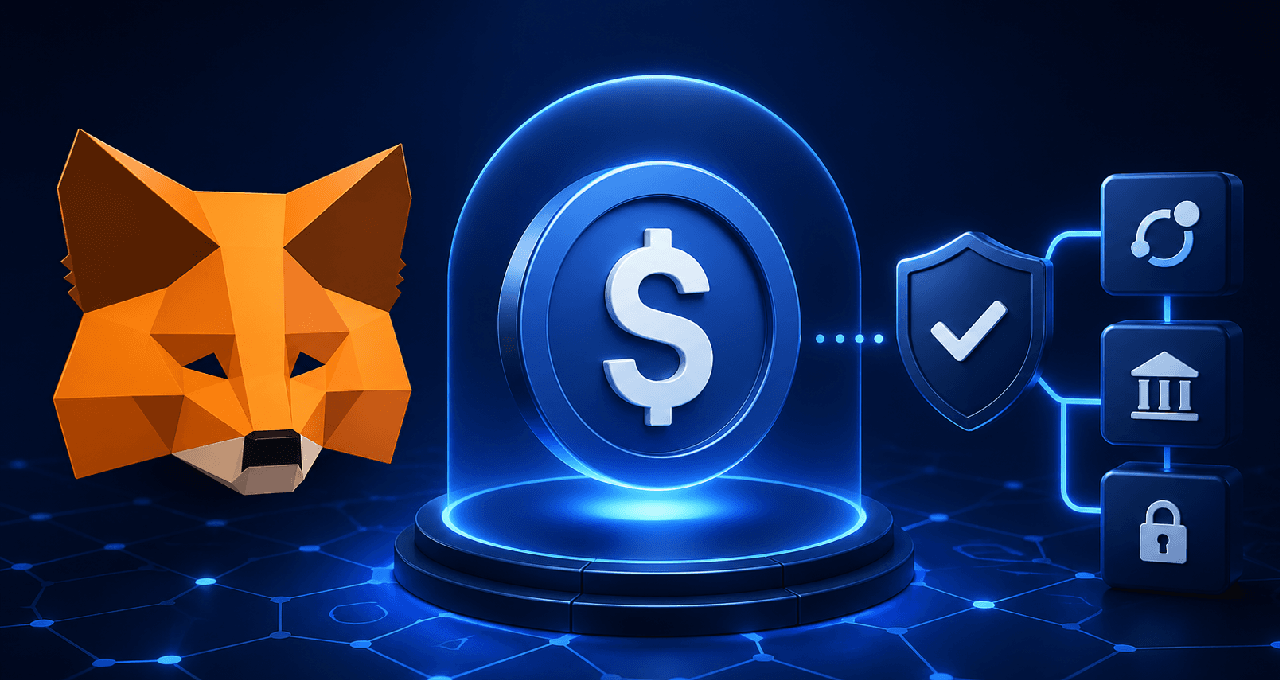
MetaMask, the most widely used self-custody Ethereum wallet, launched MetaMask USD (mUSD) as part of its broader strategy to expand into financial services beyond just a browser wallet.
mUSD is a stablecoin product integrated into the MetaMask ecosystem. It is designed to be 1:1 redeemable for US dollars and aims to give MetaMask users a native stable asset that they can hold, transfer, and eventually use within DeFi protocols without needing to source stablecoins externally.
What makes mUSD different from most existing stablecoins is its compliance architecture. Rather than being a fully permissionless asset (like DAI historically) or a simple issuer-controlled token (like USDC or USDT), mUSD integrates Predicate Asset Compliance, a system that runs compliance checks directly on-chain at the point of transaction.
What Is Predicate? How On-Chain Compliance Works
Predicate is a blockchain compliance infrastructure provider that enables issuers to embed programmable compliance rules directly into token smart contracts. Rather than relying on off-chain checks or manual blacklisting after the fact, Predicate runs real-time screening logic at the contract level.
Here is how the mechanism works in practical terms:
Step | What Happens |
1. User initiates a transaction | A wallet user tries to send or receive mUSD |
2. Predicate compliance check fires | The smart contract queries Predicate's compliance engine to verify whether both the sender and receiver wallets meet the required compliance conditions |
3. Conditions are evaluated | Predicate checks factors such as whether the wallet has completed KYC, is on a sanctions list, or is associated with flagged activity |
4. Transaction is approved or blocked | If compliance conditions are met, the transfer proceeds. If not, the transaction is automatically reverted |
This is fundamentally different from how most stablecoins operate today. USDC, for instance, maintains a blacklist that Circle can update, but transfers between unlisted wallets proceed without real-time screening. Predicate brings the compliance decision into the transaction itself, making it automated and instantaneous.
ℹ️ This does not mean every mUSD user is manually reviewed before every transaction. The system uses pre-verified status signals — once a wallet has passed KYC, it holds that compliance status until conditions change.
What Automated Stablecoin Controls Mean for DeFi Users
For regular DeFi users, the introduction of on-chain compliance controls on a stablecoin like mUSD has significant practical implications. Let us break them down honestly.
1. Wallet Access Can Be Restricted Automatically
If your wallet is flagged by Predicate's compliance engine, whether correctly or incorrectly, your ability to send or receive mUSD can be blocked at the smart contract level. You will not receive a notification that you have been blacklisted. The transaction will simply fail.
This is different from your exchange account being suspended. A suspended exchange account locks your funds within a custodial system. A compliant stablecoin blocking your wallet affects your ability to transact with that asset even from self-custody, which is a meaningful distinction.
2. DeFi Composability Becomes Complicated
One of DeFi's most powerful features is composability: the ability to combine protocols like Lego bricks. A stablecoin that includes compliance logic creates friction in this system. If a DeFi protocol wants to integrate mUSD as a collateral asset or liquidity source, it must either:
Accept that some users may be blocked from using that protocol if they cannot transact with mUSD
Build compliance-aware smart contracts that account for the possibility of mUSD transactions failing
Avoid mUSD entirely and use permissionless alternatives
This creates a two-tier DeFi ecosystem: protocols and users operating within compliant rails and those operating outside them. The practical impact on liquidity fragmentation is still being understood.
3. Recourse When Incorrectly Blocked Is Unclear
Traditional financial institutions have regulated dispute processes. If your bank account is incorrectly frozen, there are legal avenues available to you. With on-chain compliance systems, the recourse framework is less defined.
Who do you contact? How do you challenge a compliance flag? How long does remediation take? These are questions that the crypto industry and regulators are still working through, and mUSD's launch does not yet provide widely published answers to all of them.
Compliance vs Decentralization: The Core Trade-Off
Dimension | Compliant Stablecoins (mUSD with Predicate) | Permissionless Stablecoins (DAI, LUSD) |
Access Control | Issuer and compliance engine can restrict transfers | No central access control; transfer is always possible between wallets |
Regulatory Risk for Users | Lower: designed to meet AML and OFAC requirements | Higher: regulators may treat these as unregulated instruments |
DeFi Composability | Restricted: protocols must be compliance-aware | Full: any protocol can integrate without restrictions |
Trust Model | Trust issuer and compliance provider | Trust smart contract code and governance |
User Protection | Requires KYC and creates audit trail, which may help with disputes | No KYC, no dispute trail, full user responsibility |
Institutional Suitability | High: meets compliance requirements for regulated entities | Low: most regulated institutions cannot use permissionless assets |
Neither model is inherently superior. The right stablecoin for a given user depends on their needs, jurisdiction, and risk tolerance. The emergence of compliant stablecoins does not make permissionless stablecoins obsolete, but it does shift the landscape for institutional and mainstream adoption.
OKX and BitGo: Off-Exchange Settlement as Parallel Infrastructure
Running in parallel to the MetaMask USD development, OKX announced an off-exchange settlement partnership with BitGo, one of the most established institutional digital asset custodians.
Off-exchange settlement allows institutional traders to hold their assets in custody with a trusted third party (BitGo) rather than leaving them on an exchange (OKX). When they want to trade, the exchange and custodian coordinate settlement, meaning the trader gets the execution benefits of the exchange without exposing their full assets to exchange counterparty risk.
Term | Plain English Explanation |
Off-Exchange Settlement | Completing a trade's financial movement outside of the exchange's internal systems, typically through a trusted custodian |
Custodian (BitGo) | A regulated third party that holds assets on behalf of institutions and ensures they are secured and insured |
Counterparty Risk | The risk that the exchange you are trading on becomes insolvent or is hacked, causing you to lose assets held there |
Why It Matters | After FTX collapsed in 2022, institutional demand for solutions that separate trading venues from asset custody grew sharply |
The OKX-BitGo partnership is significant because it signals that institutional custody and exchange infrastructure are becoming more interoperable. This reduces a key friction point that has historically prevented large fund managers, family offices, and corporate treasuries from engaging more actively with crypto markets.
For active traders on OKX, this development strengthens the platform's institutional credibility. If you are not already using OKX, it is one of the more established exchanges for spot and derivatives trading.
What Compliant Stablecoins Signal for the Broader DeFi Landscape
The launch of mUSD with Predicate compliance is not an isolated product decision. It is part of a broader shift in how the crypto industry is approaching the regulatory environment.
Several trends are converging:
The US stablecoin regulation framework is advancing in 2026, pushing issuers to embed compliance at the protocol level
Institutional DeFi is growing, and institutional participants require compliant rails to operate legally
Regulators in the EU under MiCA are demanding that stablecoin issuers maintain KYC on their users
Major wallet providers like MetaMask, which have mainstream user bases, face commercial pressure to offer regulated products
The result is likely to be a bifurcated stablecoin market. On one side, fully regulated, compliance-integrated stablecoins designed for institutional and mainstream retail use. On the other, permissionless alternatives favored by privacy-focused users and protocols that require unconstrained composability.
Understanding which stablecoin to use, and why, is becoming an essential skill for any crypto user. For a comprehensive overview of the stablecoin landscape, check out our dedicated guide linked at the end of this article.
⚠️ If you hold or plan to use mUSD, ensure you understand the KYC requirements associated with it. Incomplete compliance documentation could result in your transactions being blocked without warning.
Frequently Asked Questions
What is MetaMask USD (mUSD)?
mUSD is a US dollar-pegged stablecoin developed within the MetaMask ecosystem. It is designed to be redeemable 1:1 for USD and integrates Predicate Asset Compliance for real-time, on-chain compliance screening.
What is Predicate and how is it different from a blacklist?
Predicate is an on-chain compliance infrastructure provider. Unlike a simple blacklist (which blocks specific wallet addresses reactively), Predicate runs real-time compliance checks at the point of each transaction, evaluating current compliance status rather than relying on a static banned list.
Can my MetaMask wallet be blocked from using mUSD even if I have done nothing wrong?
In theory, yes. If your wallet is incorrectly flagged by the compliance engine, your mUSD transactions could be rejected. This is a known risk with automated compliance systems. Users should ensure their wallets are properly KYC-verified through the relevant MetaMask processes to minimize this risk.
Does this affect my other stablecoins like USDC or USDT?
No. mUSD is a separate stablecoin with its own compliance rules. USDC and USDT operate under their own governance and compliance models. USDC maintains a centralized blacklist. USDT does similarly. Neither uses Predicate's real-time on-chain compliance architecture at this time.
What is an off-exchange settlement between OKX and BitGo?
It is an arrangement where institutional traders hold their assets with BitGo, a regulated custodian, rather than on OKX's exchange wallet. When trades are executed on OKX, BitGo and OKX coordinate the settlement separately, reducing the institutional trader's exposure to exchange counterparty risk.
Is DeFi still decentralized if stablecoins have compliance controls?
This is one of the most debated questions in space. The infrastructure of DeFi (smart contracts, blockchains, permissionless code) can remain decentralized even if specific assets running on it are compliance-controlled. Whether a DeFi protocol using compliant stablecoins is truly decentralized in spirit is a philosophical question that the community is actively debating.
For secure self-custody of your stablecoins and Bitcoin, a hardware wallet remains the gold standard. Explore Ledger hardware wallets.
Disclaimer: This content is for educational and informational purposes only and is not financial advice. Nothing here is a recommendation to buy or sell any asset or use any platform. Do your own research and manage your risk.
Read more
Need deeper training?
Join our structured modules with live examples and expert checklists for effective implementation.
JOIN THE ACADEMY