Key Takeaways
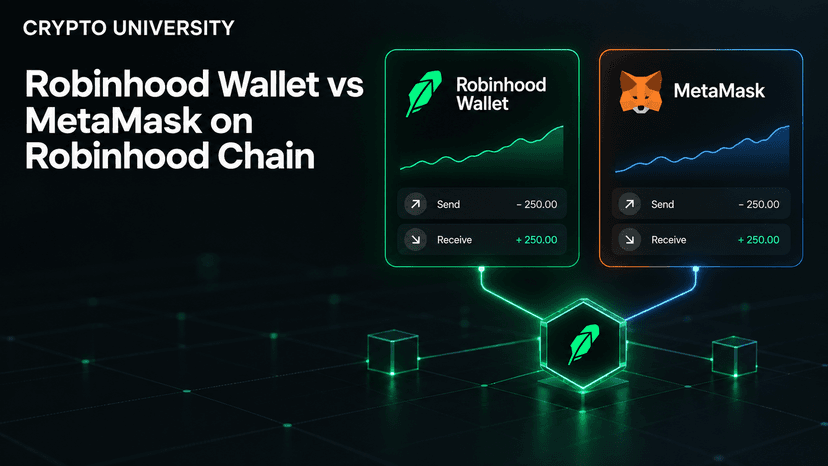
They solve different problems. Robinhood Wallet is the only consumer route to buy Robinhood Stock Tokens at issuance, and it is mobile only. MetaMask cannot access that primary market, but it works on desktop, pairs with hardware wallets and reaches the wider Robinhood Chain ecosystem.
Both are self-custody, and both use the same address format. Robinhood Chain is a standard EVM network, so one Ethereum-style address works in either wallet. Choosing a wallet is a choice about interface, features and access, not about a different blockchain.
Eligibility is the real gatekeeper, not the software. Stock Tokens are not available to US persons and are restricted in several other countries. No wallet setting changes that. Verify the network details from Robinhood's own documentation before connecting, because fake Robinhood Chain networks are a known scam pattern.
What Robinhood Chain Actually Is
Before comparing wallets, it helps to understand what they are connecting to.
Robinhood Chain is an Ethereum Layer 2 network launched by Robinhood Markets. Its public testnet went live in February 2026, and its public mainnet launched on 1 July 2026 at a company event in London. Robinhood's documentation describes it as a permissionless, Ethereum-compatible Layer 2 built for onchain financial infrastructure, with a specific focus on tokenized real-world assets such as equities and exchange traded funds.
A few technical points matter for wallet users:
It is built on Arbitrum Dedicated Blockchains and settles back to Ethereum.
It uses ETH as the gas token. There is no separate Robinhood Chain coin, so you fund a wallet the same way you fund any Layer 2, by bridging ETH.
It is fully EVM compatible. Any wallet that speaks standard Ethereum JSON-RPC can connect, with no plugin required.
It uses first-come, first-served sequencing, meaning transaction order is set by arrival time at the sequencer rather than by who pays the highest fee.
It supports ERC-4337 account abstraction, which allows features such as gas sponsorship and batched transactions.
Early activity was reported as strong. Robinhood Crypto GM Johann Kerbrat said publicly that the chain had attracted roughly 450 million dollars in total value locked and processed more than 95 million transactions within three weeks of launch. Treat that as a widely reported company figure rather than an independently audited one.
The Two Wallets in Plain Terms
Robinhood Wallet
Robinhood Wallet is a self-custody mobile app, separate from the main Robinhood brokerage and Robinhood Crypto accounts. Services are offered through Robinhood Non-Custodial, Ltd., a Cayman Islands company. You hold the private keys, and assets held there are not FDIC insured or SIPC protected.
It first launched in beta in 2022 supporting only Polygon, and expanded over time. As of mid-2026 it supports Robinhood Chain, Ethereum, Bitcoin, Solana, Dogecoin, Arbitrum, Polygon, Optimism and Base. In-app swaps run through the 0x API and LI.FI decentralized exchange aggregators.
Its defining feature on Robinhood Chain is Stock Tokens, which launched alongside the mainnet in more than 120 countries, with availability varying by jurisdiction.
MetaMask
MetaMask is a general purpose self-custody wallet built by Consensys, available as both a browser extension and a mobile app. It spent most of its life as an EVM-only wallet, then added native Solana support in May 2025, Bitcoin in December 2025 and Tron in January 2026, alongside networks such as Monad and Sei.
Its multichain account model derives EVM, Solana and Bitcoin addresses from a single recovery phrase. On the EVM side it covers Ethereum and the major Layer 2 networks, plus custom RPC support for everything else, which is how Robinhood Chain is added.
MetaMask has also expanded into a broad product suite including swaps, staking, perpetual futures, prediction markets, real-world asset access, its mUSD stablecoin, a self-custodial debit card and a rewards programme.
Head to Head Comparison
Feature | Robinhood Wallet | MetaMask |
|---|---|---|
Wallet type | Self-custody, mobile only | Self-custody, browser extension and mobile |
Robinhood Chain support | Built in natively | Added as a custom network |
Buy Stock Tokens at issuance | Yes, for eligible users | No |
Hold and trade Stock Tokens | Yes | Yes, as standard ERC-20 tokens |
Hardware wallet pairing | Not supported | Supported |
Custom networks and RPCs | No | Yes |
Desktop use | Limited, via WalletConnect QR scan | Full browser extension |
In-app dApp access | Built-in Web3 browser | Extension plus in-app browser |
Non-EVM chains | Bitcoin, Solana, Dogecoin | Bitcoin, Solana, Tron |
Perpetual futures | Via Lighter, restricted jurisdictions | Via Hyperliquid, restricted jurisdictions |
Fiat on-ramp | Robinhood Connect, Sardine | Third-party providers |
Account recovery by company | No | No |
Best suited to | Stock Token access, simple mobile use | Broad DeFi use, desktop workflows, power users |
The Biggest Difference: Access to Stock Tokens
This is the point most comparison articles miss, so it deserves detail.
Robinhood Stock Tokens are tokenised debt securities issued by Robinhood Assets (Jersey) Limited, referred to in the documentation as RHJ. They give economic exposure to underlying shares and ETFs. Critically, Robinhood's own documentation states that they do not grant investors any legal or beneficial rights in, or against the issuer of, those underlying securities. You are not buying the share. You are buying a debt instrument that tracks it.
Technically, each Stock Token is a standard ERC-20 contract with 18 decimals, with a live Chainlink price feed. Dividends and stock splits are handled through an onchain multiplier accessible via the token's uiMultiplier() function, defined by ERC-8056, which adjusts the shares-per-token ratio while the raw balance stays static until redemption.
Here is where the wallets diverge.
Primary market. Only Authorised Participants may subscribe for Stock Tokens directly from RHJ after business onboarding checks. At issuance, the documentation names a single Authorised Participant. Ordinary users do not mint these tokens. For eligible retail users, the consumer path to acquire and redeem Stock Tokens runs through Robinhood Wallet. MetaMask has no equivalent route.
Secondary market. Because Stock Tokens are ordinary ERC-20 contracts, they work with existing wallets and tooling out of the box. That means MetaMask can hold them and trade them on Robinhood Chain decentralized exchanges such as Uniswap, and use them in lending markets such as Morpho. What MetaMask cannot do is create or redeem them.
Jurisdictional restrictions. Stock Tokens have not been registered under US securities law and are not available in the United States or to US persons. Robinhood also lists restrictions in Canada, the United Kingdom, Switzerland, the UAE and sanctioned jurisdictions. This restriction follows the product, not the wallet. Downloading a different wallet does not create eligibility.
One practical note: MetaMask will not automatically display every Stock Token. You may need to import the token manually using the official contract address published on Robinhood's Token Contracts documentation page.
Setup Compared, Step by Step
Setting up Robinhood Wallet on Robinhood Chain
Download Robinhood Wallet from the official Apple App Store or Google Play listing.
Create a wallet and securely record the recovery phrase offline.
Robinhood Chain appears as a supported network. No manual configuration is needed.
Fund the wallet by transferring from Robinhood Crypto, using an on-ramp, or receiving from another wallet.
Adding Robinhood Chain to MetaMask
Open MetaMask and go to the network selector, then choose to add a network manually.
Enter the network details exactly as published by Robinhood.
Save, then switch to Robinhood Chain in the network list.
Bridge ETH from Ethereum or another chain so you have gas.
Verify your balance on the official block explorer before doing anything significant.
A quick overview of deeper detail on How to Get Started on Robinhood Chain: A Complete Beginner's Guide
Official Network Details
Read these from Robinhood's documentation rather than a screenshot on social media, because settings change and copied settings go stale.
Property | Robinhood Chain Mainnet | Robinhood Chain Testnet |
|---|---|---|
Chain ID | 4663 | 46630 |
Default RPC URL | ||
Currency symbol | ETH | ETH |
Block explorer |
Two safety habits are worth building. First, the chain ID is the check that matters. A network name can be anything a scammer types, but the chain ID must read exactly 4663 for mainnet. Second, Robinhood notes that the public RPC endpoint is rate limited and not intended for production applications, so developers should use a dedicated provider such as Alchemy.
Fees, Gas and Costs
Neither wallet charges you to hold assets. The costs come from network fees and product fees.
Cost type | Robinhood Wallet | MetaMask |
|---|---|---|
Gas on Robinhood Chain | Paid in ETH, Layer 2 rates | Paid in ETH, Layer 2 rates |
Swap fee | Routed via 0x API and LI.FI, aggregator and network fees apply | Reported at roughly 0.875 percent in 2026 reviews, plus network fees |
Fiat purchase fee | Varies by provider | Reported at roughly 1 percent on top of partner pricing |
Bridging | Network fees plus bridge costs | Network fees plus bridge costs |
Fee schedules change frequently and promotional periods are common. Robinhood has periodically covered network fees on certain swaps as a promotion. Always check the current fee disclosure in the app before transacting rather than relying on any published figure, including this one.
Security and Recovery
Both wallets are non-custodial, which means the same fundamental trade-off applies to each: no company can freeze your funds, and no company can recover them if you lose your recovery phrase.
Where they differ:
Hardware wallet support. MetaMask pairs with hardware wallets, keeping the signing key on a separate device. Robinhood Wallet does not offer this, so keys live on the phone. For large balances, this is a meaningful gap.
Attack surface. MetaMask's browser extension is a frequent target for fake extension clones and malicious website prompts. Robinhood Wallet's mobile-only design avoids extension-specific risks but concentrates everything on one device.
Complexity. MetaMask's larger feature set means more permissions, more approvals and more ways to sign something you did not intend. Simplicity has real security value for beginners.
Transaction screening. MetaMask has added protective features including transaction simulation and screening tools. Robinhood applies compliance and risk tooling at the network level through partners such as TRM Labs.
Regardless of which you pick, revoke unused token approvals periodically and send a small test transaction before any large transfer.
Which Wallet Should You Use?
If you want to... | Use |
|---|---|
Buy Robinhood Stock Tokens as an eligible non-US user | Robinhood Wallet |
Keep everything in one simple mobile app | Robinhood Wallet |
Use a hardware wallet for larger balances | MetaMask |
Work on desktop with DeFi apps | MetaMask |
Interact with new or unlisted Robinhood Chain apps | MetaMask |
Manage many chains and custom networks | MetaMask |
Trade Stock Tokens on a DEX after acquiring them | Either |
A common real-world pattern is to use both. Eligible users acquire Stock Tokens in Robinhood Wallet, then move a portion to a MetaMask address paired with a hardware wallet for longer-term holding, or for use with desktop DeFi applications. Because both wallets use the same EVM address format, moving between them is a normal onchain transfer on the same network.
Risks and Common Mistakes
Assuming an address means assets are everywhere. The same address existing on Ethereum, Arbitrum and Robinhood Chain does not mean your balance appears on all of them. Check the network selector before panicking.
Adding a fake network. Imitation RPCs with familiar names are a known scam. Always confirm chain ID 4663 and source the RPC from official documentation.
Sending on the wrong network. Sending tokens to an exchange or wallet that does not support Robinhood Chain can result in permanent loss.
Forgetting gas. A wallet with tokens but no ETH cannot transact on Robinhood Chain.
Treating Stock Tokens as shares. They are debt securities providing economic exposure, not equity ownership, and they carry issuer risk.
Losing the recovery phrase. Neither company offers account recovery.
Frequently Asked Questions
Does MetaMask support Robinhood Chain by default?
Not as a preloaded network. Robinhood Chain is EVM compatible, so MetaMask connects to it as a standard custom network using the published RPC URL and chain ID 4663. Robinhood's documentation includes a one-click add option for supported browser wallets.
Can I buy Robinhood Stock Tokens in MetaMask?
You cannot acquire them at issuance in MetaMask. That primary market path runs through Robinhood Wallet for eligible users. Because Stock Tokens are standard ERC-20 contracts, MetaMask can hold and trade them on secondary markets such as Uniswap once you already own them.
Is Robinhood Wallet the same as my Robinhood app account?
No. Robinhood Wallet is a separate self-custody app where you control the private keys. Your Robinhood Crypto account is custodial, meaning Robinhood holds the assets. You can transfer between them, but they are distinct products with different protections.
Do I need a Robinhood account to use Robinhood Chain?
No. The chain is permissionless. Anyone can connect a compatible wallet, deploy contracts and interact with applications. A Robinhood account is only required for Robinhood's own products, such as acquiring Stock Tokens.
Which wallet is safer?
Neither is inherently safer, because both are non-custodial and both depend on how you store your recovery phrase. MetaMask has an edge if you use a hardware wallet, since the signing key stays off your phone or computer. Robinhood Wallet has an edge in simplicity, which reduces the chance of user error.
Five Related Terms
Layer 2. A network built on top of a base blockchain such as Ethereum that processes transactions more cheaply and quickly, then settles results back to the base layer.
Self-custody. Holding your own private keys, meaning no company can access, freeze or recover your assets on your behalf.
Chain ID. A unique number identifying an EVM network. It prevents a transaction signed for one network from being replayed on another, and it is the most reliable way to verify a network is genuine.
RPC endpoint. The server address a wallet uses to read blockchain data and broadcast transactions. Using an untrusted RPC can expose you to misleading transaction information.
Tokenized real-world asset (RWA). A blockchain token that represents exposure to an off-chain asset such as a share, bond, commodity or fund.
Sources
Robinhood Chain Documentation, "About Robinhood Chain", docs.robinhood.com/chain
Robinhood Chain Documentation, "Add network to your wallet", docs.robinhood.com/chain/add-network-to-wallet
Robinhood Chain Documentation, "Stock Tokens", docs.robinhood.com/chain/stock-tokens
Robinhood Newsroom, "Robinhood Accelerates Global Expansion with Robinhood Chain Mainnet, Stock Tokens, Agentic Trading and New Suite of DeFi Products", 1 July 2026
Robinhood Newsroom, "Robinhood Chain Launches Public Testnet", 10 February 2026
Robinhood Support, "Send, receive, and swap crypto"
Coinage, "How Robinhood Launched Its Own Chain at a Record-Setting Pace", July 2026
Decrypt and The Block coverage of MetaMask multichain expansion, December 2025
Coin Bureau, "MetaMask Review 2026", updated August 2026
CryptoSlate, "MetaMask Wallet Review 2026"
Figures on network activity, fees and yields are as reported at the time of writing and may have changed. This article is educational and is not investment, legal or tax advice.
More Reading
Best Robinhood Chain Trading Platforms in 2026: FOMO, GMGN, Uniswap and OpenSea Compared
What Are Tokenized Stocks? Robinhood Chain Stock Tokens Explained
Robinhood Chain: How to Get Started
How to Get Started on Robinhood Chain: A Complete Beginner's Guide
Solana vs Robinhood Chain: Which Network Has the Better Future?
Is Robinhood Chain a Real Blockchain or Just Robinhood's Database?