Key Takeaways:
Stablecoins are designed to maintain a stable value, typically pegged to a fiat currency, but they carry their own distinct risks including counterparty risk and depegging events.
Volatile tokens can offer significant returns but expose holders to large price swings, liquidity risk, and project-level failures.
Understanding which risks apply to each asset type helps you make more informed decisions about how you hold and use crypto assets.
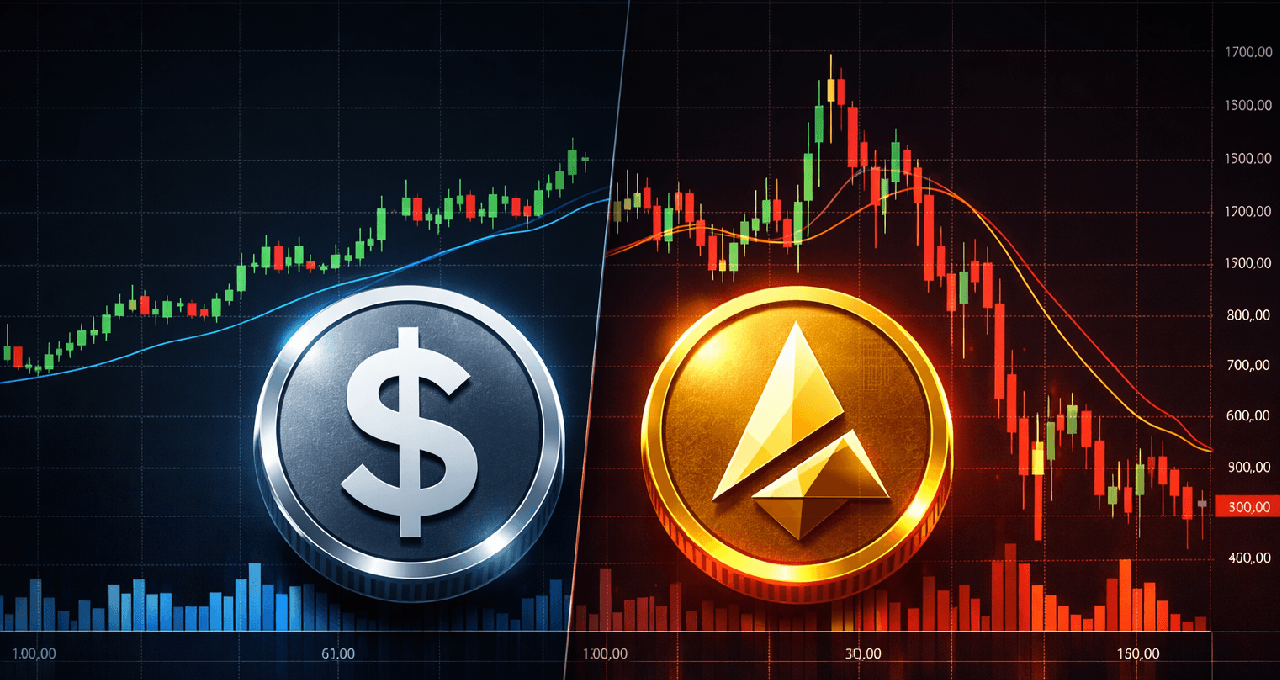
One of the first choices a crypto user encounters is whether to hold stablecoins or volatile tokens. These are fundamentally different types of assets with different purposes and different risk profiles.
Neither is universally safer than the other. Both carry risks. But the nature of those risks differs significantly, and understanding those differences is important for anyone managing crypto assets.
What Is Stablecoin?
A stablecoin is a cryptocurrency designed to maintain a stable value relative to a reference asset, usually the US dollar. The goal is to combine the technical properties of crypto, such as fast transfers and programmability, with the price stability of a traditional currency.
Stablecoins are widely used for trading, savings, transfers, and participation in decentralised finance (DeFi) protocols.
Common examples:
USDT (Tether) - fiat-backed
USDC (Circle) - fiat-backed
DAI (MakerDAO) - crypto-collateralised
FDUSD, PYUSD - newer fiat-backed options
What Is a Volatile Token?
A volatile token is any cryptocurrency whose price is not pegged to an external reference and fluctuates based on market forces. Bitcoin, Ethereum, Solana, and most other crypto assets fall into this category.
Volatile tokens can increase significantly in value over time, but they can also lose substantial value quickly. Price swings of 20 to 50% over days or weeks are not uncommon in crypto markets.
Core Difference: Price Stability
The most obvious difference is price behaviour.
Asset Type | Price Behaviour | Example 1-Year Range |
Fiat-backed stablecoin | Stays near $1.00 | $0.995 to $1.005 (typical) |
Crypto-collateralised stablecoin | Aims to stay near $1.00, wider variance | $0.97 to $1.03 (typical) |
Bitcoin (BTC) | High volatility | Can range +/- 50-80% in a year |
Altcoins (smaller caps) | Very high volatility | Can range +/- 80-95%+ in a year |
Note: Range figures are illustrative based on historical behaviour patterns, not predictions.
Types of Stablecoins and Their Risks
Stablecoins are not all the same. Different types achieve their peg through different mechanisms, and each carries distinct risks.
Fiat-backed stablecoins Backed by reserves of fiat currency (such as US dollars) held in bank accounts or equivalent assets. For every token in circulation, there should be equivalent reserves.
Examples: USDT, USDC, FDUSD
Risks:
Counterparty risk: the issuing company must be trusted to hold adequate reserves
Custodial risk: reserves are held in traditional financial institutions
Regulatory risk: issuers can be forced to freeze or blacklist addresses
Reserve transparency varies by issuer
Crypto-collateralised stablecoins Backed by cryptocurrency held in smart contracts. To account for the volatility of the collateral, these stablecoins are typically over-collateralised.
Example: DAI (backed by ETH and other assets via MakerDAO)
Risks:
If collateral value drops sharply, the system may struggle to maintain the peg
Smart contract vulnerabilities
Governance risks tied to the DAO making decisions
Algorithmic stablecoins Attempt to maintain their peg through algorithmic supply adjustments rather than holding collateral. These have proven highly risky in practice.
Historical context: The collapse of TerraUSD (UST) in May 2022 is the most significant example. UST lost its peg and went to near zero within days, causing widespread losses. This event significantly damaged confidence in algorithmic stablecoin models.
Risks:
Peg mechanism can fail under stress
No collateral to fall back on
Can collapse rapidly once a depegging event begins
Stablecoin Type | Backing | Key Risk |
Fiat-backed | Fiat currency reserves | Counterparty and regulatory risk |
Crypto-collateralised | Cryptocurrency (over-collateralised) | Collateral volatility, smart contract risk |
Algorithmic | None (algorithmic supply control) | Peg failure, collapse risk |
Risks Specific to Volatile Tokens
Price volatility The defining risk. A token can lose 70% of its value in a bear market and much of that may never recover, particularly for smaller or less established projects.
Liquidity risk Smaller tokens may have limited trading volume. In a falling market, selling a large position can be difficult without moving the price significantly against you.
Project risk A volatile token is only as strong as the project behind it. Team departures, failed product development, exploits, or regulatory action can send a token to near zero regardless of broader market conditions.
Concentration and manipulation Smaller market cap tokens can be more susceptible to price manipulation by large holders. Low-liquidity tokens are particularly vulnerable.
Regulatory risk Regulators in various jurisdictions continue to evaluate which tokens may be classified as securities or otherwise regulated. This can affect availability and value.
Risks Specific to Stablecoins
Depegging A stablecoin losing its 1:1 peg is called depegging. This can be temporary, such as USDC briefly dropping to around $0.87 during the March 2023 Silicon Valley Bank news before recovering, or permanent, as with TerraUSD.
Counterparty risk Holding a fiat-backed stablecoin means trusting the issuing company to hold adequate reserves and operate honestly. Reserve audits and transparency vary between issuers.
Freezing and blacklisting Centralised stablecoin issuers like Tether and Circle have the technical ability to freeze individual addresses, for example in response to law enforcement requests. This is a form of censorship risk that does not apply to truly decentralised assets.
Smart contract risk Stablecoins that operate through smart contracts, including DAI and many DeFi-integrated stablecoins, carry the risk of bugs or exploits in those contracts.
Yield chase risk High yields offered on stablecoin deposits in DeFi protocols are not risk-free. The stablecoin itself may be stable, but the protocol offering yield may not be. Platform failures and exploits have caused stablecoin losses even when the underlying asset maintained its peg.
Side-by-Side Risk Comparison
Risk Type | Stablecoins | Volatile Tokens |
Price volatility | Low (by design) | High |
Depegging / project collapse | Possible for some stablecoin types | Common for low-quality projects |
Counterparty risk | High for centralised types | Lower (depends on project) |
Liquidity risk | Low for major stablecoins | Higher for small-cap tokens |
Regulatory risk | High (issuers are regulated entities) | Varies |
Smart contract risk | For DeFi-integrated stablecoins | For DeFi-native tokens |
Censorship / freeze risk | Present for centralised types | Generally lower |
Long-term return potential | Limited | Potentially higher, with higher risk |
When to Use Stablecoins
Preserving value during market downturns without exiting crypto entirely
Moving value quickly across exchanges or wallets
Earning yield in DeFi with lower price volatility
Bridging between fiat currency and crypto ecosystems
When to Consider Volatile Tokens
Seeking long-term exposure to a specific blockchain ecosystem
Participating in staking, governance, or on-chain applications
Diversifying across different projects and use cases
Accepting higher risk in exchange for higher return potential
The False Safety of Stablecoins
One common misconception is that stablecoins are safe by default. They are stable in price, but that is not the same as being risk-free. Counterparty risk, smart contract risk, regulatory risk, and the rare but real possibility of depegging mean that stablecoins require their own due diligence.
For most users, holding major fiat-backed stablecoins like USDC or USDT carries manageable risk. But diversifying across stablecoin issuers and being cautious about where those stablecoins are deployed (which protocols, which platforms) is still sensible practice.
FAQ
Are stablecoins completely safe? No. Stablecoins carry their own risks, including issuer counterparty risk, the possibility of depegging, and smart contract vulnerabilities for DeFi-integrated types. They are designed to be price-stable, not risk-free.
What caused TerraUSD to collapse? TerraUSD (UST) was an algorithmic stablecoin that relied on a mechanism linked to a sister token, LUNA, to maintain its peg. In May 2022, a loss of confidence triggered a bank run-style event that the algorithm could not contain, resulting in both UST and LUNA losing nearly all value within days.
Is USDC safer than USDT? Both are fiat-backed stablecoins, but they differ in their levels of transparency, reserve composition, and regulatory relationships. USDC is issued by Circle and generally considered to have higher reserve transparency. USDT is issued by Tether, which has historically faced more scrutiny over its reserves. Both have maintained their pegs through most market conditions, though USDC briefly depegged briefly in March 2023 during banking sector stress.
What is depegging? Depegging is when a stablecoin's market price moves meaningfully away from its target value, typically $1. This can be temporary or permanent depending on the cause and the stablecoin's underlying mechanism.
Should I hold stablecoins or volatile tokens? This depends entirely on your goals, time horizon, and risk tolerance. Many users hold a combination, using stablecoins for stability and liquidity while holding volatile tokens for longer-term exposure. This is not financial advice.
Disclaimer: This content is for educational and informational purposes only and is not financial advice. Nothing here is a recommendation to buy or sell any asset or use any platform. Do your own research and manage your risk.
More Read
Need deeper training?
Join our structured modules with live examples and expert checklists for effective implementation.
JOIN THE ACADEMY